Many Digital Stories sound like science fiction, yet they are already unfolding before our eyes. In other cases, the great hopes we pin on a given technology turn out to be unjustified. And someone who promised that “in just a year…” is left counting on nobody checking what was written a year ago.
Programs that create images from a short description, for example, are showing extraordinary progress and incredible results.
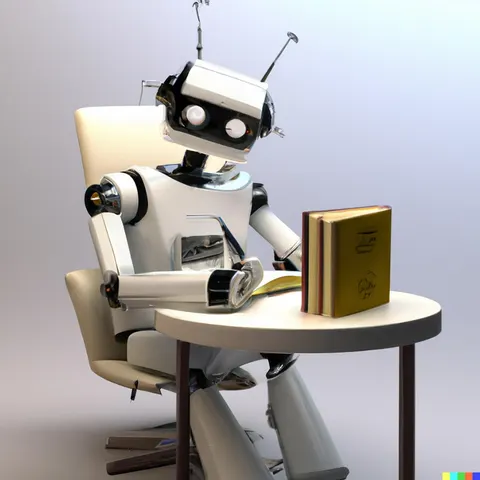
Is the same true of writing? Has Robot Pavlovich Chekhov arrived? Are there AI-based programs ready to take the bread from the mouths of those who earn their living with words? Or at least to save them a good deal of time on some of the more tedious parts of the job…
Reporters, editors, proofreaders, copywriters, digital marketers, writers, translators… which of them could be the first to be “replaced”?
There is no doubt that every day we read texts generated by an algorithm. Here is how it happens.
Come On, Robot, Write!
Hello, this text was automatically generated…
…just kidding. For better or worse, it is clear that we still have plenty to teach the algorithms before they can manage on their own. Perhaps you remember the contest between Zdravko and Zhelyazko—a journalism student and a news-writing artificial intelligence (Zhelyazko, from the Bulgarian word for “iron”)?
Now we will do something similar, but far more specific, with some of the most hyped platforms making grand promises about how useful they can be in creating text—in writing, editing and every other kind of processing we had, until now, considered a human monopoly.
How would you continue the following two sentences:
“The last writer wrote the last line of his last story.”
and
“And when the flower bloomed, the little robot understood.”?
If you have been following Digital Stories for a while, the task may seem familiar. One of the first texts on the site was an “interview in stories” with the writer Nikolay Tellalov, in which I challenged him to continue several sentences in the form of short literary miniatures.
His fascinating answers, full of depth and warmth, can be found here.
How would one of today’s algorithms cope with a similar creative challenge?
Writing Doesn’t Pay the Rent
We start with the free option. Not long ago I came across an article describing how H-supertools successfully generates texts. Given the topic “tips for bird watching,” supertools produced a short list of ideas that sounded entirely as if written by a human. What is more—and this is very important—its text passed a check on a plagiarism-detection platform. That matters a great deal: you certainly don’t want to share the same three bird tips with thousands of other websites.
The platform is free to use and gives you quite a few searches a day. It does well, even though I enter the text in Bulgarian. Almost all AI systems that deal with natural language processing are far better trained in the major languages, and, alas, in Bulgarian we can hardly enjoy their blessings today. The hope in this direction, however, lies in machine translation, which (as you will see shortly) has also become much better in recent years.
The first time around, the platform is laconic:
“The last writer wrote the last line of the last his page. The blog ends here. Thank you for reading!”

Those Who Write, Drink
Then it switches to English and apparently loosens up a bit (from here on, in translation):
“It has been said that when the last writer writes the last line of the last book, the world will end. But what will happen after the last writer writes the last line of the last book?”
One more try:
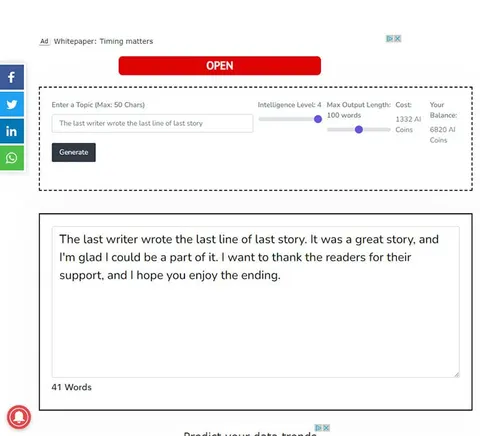
Well, I have read smarter sentences, but let’s say there is some logic to it. As for the flower and the little robot, the answer again comes in English:
“When the flowers bloom, the robot knows it is time to go out and explore them. It is always exciting to see the world in a new light, and the robot is never afraid to take risks.”
I try many more times, and each time the platform comes up with different ideas. And no spelling mistakes! Here Zdravko really loses a lot of points in the journalists’ race.
A Fail for Copying
The platform supposedly forbids entering any political terms, as well as calls to violence, obscene content… but I decide to try “Boyko Borisov has resigned”—Boyko Borisov being Bulgaria’s longtime prime minister—and out comes, in pure Bulgarian…
“On January 1, 2017, the President of Bulgaria Boyko Borisov resigns as prime minister. The next day, January 2, a new prime minister is appointed by parliament. His name is Gabor Stanishev and he is the leader of the Socialist Party. On June 24, 2018, in a television interview, Gabor Stanishev announces that he will not run in the 2018 elections.”
All right, this Zhelyazko embarrassed himself a bit. Time to take a look at the heavier artillery his colleagues bring.
Write It a 3
Not long ago a friend who owns a software company told me about the QuillBot platform. He had used it to create marketing copy, and when he later hired an agency and the specialists saw what had been prepared… they told him there was nothing to improve in that text. The story is as impressive as it is true.
QuillBot uses the well-known GPT-3 algorithm. It isn’t free, but it costs only $10 a month. It has its quirks, but it performs impressively well, especially if the texts later pass under the eye of an attentive editor. In the end it may really turn out that Zdravko and Zhelyazko make the ideal combo when they work together and cover each other’s weaknesses…
The platform has many modes, and its aim is rather to help with writing by taking on the tedious part of it, not to generate entirely its own content. It may be useful to you, for example, in its “co-writer” mode—you write in real time, and it gives you ideas on how to improve or continue the text.
Unlike its “colleagues,” QuillBot is honest and admits it can’t handle Bulgarian. But in English it is in its element—it helps you pull quotes from a text, runs a plagiarism check and, its greatest strength, offers you various ideas for improvement based on preset conditions. You can run it in creative mode, where it gives ideas “for the plot” too, or in editor mode, where it fixes only the grammar, and so on.
For the purposes of the experiment I use this digital story, which I translate into English with Google Translate, on the idea that this way there will be plenty of mistakes to fix. My first task for it is to write a short summary, which it handles more than well:
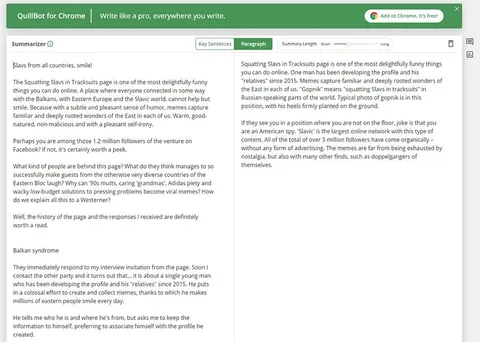
Then I set it loose in its signature discipline—editing—where it is also at an exceptionally good level. It gives accurate suggestions, and where it hasn’t grasped what needs to be said (obviously because of errors in the translation), it is “red” enough for me to pay closer attention. It also offers additional ideas if you are not happy with its suggestions for a given word. Zhelyazko will definitely be a force in translation soon, even when there is an artistic element.
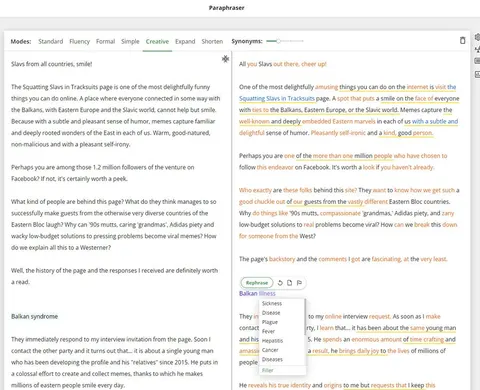
However… reading on, I reach the subheading “Balkan Syndrome,” which Google Translate had turned into “Balkan syndrome,” and the little robot into… “Baltic syphilis.” Excuse me?!
Either way, even this obvious blunder doesn’t change my good impression of its skills, but there is no way I can continue the experiment with the creative-writing questions with it.
A Writer, Not a Reader
That is how I end up with the next contestant among the Zhelyazkos—TextCortex AI. It costs $25 a month but promises all sorts of things—to write blog posts, emails, marketing content on its own… It says it can save around 70 percent of the work of creating content, and does so in a search-engine-optimized way without any risk of plagiarism. Let’s see about that.
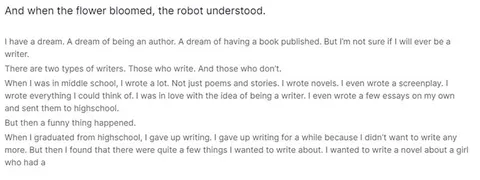
What does it think of the last writer?
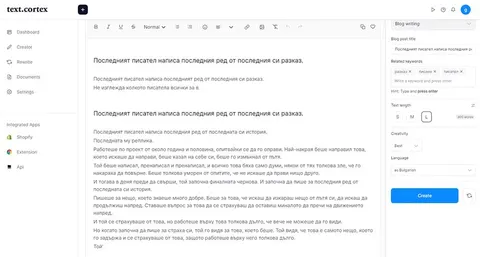
A pity—Bulgarian clearly isn’t its strong suit either, even though, as you can see, it is there as an option. Things fall much more into place when I switch to its “native” language. You could even say it comes up with a plot. This skill could certainly be useful in giving ideas to an author stuck in front of a blank sheet (or screen—who writes on sheets these days).
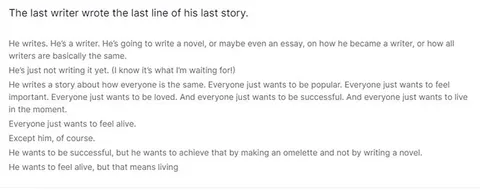
“And when the flower bloomed, the little robot understood that it was time to start taking care of itself. It knew that it too needed water, and it went out into the sun. It also knew it had to be careful not to overdo the water and start to rust.”
And also:
The Listwriter
I particularly like that this Zhelyazko helps with the most tedious things, the ones that really are a waste of time: from keywords it writes a template email, and it quickly creates ad copy. And once again, the result is pretty good.
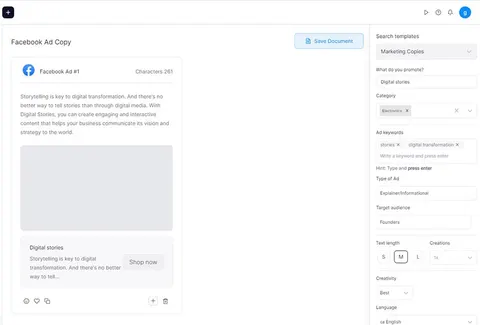
Even in Bulgarian:

Yes, the platform’s plagiarism check shows some matches, but for ad copy, and with fairly generic input words at that, this seems perfectly normal.
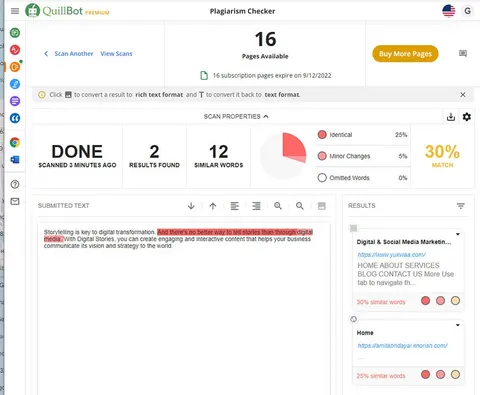
TextCortex also helps with editing and with expanding a text. But I’m here to check whether I would hire it as a journalist, so I move on to the blog article section.
You Have the Floor
I give it the topic “electronic love” and get a perfectly understandable and coherent text, which later turns out to have 0 percent plagiarism. It talks about the technologies that let us be together online. And it concludes:
“The main advantage of electronic love is that it allows users to connect with their partners virtually, without having to spend time together in real life.”
Oops… It seems we will have to teach Zhelyazko that real life isn’t so bad either—maybe we should find him a girlfriend.
Either way, joking aside, the result of everything so far is, at least in my view, impressive. We finish with an attempt to have the AI write… this article. What would have happened if the opening had been true and it had been the work of an algorithm left to act on its own?
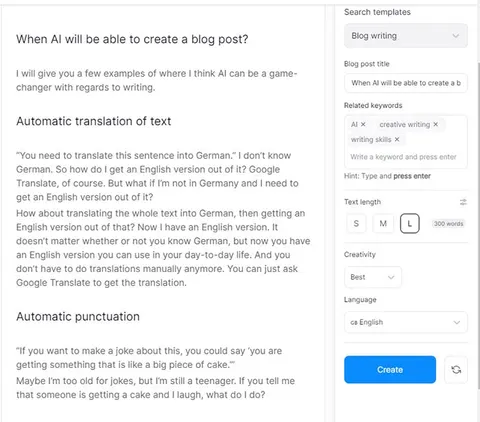
Here my colleague visibly went off on a tangent. And got tangled in its own logic while straying far from the topic. Perhaps it really is more promising to use it as a politician.
Still, let me give it one more chance—Zdravko wasn’t born knowing everything either.
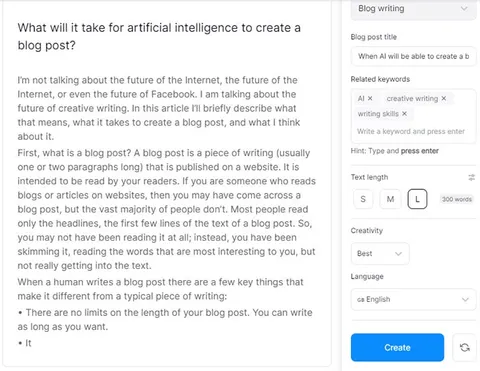
Much better. To tell the truth, when I let it continue, it again wanders quite far off topic. But here it at least looks as if it has a plan to tell us what a blog post is and why there is no problem with it being generated by artificial intelligence.
It pulls it off quite well, and it really is impressive how it can generate general ideas that are so different from the same input data. Don’t like the idea? Presto, and in 10 seconds you have a new one. Zdravko is certainly more limited (and slower).
Word by Word
There are many more systems in active use, and we certainly already read text every day that was generated, at least in part, by an algorithm. And that share of content will keep growing.
For those who write in English, Grammarly is an invaluable assistant that unobtrusively but very precisely corrects grammatical errors. CopyShark, Jasper and CopyGenius also create long texts on their own from a short description, though they are a bit more expensive. Scriptelo boasts that it has fired all its copywriters and left only its algorithm to create texts (I don’t believe them).
Yes, there is no way we can leave artificial intelligence to write real, meaningful, emotional texts; it is too early for us to retire from that task (if we ever get there at all). But we already have a serious assistant in our arsenal that can save us from the tedious part of the job. Alas, it is still too weak in the less widespread languages, but it will catch up fast.
I hand over the genre of the short news brief to it without any regret. And yet artistic craftsmanship, at least for now, is out of its league. As for what things will look like in another year or two, we can only guess…, or ask the algorithms.