What do your Christmas and our Christmas have in common?
This holiday goes far beyond the commercial, the feasting, the exhausting bustle. It is a state of mind, a meeting of past, present and future.
It sounds impossible to gather the many vivid faces of the holiday in one place. Yet that is exactly what the recently published anthology Nashata Koleda (Our Christmas) does. In it, Zachary Karabashliev brings together stories by some of the most popular authors of different generations, genres and worldviews. Digital Stories is part of it too, with the story “Merry Christm@s.”
Zachary Karabashliev is a beloved writer and playwright, author of novels such as 18% Gray, Havra and Opashkata (The Queue), which have been translated, awarded and reissued. He is editor-in-chief of the Ciela publishing house. Before that he was a photographer, and he lived in the United States for many years.
“The anthology is like an apartment building on a cold, snowy December evening, here to remind us that miracles are possible,” the cover reads. This book is the reason we meet on the eve of the warmest of holidays, to reflect on the past and the future in a conversation we will, it turns out, continue in 78 years. About miracles, about the new beginning of the Nativity and the doors it opens. About the meaningful stories that have gathered us around the family table from prehistoric to digital times.
Merry Christm@s!
– What does your Christmas look like in a single photograph?
– Kids, a tree, family, commotion, a table laden in the most traditional way with meatless dishes for Badni Vecher, the Bulgarian Christmas Eve, when the table is set only with fasting food, music…
– You write that with Our Christmas you set out to discover what moves 15 very different authors. So what did the answer turn out to be?
– Each of them headed in a completely different direction, and that is the most beautiful part.
Like a little square with many side streets, each leading to different houses.
From historical events, through fantastic tales, social networks and social dramas, crime plots… it has everything.
– Why is it worth people thinking about Christmas? In its consumerist form today, we hear and talk about it for a whole month anyway…
– Because it is
one more way to talk about the Good that will be born this year too,
even in the darkest days of the year.
– Georgi Markov, the Bulgarian dissident writer murdered in London in 1978, wrote about the Nativity as a “universal day of goodness” that we can celebrate “in defiance of all evils, disasters, wars.” We seem to have somewhat forgotten that side of “universal goodness.” Is it abstract, or does it have concrete dimensions?
– There is nothing abstract in Georgi Markov’s words. With him everything is concrete; he wrote the Truth, with real names, and it is no accident that his In Absentia Reports About Bulgaria was the most listened-to illicit broadcast under socialism.
– His words sound frighteningly contemporary. Will they ever stop being relevant?
– God willing,
humanity will grow wiser one day, so that there is no need to read George Orwell and Georgi Markov.
But that is unlikely to happen in the coming years.
– You have a visible reverence for the émigré authors of the 1970s and 1980s, such as Georgi Markov and Viktor Paskov. What makes them strong from today’s point of view?
– The purity of their style, their expression, their themes and the freshness of their language.
– Why are stories told at Christmas all over the world, while we in Bulgaria have no such tradition?
– Because that is what we inherited from socialism. Not to tell our own family stories, so that we could listen to the Party’s fabrications; not to explore our own bloodline, so that we could follow the Party line; to be consumers of the big Lie rather than generators of our small, personal Truth.
– I think it is far from only that. My brightest Christmas memories are from my childhood under socialism, and from my family, who believed deeply in that ideal. But, alas, today it is almost a miracle to be able to talk calmly about such things.
You write that “every Nativity is a miracle.” Today I think we suffer from an acute shortage of miracles. Where do we find them? How do we attract them?
– If you want a miracle: a) wish for it; b) work for it; c) be ready to bear it.
– Christmas is a time for memories and looking back. Why do we need that? When does excessive immersion in the past turn into a pathology?
– When we remember only the bad. I lived through the lousiest period of communism, but I remember only the good moments with my grandmothers and grandfathers, even though they were persecuted by the regime. I remember the beauty of the rooftops turned white and the pain in my little toes, numb with cold from sledding down the hills on sleds and plastic bags.
– You write that even today we need to share and tell stories about witches and good heroes. Who are the good heroes today? Is it harder to find ones who can bring us together? Would the good old heroes become influencers today?
– They ARE!
Every positive hero in world culture is, willy-nilly, an influencer too.
From Hercules, through Hansel, all the way to Harry Potter—they all influence us, one way or another. While they entertain us with their adventures, they pass on human experience distilled over millennia. If you do A, B will happen to you; if you defeat C, you will get D, and so on…
– At what moments do you regret having come back?
– Not a single one, however unbearably hard it has been for me here.
– I asked Ivan Landzhev how we can restore the power of words, and he replied: “By ceasing to hurl them at each other.” As a poet, he put it with uncompromising precision. But can we stop? How?
– You restore the power of words only if you back them up with your actions every day. There is no other way.
– Strong, distinctive literature is born in dramatic times. The times seem dramatic again—but is strong literature here, in its Bulgarian dimensions?
– Yes, it is here. It never left. Look for it.
– What is the great Bulgarian novel of the 20th century?
– Those are big words, but probably Tobacco, Dimitar Dimov’s epic of the 1950s.
– And has the one for the 21st century appeared yet?
– I suggest we talk again in 78 years, and I will answer.
– What is the biggest weakness of the young authors who come to you?
– Everyone arrives with their flaws. And every weakness can be overcome. But not knowing the literary tradition, those who wrote before you, is not just a weakness—it is a foolish weakness.
– Is it words or images that make us human?
– Even ravens remember images. But words are unique to human beings.
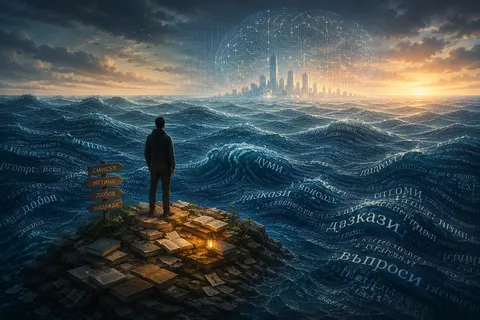
– But words now belong to our creations as well. Artificial intelligence algorithms are already astonishingly good both at creating images and at writing on assignment… Which will they take from us first, photography or writing?
– We live in a world dominated by imagery. The human brain is built in such a way that 3/4 of it deals with vision. Imagery is winning (for now) the race for human attention.
– How do we explain to artificial intelligence what Christmas is?
– And why would we need to explain to artificial intelligence what Christmas is?
– Because otherwise there is no way to finish the road we have set out on—making it resemble humans as closely as possible. So which books would you put on the reading list of a future artificial intelligence capable of achieving that?
– There are many. From Plato to Sylvia Plath—God, there are so many books to read.
– Where do untold stories go?
– To someone else, who will tell them.
– One of my guests, Nikolay Genov, aptly said that literature can still save us from the future. Because when the future arrives, literature will no longer be here. Forgive the trite question, but how long will literature stay alive?
– As long as there is someone who wants to listen. Then there will also be someone to tell.
– Do books grow old? And are there books that age beautifully?
– The beautiful ones don’t grow old.
– What can a writer save with their writing?
– Nothing.
– What do you wish “the good old man,” Grandfather Christmas, would bring the world next year?
– Peace.