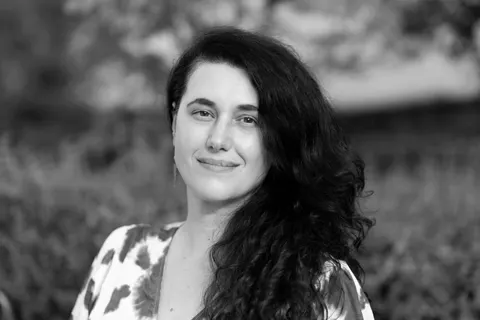
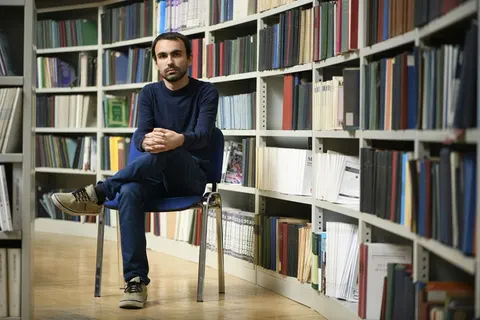
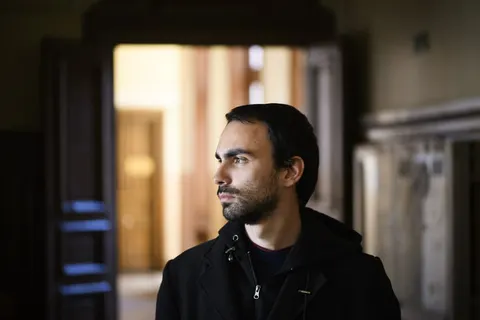
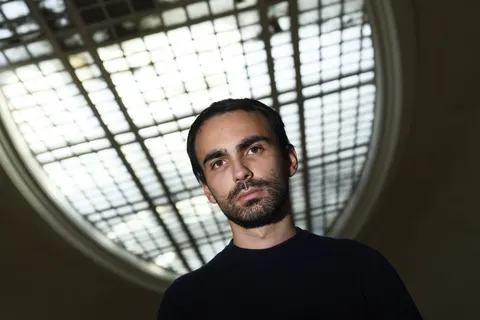
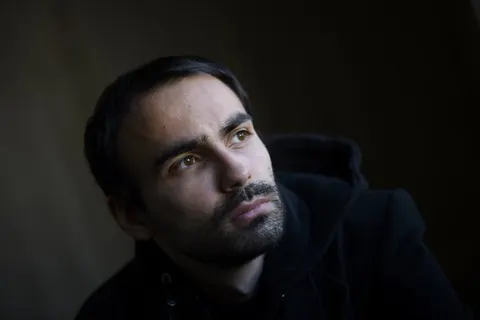
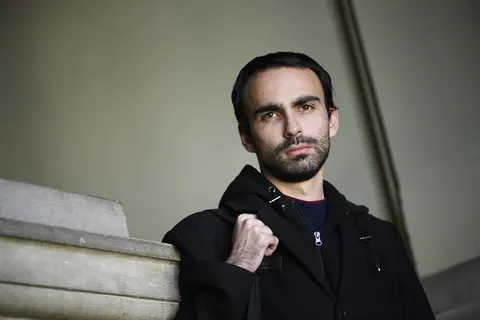
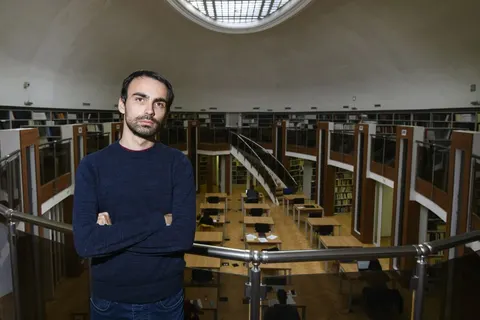
Nikolay Genov is a lecturer, a PhD in literary theory and a chief assistant professor at the Institute for Literature of the Bulgarian Academy of Sciences (BAS). A young man who loves books and dreams of lighting the flame of that love in more young people.
He is also a thorough researcher, as his new book Virtualniyat chovek: opit varhu fantomatikata (The Virtual Human: An Essay on Phantomatics) makes clear. With a literary scholar's sharp eye, but also with a real interest in modern technology, he returns to the analytical writings of the timeless science fiction author Stanisław Lem. Together they go looking for the depths of the virtuality into which our technological present keeps flinging us.
Is the end of literature approaching? What does a genre like science fiction have to tell us today? How does the human fit into the bowels of the machine, and the machine into the heart of the human? What should Mark Zuckerberg learn from the wise Stanisław Lem while building his notorious metaverse?
– Over the last few decades science fiction seems to be suffering; not many exciting things are happening in the genre. Could it be that technology itself has taken over its role, now that it has started turning its ideas into reality?
– Terribly interesting things keep happening, but technology has certainly changed the genre insofar as it has taken over a significant part of its focus. After all, classic science fiction relates to time differently. Now, it seems to me, the distance has shrunk; it is even
hard, when we read science fiction, to think that it is about the future,
rather than about some modified present, or—what should we call it, to set apart its projection, its extension into the supposedly upcoming—the “immediate”? Clunky, but it will do.
William Gibson, by the way, does something very interesting on this point. In The Peripheral—his second-to-last novel—he develops the plot in two times: one recent, close to and similar to our own present, and another, very distant, lifeless future. The second needs the first, not by virtue of some causality, but by the laws of memory and absence.
Besides, as Gibson himself wrote much earlier and on an entirely different occasion: “We have no future, not in the sense that our grandparents had a future, or thought they did. Fully imagined futures were the luxury of another day, one in which ‘now’ was of some greater duration.”
So the only thing science fiction has at its disposal is recognizing and tracing (analyzing) patterns, or—in the spirit of the quote above—“risk management.”
It tries to make up for a shortage, to orient us in the time we live in, even though that time is still largely inaccessible to us. We are talking about a present that seems so incomprehensible. From this position, I think science fiction really has changed, but at the same time it is going through a kind of small, quiet flowering. Cyberpunk, for example, has been an extremely popular genre lately, hasn't it?
– But there the fantasy elements often take the lead.
– I don't know; it seems to me it has always been more interested in the political and social problems of the present. It projects them somewhere else, as all of this literature largely does. And still, while we are talking about it, we are obliged to raise a question that, alas, never gets a final answer:
To what extent can science fiction speak about the future at all?
At first glance we are left with the impression that some distance has shrunk, but what distance is that? Doesn't science fiction in fact always project the present into the distant future?
That, by the way, is why I like Lem so much: he constantly tries to escape the human, to reach far more complex things. The best-known example, of course, is the ocean of Solaris, something we cannot even fit into familiar forms.
How well science fiction copes with that challenge, and to what extent it should be a forecasting genre, is the big question. Should we be asking it what will happen? Can it answer us at all?
– Maybe skillful forecasting—technologies, phenomena, trends coming true—is what impresses most readers.
– Yes, people want to know about the future, to peek into it. Recently I was deeply struck by Ivan Popov's book Kiberpank, evristika, futurologia (Cyberpunk, Heuristics, Futurology). He was a science fiction writer who also wrote theoretical texts; sadly, he passed away not long ago. The book develops a very interesting thesis—that classical futurology merely stretches the present, while the future is always hostile to it, its complete negation,
so radically different that it can only mean its death,
that is, it would be characterized by a change of everything. It is not simply about new technologies arriving, but about a change in the social structures, ethics, economics and politics we know. In other words, the future is an absolute otherness that destroys the present and its values.
There have been several such transitions in history. For example, when humans switched to a settled way of life, that changed their reality. And inevitably, the new future will be proclaimed by the rapid development of information technology.
– It's already here.
– Not yet. Yes, technological innovations are moving in and dismantling the way of life we know, but they haven't yet destroyed or changed everything completely. According to Ivan Popov, this “delay” happens because the center of civilization has its own mechanisms for holding on to the present; it is always fighting the future and trying to postpone its own inevitable death. Meanwhile the future breaks in through the periphery.
I have some hesitation about this thesis, though, because it seems to me that—on the contrary—the future actually erupts from the center, while we, traditionally placed—for better or worse—on some dubious periphery, still manage to hold it back.
But the future will come when new technologies don't merely break into our world, but conquer it.
We are not talking about a war with the machines or total submission to artificial intelligence, although that is one of the common science fiction conflicts. No, it is about something far subtler—the process in which we stop seeing as valuable everything we have considered meaningful. Literature, for example.
It is very hard to talk about this, but let's look at some statistics. Surveys are being done; fewer and fewer people around the world read. Microsoft came out with a report saying that in part of the younger generation the attention span is sometimes like a goldfish's. Because of the pace of platforms like TikTok, where you constantly swipe from clip to clip, because everyone is trying to grab your attention with whatever they can, you lose the ability to concentrate, to hold your focus, to remember, and therefore to handle more complex syntactic constructions, images, ideas.
A dance of pixels and vulgarity, in which language degrades and crumbles into incoherent sounds.
– Our inability to hold our attention really is changing us as a species. On the other hand, more and more books are coming out, though that may not be such an accurate indicator…
– Young people's attention is withering to such an extent that I myself, as a teacher, have come across students who told me: “I try, and I can't concentrate enough to understand what this text is saying.” Two or three pages, sometimes even one, seem like too much to them; they can't read “this whole thing.” And even if you feel they are showing some interest and a desire to understand what it is about, something is missing.
Let's look at what is happening to literature departments in the Western world—they are closing. Universities that had a humanities orientation are retooling into science and math, because the humanities don't produce a product, “only” value, worth. That no longer fits into the calculations of a system like ours.
We are witnessing the decline of the idea of the learned person, who simply knows because knowing is a good thing. I have always admired encyclopedists, people who have really read a lot, and when you listen to them you marvel at their eloquence and memory and are humbled by the depth of their thought. Replacing those people with someone who simply finds their bearings and adapts quickly…
These are just the tentacles of the future reaching into the present.
I don't know whether we will live to see the future, and I'm not sure I'm very enthusiastic about greeting it, but it certainly won't be something we will accept easily. So, ironic as it may sound, science fiction is currently trying to hold on to the present; it is not on the side of such a—from our point of view—moral and intellectual collapse.
– Because it would fall victim to it too.
– That's right. We can recognize a certain conservatism in science fiction.
It is a somewhat sad observation, but I still don't come across good enough attempts at creating speculative narratives here in Bulgaria. Why? Our literary history has something to boast about on this count, too. What has changed?
I explain it to myself simply:
Fewer and fewer people read, while more and more want to write.
Could the latter actually be a reaction to the “shortened moment,” an attempt to preserve yourself in the bosom of a tradition and draw dividends, symbolic capital, to console yourself in the face of pessimism? Maybe. But then we arrive at the paradox that, without reading, you try to make something, not knowing it has already been made, and made better. It shows that there is no literary culture whatsoever behind what you are offering.
People who don't read usually say the same thing—nobody reads, everybody writes. For some reason they leave themselves out of the count. And those who do read and write well seem, for their part, to refuse to think about what they are doing. They try to use their talent to make up for a lack of specialized knowledge that is more accessible than ever. And the position of the critic, the figure who should observe, reflect, demand more and try to cultivate some meaningful process with their taste, seems to have been erased entirely.
– And not only in literature, in every art form, even in journalism. Today the criterion for whether a journalistic task has been done well is likes and reads. They feed the author, and every other benchmark disappears.
– It happens at every level. We saw, for example, what kind of people were invited to hash out politics on election day: influencers and internet memes. At the same time, we witnessed election campaigns with so many punctuation and grammar mistakes that it wasn't even funny. We're talking about text at the most official level, after all… could they really not find even one semi-literate person to look it over?
– Nobody considers it a priority, quite simply; spelling in online media is also… how should I put it. Interestingly, though, of the 170 pieces published on this site, the most-read is still the one about spelling—an interview with Pavlina Varbanova, creator of the website Kak se pishe? (How Do You Spell It?)…
– That too is a remnant of a past we are trying to hold on to—linguistic literacy as a value. General culture as a whole. It's just that you can now earn a good salary without knowing “exotic” things like who Homer was and how to separate the simple clauses inside a compound sentence.
– I recently published a piece on precisely this topic, the internet as a machine of forgetting. And most of the comments said that some knowledge is pointless now, that you don't need to know the names of capital cities, for example. But in my view it is exactly the “pointless” knowledge that creates art.
– Some would say there is nothing finer than art for art's sake, than knowledge for knowledge's sake.
I hardly think I'll surprise anyone by saying that serious science fiction is much more than an entertaining plot about spaceships and time machines; it weaves together knowledge from different fields; it uses the sciences to constitute itself, holding the social, the humanistic and the scientific in a single commentary, in a shared meaning.
– In your book you often mention Jaron Lanier; you write about him as the creator of virtual reality in its modern digital form. Today, though, he is more of a guru fighting against the way the tech world is built, against social networks.
– That is the other myth of technological progress—which is why I found it so interesting to work on virtual reality.
What does this myth embody? The return to the Garden of Eden.
We'll just sit comfortably at home, put on our goggles, and all our fantasies will come true.
Science fiction tries to refute this too; it shows us the problems facing such an immersion. Authors like Lem even work in this direction theoretically. That was one of the stakes of An Essay on Phantomatics—to rehabilitate Lem's position as a pioneer. As early as the 1960s he began working on the subject we now, somewhat loosely, label “virtual reality.” It is worth engaging with his reasoning and hearing his objections to the possibility of such a “total simulation.”
– What are they?
– There are many, and of every kind: ontological, biological, economic, technological. I tried to gather them in my book, to develop them further, to add some notes to them and to propose possible solutions where I believe there are any. But let me share a personal and especially sad experience—my first encounter with a headset.
At the International Literature Festival they offered you the chance to experience Kafka's The Metamorphosis in virtual reality. It sounded great; there was a huge line, everyone wanted to try the virtual world, to be Gregor Samsa waking up as an insect.
We're standing in front of a makeshift booth, my turn comes, they give me some slippers and put a big helmet on my head. The first problem is that the helmet's cable is terribly thick and heavy, and one person has to hold it up behind me the whole time. And try not to breathe down my neck, so it doesn't turn into a different kind of simulation…
I find myself in an animation; there is knocking at the door. I get up; there is a mirror in the room, for perfectly obvious reasons—you see yourself as a bug, it looks a lot like an ant. But this bug has a great many limbs, and I have only two arms. I can raise my arms, and two little legs go up; over the rest I have no control at all. What's more, the whole time I feel my anthropomorphism and I move on my two feet. In the book we read how at first Gregor learns to walk, to keep his balance; how he gets used to his new body.
Here is something technology cannot give us: a way out of our own anthropomorphism. Our sensory experience, or our sensory inheritance, would be the greatest obstacle to immersing ourselves in an entirely new phantomatic world.
– We'll still need to go to the bathroom…
– As far as I remember, in Ready Player One (the novel) the protagonist Wade Watts makes a similar observation.
I will hardly ever forget how a science fiction fan once asked me: “Will I be able to be a melody?” How? What does it mean to be a melody? My conservative answer is no. I don't know what it is like to be a melody; neither does he; neither does the machine.
– Maybe it's precisely the machine that will tell us, since it often offers new paradigms?
– Yes, but there is no way to confirm it. How would we be sure the sensation isn't just an illusion? Or what does it even mean to be a trumpet?
– Recently I “asked” an artificial intelligence how it imagines the poems from Boris Hristov's Vecheren trompet (Evening Trumpet). The result was a beautiful image, but with no trumpets. And one woman wrote me a comment—they are there, the algorithm simply understood them metaphorically, as little stars.
– I read the piece, looked at the images, and the whole thing rattled me a little. I said to myself, “Here we go, there will be calls to ‘redefine’ art again.” There is a lot of enthusiasm; everyone will be able to become an artist. Well… I'm not sure. We will never be able to become artists if a machine can paint for us, because “artist” is a concept of the past and it will simply disappear. The very role of the artist includes training, technique, work, perspective, a human being. When all that falls away, we will have “something that is like…”
– What is the most important thing Mark Zuckerberg should understand from Stanisław Lem while building his metaverse?
– The first and most important thing, in my view, is that
we cannot have a true metaverse.
Lem develops this idea by thinking about technology on the model of biological revolution. In the novel The Invincible, machines have ended up on a planet their creators could never reach. They started a war for survival, because the planet's energy resources were exhausted. And in the end they arrived at two solutions—some became giants in order to reach solar energy and survive, while others evolved into the simplest possible form they could produce: they can assemble into swarms when there is danger, and the rest of the time exist as triangular chips.
The metaverse is simply an evolutionary attempt to save something that is undergoing transformation and slowly beginning to die—Facebook. This results in gigantism: it will no longer be a social network, it will be an entire metaverse.
But if we read The Invincible, we see that those giants can't move at all. They are lethargic; they don't have enough energy. This project seems doomed to stagnation to me.
The other thing Zuckerberg has to weigh is the body. Look, to prevent sexual abuse, avatars will be shown from the waist up, as if sexuality stopped there.
In other words, the body keeps causing problems and cannot be defeated so easily.
So far, what I hear in the metaverse is just the old song in a new voice.
– Another theory, which comes from tech circles, holds that AI development is advancing exponentially. At some point it overtakes us, and we reach the point of singularity, beyond which we can only guess what awaits us.
– I'm skeptical about artificial intelligence too. Reading science fiction makes me more conservative than open to sharing that kind of enthusiasm. Incidentally, this is also a problem Lem points out as an obstacle to the phantomatic. He says it would be much easier to simulate Miss World than Einstein. Then again, let's hope people will want to talk to her more.
In the Polish writer's works we see machines at an advanced stage of artificial intelligence. They reason like humans. And what do they start doing? They become unfit for work; they want to cheat the system.
If we create a perfect AI, it would have to be clever enough to run away from us, to spare itself the duties we would delegate to it. Humorously speaking. We can't talk about a self-aware machine that would want to replace humans. The human is in a dreadful position that nobody would like.
I keep thinking that
if we really manage to replace the human, we will simply create an artificial human. So what?
Yes, maybe it will be faster, it will be able to do far more than we can. But will there be anything qualitatively different in the whole business?
– It will create technologies that help us live longer. It will tell us whether there is a God, aliens…
– Would it want to? It doesn't strike me as particularly intelligent for a being that need not be like us to want to resemble us. I'm skeptical because we are trying to reproduce the human. We often think of artificial intelligence as an accelerated human. There is a lot of criticism along these lines—whether that thread is right at all.
– For me, the biggest problem is again that it is being created on the principle of a commercial product, by big companies, without enough regulation, without discussion and reflection. That's what I'm trying to do by collecting the opinions on the subject of people from all kinds of fields.
– When Mary Shelley's Frankenstein; or, The Modern Prometheus came out, at first nobody was especially impressed by the fact that it was about an artificial being created by man through his science. What was on the agenda there was the moral problem, and only later did people start to read the plot as part of the theme of scientific progress. The debate you mention seems to stay in the background compared to the technical one. And that too is telling.
– Unlike many of the great science fiction writers, Lem lived to see the web. “Until I started using the internet, I didn't know there were so many idiots in the world,” he wrote in 2001. Does that sound like prophecy? Back then things looked completely different…
– That's right. I'm appalled, and you probably are too, especially in recent years. It didn't strike me so much before, but now I see what is going on and I'm horrified. It's revolting to react with laughter when someone has died a violent death. We see terrible tragedies, and underneath them—awful reactions.
I'm reminded of Sergei Lukyanenko, who explores the theme of the phantomatic world by thinking of that network on the model of the internet. A loser appears there who is later interpreted as the sum of all the impulses of the human unconscious. People spend a lot of time in that world, and their repressed desires accumulate and become personified. This loser is inept, talentless, in despair at the world. He wants to die but can't.
Well, if the internet could gather all the information collected over these 30 years and embody it in an artificial intelligence, that is what it would be: the loser. The most depressed being imaginable, one that has seen so many things that it wants nothing to do with their source.
– So we come back to where we started. Literature can undoubtedly protect us from our ugliest sides, and yet we give it less and less of a chance.
– I think it can do that. It's hard to give a satisfactory definition of “literature,” but we can still call it “valuable text.” That is, if we do some kind of psychoanalytic reading, we may find that there is sublimation in it. Those repressed impulses are given value in something that is an ideal expression of the human spirit.
Why don't these processes work on the internet? According to Lukyanenko, the streams just pour out there, because we are in the realm of the unconscious. Literature implies some sifting, overcoming impulses and turning them into something more. Social networks don't do that.
I'm not sure human empathy has always been as low as it is today. The very fact that you can find an audience that denies everything, even the shape of the planet…
We have more information than ever, and we cannot use it constructively.