“Suddenly it became clear just how far apart people had actually drifted.”
Why did empathy fall victim to our capture by social media? How do we get it back? Why have selfishness and the drive for self-sufficiency become the main obstacle to our happiness?
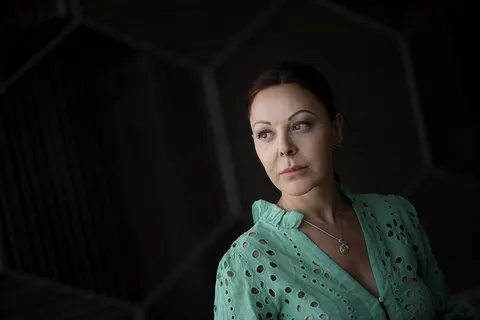
Ani Vladimirova is a psychologist with a long and colorful career and an always interesting point of view. Known from numerous television projects, she also created Bulgaria’s first website for online therapy—www.e-therapy.bg—back in 2003.
She practices psychotherapy and runs training in communication skills and conflict resolution. She has created her own mental health program for kids between 6 and 11. She holds master’s degrees in psychology, pedagogy and history from Sofia University “St. Kliment Ohridski.”
We meet to talk about the big challenges facing the “little” person. About the imperceptible changes technology has brought us. About how it made us feel godlike, even though we are still the same fragile, vulnerable creatures. About the instincts that will one day make us value information again.
– Ms. Vladimirova, you say that maladjustment today is enormous because of the years of isolation, the war, but also because of technology and virtualization. How has online communication changed us?
– What strikes me is
the enormous spiritual and emotional distance between people, caused by their inability to get to know each other
through nonverbal communication, through the senses, through sensations…
This spills over into real, physical closeness as well. The need for shared feeling and empathy is lost. Sometimes, when we counsel couples, even couples with children, it turns out we literally have to translate for them. These are people who live under one roof and sleep in one bed. But the digital world prevails, and it affects the way we perceive reality, too.
The same goes for the political situation.
We have grown so used to poses and impression management in the information we take in that we have lost our instincts.
Instinct is what tells you, without your having to think about it—through goosebumps, through the contraction of your pupils, through physical reactions—whether something is true or not. Whether someone is authentic or not. Whether they are telling you the truth… Right now we don’t “hear” our instincts, they are muffled, and someone is constantly explaining to us what the truth is…
The world isn’t black and white, there are nuances we have lost, and trolls often lead us around like monkeys. They tell us this or that is true, and at some point you can’t put the facts in order. They won’t fit into the picture, but having no other explanation, you start getting used to it.
– What awaits us after that?
– I think we are still in a kind of adaptation period. Personally, I feel far from having the necessary and sufficient information to predict consequences, directions, transformations… There’s a maxim in history: a hundred years must pass after events, so that all the eyewitnesses who would distort them have died off, before we can see the real picture…
– Why exactly did empathy fall victim to the way we perceive the world online?
– Because it comes through the senses—through touching, hearing, seeing. And what do we look at all day? A screen. Is there any touch in it, any authentic perception?
– Soon we’ll move into virtual reality, and those sensations will become more and more authentic. They won’t be real, but they will be authentic.
– True. That’s why I say we are adapting to this world, but for now it isn’t all that authentic. For example, hyperrealism in animation had a very negative effect on small children’s instincts and perceptions. They began to lose the ability to distinguish details in objects, because a perfectly drawn person can’t be told apart from a real one. But
the drawn one doesn’t carry the full range of physical messages that a living person carries.
The digital world takes away several of the five senses through which we perceive the real world. They are replaced and steered by surrogate impressions that aren’t authentic. Yes, there’s a “conductor” behind them handing them to you, but however good his intentions, we still haven’t caught up with nature in creating the authentic human.
– And what will happen when technology achieves authentic sensations?
– I honestly don’t know. I know the Earth is overpopulated, that we don’t have population reduction through wars, disasters and epidemics the way we used to. I know resources are shrinking. I know our garbage is choking us. That something is wrong—but where we’re headed, I don’t know.
– Painting this distorted picture of the information that reaches us, it seems the big problem is that we have fewer and fewer landmarks, reference points, criteria for truth. That’s why our positions are unstable—we bond with certain people online over a particular topic, then the question of the day changes…
– Exactly. This has led to a huge chasm both between generations and between the sexes. Parents, grandparents and children today speak different languages. It’s very hard to find any connection between them in terms of mentality or values.
Take the political situation. We face yet another government, maybe yet another election. Supposedly everyone agrees: a form of communication must be found, these people must somehow build a bridge toward one another so that we can unite as a nation and move somewhere.
I translate this into the language of psychology—developmental psychology, in this case. These “young ones,” as everyone mockingly calls them, are hyper-ambitious to get something done. They look to me like teenagers who want to rearrange reality fairly; they carry an enormous charge of energy and enthusiasm. The analogies with adolescence are many—we have our own styling, we’re only from certain schools, and we let people into the group by password… We don’t talk to teachers and old fogeys… Then they get free rein and in the end turn out to be more like kids who’ve broken into a villa for a party (wheee, let’s fly somewhere for dinner). Well, obviously, when they leave, almost everything is upside down… The old homeowners come back and explain that the young are good for nothing. And all of us on the sidelines are like the neighbors who call 112, Europe’s emergency number, enjoy the show, pretend to be doing something, while inside the ruckus rolls on…
And, quite naturally, as a psychologist, I ask myself: “When will these people come closer?” Well, on the one hand, when the teenagers grow up. Besides piling up experience through trial and error, that also means behavioral and communicative maturity, self-control, higher organizational demands… And the “older ones” always have to lower their egos to let the new in, to become more liberal, more open, and to “allow” the young to grow up. But that is a process that takes a lot of time, and we don’t have it.
– Do we really live in far more dynamic times, or is that an illusion? Some say there have always been pandemics and wars. Apparently we thought we had reached the end of history, and then these things showed up again…
– We live in very different dimensions of time and space. Look at how long a purely scientific piece of information used to take. You had to go to the library, dig, hunt for volumes, read. Today it’s obvious—no need for me to draw analogies.
What about the connection between two people? A ship sails, carrying a letter, and she sits and waits. Now you just open the catalog of babes and start talking to five or six at once.
Space… People spoke four or five languages during the Bulgarian National Revival, the nineteenth-century cultural awakening, for the simple reason that getting from Sofia to Vienna took so long on the road that you picked up the languages of the peoples along the way. Now you can go around the whole world in 24 hours.
We began to live with the idea that
space is very small, that we can be at any point, and time is controllable, we can take everything from it.
We became godlike in our heads. I can have everything, I’ll build such a startup that I’ll blow the rest away in no time. And
with that, respect for the road people have traveled was lost.
If in the old days an elderly person was something of value—and in Eastern cultures it is still so—with their experience, their knowledge, what they had lived through, today they are a grotesque and a parody.
Why, over the last six months, have the “teenagers” refused to talk to anyone outside their age group? Because to them that person is old-fashioned, a clueless dinosaur they have nothing to say to.
They will create a new world. Only you can’t create a new world without standing on the previous one. And it shows. Then this speed of time, this omnipotence over space, made us self-sufficient.
– Is this self-sufficiency a problem?
– More and more often, women over 40 come into this office and say: “Oh, what do I need a man for, I have everything, I can have anyone. A child too, if I want—with IVF now, I’ll pick one from a catalog. Blond, blue-eyed, Scandinavian, six foot six. Why would I need a man to look after and coddle?”
This selfishness, this self-sufficiency keeps you from being empathetic. You have no motive to fulfill the other person’s wish, to see the joy in their eyes, to share the feeling.
– And perhaps that is what somehow keeps us from being happy.
– It alienates us. Yes, and it keeps us from it. However much it may seem that once you buy and own everything you’ll be happy,
in fact you are happy when you can share it with someone.
By becoming alienated, we can’t share it. This pandemic showed the problem in its sharpest form. Suddenly mother, father and two kids were shut in at home. It turned out he couldn’t go hunting and get drunk with his friends, couldn’t blow off stress, because he and she had nothing to talk about. She, unable to go to the spa and get five kinds of nail extensions or gossip with her girlfriends, had nothing to say to him. They don’t know their children, and you can no longer yell at the teachers for not teaching them.
Suddenly it became clear just how far apart people had actually drifted.
A whole lot of families fell apart, domestic violence increased. Children with eating disorders, with psychiatric symptoms. All this happened because you can’t be happy alone.
– And what can bring back the balance?
– Our nature. Always, when things reach the edge, life “slaps us across the face” and we come to our senses a little. This is nothing new. What happened to the Roman Empire? They vanished because they reached such perversions, such depravity. What happened to the endless Soviet Union? It fell apart, it’s gone…
And now, too, oversaturation, the loss of values and megalomania have given birth to great-imperial ideas—we see it internationally. Clearly nobody has learned from the experience of history. Man is simply an animal, making the same mistakes.
– Is that really so? Why do we have this history, why do we study it, why do we consider ourselves so developed, if we keep falling into the same pits?
– In some respects we are increasingly developed, but in others—the will to power, egocentrism—we’re just the same. We haven’t advanced much physically; quite the opposite, we are regressing. If they dropped you in the Balkan Mountains without a compass, hiking boots and anoraks, how long would you last?
We would hardly survive without our gadgets and the things we’re armed with. Yet at the same time they give us the illusion that we are godlike. That’s the paradox. You
go on being the same fragile jelly with a limited brain box, but armed with gadgets, you think you’re God.
Like in The Wizard of Oz—what was the wizard? A puny little man inside a big head, with the trappings of power. Why did the Scarecrow, the Tin Man, the Lion and Dorothy turn out stronger than him? Because they had hearts, souls and the will to live.
– What can we change so that we hear those last words more often from the young—“heart,” “soul,” “will to live”?
– There’s a law that people have more or less equal amounts of happiness. If the first part of your life wasn’t very happy, the second will be, and vice versa. Seems strange, doesn’t it? But there’s a very serious logic to it. If you had a happy childhood, if you were cared for, you don’t develop eyes for evil, for danger. And when you step onto the stage of life, you aren’t prepared for all those who will abuse you and take advantage of you… And the reverse: if you had a hard childhood, lots of problems, they taught you, sharpened your senses, and as a grown-up you know how to value things, you know where you’re going, you know how to share.
– I read that for Musk, too, the biggest worry is how his children will turn out, given how easy life is for them. Whereas in fact we fall victim to everything said so far because we like things easy and comfortable. Is that also a human instinct?
– Of course—the pleasure principle. Thank God we want things easy! Because look at the clever and beautiful things humans invent. We shouldn’t get carried away with extremes, with black and white.
Religions are built on this—dualism, the eternal choice between the light side and the dark side. Dark and bright epochs alternate. “This too shall pass,” as the cliché goes.
– The classic cliché of grandmothers who have seen plenty of things pass.
Today we find it harder and harder to concentrate because of the abundance of stimuli. What is the way out?
– Today I counseled a child who gave me a list of all the forms of sexual identity. Wrote and wrote and wrote. And in that moment I realized: if you can’t concentrate on what you are in terms of sex and gender, how are you going to concentrate your attention? These kids sit wondering whether they are pansexual or omnisexual and can’t identify themselves.
And it’s like that with everything. You wonder how to swim in the ocean of information.
– Can we at some point start valuing information again?
– It will force us to. You see what is happening in Ukraine. In the end, when the electricity, food, internet and fuel run out,
you start to value whether the sun will rise, who will give you a hand,
whether anyone will bring you water. That’s how you value information and orientation—when you go back to instinct.
It’s no accident that I keep talking about instinct. There are two instincts that drive us—survival and reproduction. You break the reproductive one, because the person doesn’t know what they are, can’t define themselves. You break the survival one by leaving them the idea that they are godlike, that they can have everything.
Then war begins, and so what if people are educated and intelligent! They die. From there you go back to the beginning. You start to value the face approaching you. You start telling whether it’s an enemy or a friend. Why do people say “Good day!” to each other in the forest? Not because they are so well-mannered, but to see how the other one will answer, whether he’s all right. These are the primal things, the instincts. They will bring us back, nothing else.
– Is it also somehow a consequence of these processes that today we have no authorities? Politicians, artists. Now we have influencers, but that’s something else…
– Yes, it’s a consequence. In the old days the king, the emperor, the leader, the commander was a person-symbol. But now, the moment they get into your phone and start pulling information about you, it becomes clear that you are like everyone else—naked, pitiful, wanting carnal, elementary things. Then you can’t be a symbol, you can’t be a leader.
But on the other hand, if there are symbols, authorities and leaders, they are unambiguous. They are 100 percent—Mother Teresa, for example, because in her life you can’t find a secret second track.
– She just didn’t have Facebook.
– That’s right. That’s why I say authority is, to some extent, a symbol. And
in today’s world of underhandedness and intrusion into personal space, there’s no way you won’t get hated on,
that they won’t make something up, won’t create alternative images of you. All sorts of nonsense you can hear about yourself. Only the anonymous have it easy—until the spotlight hits them. That’s why I believe this world will sooner or later sort itself out. It’s just still dark right now. And I really love the cliché that
the deeper you go into the darkness, the deeper the darkness goes into you.
We have to find the boundary somewhere, and it isn’t sharp—our eyes have to adjust, we have to get to know the light and shadow…, but apparently that takes time.
The conversation between generations returns to Digital Stories on Tuesday. We will meet a photography project that opens the door between parents and children. What might be visible on the other side?