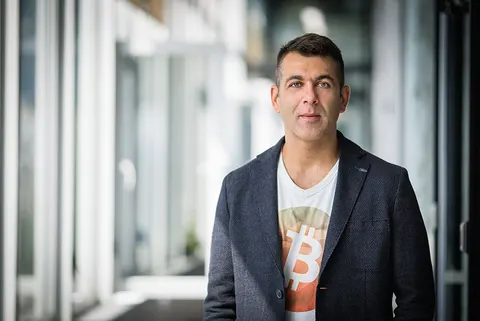
Valentin Mihov is the person you need if you want an up-to-date technological view of decentralized finance. Of blockchain applications and cryptocurrencies.
He started programming as a child. Not long after, in 2004, he was already captain of Bulgaria's national team in informatics! He won gold and silver medals at international competitions. He then graduated in computer technology at the top of his class and earned a master's degree in entrepreneurship.
He has worked in software for 15 years, the last 7 devoted mainly to blockchain technologies and their applications in the world of finance.
From 2017 to 2020 he led the technology team of the startup Santiment, a platform for cryptocurrency analysis.
What came next is even more interesting. He became co-founder and manager of Finexify, an investment fund focused on decentralized finance. He takes part in an initiative that invests in early-stage blockchain companies from all over the world. And he keeps working on all sorts of topics related to decentralized finance.
– What won you over to blockchain technologies?
– I first noticed Bitcoin in 2014. I started reading about what it was all about, and it made a very strong impression on me, above all from a technical point of view. I saw that Bitcoin solved a technical problem that had had no solution until then. Namely: how to create some kind of digital uniqueness—an asset or a unit of information that cannot be copied the way a flash drive or a file can. That makes it possible to build decentralized assets.
That's when I decided I had to be part of this ecosystem. I bought my first bitcoins and started “playing around.”
Quite unsuccessfully—I lost money, but I kept believing the technology made sense
and solved quite a few real problems.
In 2017 a chance came up to lead a blockchain project, and I decided it was a good opportunity to get into this more seriously. I spent two and a half years there and went quite deep into the Ethereum ecosystem. Just as I decided to leave the company, decentralized finance exploded. Lots of projects appeared that largely copy the traditional banking system, only in the decentralized world. I found myself in the right place at the right time…
– Let's say that when you were getting into it, this technology was booming, and then came the crypto winter. Have we reached a point where we can look at it more soberly, where things are more real?
– I've been through several crypto winters, several full cycles. I tell a lot of people this:
don't expect to get rich in the first cycle you spend in the crypto world,
if your goal is investment. I've seen it happen to many other people, and it happened to me—the first time I got in, I lost money. But afterwards I decided to hold on to those crypto assets. I told myself: I've learned my lesson, I'll leave them in my wallet and won't look at them for a few years.
Gradually you get a feel for the logic and the trends. Besides, with every cycle things settle down more. When I got in back in 2014, to buy crypto you had to go through some super-shady exchanges that were later shut down by the FBI. You'd send money abroad with no certainty you'd get anything back. I remember once sending money to a bank in Mongolia. Simply absurd! You send it off and hope something will happen.
Now it's different. We have exchanges like Binance and Coinbase, and even banks in the EU work with these exchanges. If you decide to, you can buy for really huge sums.
Liquidity is improving too. Some people say: “Oh, if only I'd bought $1,000 worth in 2009…” Come on, man, back then it was impossible—there was no one to buy from, there simply was no liquidity in the market.
– And then came 2017, which I at least associate with the term “crypto winter.”
– 2017 was the big “bear market”. Projects pop up and raise seed funding… but they don't really have any working product. Everything is literally on a sheet of paper. Naturally, a large percentage of those projects failed. If you have 1,000 companies at the idea stage, most likely 990 of them will fail, and the remaining 10 will be the real ones that build something.
I compare that period to 2000–2008—the dot-com bubble. Everyone knew the internet would change the world, but nobody knew exactly how. And a huge number of companies appeared with all kinds of ideas: we'll sell dog food over the internet.
Most of them failed, but out of all that chaos came Google, Amazon, Netflix and Facebook.
The period of turbulence was necessary so that starting capital could be poured into the ecosystem and we could see what the market actually was.
The same thing happened with blockchain, and it became clear that the real market is decentralized finance. We now have these systems on Ethereum that resemble the way banks work. There's a lot of liquidity in them, they've gathered a large number of users, and it's clear they're better than ordinary banks in many respects.
First we had normal banks, where you had to go to the counter for everything; then came online banking. And now the next stage has arrived—decentralized finance. Here's the question: if I get in now and buy into the top 10 projects by market capitalization, will I be rich in a year? Well, that's not at all clear—there's a risk prices will fall. If you get in now, don't expect to get rich within a year. You have to look at the crypto world as a long-term investment. Things move very fast, and it's not clear whether the companies most in demand right now will still be successful a year from now. I advise people who want to enter the crypto space to start with the big players like Bitcoin and Ethereum, because they're more predictable.
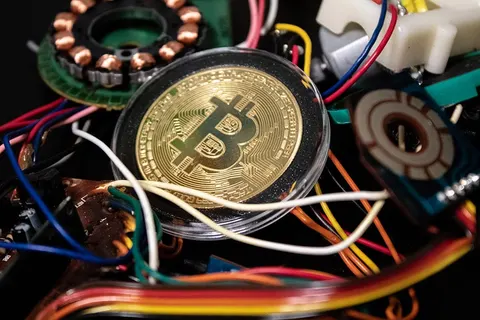
– But that's where the bigger profits are, because some of them are bound to take off, if we compare them with the Google, Amazon and Facebook you mentioned… The hard part is choosing among thousands of potential opportunities.
– That's true. The problem is that to make a genuinely informed decision, you have to read quite a lot. Even for me it's
very hard to keep up with absolutely everything happening in the crypto world right now, even though I do this full time.
To a large extent it's impossible to be fully informed about everything that's going on.
– Still, what's your advice for choosing?
– I think people should avoid the old projects that have no market application. There are things in the top 100 by capitalization that are absurd. Ethereum Classic, for example. It split off from Ethereum in 2016 and isn't really maintained—it's a dead project. The same goes for Bitcoin Gold.
In this ecosystem it's very hard to separate the noise from real information.
Because everyone is selling you whatever they themselves have bought. That's simply how the ecosystem is set up. That's why I advise people to look at the big ones like Bitcoin and Ethereum. Otherwise it's worth tracking how much money users spend to use a given ecosystem—you can see that on the site CryptoFees. That indicator is a sign that there's demand for the technology, and that there's a market.
Another important indicator is liquidity—how much money has been poured into the project. A valuable resource there is DefiLlama, which shows how much money is in each protocol. Another indicator is the number of addresses using the technology—you can see those on DappRadar, but bear in mind that these statistics can be very unreliable.
Liquidity and fees—in my view, those are the important indicators…

– And you keep your fingers crossed that tomorrow Musk will tweet something about that currency.
– Yes, that's the other thing. To me, currencies like Dogecoin and Shiba Inu are largely speculation. Many people will say: it's all speculation.
– I read you saying that Bitcoin will be the future equivalent of gold, because it's a limited resource with a large ecosystem, while Ethereum will in some way be the foundation of the new banking system. And that between them they essentially cover almost the entire need for decentralized finance.
– Yes, that's in a world where we imagine there's a single winner in each of these areas. I think there will be other technologies that take some market share from these applications. For example, it's not clear who will be the biggest rival in the Ethereum world—offering smart contracts, but with lower fees at the cost of less decentralization. Several projects are fighting for that—Solana, Fantom, Polygon. Competing with them are layer-two solutions, which offer lower fees on top of the Ethereum blockchain—those are Arbitrum and Optimism. Which of all these projects will be number 2 isn't clear at this stage. And from that point of view it's difficult if you decide to invest. All these projects have liquidity, they have users. And things are constantly changing.
– Until recently the big fad was mining—quite a few people set up workshops in their basements for it. Today there seems to be no practical point to that anymore?
– Generally, yes. I think next year Ethereum will switch to Proof-of-Stake, and Ethereum mining, which is done with graphics cards, will become largely pointless. To the joy of every gamer, graphics card prices will drop, and the market for this kind of digging will shrink very sharply.
At this stage there's not much point in getting into cryptocurrency mining. The profits are negligible, unless you have very, very cheap electricity.
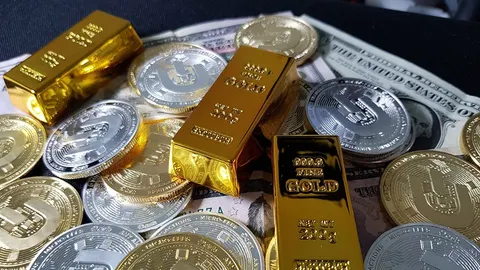
– What will happen when the last Bitcoin is mined? They're a limited resource; at some point they'll simply run out, and maybe their price will explode?
– There's a lot of speculation about that. Right now Bitcoin provides a kind of subsidy to everyone who mines—for every block they get 2.5 bitcoins. At some point that subsidy will drop almost to zero, and it's that moment that worries me more. The idea is that the network will then be sustained by the fees people pay to use the blockchain.
There's no way a blockchain can be infinitely secure—there's always a theoretical amount of money that, if you had it, would let you attack the network and “break” it. How secure a blockchain is depends on how much money that would take; the term is “security budget.”
Personally, I'm skeptical that fees will be enough to guarantee a sufficiently high security budget, and that would endanger the whole blockchain. Of course, this will happen at least 20 to 30 years from now. There are many solutions that could avoid it—for example, a change in the consensus algorithm. I think over time, once we've seen Ethereum's transition, we'll see how well that technology really works. Another possible option is for Bitcoin to move onto Ethereum's consensus algorithm. That is, bitcoins would be transferred onto the Ethereum blockchain and take on its security budget.
All of this is one more example that
this ecosystem still has plenty of rough edges to smooth out before anyone can say it will be digital gold,
worth its price for a long time to come.
– In some ways the pandemic is speeding things up too. A few days ago I saw that the guy I buy tripe soup and kebapcheta (grilled minced-meat rolls) from has also opened a crypto wallet. For people who aren't prepared, is this approach more of a chance at incredible riches or a pyramid scheme?
– A sign that we're nearing the top of the market is when you get into a taxi and the driver tells you about the price of Dogecoin. I recently traveled abroad, and at the border they asked me what I do. When he found out, the customs officer replied: “Ah, I bought some Dogecoin and Shiba Inu, but the price has really dropped.”
That's usually a signal that the market is overheated,
and we went through one such moment this year, when Bitcoin reached $65,000 and then crashed by 50 percent. But now things are moving up again, and it's even reached a higher price. We'll see what happens. But when absolutely everyone starts talking about Bitcoin, that's the worst possible time to buy. And that's the dilemma I face. When the market overheats, an awful lot of people come to me asking what to buy. And when the market crashes, there's nobody.

– Actually, that's exactly the moment to buy.
– That's why I think it's important for people to get in and buy something with money they're prepared to lose and that won't keep them up at night.
If they wake up at night to check their wallet, they've invested too much,
and they need to cut back. First get into it, see it, feel how things move, go through one cycle.
That initial investment is your ticket to start paying attention to what's happening. And once you pay attention and follow the market, you'll acquire the skills you need to sense the right moment.
– Vitalik Buterin says that the most interesting applications of smart contracts are the ones even he hasn't thought of. Outside finance, which areas do you think have a big future for them?
– One, in my view, is gaming, the so-called “play to earn.” Someone installs Diablo, say, plays for 100 hours, collects some items, then stops. In this model we can integrate blockchain, and that way there'll be a market for all the items found and used there. A real market is created, and I think it has very big potential.
This is largely connected to NFTs. I think there will soon be another explosion in this area too—we're already seeing the first signs of it—in art and the way artists sell it. If a painter paints a picture, puts it in a gallery, it gets bought, and at some point its price skyrockets. The artist won't make anything from that. Now we have an alternative mechanism. The painting isn't transferred through some paper contract but through an NFT—a unit that lives on the blockchain and can be transferred between people. Then, whenever this token changes hands and a transaction takes place, the artist gets a certain percentage.
We're seeing many interesting experiments in this area. Some people bought a Banksy painting for $100,000, then made a video of themselves burning it in a park and created an NFT representing ownership of the painting.
The NFT sold for $300,000, even though the painting no longer physically existed.
The Mona Lisa is worth $200 million, and the only way to buy it is to pay that. But what would happen if we made an NFT representing it, then split it into 1 million pieces and put each on the market for $200?
Whoever holds the largest share could decide where the painting is exhibited. And at the same time it would let ordinary people like you and me own fine art, something that has survived through the centuries. Something whose price never really falls, but only rises over the centuries.
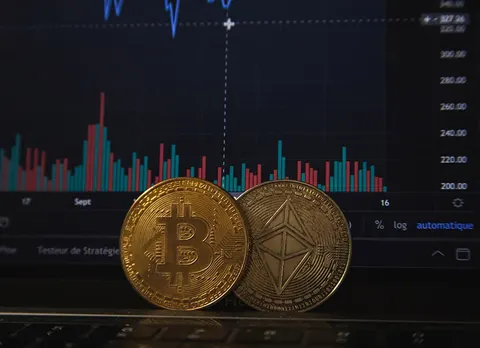
– Yes, but it's somehow counterintuitive. Every time I try to explain the principle to someone, I struggle—it's as if you're buying nothing.
– The question is what's behind it. We could argue that art as a whole is actually nothing. Because it doesn't create any kind of goods—you can't eat it, you can't drink it, it isn't a factory that produces something.
Art is simply a social construct,
people have decided that this painting is very beautiful. You can try it: open the Wikipedia article on the most expensive paintings in the world and see how many of them you recognize. Out of 20 paintings, I recognized two. Maybe I just don't understand art? But when I tried this experiment with other people too, I told myself: fine, there's obviously something here I just don't get. Obviously it's about some kind of social contract. That's what art is, and I think NFTs are a chance for it to move forward.