Gathered here are some particularly intriguing expectations that come from 60 years ago and paint a picture of today. What did the science fiction writers get right?
- The first issue of the cult magazine Kosmos, a popular science monthly for young Bulgarian readers, comes out and opens up a whole new world for its audience. And that very first issue publishes the piece “A Window to the Future,” which gathers the predictions of “Soviet science fiction writers” about what lies decades ahead.
A little later, the father of modern science fiction, Isaac Asimov, also gathers his predictions in an incredible essay. What will the world look like half a century on, in his view? What did he get right?
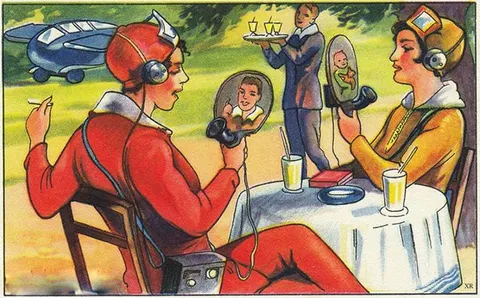
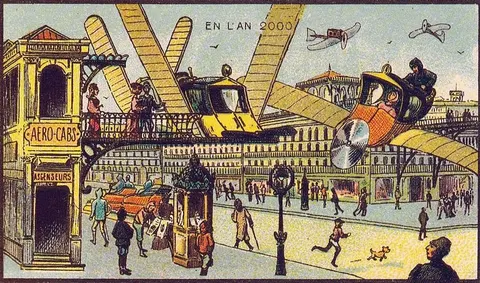
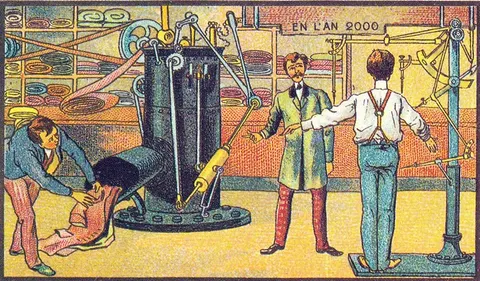
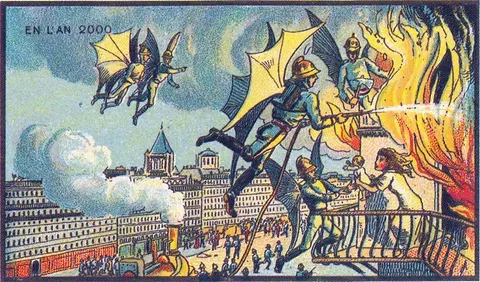
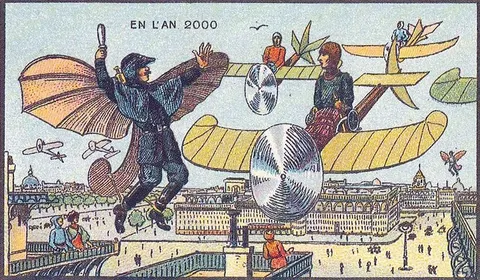
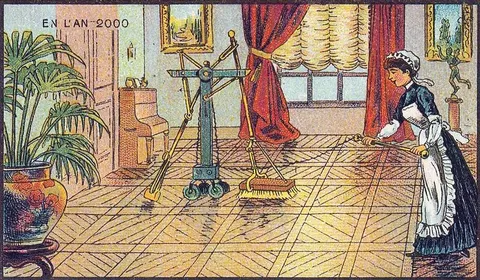
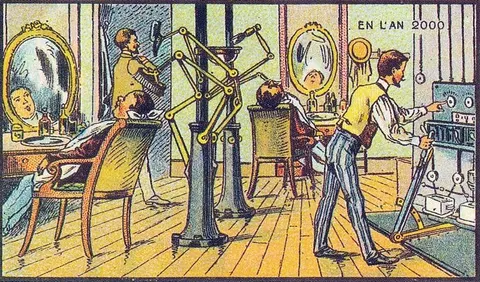
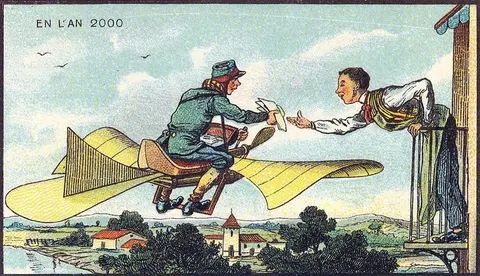
The predictions are “garnished” with illustrations that are “wiser” by another 60 years. The pictures were created by the French illustrator Jean-Marc Côté for the 1900 World's Fair and show how he imagined the world would look in the year 2000. Curiously, these cartoons, circulated as postcards, lay forgotten for a long time before none other than Isaac Asimov revived them as illustrations in one of his books.
Forecasting is an impossible art. And still, what did the science fiction writers on both sides of the Iron Curtain get right, and where did they go wrong?
The predictions of the Soviet writers, Asimov's and Côté's alike have certainly aged in interesting ways…
Visit to the World's Fair of 2014
Isaac Asimov, The New York Times, August 16, 1964
(Abridged)
The New York World's Fair of 1964 is dedicated to “Peace Through Understanding.” It looks toward a world of tomorrow without thermonuclear war. And why not? If such a war comes, there is certainly no point in discussing the future. But what will it be like, say, in 2014? What will the World's Fair of that year look like?
I don't know, but I can guess.
One thought that occurs to me is that men will continue to withdraw from nature in order to create an environment that will suit them better. By 2014, electroluminescent panels will be in common use. Walls and ceilings will glow softly in a variety of colors that will change at the touch of a button. Windows will let in light depending on how strong the sun's rays are.
There is an underground house at the fair which is a sign of the future. If its windows are not polarized, they can alter the “scenery” by controlling the light. Underground houses, with easily controlled temperature independent of the whims of the weather, with purified air and controlled light, will be very common in the suburbs.
The surface will stretch out in great expanses of grass—pastures and parks.
Only a small part of these spaces will be occupied by people.
Gadgetry will continue to relieve people of tedious daily chores. Kitchen units will be devised to prepare “automeals”: heating water and making coffee on their own, baking bread, frying, cooking eggs, grilling bacon. Breakfast will be “ordered” the night before and be ready at the hour we specify. Complete lunches and dinners, with the food semiprepared, will be stored in the freezer until we decide to process them. I suspect, though, that even in 2014 it will still be advisable to have a small corner in the kitchen where some meals can be prepared by hand, especially when we are expecting guests.
Robots will neither be common nor very good in 2014, but they will be in existence. IBM is not showing robots at the current fair, but it is betting on computers, which already display astonishing complexity. They are especially impressive in their ability to translate from Russian into English.
If machines are that smart today, what may we expect in 50 years?
It will be computers like these, only far more miniaturized, that will serve as the “brains” of robots. What is more, one of the main things IBM shows at the 2014 fair may well be a robot housemaid—large, clumsy and slow-moving, but capable of picking up, tidying and cleaning individual items around the home. Visitors will probably have fun scattering debris across the floor of the hall to watch the robot carefully pick it up, classify it as trash and set it aside. Robot gardeners will probably make their appearance too.
Appliances in 2014 will have no cords, running instead on long-lived batteries powered by radioisotopes. There will be experimental fusion power plants as well. Large solar power stations will also be in operation in a number of desert and semi-desert areas.
There will be many vehicles designed to have as little contact with the surface as possible. There will be airports, of course, but even ground transport will take to the air, a foot or two off the ground.
Much effort will be put into designing vehicles with “robot brains” that can be set for a particular destination and will get there without any involvement from a human driver. I suspect one of the major attractions of the 2014 fair will be small robotized cars maneuvering on their own two feet above a crowd, avoiding collisions.
Communications will develop to the point where we will be able to see the person we are talking to, just as we now hear them on the phone.
The screens will be used not only to see the person you call,
but also for studying documents and photographs and reading passages from books. Synchronized satellites hovering in space will make it possible to reach any point on Earth, including the weather stations in Antarctica.
Conversations with the Moon will be carried out by modulated laser beams. Communication will be slightly uncomfortable, though, since it will take 2.5 seconds for a question and answer to be exchanged. With Mars the delay will be 3.5 minutes, and that is at its closest. In any case, by 2014 only unmanned ships will have landed on Mars, although the 2014 fair will display a model of a future Martian colony.
Wall screens will replace today's television sets, and transparent cubes will broadcast three-dimensional images. One of the most popular exhibits at the fair 50 years from now will be 3D televisions in the shape of cubes that can be rotated so they can be viewed from every angle.
In 2014 the planet's population will be 6.5 billion, and that of the United States 350 million. Because of population growth, more desert and polar territory will have been brought under human control.
Ordinary agriculture will be hard going, and there will be farms making far more efficient use of microorganisms. Processed yeast and algae will be available in all sorts of flavors. The 2014 fair will feature “mock-turkey” and “pseudosteak.”
Not everyone will fully enjoy the comforts of technology. A larger share than today will live in deprivation, and although they may be better off materially than they are now, they will fall further behind the advanced parts of the world.
The world will certainly have chosen to limit the birth rate in order to avoid overpopulation. Mechanical devices will be used to replace diseased hearts and kidneys and to unclog arteries, mortality will decline, and average life expectancy in some parts of the world will reach 85 years.
All high school students will learn the fundamentals of computer technology, will know binary arithmetic and will use computer languages developed from today's Fortran.
Even so, mankind will suffer terribly from boredom, a disease that will spread more widely with each passing year. This will have mental, emotional and sociological consequences, and I dare say that psychiatry will be by far the most important medical specialty in 2014. The lucky few who can be involved in creative work of any sort will be the true elite of mankind.
And the most somber prediction I can make is that in 2014, in a society full of leisure, the most glorious word in the vocabulary will have become “work”!
“A Window to the Future”
(Published in Kosmos magazine, issue 0/1962)
How will people live at the end of the century, centuries from now, millennia from now? Who does not ask these questions, who is not stirred by them? But answering them is very hard. A group of Soviet writers have tried to peer ahead and throw open for us the window to the future.
Here is how the writer Anatoly Dneprov sees humanity's achievements 30 to 50 years from now:
Of course,
the problem of interplanetary travel will be successfully solved.
We may hope that scientists will master the technique of artificial photosynthesis and that, having harnessed thermonuclear sources, humanity will obtain abundant energy for all its needs. Undoubtedly, complete and comprehensive mechanization and automation of every kind of production will also be introduced.
I foresee great successes in biology and medicine. The creation of a living cell under laboratory conditions will be a true revolution in science. It can hardly be overestimated. And its immediate results will be an abundance of food, control over life processes, a solution to the problem of longevity and the complete elimination of all diseases and infirmities.
The writer Georgy Gurevich is also confident that the people of communist society will live very long and will enjoy their youth more than once. He thinks the constitutions of the communist era will contain a clause:
“Every citizen of the Solar System has the right to youth.”
He believes that in the more distant future humanity will grow to 100 to 200 billion people, and that people will then adapt space to be their home: they will give the Moon an atmosphere, heat Mars, cool Venus, settle the giant planets and build many inhabited artificial islands in interplanetary space. He believes medicine will find a way not only to prolong human life considerably but also to give the old their youth back.
The writer Boris Lyapunov turns his gaze not to the expanses of space but to the ocean floor.
Not three but five billion people will live on the globe in the year 2000.
How much food, raw material and energy a growing humanity will need! People will not be able to do without the gifts of the ocean. And the treasures of the sea depths and the ocean floor will probably be put to use long before space is practically mastered. Mine shafts will appear on the ocean floor sooner than on the Moon, and underwater plantations will yield harvests sooner than the orchards and vegetable gardens of Mars.
But let us take a stroll along the seabed of the future! All around us sail every kind of vessel: underwater cargo and passenger giants, fishing and whaling boats, automatic seaweed mowers, submarines laying cables. Machines controlled from land drill boreholes, extract oil and natural gas, and mine all manner of ores.
Yes, the expanses of the ocean have at last found their master. Man not only extracts their vast riches but brings his own order there. He has changed the course of undersea currents, warmed the Arctic waters and altered the climate of the cold regions. He breeds valuable species of fish, protects them from predators, prepares food for them and helps them settle new places. From seaweed he extracts valuable raw materials and metals. He taps the inexhaustible sources of energy hidden in the ocean—the tides, the temperature difference between the surface and the depths—and from water he obtains fuel for thermonuclear power plants.
And now the floor goes to the Strugatsky brothers.
There are people who imagine communism rather strangely: humanity stops working. Machines create abundance.
In the drinking water reservoirs, lemonade. Or even beer. There is everything, and in unlimited quantities. The only thing missing is unfulfillable wishes. Humanity, weary and pampered, takes its pleasure, supported entirely by machines. There is nothing to want, nothing to dream of, nothing to strive for. That is not communism. That is numbing boredom. Yes, there will be abundance. Yes, there will be machines—a multitude of ingenious machines that will do all the unpleasant and monotonous work. But not so that man can drift along in the fat of idleness. We are certain: communism is not the greasy paradise of famished philistines, nor the dreamy rose-tinted distance of a poetic idler. Communism is humanity's last and eternal battle, the battle for knowledge, a battle infinitely hard and infinitely absorbing. And
the future is not a grandiose home for the invalids of a retired humanity, but millions of centuries spent resolving the last and eternal contradiction between the infinity of mysteries and the infinity of knowledge.