Art and technology are not enemies, not even rivals. They are two sides of the best that human beings are capable of.
Unfortunately, these two vast worlds meet rather rarely. And when they do, in the full sense of the word, the result can echo for centuries. One particularly telling example of this bears the name Bauhaus.
(For anyone who has no time to read—here is everything important on the subject in 12 lines.)
When the Foundations Were Poured
We are talking about nothing more than a single art school. Its founder and teachers decided they would work differently, by bringing the modern together with the aesthetic experience of the past. Their dream, objectively speaking, lasted a mere 14 years, but it did not vanish afterward, because it left behind an enormous legacy and the magic of the Bauhaus, which to this day keeps pushing many fields of art and technology forward.
Time would show that this was the most influential school of applied arts, design and architecture of the 20th century. The Bauhaus created the laws and rules by which generations of specialists would work… and we will try to capture where the magic of this movement lies. Is there a way to recreate it in our ultra-dynamic times? Let us imagine that a similar phenomenon of a new generation might appear, one that brings technology and art together. And that also paints so much of the lives of the people who will come to Earth after us…
Master Builders
Bauhaus is a building supplies store. At least that is what 9 out of 10 random passersby will tell you if you ask them. In fact, the “Building House,” as we would translate it from German, is the name of a genuine revolution, if a quiet one.
The tenth person you ask will surely turn out to be a true admirer of the movement and will start telling you about it with enthusiasm. Most likely because they belong to one of the countless professions this phenomenon has influenced. They might be a product designer creating the objects we fill our homes with, an architect, or a designer in any other field with a feel for modernist forms. They might be an engineer with a structural turn of mind, an artist or an art lover inspired by names like Wassily Kandinsky and Paul Klee, or simply by clean, meaningful forms that unite the classical and the modern… yes, all these people certainly know a great deal about the subject.
For everyone else, though, we will begin briefly with the story itself, before discussing what made it so special. Then we will reflect together… don't we need exactly that today, a digital Bauhaus, a “Digitalhaus”?!
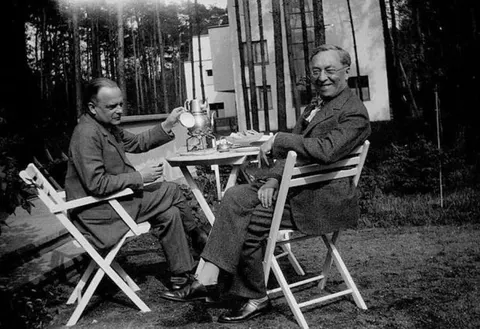
We Will Build a Factory
So each of the figures we have sketched, the professions and the people with various interests who developed a strong attachment to this school, has their own reasons to like it. Many of them will even try to convince you of the school's uniqueness with arguments that contradict one another.
And yet, if there is one thing that brings them together, it is a reverence for the rational and the clean as the guiding forces. For the meeting of technology and aesthetics.
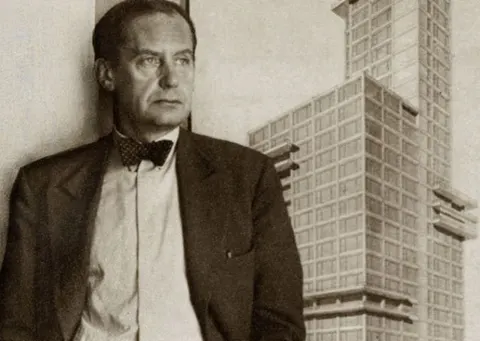
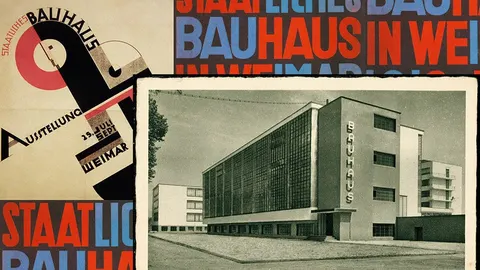
That was precisely the dream of the architect Walter Gropius when, on April 25, 1919, he welcomed the school's first students to its original building in Weimar. Even while he was at the front during the First World War, Gropius dreamed of creating a school that would change the meaning of design. The bombs spared him, and the result surpassed even his boldest dreams.
Formally, his project was a merger of two existing institutions in Weimar, the School of Applied Arts and the Academy of Fine Arts. But if we think about it, there was nothing formal about it at all.
Straight as a Plumb Line
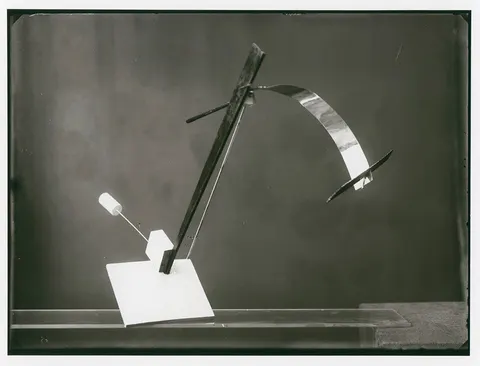
Gropius set craftsmanship as the guiding principle. He believed that every artist must learn the craft they will practice, as must every architect and every sculptor. They had to know their materials to perfection, to know the details of every step of their work. Only then would they be capable of truly meaningful creation. In this sense, technology can become a synonym for art, simply viewed from a different angle.
“The artist is an exalted craftsman. In rare moments of inspiration, moments beyond the control of his will, the grace of heaven may cause his work to blossom into art. But proficiency in his craft is essential to every artist. Therein lies the prime source of creative imagination,” reads the manifesto with which the school was opened.
To ensure the meeting he sought, Gropius decided that students should have two teachers for every subject. Masters and craftsmen provided the professional knowledge, while artists took care of aesthetic inspiration and the development of taste, of a personal vision.
Special emphasis was placed on handwork and practical exercises. Because, according to Gropius, manual and machine labor do not differ in essence, only in the scale that technology allows.
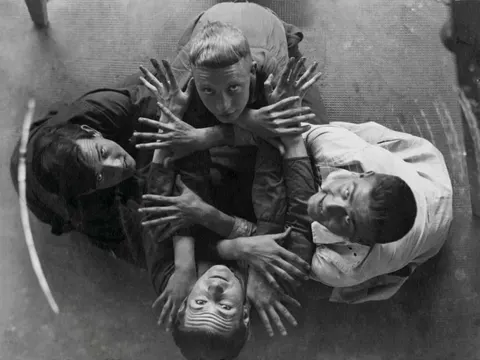
But theater and construction, psychology and dance were taught as well, all in search of the fullest possible release of the creative potential hidden deep within every student.
My Home Is My Castle
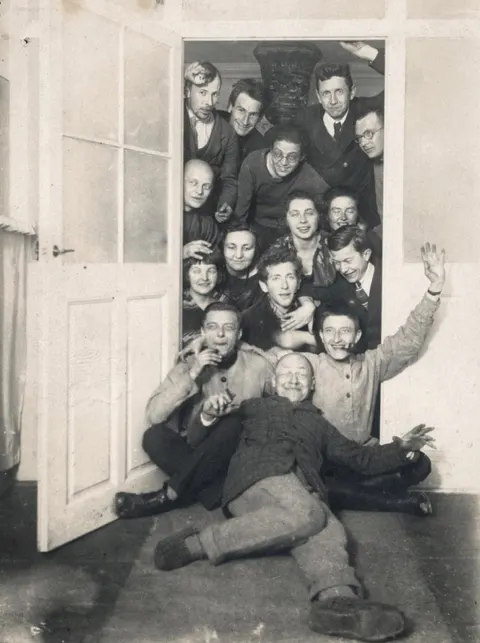
The director did everything in his power to bring in the best in their professions. Besides the Kandinsky we mentioned (who later also became deputy director) and Klee, the Bauhaus soon welcomed one of the masters of early photography, László Moholy-Nagy, as well as countless other proven names, though these were famous mostly within their own fields. From the very first class, students who stood out for their skills also stayed on as teachers.
Fourteen years—almost every one of us has spent at least that long in the education system. And that is all history granted this remarkable school. It appeared in the dizzying, intoxicating years between the world wars. Provoked in some way by the First, and swept away by the rumbling of the approaching Second.
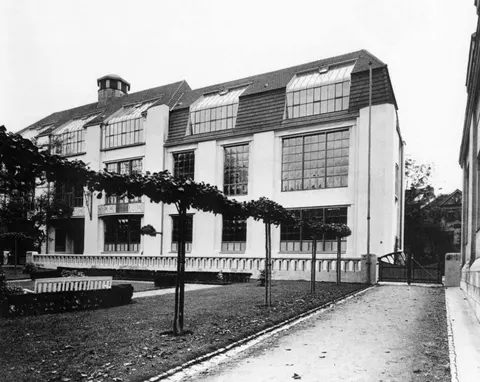
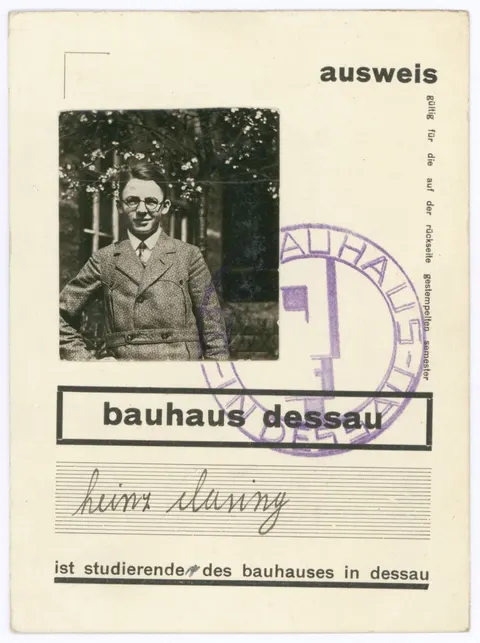
In 1926 the Bauhaus moved to Dessau, into an elegant building that Gropius designed to carry the spirit of his idea.
Two years later, the founder decided that he had laid the foundations he had dreamed of and that it was time to clear the way for those who would follow. He chose his successor himself: in 1928 Hannes Meyer, who had previously led the architecture courses, became director. Mostly because of his Marxist convictions, however, Meyer was forced to leave only two years later. The new director chosen was Ludwig Mies van der Rohe, known to the public simply as Mies. He was handed the far from easy task of trying to preserve the venture that had gathered such momentum.
The Roof Falls In
But nothing is stronger than time. In 1932 the Bauhaus moved to Berlin in an attempt to survive the gathering storm. The following year, when the Nazis came to power, was officially the last in this story.
The romantic version of the ending says that good old Ludwig Mies van der Rohe gathered all the students and teachers for a glass of champagne one hot evening at the height of summer. And only at the very end, when the time came to part, did he tell them that the end of the Bauhaus had come and it was time for everyone to run.
Fortunately, they managed to get away.
The end of the school by no means ended its story. First of all, quite literally, the movement scattered across the world. Many of its graduates left for Palestine, where, in the lands of today's Israel, they could create and show what they had learned. In the 1930s more than 4,000 buildings were built in Tel Aviv; today they are known as the White City and are a UNESCO World Heritage Site, because they carry the authentic spirit of the Bauhaus.
Construction Troops
Mies, the last director, left for America, where he also left an enormous mark. Quite a few enthusiasts headed for the USSR, where they made a serious contribution to architecture and design that can still be seen today, mostly in Russia.
The Marxist Hannes Meyer, of course, also went to the USSR with big plans and ambitions. And he undoubtedly left his mark there before growing disillusioned with the dark years and leaving for Mexico in the 1940s. The style found a home in many countries searching for a modern future, such as Turkey and Japan.
And after the end of the hot war and the start of the Cold War, it influenced in some way the architecture and urban planning of the entire Eastern Bloc. Only one Bulgarian woman was among the school's graduates, and she had no contact with architecture there. And yet, according to many experts, Bulgaria has quite a few examples of the classic forms of the Bauhaus style. (A typical example, they say, is the Yavorov housing estate in the capital, Sofia.)
Measure Seven Times, Cut Once
The school admitted women too, although, especially in the Gropius years, they were steered mostly toward the crafts—working with textiles and fabrics—because the founder believed that metalwork and architecture were not suited to the female way of thinking.
The truth is that among its successful students there seem to be not all that many painters and artists. But this may be due to the major shift in tastes that came after the Second World War. On the other hand, the architecture and design of its other graduates, just as Gropius had dreamed, are certainly products of technology. Yet they cannot be told apart from art.
So what do we owe the movement? We cannot be exhaustive, and we risk disagreement, since we are talking about currents, not inventions.
Grade-A Concrete
In architecture, the school laid down the principles on which our homes are built. It is no accident that some call its characteristic features the “International Style,” because they became the standard in so many countries, pushing regional particularities into the background. Large windows, white walls, flat roofs, balanced spaces. Glass facades, large metal structures. The unfolding of the possibilities offered by concrete and the other materials that built the 20th century.
Its influence on graphic design is beyond dispute. The Bauhaus style, for example, underlies the graphic system of the New York subway, which has had a very strong influence on today's web design.
The list is long, but we should not leave out typography. The Bauhaus was the first to widely popularize sans-serif letters as the bearers of the new.
It lies at the heart of product design—both the iPhone and the floor lamp in your home carry at least a little of the spirit and proportions of the Bauhaus.
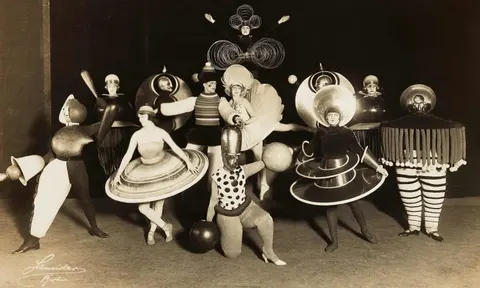
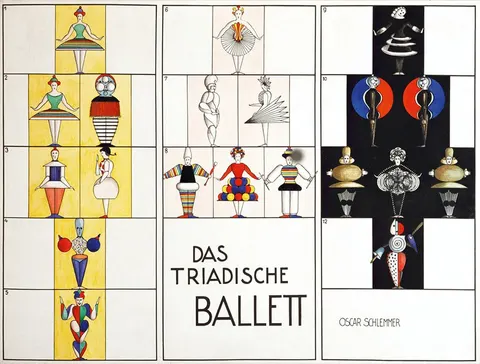
The movement transformed even the theater, with ideas for stage design and costumes created in the classes on this art led by Oskar Schlemmer.
The Beam in One's Own Eye
There is another point of view, too. There is not a single one of the school's main achievements that had not happened before it. Not one phenomenon that characterizes it, that we associate with it, that did not already exist before Herr Gropius rang the first bell.
The glass buildings, the graphic solutions, even the way of teaching at the Bauhaus—all of it had already been invented or demonstrated in one way or another. (You will find an apt summary along these lines in this piece in the weekly Kultura.)
The ideas and their applications really did precede the school. So what?
Here they came together, backed by the school's solid rationale and philosophy. Enough to reach critical mass and change the world for all 10 out of 10 people we asked at the start of today's Digital Story, even though only one of them knew it.
Building on Sand
In any case, in the circles of the specialists we have mentioned, even if you don't come across a Bauhaus admirer, you will surely meet someone who dislikes the style and the movement because they are a bigger fan of another school, whether later or earlier.
Some talk about uniformity, others about the political aspects connected with the Bauhaus's arrival in many countries.
Almost everyone, though, will single out their own versions of what impresses them. The particular solution they associate with the movement, for better or worse. Their own emotional brushstrokes that lead to the Bauhaus.
“The aim of the Bauhaus is not to spread any ‘style,’ system or dogma, but to exert a revitalizing influence on the whole field of design. A ‘Bauhaus style’ would be a confession of failure.”
Those are the words of Walter Gropius, and we have to admit that failure, apparently, is what came of it, because today everyone has their own definition, but hardly anyone would deny that a distinctive Bauhaus style exists.
Some say its success lies in minimalism, in using the least that is necessary as a means—to beauty or to meaning. Accessibility, functionality and aesthetics—others sum up the philosophy and style of the school with this triad.
One more definition: bold, clean lines and a minimalism devoted to functionality.
Fall In
I think that if you have no time for the whole article, everything it has to tell you is contained in the following lines.
Written so long ago, these are the words of the Austrian artist Herbert Bayer, from his book about the Bauhaus published in the United States in 1938:
The Bauhaus boldly accepts the machine as an instrument worthy of the artist.
The Bauhaus solves the problems of good design for mass production.
The Bauhaus gathers in its faculties more outstanding artists than any other art school.
The Bauhaus bridges the gap between artists and industry.
The Bauhaus breaks down the system that separates “fine” and “applied” art.
The Bauhaus understands that technique can be taught, but creative inventiveness cannot.
Through the methods of trial and error, the Bauhaus invented a new, contemporary kind of beauty.
The Iron Man
There is an interesting view that says the Bauhaus style itself, modernism itself, rejects historical roots and the preservation of the old. Then how and why should we preserve and display it?
Is the Bauhaus a utopia? Of course! But one of those utopias that manage to come true and even surpass their original design. Because without utopias there would be no point in continuing to struggle, no way to keep moving forward.
But then where is the magic that allowed this to happen? And more importantly: can we recreate it today, when the collision between technology and the past is more dramatic, more abrupt and more dangerous for all of us than it was in the days of the Bauhaus? Plenty of people will give you their answer; mine makes no claim to originality, and I add it only as food for thought.
Both Man and Iron
Synergy. The meeting that comes after the clash and the mutual scowling. In their pure form, between technology and art, between the humanities and mathematics, between creating and following the rules, there is no clash, only synergy. A person can consider themselves a humanities type and then discover beauty in engineering thinking as well. I say this to you as the author of a novel who today combines writing computer code with texts like this one.
Technology and artificial intelligence alike can and must move forward only if they also capture the human, creative side. Otherwise they will remain stuck as an awkward attempt, a constant target for serious criticism. What the result of such a meeting will be… we can only guess. Or dream. Like Gropius.