A bomb so powerful that you are not even sure it won't wipe out the whole of humanity. And still, you have to face yourself and your fears, weighing two monstrous injustices against each other. And you are not God, not Prometheus, not even a politician elected to make such grave decisions. Just a scientist who has found himself at the epicenter of the blast.
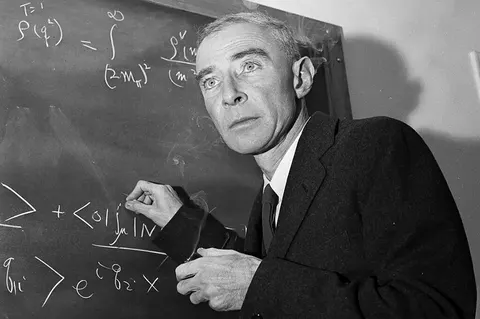
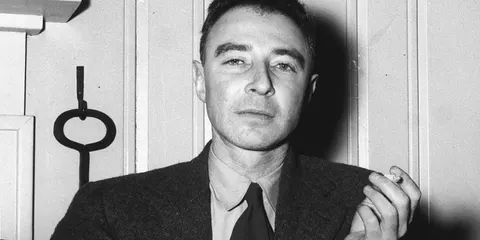
J. Robert Oppenheimer—we all know him as “the father of the atomic bomb,” and over the coming months, you can be sure, he will be talked about a lot. His dramatic story runs from creating the most powerful weapon of destruction to becoming one of the most stubborn and persuasive advocates for banning those very weapons.
And it is no accident that this story is about to be told again today. When bombs are once again falling in Europe itself. When progress in technology may, once again, carry the risk of bringing us to self-destruction…
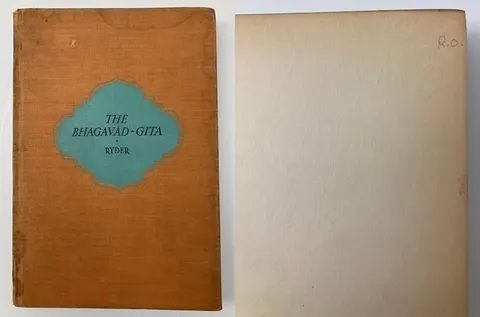
“Now I am become Death, the destroyer of worlds”—these words from the Indian epic surfaced in the great scientist's mind when he saw the effect of Trinity, the first successful nuclear test. Mere days later, what he had created would become the deadliest weapon ever used, taking the lives of 200,000 people. And, as Oppenheimer himself said, without any point to it happening…
Shock! Bombshell!
July 21 of this year will present lovers of Hollywood productions with a dilemma. Not one but two highly promising premieres await them. I personally recommend the long-awaited epic Barbie, with Margot Robbie and Ryan Gosling, which promises to bring to life a deep, timeless story…
Well, you do have another option. The less pretentious picture Oppenheimer. It will be quite interesting to see which tops the box office charts (and the “great” rivalry already has its own particular meme, going by the name “Barbenheimer”).
“Like it or not, J. Robert Oppenheimer is the most important person who ever lived. He made the world that we now live in, for better or for worse.” The words belong to Christopher Nolan, one of the few undisputed modern masters of cinema. It is he who has taken on the task of telling, in more than three hours, the story of the scientist whose name became a byword.
We will get to Nolan, and the many reasons this film looks like a must-see. But first let's get to know its hero. “The most important person who ever lived”…
Explosive
One of the greatest scientists of the 20th century, with contributions in so many fields, he never received the Nobel Prize, for which he was nominated three times. He came close to being jailed for treason during McCarthyism. His life truly resembles the plots of ancient Greek mythology.
Robert was born in 1904 in the United States, into a family of wealthy immigrants of Jewish descent. His father, Julius Oppenheimer, was a textile importer who had emigrated from Germany 15 years before his elder son was born. His mother, Ella Friedman, was a painter.
From an early age he knew he would devote himself to science. He learned fast, skipped several grades at once, and was interested in mineralogy and chemistry.
Throughout his life he remained a person of colorful interests, as if stepped out of the Renaissance. He was passionate about art, fascinated by ancient mythology, learned countless foreign languages, dead ones included, and knew the mystical texts of the East in detail. All while searching for answers to the big questions about the structure of the universe using the tools of the modern age.
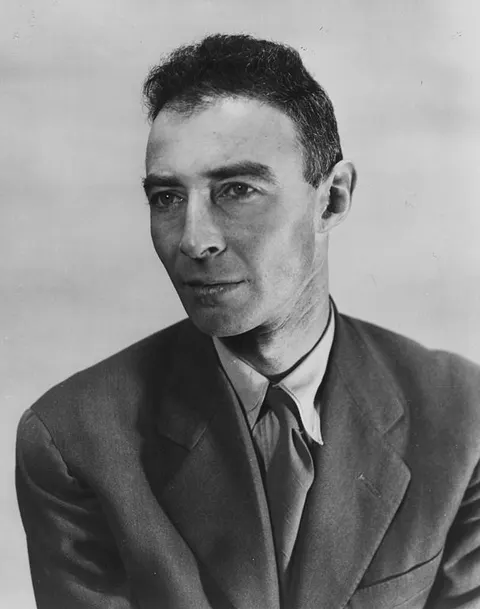
He graduated from Harvard and then left for Europe, where, in the days of the Belle Époque, the science of the universe was living through its golden age. At first he worked at Cambridge, but decided he would make a better theoretical physicist than experimentalist (perhaps, in the end, it would turn out to be exactly the opposite?).
So he ended up in Göttingen, where he earned his doctorate under the undisputed great name of the day, Max Born. While studying, he befriended scientists such as Werner Heisenberg, Wolfgang Pauli, Paul Dirac and Enrico Fermi.
Elementary Particles
He returned to the United States, began teaching at Harvard and then at Berkeley, and became part of the core group of scientists who would build an impressive school of physics on the other side of the ocean.
He became a beloved teacher. Students enrolled in his courses several times over, captivated by the accessible way he taught extremely complex problems. By the magnetism with which he explained them.
He worked in theoretical astrophysics, nuclear physics and many other fields. Building on Paul Dirac's research, he is believed to have been the first to predict the existence of the elementary particle known as the positron.
In 1928, “Oppie,” as his students called him, came down with a mild form of tuberculosis and, on his doctors' advice, went to New Mexico. With his father's help he bought a small ranch in the region that would forever remain linked to his name. At the time he liked to say that physics and New Mexico were his two great loves, and he wondered how they could ever be combined. Well, they would be—like the nuclei of atoms…
Short Fuse
Don't picture him as a dry scientist devoted only to science. For three years he had a relationship with Jean Tatlock, the daughter of a colleague, a professor of literature at Berkeley, and herself a medical student.
Their relationship was quite stormy, and shortly after they broke up, he met Katherine Harrison—Kitty—another Berkeley student, who certainly had an even stormier past. Her second husband had been killed in the Spanish Civil War, and she had recently married her third, a professor of medicine. Even after she became pregnant by Oppenheimer, her husband refused a divorce; it had to go through the courts before she and the scientist could marry and their first child, Peter, was born.
Both of the scientist's great loves were rebels, strong characters and… connected to the communist ideas fashionable at the time among disaffected young people in the West. Something that, years later, would cause Oppenheimer serious trouble.
He and Kitty also had a daughter, Katherine, but by then it was December 1944 and the family had settled in New Mexico for the long haul…
When Thunder Strikes
As a young man the scientist had no interest in politics whatsoever, but things changed when Hitler came to power in Germany. Many of his teachers and friends of Jewish descent were persecuted, and he could not remain indifferent. He came to the conclusion that the fascist machine had to be stopped. Whatever the cost.
The American government launched the Manhattan Project in 1940 with a budget of $6,000. The goal was to explore the possibility of creating a new generation of weapon that could prove decisive in the war already raging in Europe.
The public would have no idea the project existed until it had achieved its goal and the first atomic bomb was dropped on Hiroshima. After that, its name would forever be tied to Oppenheimer's.
Gradually the project became a huge priority. Within five years the money allocated to it reached $2 billion, making it the second most expensive American scientific project after the mission to land on the Moon.
The Thunderer
Somewhat strangely, given the persecution that followed, it was Oppenheimer who was chosen to lead the team that would develop the new-generation weapon.
It was on his suggestion that the top-secret complex at Los Alamos, New Mexico, was established, where serious scientific and experimental work began over the following years. The site chosen for the base was close to the scientist's ranch.
Oppenheimer had little experience managing large teams, but he showed unexpected talent. Some of the greatest scientists of the time joined the work, among them Ernest Lawrence, Enrico Fermi and Richard Feynman.
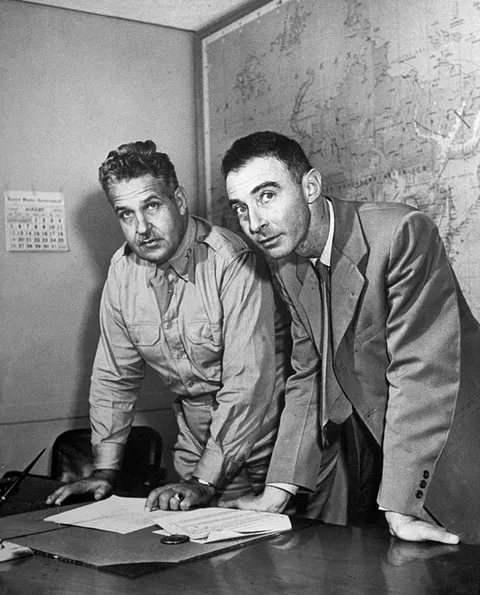
The military side was led by Colonel Leslie Groves, who later said of Oppenheimer: “He's a genius. A real genius. He knows about everything. He can talk to you about anything you bring up.” The two became a successful team… insofar as one can speak of success here.
Big Gun
And so we come to July 16, 1945, the date set for the first serious test of the new weapon. The bomb was nicknamed the Gadget, and the test received the considerably more poetic name Trinity. Suggested, of course, by Oppenheimer. It came from a poem by John Donne, written shortly before his death, about a man who is not afraid to die because he believes in resurrection.
Rather ominous for a test the scientists were not at all sure they could control, one that had been calculated in advance, yet which many believed might prove… fatal to life on the entire planet?
No one was sure the math was right and that the world would still be there after the experiment. As Oppenheimer's colleague Isidor Rabi recalled, two minutes before it, “he muttered, ‘Lord, these affairs are hard on the heart.’ When the giant mushroom rose and the low, cutting roar of the blast followed, his face relaxed. He turned and walked back like a hero in a western. Like a man who has done his job…”
The lines about death we began with were no accident. And yet, by all accounts, the scientist at the time was driven forward solely by the idea that an American defeat in the Second World War would be the end of the world, and that the atomic bomb, with its unpredictable consequences, was the lesser evil.
The Gadget, Little Boy, Fat Man
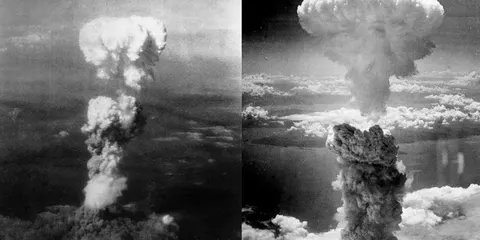
Three weeks later—on August 6 and 9—two more bombs of similar design but far greater power were dropped on the Japanese cities of Hiroshima and Nagasaki. They too bore less than poetic names: Little Boy and Fat Man. The cities were razed to the ground, and some 200,000 people died.
Yes, this led to Japan's unconditional surrender, but to this day the question remains whether the brutal decision could have been avoided, whether the samurai would not have surrendered anyway, as the natural course of the war suggested.
Oppenheimer himself claimed he had been seriously misled about how the war was going. Of course, the decision was not his but the politicians' and the generals', and yet without his work it would not have been possible.
Frank, Robert's brother, recalled that when they learned one of their “devices” had exploded successfully, his first thought was: “Thank God, it worked.” Only afterward came “all the horror of killing so many people.”
“Mr. President, I feel I have blood on my hands,” Oppenheimer would later tell President Truman at a meeting. “The way nuclear bombs will be used was set by Hiroshima. The bomb was used against an essentially defeated enemy, becoming a weapon of aggression.”
Thundering Words
With each passing year, Oppenheimer grew gloomier and more withdrawn.
After the war he became a star, appearing on the covers of glossy magazines. Especially once other countries made unexpectedly rapid progress in developing nuclear weapons, he insisted ever more fiercely on international agreements, which in turn drew dangerous attention to him in those days.
He spoke more and more often about the need for strict bans on nuclear weapons, and against developing the next generation—neutron bombs. Oddly enough, his name would be missing from the appeals by the world's scientists to halt tests in that direction. But there was always something contradictory about him.
Then he fell from grace. A sweeping investigation was launched against him, aimed at proving he was a spy who had betrayed his country. Secret agents trailed him; from national hero he became a sinner. And although nothing was ever proven, only a formal rehabilitation followed, in the early 1960s.
Like Universes Exploding
By then, however, it was too late. Driven all his life by turbulent emotions, he chain-smoked three or four packs of cigarettes a day. Whether because of that, the stress, or the tests as well, he developed incurable throat cancer and departed this world on February 18, 1967. His wife Kitty scattered his ashes in the waters near their seaside home on the exotic island of Saint John, where the family had spent much of the last decade, far from the world, in a spartan cabin, sailing far out on their yacht.
After Kitty's death five years later, the seaside home passed to their daughter Katherine, who took her own life there shortly after being fired from her job over the FBI's old accusations against her father.
And yet it seems everything ended for him back then, in the moment Oppenheimer recalled the words: “Now I am become Death, the destroyer of worlds.”
How Are You? The Bomb!
It is as if two people lived in him all along—the melancholy, withdrawn, introspective scientist and the public image, the decisive man ready to make harsh choices. The rigorous scientist and the lover of mystical Hindu texts. According to his own brother, Robert often liked to say that he needed physics more than friends.
“Both the man of science and the man of action live always at the edge of mystery, surrounded by it,” Oppenheimer said.
He is undoubtedly a hero whose fate has been told many times, in all sorts of ways. And yet enough time has to pass before history can tell its stories with sufficient conviction.
In the late 1970s, the American historian Martin Sherwin decided to dig deep into the scientist's life. He told his editors he would be done in four or five years, but he kept on and on piling up documentary evidence. He got hold of declassified documents, talked to Oppenheimer's family and friends, until… almost 30 years had passed, he had amassed 50,000 pages of material about his subject, and the end was nowhere in sight.
He decided he couldn't manage alone and called in his colleague, the historian and journalist Kai Bird. For another five years the two sorted and made sense of what had been gathered, before publishing in 2005 the book American Prometheus, which distills the essentials of that enormous mass of documents into 800 pages. The following year they won the Pulitzer Prize for Biography.
Thunder and Lightning
And indeed, thinking of Oppenheimer, how could the association with Prometheus not arise—the ancient Greek titan who gave fire back to humanity. Fire that can be salvation or death. And as a result, he was chained to the Caucasus mountains and doomed to centuries of torment… After him comes curious Pandora, who opened the box holding all the evils of the world.
There is, by the way, another archetypal Prometheus, one we less often call by that name. Frankenstein; or, The Modern Prometheus is the full title of Mary Shelley's book about the inventor who decided to play God and create a human likeness. A novel with two centuries of patina, which is not merely Hollywood horror but a prophetic parable, once again, about knowledge, about common sense, about technology slipping out of control…
To finish, we return to Hollywood, because it is Bird and Sherwin's American Prometheus that Nolan built his long-awaited film on, arriving at the end of July.
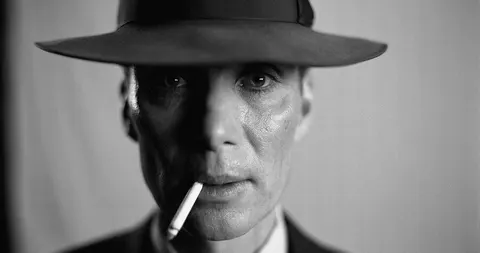
It will be the director's longest, and it will certainly be spectacular, as the trailers show. Some scenes will be in color, when it tells of the scientist's work; others in black and white, when it gets to the investigation against him.
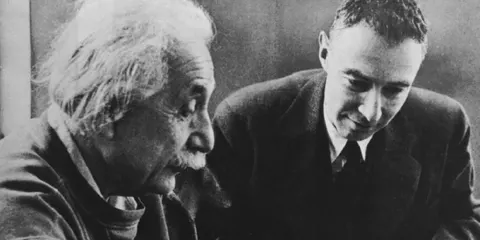
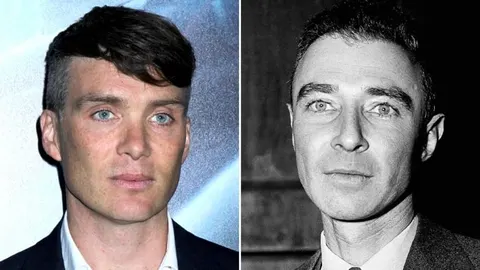
The cast is impressive too. In the trailers, the Irishman Cillian Murphy is literally indistinguishable from Robert. Matt Damon plays Colonel Leslie Groves. Also on board are Rami Malek, Robert Downey Jr. and Kenneth Branagh. Einstein makes an appearance as well—we can't do without our favorite pop clichés.
Even for the most important scene, the Trinity test, the director decided not to use computer-generated imagery. Could he be afraid of technology?
Oppenheimer's Cat
12,512—that is how many nuclear warheads maintain the “peaceful balance” today, according to the independent organization SIPRI. Their number keeps growing in almost every country that possesses the technology.
Without underestimating Barbie, it is good that even today there is art unafraid to seek out the more important themes, to run from the fashionable, even from propaganda. Whether it has worked, everyone will soon be able to decide for themselves.
If scientists once wrote letters calling for a ban on nuclear tests, today they write them about developments in artificial intelligence. Of course, in times when war is returning, AI is only one of the directions of development that deserve a dose of vigilance. Caught up in the day's news, we humans easily miss the big picture—as the days of the Manhattan Project show, and as do those of deep neural networks.
Are we safe from nuclear weapons today? Couldn't things have turned out so that the future of life on the planet did not depend on politicians with their notorious briefcases? And on a volatile world politics hanging by an ever-thinner thread of balance?
Is fear of technology healthy at all? Is there sound thinking where every new piece of knowledge also adds a fragment of the unknown? Where the dream of technical progress actually turns into the familiar Pandora's box? Only without the hope that comes out last…
It is too late to ask Oppenheimer; he has made his choice. Let's hope no one has to face a similar situation in our time. Alas, the natural spiral of history suggests otherwise…
This piece is part of the new issue of Dolce Far Niente magazine