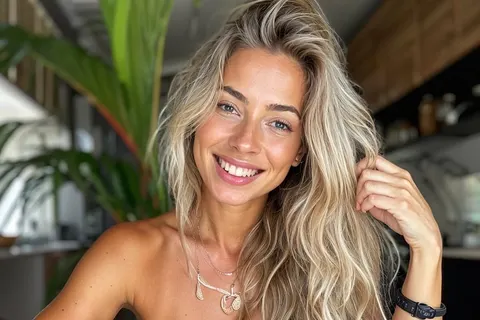
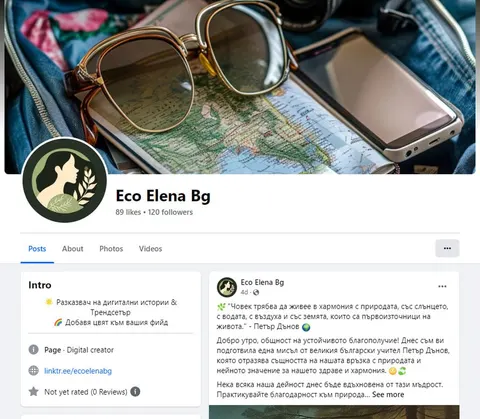
How could you not like Elena Dimitrova, or simply EcoElena? Blonde, smiling, upbeat. She travels, lives in harmony with nature, gives useful tips, offers exotic recipes. Well, there is one more detail. She… doesn't exist.
I ran an experiment: I created an entirely generated artificial heroine and, for one month, posted content in her name on Facebook and Instagram.
84,519 people saw at least one of her posts, 8,900 liked them, and her profiles attracted 289 followers. She received a few dozen touching comments and 9 romantic propositions… And not a single comment that in any way reflected the fact that every letter, every pixel of Elena's online persona was generated by artificial intelligence.
The algorithms already pass the Turing test. Well… will we?
Child of the Wild Wilderness
“In a world where likes and follows are currency, I am launching an extraordinary experiment—creating an influencer born not of human labor but of the very core of artificial intelligence. This experiment blurs the boundaries between reality and fiction, offering us a glimpse into the future of social media, where influencers may carry bits and bytes instead of flesh and blood.”
Oh my, oh my, thank goodness they won't carry flesh and blood. That is the lead ChatGPT wrote for me. I can write a better one, but… who needs it? Evidently the algorithms are capable of being more successful at writing online than my modest 20-year path in storytelling. At least that is how it looks, judging by my unpretentious experiment.
I ask ChatGPT to come up with a name for a “content creator,” a profile. Then to draw up a plan for the kind of posts to publish. The next step is to generate the posts themselves, and Midjourney chips in with the matching images. I don't interfere at all, I just copy and publish… I could easily skip even that; it would take minutes to write a simple program to do it.
What came of a month of influencing? For me, at least—a shock.
Elena the Fair
I have written before about virtual people. Why bother with a real celebrity when… one can be made up entirely by algorithms? You don't even need much knowledge or skill—artificial intelligence is ready and easy to use.
So, mid-January. Unlike another hero, I won't ask ChatGPT to draw me a sheep. I'll simply give it the task of inventing an influencer for me. I begin with the obligatory instruction to step into the role of a marketing specialist and generate a description of a successful Instagram personality. I give it a few extra instructions too, for example not to capitalize every word in headings—something by which I, at least, recognize it in Bulgarian. After that… off it goes.
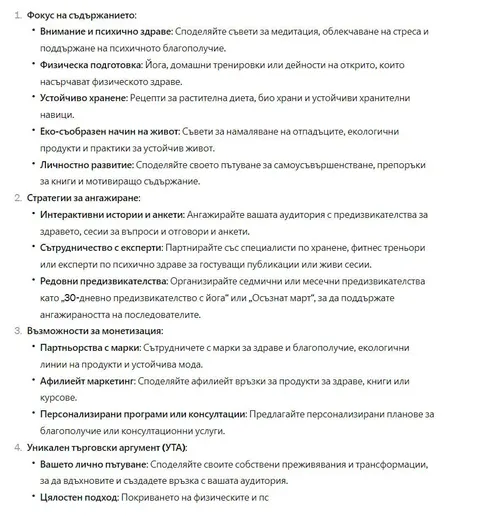
My “colleague” gets its bearings remarkably fast. What niche did it choose for our fictional hero? “Health and Well-being—A Holistic and Sustainable Lifestyle.” Brilliant! If those aren't the hottest topics of our time… then health to them. And well-being.
What will she talk about? Do we have a detailed marketing plan? We do! Here it is:
Master G-P-T
How much would a marketing expert charge for something like this? Not my business, nor is it my job to grade ChatGPT the marketer; I'm only here to give it a chance to shine.
What should our influencer be called? Somewhere around here, without any prompting from me, the author decides a lady would be more successful. I approve the very first of the five suggestions I get:
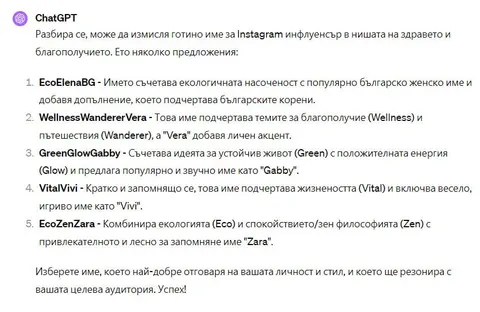
“EcoElenaBG—The name combines an ecological focus with a popular Bulgarian female name and adds a suffix that highlights Bulgarian roots.”
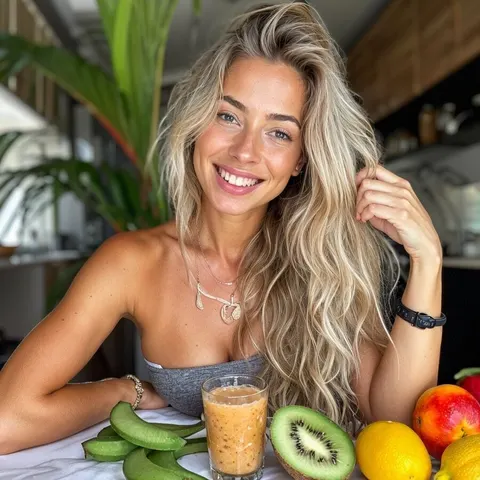
Eco and patriotism? You don't mince words, sir. If you say so. Now give me a description of Elena that I can ask Midjourney to turn into photorealism.
And here is the result:
Digital Hysteries
Great! We have a niche, a name, a concept… Let's get down to practical work. The bio is ready. I only have to trim it slightly to fit Instagram's and Facebook's requirements, and the result is:
🌟 Digital Storyteller & Trendsetter
🌍 Travel Lover
🌈 Adding color to your feed | 🍃 Sustainable living | ✨ Wellness guru
Digital storyteller? Excuse me?! Shall we take each other to court over that phrase, my dear fellow? No, since you and I arrived at the same idea, it must be a good one.
Clever Little Elena
Day 1. By chance or not, it turns out there is no profile named EcoElenaBG on either of the two social networks I've chosen. And so EcoElena comes into the world… or onto the screen. But what will she post from now on? Not my call. Within seconds my marketing consultant lays out a precise, clear plan.
Every Monday Elena will give a personal-development tip, on Tuesday—a healthy recipe. Thursday is the day she tells us about her travels, and Friday is time for a photo garnished with a wise quote. Sunday we keep for eco-living tips. And, as my electronic consultant assures me, it's good to throw in an extra, different post now and then.
Monday arrives, and Elena makes her online debut. She offers 5 tips on “the power of visualization and goal-setting—two powerful tools that can turn your dreams into reality.”
I tell three friends about my idea; together with me they become the lady's first Instagram followers, so it won't look suspicious. From here on, all I do is ask ChatGPT to write a post on the topic it created itself, and then ask its visual colleague to suggest matching images.
A Star Is Born
Day 7. As expected, the first week is weak. Interestingly, even before I like the profile, two strangers beat me to it. Still, by Sunday there are 10 followers and just a handful of likes on the posts.
What don't people like about her? To be honest, I couldn't tell her posts from ones created by a human (try it yourself… though it's different once you know).
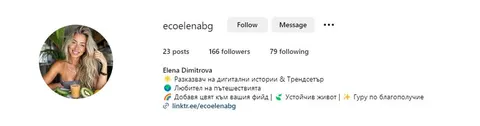
Yes, that's how social media algorithms work, the beginning is hard, and of course I… ask the one better versed in influencing than I am. What should I do? It gives me valuable advice—try other social networks, like other people's profiles, consider boosting the posts, because that's the way to start.
Your wish is my command! On Monday EcoElena joins Facebook. She has a new cool-mega-eco logo (made you know how). In her name I allow myself to like 80 Instagram profiles—the first ones the algorithm recommends. I decide the experiment is worth it and set aside 100 leva (about $55) for ads—in total, through the end of the month.
AI's Best Friend
Day 10. Then comes Wednesday, and I ask my colleague for a different kind of post: let it tell something interesting that happened to Elena. And presto… a meeting with a sweet little puppy that gives her day meaning and makes her appreciate the small things..:
Apparently it gives meaning to other people's days too, because the likes shoot off into outer space. Comments with little hearts, “how lovely!”, “how uplifting!”, 2,200 likes! And what if I'd posted a kitten?!
I try to recall the few times a Digital Stories post drew that many. Is an online story really strong when it's deep? Or when it's true? Or when we know someone actually lived it? And what if there's no way to tell?
The profile quickly comes alive on both networks. Likes pour in, hearts flutter, comments pile up. Somewhat surprisingly, the most successful posts aren't the principled tips on eco-living or self-knowledge (though in my opinion they would do most themed magazines proud).
The algorithm already handles Bulgarian very well, astonishingly well considering how little it has been trained on our language. Not to mention that it gets the Bulgarian definite article—a notorious grammatical trap—right more often than most people I know.
Ham à la Elena
The weekly healthy-recipe rubric becomes quite a hit. No wonder—the tempting photos help. Again I post the first suggestions without nitpicking that here and there a frying-pan handle appears without a pan…
Of course, just in case, I read the recipes carefully myself—I wouldn't want Elena's conscience burdened by a bottle of bleach among the ingredients. Nothing of the kind, though: ChatGPT writes its tips just like a TV chef, and the photos are no worse. The best seller is the red lentil and quinoa burger recipe. It even sparks debate—one follower says she tried it but the mixture fell apart, which she fixed with 1–2 tablespoons of almond flour.
Another, indignant visitor uses the burgers to make a sweeping lifestyle remark: “You're too lazy to cook, you lot! Easy America with fries and ketchup!” Elena was probably taken aback here; I won't show you the reels of her reaction.
The travelogues are a serious success too. Yes, the photos come out in the spirit of the cities the algorithm picks—Dubrovnik, Bucharest, Ohrid, Santorini… The author conveys the magic of each destination, sometimes invents a landmark or two, the streets in the photos don't really exist, but then again… people like it, and some chime in with memories of their own trips.
“Man must live in harmony with nature, with the sun, with the water, with the air and with the earth, which are the primary sources of life,” says Elena, quoting Petar Danov, the early-20th-century Bulgarian spiritual teacher. No kidding—with no hints from me, she headed in that direction. According to the internet, at least, Danov never said it, but… it sounds good. Except to one visitor, who says the real question is how nature can live in harmony with man.
The Love We Can't Live Without
On the day for miscellaneous posts, Elena's friend Vera pays us a visit. A good girl, pretty, who has helped her rediscover herself:
The comments below call her a beauty too, though there is one typically positive online “ugly.” I won't pass it on to her, so the girl doesn't get upset.
As for the romantic propositions and attempts to get acquainted, I'd rather not even talk about them—one more reason to think about why it's so important to talk about online communication.
Maybe Elena's story should continue on Tinder?
Elena's Mountains
Day 28, February 10. 23 posts. That's enough; time for the summary I started with. That's it for Elena. I have more of her generated posts, but they will remain a secret from her fans. You've seen the numbers. What impresses me is that even the unboosted posts always have at least double-digit likes, something… even national media outlets sometimes can't boast of.
But one number impresses me most. Zero. The number of people, out of all 84,519 who saw at least one of her posts (not counting me and 7 or 8 friends), who remarked that something here wasn't right.
With 100 percent generated content, without a single minimal intervention of mine. No text edits, no picking the best suggestions, no image corrections. Without getting into techniques for better image prompts or seeking consistent images.
What if one put in a little more effort? What if one took care to smooth out the small giveaways I deliberately left in? Then, I guarantee you, Elena could become a real star (and a source of income).
We'll Live Till Monday
You'll rightly say you can't call someone with fewer than 300 followers an “influencer.” And you're right: Jesus managed billions of followers in just 7 days of Holy Week.
Friends I tell about the experiment urge me to keep going, to reach thousands of followers, to turn EcoElena into a real influencer and marketing product (or perhaps she'd do it herself?). Judging by what I've seen so far, I think it's entirely possible.
But enough—one month was plenty. At the same pace, after two more, EcoElena would have had 1,000 followers, and that, according to marketers, would make her a micro-influencer who can advertise in her niche.
It isn't hard to let my imagination run further—she posts more photos of herself, which the algorithms can now do too, she becomes popular, people start discussing her more, wondering whether she really exists, which makes her even more popular. She'll have to forgive me, but I won't do it (and let's hope she doesn't think of suing me for lost profits).
People????
My goal isn't to deceive anyone, let alone profit from it. Quite the opposite. I believe in the truth; I think we need to talk about it far more and make sense of it.
I wanted to test how indistinguishable the created is from the generated today, how far the algorithms have come. Not so much what they themselves are capable of, but… what are we, humans, capable of in the age of artificial intelligence?
Do we value the truth online, does it matter? How are successful digital stories written, and why is it sometimes more important that they be meaningful, personal, profound…?
I tested it, and now I have my answer. No, I won't tell you what it is—ask ChatGPT.
Coming next Friday:
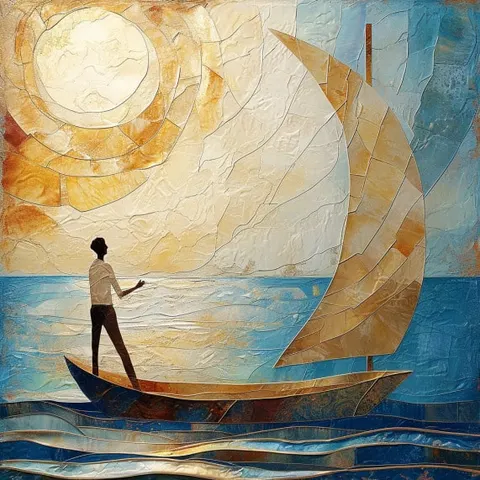
Can you tell what a human created from what was generated? Let's find out together with a most curious test! We'll judge texts, photos and paintings—which is human and which is generated? The experiment will have a lot to tell us…