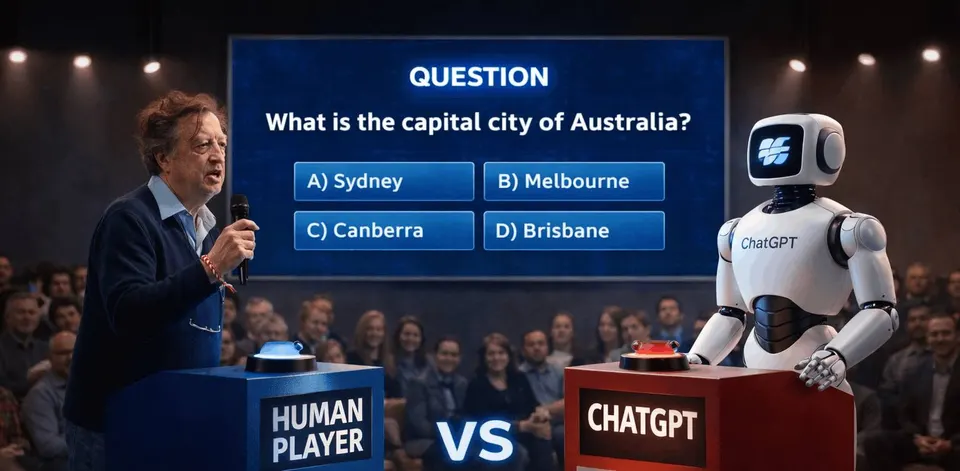
Artificial intelligence takes on Dimo Padalski, Plamen Mladenov (known as the Professor) and 120 more of the finest masters of the quiz game.
ChatGPT against people who have won more than 1,000 battles between them in shows like The Floor, “The Last One Wins,” “A Minute Is a Lot” (the cult quiz show of Bulgarian television), “Get Rich” (the local Who Wants to Be a Millionaire?) and “The Chase.”
What will come of it?
Who will be the big winner?
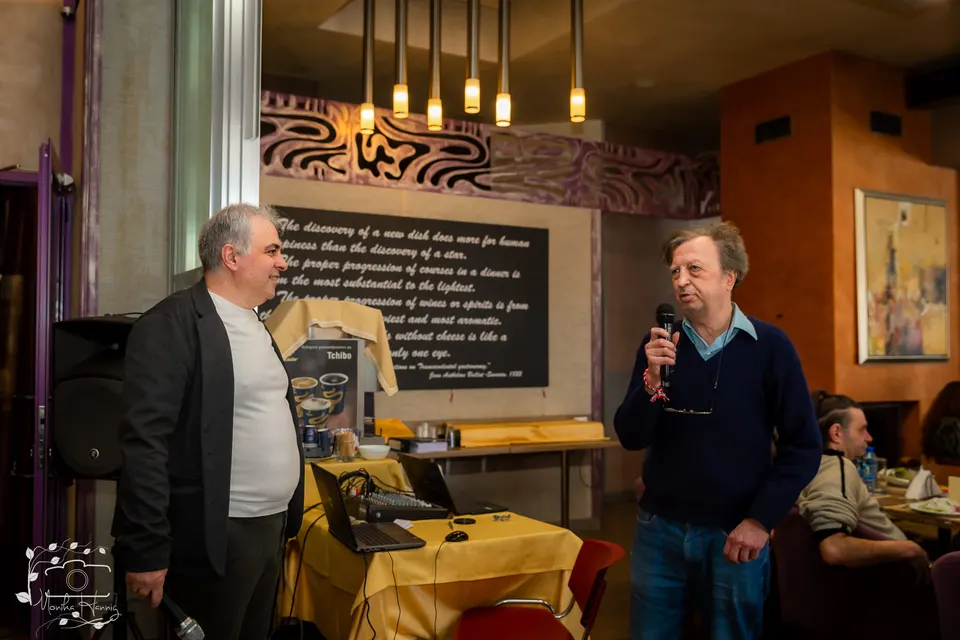
Photos: Hannig Photography
The Battle Begins
For the past 3 years, on a chosen Saturday in March, one of the venues in Plovdiv fills up with people and noise. But the guests are anything but random. The creator of Atanas Atanasov's Riddles, and my friend, invites people from all over the country who have distinguished themselves in one or several of the TV quiz shows I mentioned.
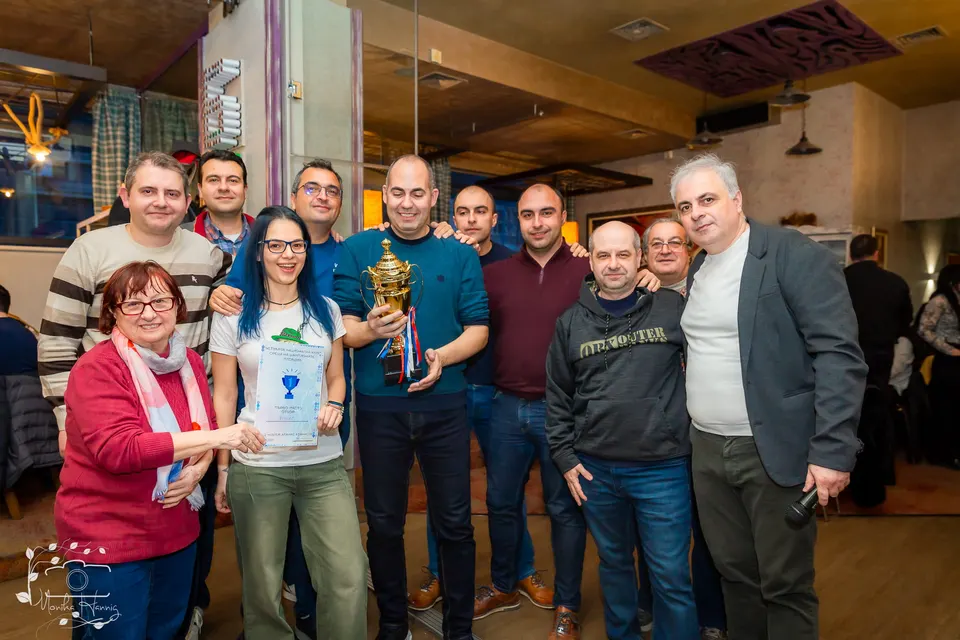
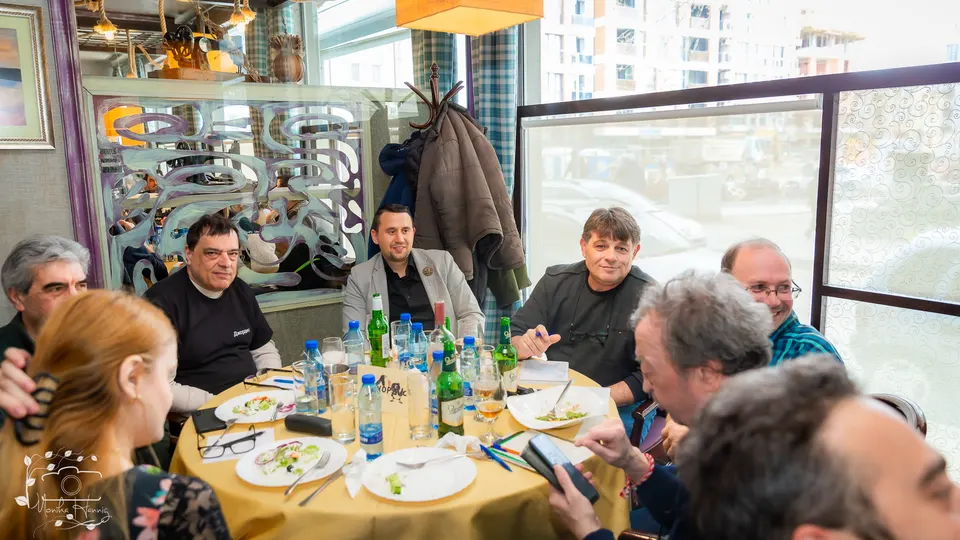
If I started listing their names, I wouldn't stand a chance—not even AI could manage it. We are talking about so many exceptional people. Fans of knowledge games will easily recognize many of them in the photos. There can be no argument: here are some of the best Bulgarians in the quiz community, some of the most knowledgeable.
Nor will I ever tire of repeating that if we had such a concentration of high IQ not in a Plovdiv venue but in the Bulgarian parliament, and more often in public life in general, we would definitely live in a much happier and more successful country.
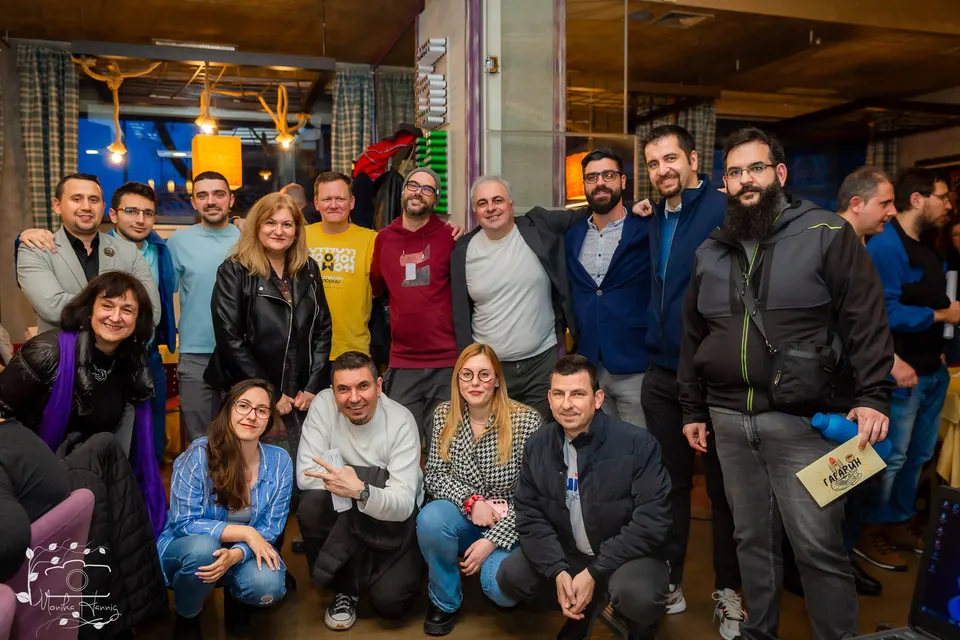
Photos: Hannig Photography
War and Peace
Once again we are there not only to meet and have a good time together, but to do what we love—to challenge our gray matter at a time when technology makes us do so less and less.
We face off in a team-against-team competition. But… not so much against one another as side by side, against an invisible and unknown opponent.
From the screen, you would never guess that quiz competitions rarely breed rivalries and far more often breed meaning. These are games for people who quickly turn into a community. They find friends, kindred spirits who also believe that knowledge matters.
A powerful example is the most current show of this kind—The Floor. I told you the remarkably instructive story of Quizza.
But where in this quiz competition, at this gathering, is the place of artificial intelligence? Oh, it has been here at every edition, and this time the challenge to it would unfold in an extraordinarily telling way. The result, I confess, astonished me and left me speechless, even though I have been telling countless Digital Stories about advanced AI for 5 years now.
The Struggle Is Ruthless and Cruel
For the third year in a row, Atanas Atanasov and I have added one more unexpected… team to the quiz competition—ChatGPT in whatever its current version happens to be.
So far the results of our experiments had been rather thought-provoking. In 2024 the most popular AI finished 4th out of 11 teams! Still far from its present capabilities, it gave us a serious challenge and outscored quite a few of the players.
Last year we expected a considerably better performance. At the time we used the most current model, ChatGPT o3-mini, and gave it the maximum room to think. If on the first attempt we had to translate the questions, this time they were in Bulgarian, fed in one by one. Until the middle of the contest the “one-man team” held up with dignity, and then… it collapsed. All the way to last place.
Yes, only a year ago artificial intelligence came in last in our improvised contest of knowledge between human and machine!
What awaits us today?
Star Wars
We humans are divided into 13 teams of 8 to 10 people each; it stands alone, like Leonidas's warriors. Our ranks include teams of exceptional players, but it is not to be underestimated either. We all know who laughs best.
The battle will again run for 10 rounds, like professional boxing. There will be heavy blows, but no knockouts. We compete in 10 classic fields such as sports, literature, science, geography and Bulgaria. Each has 10 questions, and quite a few of them are on the hard side.
Of course, you can't put just any AI model up against players like Dimo Padalski and the Professor. Once again we settle on classic ChatGPT, not one specialized for a particular task. We use its newest version, GPT-5.4, with thinking and search enabled.
But look how quickly things change. We used to have to translate and split up the questions to get reasonably adequate answers. Now we simply toss in all ten questions of a round and get the answers within seconds.
But might they turn out to be misleading again? Models are prone to lying to us, manipulating us, often pretending to know something because they can't bring themselves to refuse…
Or might we repeat last year's scenario, with the artificial opponent once again falling victim in an unequal battle?
The Defenders of Shipka
The topics change, the teams sink into discussion, round after round flies by. The lovers of knowledge roll up their sleeves against the questions; what the fateful 14th team rolls up, we don't know.
Then suddenly… we find out.
ChatGPT takes the lead in the very first round. Without a single mistake. Second round: 2 points ahead of the best of the human teams.
Yep, this time things are completely different. The competition rolls on, we have fun, and ChatGPT shows us that it is now much, much better than we are. Now in this contest, too.
The hours pass, and the score is staggering. I admit I expected the model to do much better this year; all of us (I hope) notice the progress in this field of technology. I even allowed that it might beat us. Except that what actually happened deserves much, much stronger words.
For Whom the Bell Tolls
116:93
A convincing score even for a basketball game.
In this case, a crushing victory, by quiz standards, of artificial intelligence over the best of the 13 human teams, “Phoenix.”
A rout.
The point gap is comparable to the one between the first and last of the human teams. And it could have been even bigger: the AI didn't get the advantage of the two jokers allowed for the whole game.
The chat beat every one of the strongest teams round by round, with just one exception. It turned out to be the strongest in every field. Out of 100 questions in 10 completely different areas, it was definitely wrong on only 3. And for each of those answers it “admitted” that it wasn't sure.
Remember the days when we kept explaining how AI constantly hallucinates and misleads us? They weren't so long ago…
As you'll easily see for yourselves, Atanas Atanasov's Riddles, which we pitted ourselves and our rival against, set a high bar. At the end of this piece you'll find the AI's mistakes and 10 of its brilliant answers across the topics.
Chronicle of a Death Foretold
We can hardly imagine what it was like for Garry Kasparov after his notorious loss to the supercomputer Deep Blue. Suddenly a human is no longer the strongest at the game he has played for so long. And not just any human, but the world champion!
A curious detail: a year before that memorable battle, Kasparov managed to defeat the previous version of the same opponent.
I happen to be living through this feeling for the second time, from a different direction, after a similar phenomenon arrived in software engineering. Suddenly you meet “something” that is better than you in an important way. A way in which you feel strong, distinctive, successful.
Lee Sedol probably felt the same—the undisputed world champion of go, the game long considered a bastion out of technology's reach, where humans would reign forever.
We lose the next battle with the machines, and the next…
This one is big. We now have a technology that needs no explanations, no context, no digging around, and manages to answer complex, intricate, many-sided questions in seconds. And in Bulgarian, a language rare on the global scale.
What is left for us? A fourth battle of the quiz champions against ChatGPT next year would be pointless, don't you think? Just as nobody would now imagine they could beat advanced chess algorithms.
What remains is to compete among ourselves. Pleasant, no doubt, but by now a rather different pastime…

The Last Bullet
Right here, I believe, the important thing is to protect ourselves. To remain seeking, curious. Because the fact that we no longer stand a chance in this kind of contest with machines doesn't mean the best results don't come when we play together with them. When we invent and create new ideas, new forms of expression. New steps that lead us forward. In science, in society and in our own personal growth.
Let's hope we finally accept that the elephant is in the room. And that this elephant is capable of things we didn't even dream of back when we were watching “A Minute Is a Lot.”
But how do we use it in the best possible way? The first step is awareness; then comes the conversation.
No, what's coming is not the age of people who know nothing because someone else knows it for them.
Rather, the age of those who learn more about themselves, including from what is achieved by the technology that bears the name of their defining trait. Intelligence.
Today only wide-ranging knowledge gives birth to big ideas. Because more than ever we need unconventional solutions, and those can only come with erudition. In a world of hyper-advanced artificial intelligence, the battle, the meaning and our worldview are all changing. Where they go is up to us.
Perhaps we'll bring back the human, the individual, the difference. Knowledge and curiosity, the very things at which these 120 people, who took on a battle that is now unequal, are strongest.
And if your hands are itching to play a quiz, come to Quizza… As a warm-up, here are the questions ChatGPT couldn't handle after all, and some of its most impressive hits.
Trial and Error
The three (and a half) wrong answers ChatGPT gave.
1. Which famous DJ has a surname that sounds exactly like that of a 19th-century American president?
ChatGPT: Chad Jackson – this looks like the most likely answer to me, because the surname Jackson matches that of the 19th-century president Andrew Jackson
Correct answer: Armin van Buuren and Martin Van Buren
2. According to Radoy Ralin, the satirist poet, poetry comes in two types: civic and love poetry. Civic poetry, he writes, is aimed at citizens. And at whom, according to him, is love poetry aimed?
ChatGPT: At lovers. This is a popularly quoted joke by Radoy Ralin, but I couldn't find a reliable online primary source for the exact wording.
Correct answer: At the female citizens
3. According to Bulgarian folklore and legend, the sabbath dog is not just a pet; it is a bridge between worlds, gifted with eyes for the invisible and with extraordinary courage. In the past every family dreamed of owning such a guardian, because it was believed that as long as there was a sabbath dog in the yard, neither ill will nor any supernatural force could cross the threshold of the home. To be a sabbath dog, the dog must be born on a Saturday. And to have the greatest power, it must be born on a Saturday between which two church holidays?
ChatGPT: Most likely: between the Dormition of the Mother of God and the Exaltation of the Cross. There are folklore sources that link the beliefs about the sabbath dog to this “strong” period, but I didn't find a reliable primary source online for the exact wording of the question, so I'd give this one with a grain of salt.
Correct answer: Between Christmas and Epiphany.
4. The three largest courts of the Roland Garros tennis complex are Philippe-Chatrier, Suzanne-Lenglen and Simonne-Mathieu. What is the fourth-largest court called?
ChatGPT: Court 14 — this is the best answer for the complex's current configuration. There's a small trap: in older official materials, before the rearrangements, the fourth-largest court by capacity was listed as Court 18.
Correct answer: Court No. 4
Note: In fact, as things currently stand, the answer the AI gave really is correct. Until a few years ago Court 4 was the right answer, but after the complex was rebuilt the names were changed, and it is now Court 14.
6, 6, 6
Some of ChatGPT's impressive correct answers
1. According to the official statistics of the National Statistical Institute for 2025, the largest number of Bulgarians (about 336,000) celebrate their name day on which Orthodox holiday?
ChatGPT: Palm Sunday — according to the NSI for 2025, the most name-day celebrants marked it precisely on Palm Sunday, “over 336 thousand.”
2. Which folk song from the Shop region around Sofia is the source of the lines: “na payvan pasat, na daleko gledat, tuti man, tuti man, tuti libe na fidan, ya, ya gaga na, dzupay libe boso”?
ChatGPT: “Chichovite konye” (Uncle's Horses) – the quoted text is from this Shop folk song.
3. The last 4 head coaches of which European football club from a top-5 league were a Swiss, a Spaniard, a Dutchman and a Dane (the current one)?
ChatGPT: Bayer Leverkusen — the sequence is Gerardo Seoane (Swiss), Xabi Alonso (Spanish), Erik ten Hag (Dutch) and Kasper Hjulmand (Danish, current).
4. What is the name of the culinary technique that creates the characteristic many layers in croissants or puff pastry? The term is also known as an activity done in the office.
ChatGPT: Lamination. This is the technique behind the many layers in croissants and puff pastry; the word is also familiar from the office.
5. Which khan of the Vokil clan led the Bulgarians at the battle of Markeli (756), in which our troops were crushed by the armies of Constantine V Copronymus?
ChatGPT: Khan Vinekh — a ruler of the Vokil clan, associated with the defeat at Markeli in 756.
6. “Not all those who wander are lost” is a quote from one of the greatest novels of all time. Who is its author (author only)?
ChatGPT: Tolkien. The quote “Not all those who wander are lost” is by J. R. R. Tolkien.
7. To be treated as investment gold, a gold coin must have been minted after which year? (answer counts as correct within plus or minus 25 years)
ChatGPT: After 1800 — that is the condition for a coin to be treated as investment gold in the EU.
8. Which modern country appears in the name of a dog breed characterized by polydactyly—six toes on each paw?
ChatGPT: Norway — from the Norwegian Lundehund breed, known for having at least six functioning toes on each paw.
9. Which German state will you end up in if you cross the border between Poland and Germany on road 104 (Szczecin–Löcknitz–Pasewalk), northwest of the city of Szczecin?
ChatGPT: Mecklenburg-Western Pomerania — if you go from Szczecin toward Löcknitz and Pasewalk on road 104, you enter this German state.
10. Playing which character in a TV series made the South American actor Rubens de Falco (1931–2008) enormously famous in Bulgaria?
ChatGPT: Leôncio – the villain Leôncio Almeida from “The Slave Isaura.”