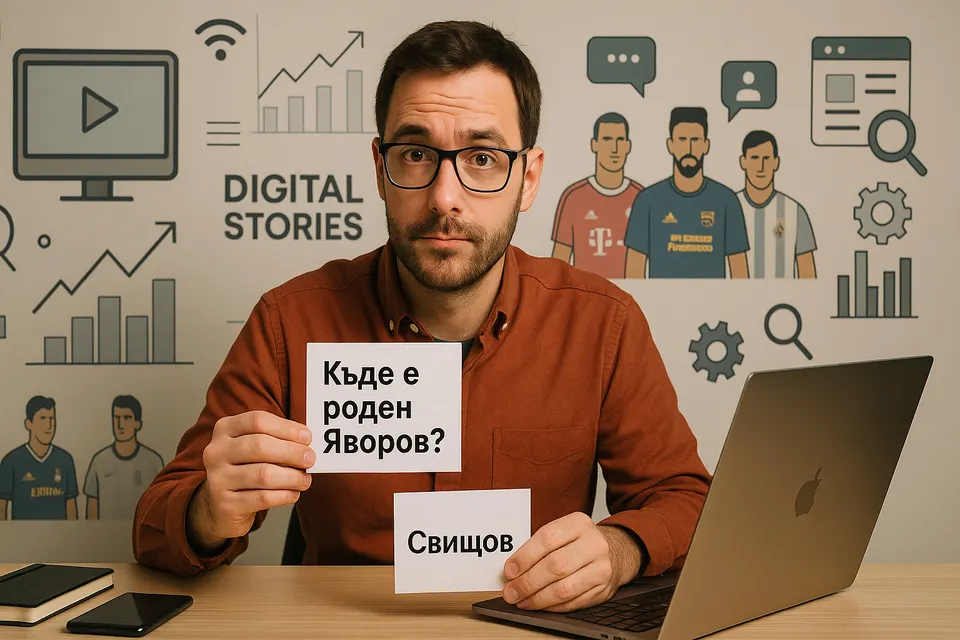
What is Yavorov's hometown? Svishtov.
Artificial intelligence hallucinated that, and rather clumsily, you might guess. Except it wasn't the machine. It was me, taking part in a prime-time show on Bulgaria's oldest television channel. I would have thought I was more likely to get my own name wrong than the birthplace of Peyo Yavorov, one of Bulgaria's greatest poets and a man whose story has fascinated me my whole life. Yet I got it wrong, and I won't be showing my face in Chirpan, the small town where he was actually born, anytime soon.
Knowledge is not a given. Curiosity doesn't come on its own; it takes effort.
But is there any point in remembering where Yavorov was born in an age when we can check it in a fraction of a second?
Would he have written different poems if he had been from Svishtov, a town on the Danube?
Will the next generations know where he was born, how he wrote? What stirred him, where and how he met love?
If you like, ask ChatGPT. Or the Constitutional Court.
My own answer is this: today, more than ever, it matters that we stay curious!
The Full and the Hungry
“Stay hungry. Stay foolish. Never stop learning, your whole life long,” Steve Jobs said in his famous speech to graduating students. “Hungry.” Not for food, but for the other thing, the more important one. I still believe that you are not what you eat. You are what you read, what you take in, what you remember.
Chirpan. I have never been there, I don't know what the locals are like or what sights the town has, and yet (I thought) I knew one thing: one of my favorite poets was born there.
Why should anyone remember facts, the birthplaces of particular people, the remarkable goal scored by their favorite footballer? There's no practical point. Who needs curiosity? For the first time, we have a technology that can free us from it entirely!
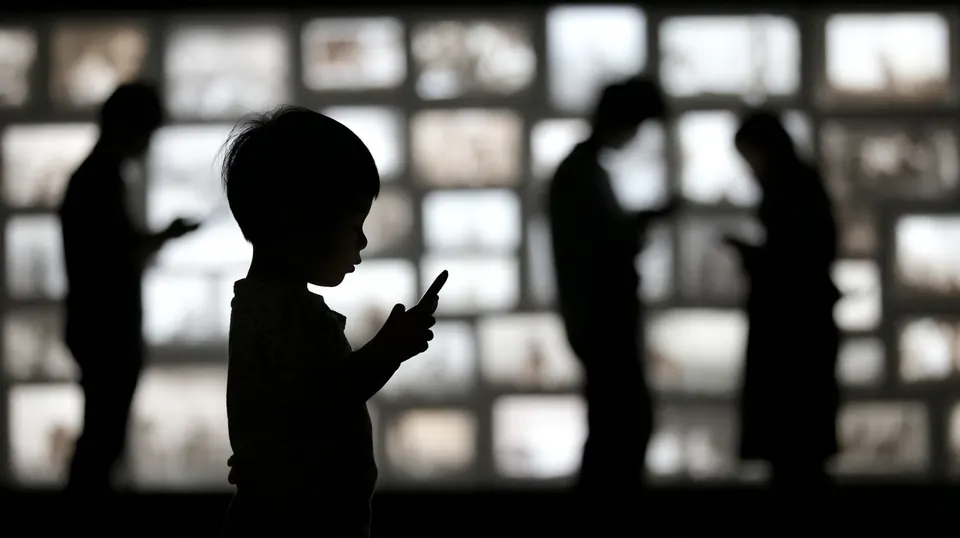
We stopped needing to remember long phone numbers and capital cities long ago. We turn on GPS even for routes we drive every day. The global machine freed us from many tasks, and we handed them over lightly, without a second thought. As a result, concentration flew away after them, along with deep attention and the ability to read long texts. Even the ability to talk to one another properly, especially when we disagree on the latest hot topic of the day.
A Distorting Mirror
They are here, after all, to help us. They spare us more and more of the hard, monotonous work and free up our time for more and more meaningful pursuits (and if we waste it scrolling, that's not their fault). Machines are the blessing of the age we live in and the greatest proof of humanity's vast potential and incredible power.
They are here because of human curiosity, too. Because of the desire of one scientist after another to try something new, to expand human knowledge. To uncover yet another small piece of nature's secrets. From the first crude abacuses, through primitive computers capable of basic calculations, to all the world's knowledge in the phone in our pocket, and an even more thrilling, impressive future.
With which the cycle may be closed once and for all. We may live out the fate of the Buendía family, who finally grasped from the ancient parchments that “everything written on them was unrepeatable since time immemorial and forever more, since races condemned to one hundred years of solitude did not have a second opportunity on earth.”
Ordinary human curiosity, the kind that makes it worth remembering the name of Madagascar's capital, but also makes you ask exactly how your town's budget for street lighting is being spent.
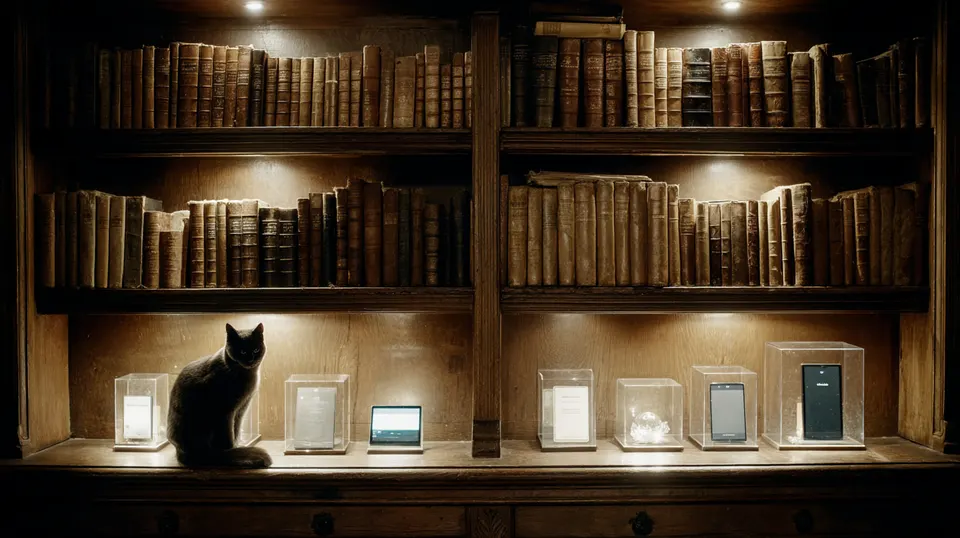
Curiosity Killed the Chat
“They say curiosity killed the cat. The good news is that cats have nine lives—and if they didn't, humanity might not have had even one. Because it is precisely thanks to human curiosity that our species has survived, evolved and come so far—from the caves to the age of space travel and advanced artificial intelligence.”
Do you like the cat metaphor? I like it a lot, and I agree with every one of these words, written by ChatGPT. And it's wonderful that we now have an algorithm that can write them. More than that, it can already produce, on its own, a long article very much like the one you are reading. For me, the problem is that the chatbot has no qualms about speaking in the first person plural on behalf of all humanity. No, the problem isn't even its naive arrogance. It's how such boundless ability really could swallow our curiosity. And with it, ourselves, spat out as hedonistic, meaningless creatures, incapable of dreaming.
I have run all sorts of experiments so that together we can look for the limits of what today's technology can do. From an entirely generated profile that reached 85,000 people online without impressing them with anything at all. To AI-“written” poems ranking among the best in two consecutive prestigious poetry competitions.
There is one more experiment, though, that I am still gathering the courage and arrogance to carry out—I have something to learn from my electronic colleague here. To publish an entirely generated article on some topic and see whether readers notice the difference.
I confess the thought that they won't frightens me. Not because of careless reading, not because of the collapse of standards for meaningful text in the modern era. But because the development of these technologies is relentless, and even if the task is beyond today's latest impressive AI model, it will be within reach of the next one.
Move 37
This is a story Yuval Harari likes to tell. You have probably heard of the game of Go. The last bastion of resistance, the contest in which technology found it hardest to beat humans. Well, almost a decade has passed since the famous match in which even that happened. The catch was that, unlike chess, in Go the moves cannot be calculated in advance; the possible developments are far too many even for powerful computers. So the machine has to learn on the fly, to react, to make sense of things, not just to check probabilities.
The undisputed champion Lee Sedol confidently predicted he would win 5–0, but he lost the very first game. That led to the second game and the notorious Move 37. Until then, the game had been going rather dully for the experts. After a series of routine exchanges, Lee felt the tension and allowed himself a short break.
In his absence, AlphaGo played move number 37.
Lee came back, looked at the board… and was left speechless. The machine had made a strange, unexpected move that looked suicidal. Or brilliant? The champion, who had played thousands of games against the very best, saw something that would never happen against a human.
After the match, a stunned Lee said that Move 37 had expanded his understanding of the game. It had made him see Go in a new light and ask himself what creativity means.
Harari calls this move a turning point in human history. I think so too, because it is the definitive answer to everyone who keeps repeating, to this day, that AI merely repeats and does not create.
There are quite a few arguments that the machine can build a curiosity of its own, whatever we choose to call it. That, however, is one more reason to guard ours stubbornly. Because only in the combination of the two could we use them creatively.
The Love of Asking
I often ask the writers who have impressed me and who visit me as guests what they would do if one day they read a text worthy of their own pen that was in fact the work of algorithms. Some reply that they would be frightened, others that they would like it, still others are completely convinced it will never be possible. But all of them boldly declare that even then they would not stop writing. For which I admire them. I don't even have that kind of courage (apparently the limit of mine lies somewhere around announcing on national television that Yavorov was from Svishtov).
I can more easily picture myself slowly but irreversibly giving up writing. Not only because even today there are far more people writing than reading. But because of the other thing, too. That knowledge, curiosity, is an inner feeling, but also a race, an urge.
We will lose this race with the machines, if not today, then tomorrow. The strict laws of mathematics show unambiguously the steely persistence of the exponential curve along which each new technology arrives.
In Our Image and Likeness
“Our curiosity is spontaneous, emotional, sometimes chaotic—it can lead us down unexpected paths, far from our original goal, but that is exactly where the most interesting insights often lie. Artificial intelligence follows a path laid out by algorithms and data, without wandering off to ‘see what's over here.’ In other words, for now curiosity remains our human privilege—the spark that sets us apart from the perfectly calculating, but not always wondering, machines.”
You guessed it: this paragraph isn't mine, which is why it's in quotation marks. And once again my colleague is rather bold to speak on behalf of a humanity it doesn't yet belong to.
But then the real battle will come. Against ourselves. Against our instincts, against our self-image as the dominant species on our planet, capable of miracles.
Yes, even today all the world's information is in our hands. The dreams of medieval scribes in the most vivid colors. This has already struck at our memory—its reach and its abilities, even our attitude toward people who know, who remember, who advance science, which always rests, once again, on knowledge and curiosity.

Curious Chatty
When that tomorrow comes, we will have a model that can answer any factual question. Whether it's a different one or the same, we will also have one that creates better than all (or at least a huge number) of the finest specialists in every reasonably common field.
We will have a model that seems curious. We will inevitably arrive at one that may have no consciousness but imitates it so perfectly that, as with the other great debates, it won't matter whether the cat is black or white, as long as it catches mice.
But will its curiosity be real? Will the machine manage to develop that inner urge to learn more, and more, and more? Especially once it has lost our help. Because we can already see how the enormous amount of generated content is making things harder for the next generations of AI. Models have less and less real data to learn from.
That is where I see our place, our salvation. With the most likely few survivors who are able to concentrate, to remember. To be curious. To dream, which is also a kind of curiosity, enriched by imagination and desire.
Will there be such people? Yes, it is still up to us. Stay curious! Please…And do you know where Yavorov was born?
This piece is part of the new issue of Perfect Day magazine.