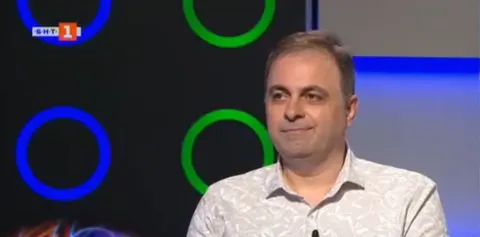
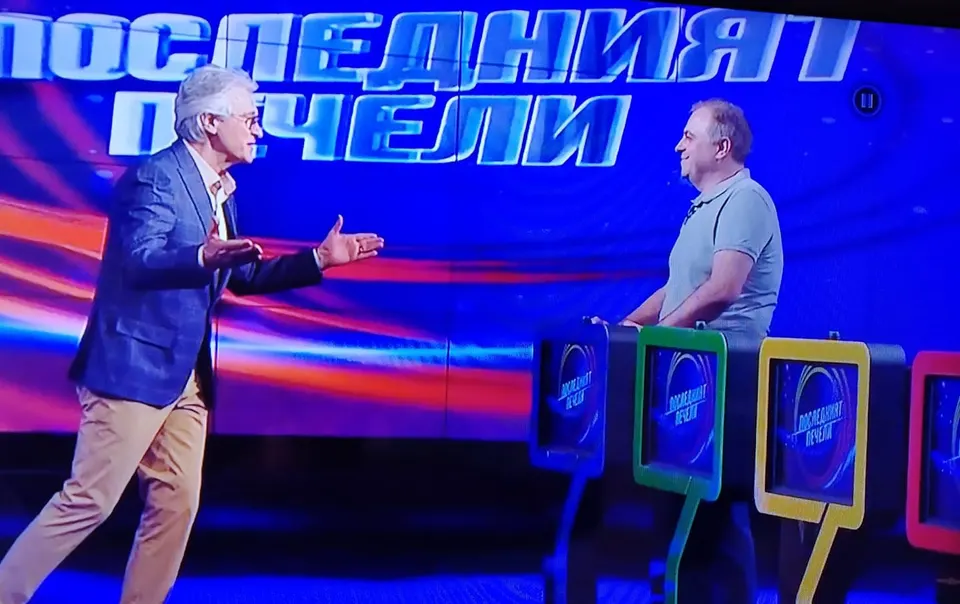
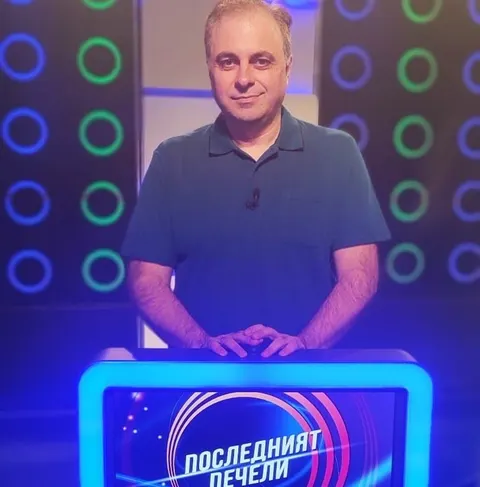
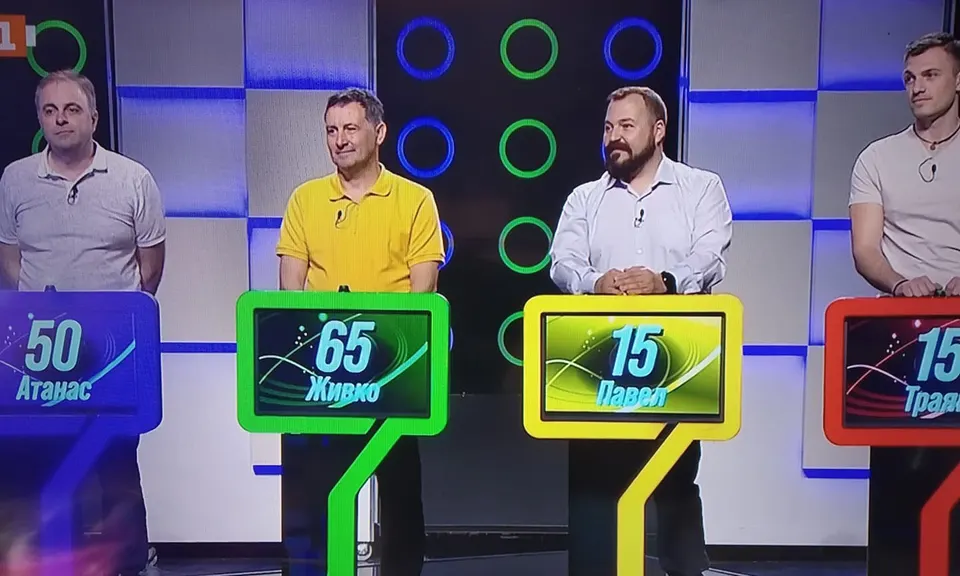
Atanas Atanasov made a long and unforgettable stay in the homes of the people who watch Posledniat pecheli (The Last One Wins), the quiz show hosted by Orlin Goranov on BNT 1, the main channel of Bulgarian National Television. He equaled the record of 18 consecutive wins and left an impressive mark with his knowledge in countless fields, with his quick mind, but also with his friendly manner. After his success, he created a Facebook page where every week he sets his visitors seven wonderfully curious logic puzzles of his own invention.
Today the internet is a machine for forgetting. Because of Google, we don’t bother to remember anything at all, and this, without exaggeration, is changing us even as a biological species.
That is why I met Nasko, as Atanas is known to his friends, to talk about the facts that are worth knowing and the challenges that are worth throwing at our brains now and then, to protect them in the bombardment of information amid a deficit of knowledge and the devaluation of general culture.
Is there such a thing as useless knowledge? What good can it do us to know the capital of CHAD? Can general culture become a value again? Here are the champion’s answers.
And at the end: a prize question awaits you that will make you think hard…
– What is the point of remembering things today, when Google knows everything? Why should we “waste our brains” on it?
– To me the point is purely human—not to lose the human in ourselves, after all. We were made as thinking people, not as robots that look everything up. We should use these biological gifts, the capacity of our brains.
– But then perhaps the capacity that is “freed up” from “useless” knowledge can go toward something else?
– Is there such a thing as useless knowledge? I don’t think so.
– Honestly, I think so too. What motivates you personally to learn more and more facts?
– I find it interesting. My brain is wired in such a way that it manages to “take things in” without my wanting it to. It happens on its own, but that’s just me. People need to see that there is something interesting, that knowledge isn’t pointless, that every single thing matters.
After all, we are part of this world and we ought to know it.
If you live on a street, you know its quirks—where there’s a turning lane, a parking spot, a garage. And living in a big world with a population of billions, it can only do us good to know it, to take an interest in what happens in it, in how things are put together.
It makes your existence a lot easier to know where you can stop, where not to stop and where there’s a pothole. In the same way, it makes your existence in the world easier if you know what an island is, which song was more popular than another at a given moment, which novel was written out of some torment of the soul, interesting things like that…
– My argument is that only the accumulation of facts makes a person creative. You can be creative if you connect seemingly unnecessary pieces of knowledge from different fields that have nothing in common.
– Yes, I agree, although I think creativity is also innate to some degree. But yes, you’re right—the more things you know and keep inside you, the more creative you could be.
– Has there been a time in your life when some such seemingly useless piece of knowledge turned out to be useful?
– The Last One Wins comes to mind immediately, but there, thousands of useless things came in handy. And that appearance is now, little by little, beginning to change who I am and everything that lies ahead for me from here on.

– In what way?
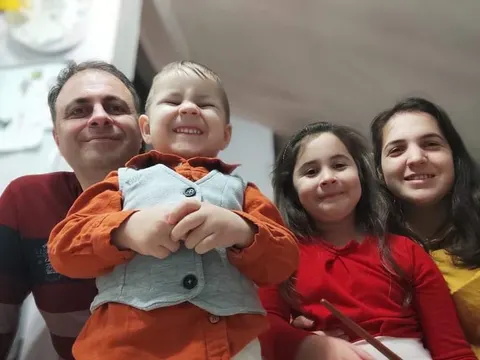
– By the way, when you were on the show, you were the favorite of my wife, the kids and me, and I don’t know why, but when you were knocked out we even stopped watching the show for a while.
Maybe you felt it yourself when you were on it: you gain a certain popularity, even if among a rather particular circle of people. I became recognizable in the shop, people stopped me in the street to take pictures with me, which was something new to me, and I was invited onto BNT’s morning show and the news.
Now I’m launching a few things I had been preparing, and they’ll get a push from that popularity.
– Thank you from the bottom of my heart for the kind words! Your puzzle page is extremely interesting, and I understand you’ll soon publish a book as well. What drew you to this kind of question? You became popular for knowing a huge number of facts, and then you started setting puzzles that are somehow on the other side of knowledge…
– For quite a few years now I’ve been writing questions for pub quizzes. I find it interesting; I’ve long been a “question writer,” I hunt for them and make them up myself. They’re the kind that provoke logical thinking but don’t require you to know any serious body of facts, or to be a member of Mensa with an IQ of 230. Yes, they’re connected with knowledge from life, but they don’t let you simply go into Google and solve them that easily.
They make you think for yourself, start digging through your own brain, ask yourself questions.
I already have more than 2,000 of them, I consider them very interesting, and I decided to try and see whether there’s an audience for them. I use Facebook, since that’s the social network I have the most contact with. I turned them into a weekly game, and the people taking part are by now not few at all, and I think there will be even more once the holiday season is over. The puzzles are gaining popularity, and that will help the future book too.
– Creating questions is hard work. I’ve been going to quizzes for 20 years myself, and it’s a great pleasure to come across a well-made question that you can solve without knowing the answer.
– Those are exactly the ones I love too. The ones that let you think, and when you see the answer, you slap your forehead and say: “Oh, how did I not get that!” And if you do get it, the feeling is super cool, pure adrenaline.
A person has to overcome mental difficulties.
Today, when you search for something on Google and don’t find it, you say to yourself: “Hey, this is super hard, I won’t bother with it.” But it ought to be exactly the opposite: “Come on, let’s see now how we can do it.”
– And how do you cultivate that kind of interest in knowledge in your own children?
– It comes on its own, from everyday life. They see their dad sitting down, writing questions, doing mental stuff, talking with mom, setting each other puzzles. We watch The Last One Wins together—they’re big fans, and since they often hear “pass” on the show, that’s what they call it: “We’re watching Pass.” Afterward they want me to make them a “kids’ Pass” too. Children imitate what they see their parents do; they copy. We constantly play question games about cartoons, colors, sounds. That’s it. If a child sees a parent who sings for pleasure every day, or plays chess, or raises their voice and swears when upset, the child will strive to do the same.
An interest in knowledge is sparked in the family. By the things you talk about, by example.
– But after that it depends on society too, and today knowledge and general culture aren’t valued.
– It seems to me that for children they are still a value. Children are curious. After that it’s up to the parent—it depends on them whether these remain a value or everything fades into sameness.
– Daniela Simidchieva, known as the woman with the highest IQ on Earth, told me that this always held her back, because it provoked envy, and on the other hand remembering everything came too easily to her and that stunted her development. Was it like that for you?
– At school I was the same. Back then, after the teachers had quizzed us, they would present the new lesson. I memorized it right there in class, I never had to study anything at home, and nobody believed me; they called me names of the era—“swot.” My grades were high, I went on an exchange trip to Hungary for top students, I got watches as prizes. But other people saw me more as some strange type than as someone to respect. Now most of the people I spend time with through the quizzes are educated, thoughtful people and respect me a lot, so again it depends on the company you keep.
– What is your personal recipe for sifting information? Because we’re all bombarded from every direction…
– I treat as important the information I hear or see from several different reliable places. I try not to put much faith in random Facebook posts or sites of unproven origin. When the information is repeated by appropriate sources, that’s when I judge it to be important. During the pandemic, for example, all sorts of theories and conspiracies were pouring out, but I think I managed to find my way.

– The pandemic, however, hit your profession—tourism—hard. Do you think things there will soon return to normal?
– When I started studying tourism, it was a super prestigious sector; then I worked as a hotel manager for 20 years at various four-star hotels. Now it’s become exactly the opposite. Even before the pandemic brought it crashing down, tourism had become super unattractive from the point of view of the people who work in it—the lowest incomes are precisely in that sector. Things turned upside down over 25 years, and when the pandemic came, the industry’s other attraction collapsed too, since foreign visits stopped.
For me there is a way out, but the mentality of the owners of tourist businesses and of those who manage tourism as an economic sector has to change in favor of the end users, the tourists. If that happens, tourism has the potential, as it does in Greece and Turkey, to pull us forward.
– Have you ever regretted choosing this profession?
– Yes,
I have regretted it, when I see, for example, the successes of IT specialists.
As a kid I competed in the informatics olympiads. Back then we had Pravets computers—the Bulgarian-made machines of the 1980s—with two or three programming languages, one of which was BASIC. We programmed, sixth graders at the time; I had made it to the national olympiad, I found it really interesting, and I could have developed in that field. But back then tourism was more prestigious, and I decided that was what I would choose. There have been many moments when I regretted it, but apparently that’s how it was meant to be.
– It’s never too late to change direction.
– That’s how I decided, although I could have switched. I judged that at this age—I’m past 45—it would be rather mentally demanding, it would take a lot of psychological energy, it would be a strain on the eyes and the brain if I started learning programming from scratch. So I leaned toward other pursuits that are connected with knowledge.
– What do you dream of?
– That my family is happy and we have no worries. But that’s very unattainable at this stage. We love to travel, but that comes down to finances; the freedom to have your own time is tied to financial freedom, so these dreams are attainable, but further down the road.
– Finally, would you like to set the readers of Digital Stories two puzzles to get their minds moving?
– Of course, it will be my pleasure!
1. In a lecture, an experienced hacker revealed that he recommends to every novice hacker a list of famous literary works from which to “learn useful subtleties” of the hacking trade. In which work, according to him, could hacking novices “learn” the most about breaking into sites using someone else’s username and password?
2. A promotional poster, specially designed in the 1980s for a large company, depicts an eye, a bee and a letter. Which letter is it?
Dear readers, send your answer to at least one of the two puzzles to [email protected] or to the Digital Stories Facebook profile by September 5, and you’ll have a chance to receive a gift—a Digital Stories T-shirt!
Updated: The draw awarded the prize to Gergana Georgieva.