Updated on November 12, 2026. This article came out in May 2025, when Jensen Huang was at the top. A year and a half later, on November 11, 2026, he resigned as chief executive officer of NVIDIA. What happened in between, you can read in the new chapters at the end.
He is one of the great stars of our day. Over thirty years of stubborn persistence, he built the company that became the most highly valued of all time. When the moment comes to unveil the next innovative chip, he turns into a marketing icon.
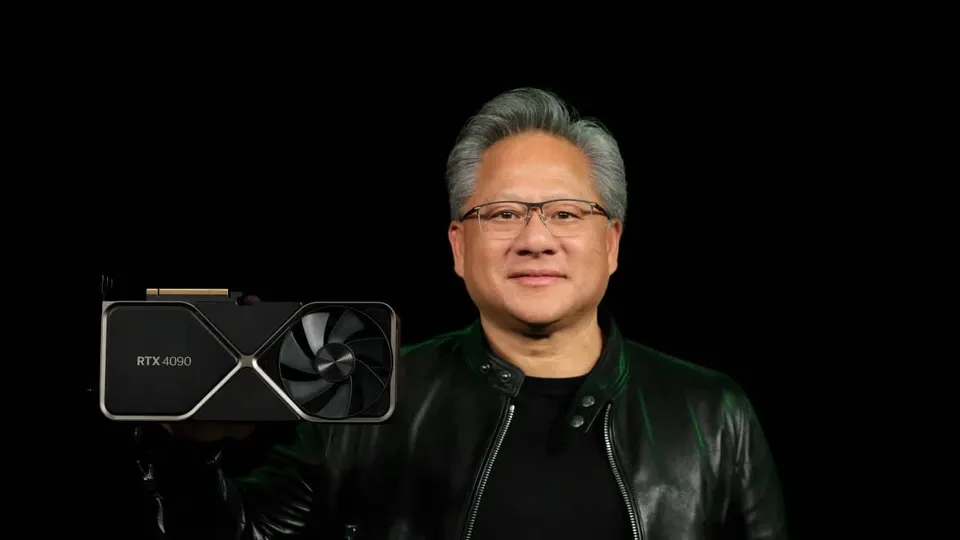
Jensen Huang grabs the leather jacket, steps into the spotlight where he feels right at home, and the show begins.
The wisdom of the East meets the polish of the West. One of the richest Americans, and the only one on the list born in China (…in a manner of speaking). His story arrives to show that strong personalities still matter today. It is worth walking his fascinating path together, and hearing his vision of the future we are all going to live in.
Dishes of All Kinds
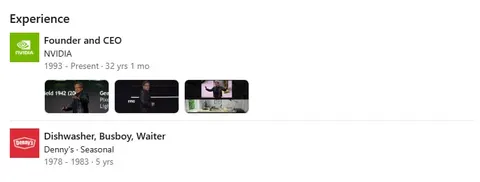
“1978–1983: dishwasher, busboy and waiter”
“1993 to present: founder and CEO of NVIDIA”
That is how our hero's résumé reads if you decide to look up his profile on the “professional Facebook”—LinkedIn. If you have never wandered into that social network, it is most often the place where people in tech raise the stakes, presenting themselves in the best possible light to impress their potential next employers. It is also the platform where, now and then, deeper and more meaningful conversations manage to happen, quite often with the people who actually make the decisions.
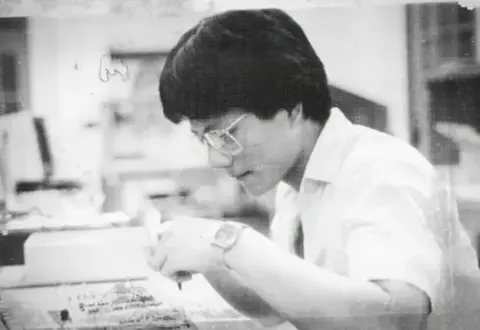
And yet Jensen Huang washed dishes until ’83, then did nothing for ten years. Shortly before Bulgaria's legendary run to fourth place at the 1994 World Cup in the USA, he founded a company that a good many people only heard of in recent years, with the boom of artificial intelligence. How is that possible?!
This Year, Wires
Let me hurry to tell you: it isn't true.
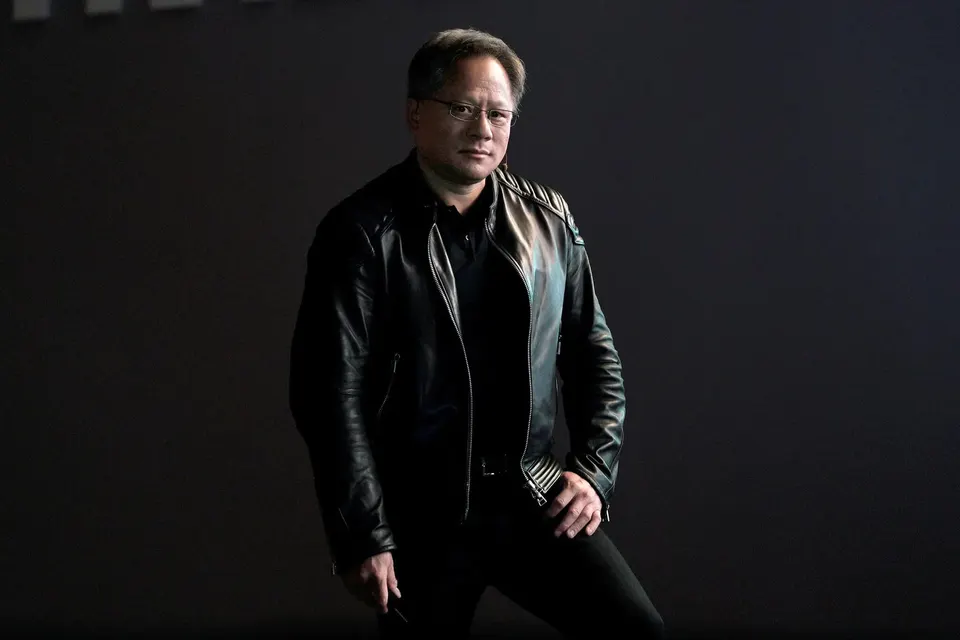
In the hiatus, the gap between the two jobs, he was preparing for everything that came next. Still, Jensen definitely has a taste for presentation. At least in my modest bubble, he is the first universally acknowledged master since the days when Steve Jobs showed off the next technological marvels. He made the leather jacket his signature, grew used to the spotlight and to great expectations.
At the epicenter of the explosion in artificial intelligence stood the companies developing one impressive model after another, led by OpenAI. But so did those on whose shoulders that enormous progress rests. Because the work of machine learning researchers moved forward generation after generation, while the technological limits often came from the capabilities of the hardware.
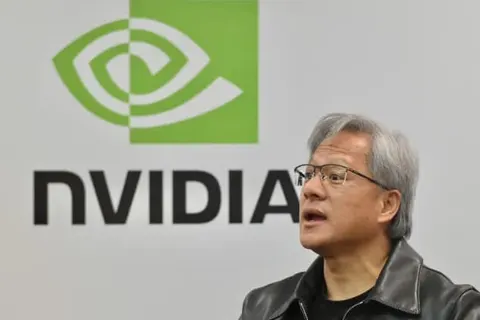
And then came NVIDIA. A company founded decades earlier to make chips for playing realistic computer games. Suddenly it turned out to be the master of the most important ingredients, the ones capable of powering the next generations of AI models.
Chip ’n Dale
Just how drastic was this change? NVIDIA became not merely the most expensive company in the world by share price. It became the most valuable company that has ever existed. Then it broke another record—for the steepest drop in market value. That happened on the day the new Chinese AI model from the company DeepSeek took the stage, showing that perhaps we are not quite so dependent on the most expensive chips to take the next big steps in AI.
Suffice it to add that until then, the only companies ever valued at 3 trillion (3,000,000,000,000!) dollars had been Apple and Microsoft.
And on that list… why is the name so unpronounceable? It comes from invidia, the Latin word for “envy,” and NV, “next vision.” “Next vision” was a term the company used early on to label its files. Geeky little jokes that went on to become one of the most popular trademarks around.
The markets have gone mad, humanity has lost its mind, you might say. But there is a reason. If we add a few more concrete numbers: NVIDIA's revenue for fiscal 2015 was $4.7 billion. For fiscal 2025 (at NVIDIA it ends in late January) it was $130.5 billion. In other words, today the company sells in less than two weeks as much as it sold in a whole year a decade ago!
黃仁勳
No, I am not cursing at you above; that is our hero's name according to his first documents. Huang Jen-hsun was born in 1963 in the Republic of China. What is that, you may ask—hasn't China been a people's republic for quite a while? Exactly: this is the official name adopted by the island of Taiwan, home to Mr. Huang's hometown, Tainan.
Life, however, quickly carried him to the other side of the Pacific, where Jen-hsun officially changed his name, and so Jensen Huang was “born.” Today his personal fortune is estimated at around $120 billion, which puts him very close to the top ten richest people in the world. He owns about 3.4 percent of the company that is the newest unavoidable force in the world of technology (and in the rest of the world, which lately is ever more tightly bound to it).
But how does this happen to a man who writes that until the age of thirty his experience was as a “dishwasher, busboy and waiter”?! The American dream in action, pure luck? Or a combination of enterprise, persistence, sound decisions… and the right moment, when artificial intelligence became the world's number one topic and it turned out that its progress rests to a great extent on the very company Jensen created.
Kung Fu Panda
His father, Huang Hsing-tai, was a chemical engineer, and his mother, Lo Tsai-hsiu, a primary school teacher. When he was six, the family moved to Thailand, to the capital, Bangkok. His parents, however, were looking east (yes, when you keep going east, even the West becomes the East). His father went to New York for training, liked it and decided the future lay there. First he sent nine-year-old Jensen and his brother, a year older, to their uncle. The uncle lived in Tacoma, Washington, but the boys soon ended up in an even smaller, more provincial place—the little town of Oneida, Kentucky, where the children faced serious hardship.
An unfortunate mistake occurred. The uncle and aunt had read somewhere that they were choosing a prestigious school… and it turned out to be a boarding school for troubled kids. Jensen had to clean the toilets every day, while his brother worked on a tobacco farm. In a town with few immigrants, the boys were bullied by their classmates, who not only insulted them but threatened them with knives. Years later Jensen would say he remembers his time there fondly. In 2019 he and his wife donated $2 million to the school, the Oneida Baptist Institute, and it named a new building after him.
A few years later the family was reunited in Oregon. Hooked on computers since childhood, Jensen enrolled at the state university, where he studied computer science and integrated circuit design. So maybe his experience before thirty wasn't only about serving tables and deliveries?
Jokes aside—his own joke, that is—he began his career in that notorious year 1984 as a chip designer at AMD. The company, whose abbreviation stands for “Advanced Micro Devices,” would for many years be closely tied to the great chip war with Jensen's future “offspring,” the two sharing an intertwined history worthy of a Taiwanese version of The Bold and the Beautiful.
His next employer was LSI Corporation, where he led the development of advanced chips. Meanwhile he didn't abandon his education—by 1992 he held a master's degree in electrical engineering from Stanford.
Seeing Green
The fairy tale of his success, as we have seen, begins a year later. “In 1993, I founded NVIDIA with Chris Malachowsky and Curtis Priem to solve the problem of 3D graphics for personal computers,” Jensen writes modestly and laconically in his LinkedIn profile. “Our pioneering work in accelerated computing led to the redefinition of modern computer graphics and the creation of modern artificial intelligence.”
Is that so? It is. Every strong story can be told in two sentences, but in most cases it loses something in the process.
Today NVIDIA employs 32,000 people. “And we are looking for talented, driven, adventurous people ready to take on challenges no one else can solve. NVIDIA employees create technologies that move all of humanity forward and support the communities where they work and live.”
Jensen Huang and company certainly don't owe their success to chance. They owe it to professionalism and innovation, because throughout these three decades of computer development they have been paving the way for the next technologies.
Both Micro and Soft
Software is a wonderful direction to grow in—ask Bill Gates. Software also carries a huge part of today's Bulgarian IT sector, which keeps being attractive and keeps growing even now, when AI is throwing serious challenges at it. Hardware, over the past decades, definitely stayed in its shadow. Technology advances, computers get better and faster; you may remember the times when a few megabytes were the very limit of storage. Then cloud services arrived, and hardware—the computers themselves with all their components—became an important but banal topic; the next solutions simply kept appearing.
And then came ChatGPT, and the world turned its gaze to artificial intelligence. Each new model keeps impressing with yet another big success, with the new capabilities it gives us (which I often show on this site). Suddenly it turned out that the “machine” itself was crucial again. That hardware progress is undeniable, but there is one particular detail that matters especially in the age of artificial intelligence. Yet what does AI have to do with a company built to do its best at showing ever more perfect 3D graphics, ever more realistic virtual reality…?
The processor is the heart of your computer. It processes data, distributes it, “runs” the code. With the rise of machine learning, which even scientists long refused to call “artificial intelligence,” things changed. Graphics processors, the chips whose only role until then had been to display things, took center stage. They are made mostly by two large companies, and they turned out to be an extremely valuable resource. It became clear that they have no rival when parallel computation is needed—which is exactly how today's machine learning algorithms work.
The Gamers' Game
No one could have foreseen anything like this back in ’93, so distant in technological time. Yes, by then computers had developed and made it into homes. But even the mass internet was still a distant illusion, and one of the undisputed uses of the time was games. A serious race was taking shape in graphics processors, and NVIDIA entered it with a flying start. Jensen launched the venture with two friends of his, who gradually faded into the shadow of media attention. The starting capital was a modest $40,000, but investors were found relatively quickly. Developing chips is certainly a costlier undertaking than software; it can't happen without serious money.
It is also harder. The company's first chip flopped. Then, in 1997, came the second—the RIVA 128—and became a market hit. Soon after, the GeForce 256 established Huang's firm as the industry leader.
The battle unfolded in a particularly interesting way. In 1996 more than thirty companies were racing to offer new graphics cards, while five years later only two had survived—NVIDIA and the Canadian ATI. A little later the rival was sold to AMD, and so we arrive at 2018, when our hero's company held three quarters of the graphics processor market against one quarter for the other giant, with almost no one else in the game.
I mentioned the curious connection between the two mammoths of the field. Great battle, free competition! You may have heard the story of the Dassler brothers, who founded the sports giants Adidas and Puma. Well, a similar plot is playing out in the age of advanced graphics chips. Since 2014 AMD has been run by Lisa Su, a distant relative of Jensen's (her maternal grandfather is the brother of Huang's mother).

Programs, and More Programs!
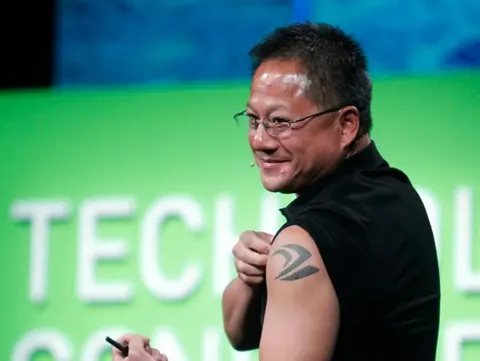
NVIDIA went public in 1999. When its share price reached $100, Jensen had the company logo tattooed on his left shoulder. He says he is unlikely ever to get a second tattoo. If he has broken that promise, there is no way for us to know, because you will hardly ever see him at a public event without his trademark leather jacket.
Pavel Durov's children number 106, Elon Musk's 14 (so far). Compared with them, Jensen is terribly boring. He met his wife, Lori Mills, while teaching her at university. They have a son and a daughter with the typically Taiwanese names Spencer and Madison. For a long time Spencer made his living from a bar he opened in his father's homeland. Then he decided he had mixed enough cocktails and started working as a product manager at NVIDIA. Madison ran a hotel for years before she too joined the ranks of the family company.
Jensen and his family give substantial sums to charity and work with the Bill & Melinda Gates Foundation. The Huang family has set aside a whole billion dollars to support students in California.
He was absent from the new American president's inauguration, unlike the familiar faces of the software world. He was even asked about it, and he said he had been busy traveling to celebrate the Lunar New Year with his colleagues. But by all appearances, a great deal will yet depend on him and his company.

Geppetto
“I think there are three conditions for people to be able to do their life's work,” Jensen reveals his creed. “Give them access to information. I don't make decisions that only one person needs to hear. I prefer an environment where a team of different experts can work on a problem. Reason through problems publicly. It is incredibly empowering to take an abstract idea and argue it down to exactly what we should or shouldn't do. A whole company. I try to encourage experts and contributors at every level of the company to work on a problem at the same time.”
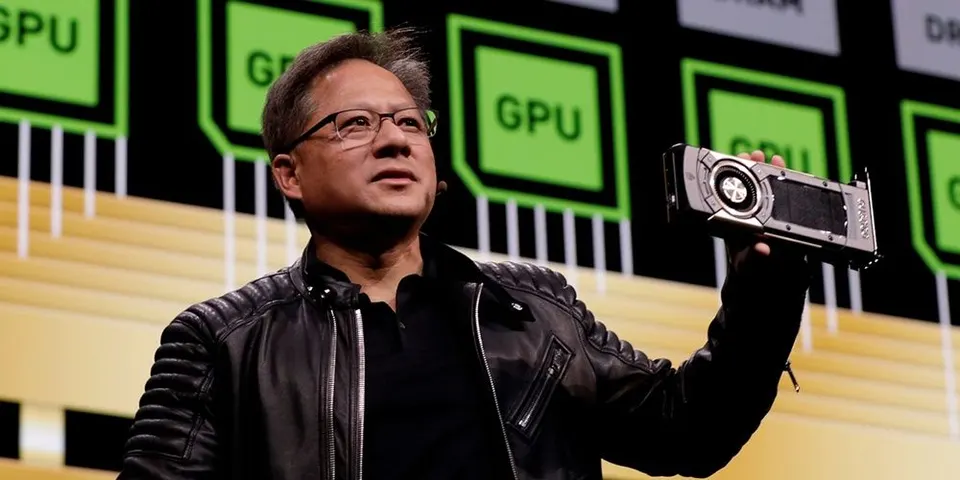
He draws every eye each time he appears at a company event to unveil the next revolutionary chip, capable of far greater computing power. And then, unlike so many promises in Silicon Valley, it turns out the promise was kept—the new generation of chips really can do everything our hero said it would.
So successful, and yet part of… the biggest “deflation” in stock market history? Yes, when the Chinese startup DeepSeek presented its revolutionary model, NVIDIA's shares collapsed at a remarkable pace. In a single day, Huang himself lost a virtual but still quite remarkable $20 billion!
Still, this battle has barely begun. And whatever its future looks like, Jensen Huang will surely be an important part of it. That is why it is worth hearing a bit more of his views on all the big questions of tomorrow.
Words Break No Bones
“The last ten years were really about the science of artificial intelligence,” says NVIDIA's founder. “In the next ten years we will have a lot of AI science, but it will be directed at its application—the fundamental versus the applied. AI will become pervasive and will make its way into almost every industry.”
For better or worse, he seems to be right. His advice to future generations is simple: “Learn to use the technology in its various forms. If I were a student today, the first thing I would do is learn AI. Get used to interacting with ChatGPT, with Gemini Pro, with Grok. Learning to work with AI is no different from being really good at asking questions.”
“If I gave a computer to someone who had never seen anything like it, there's no chance they would learn to use it in a day. Whereas today you can simply type: ‘I don't know how to use ChatGPT, tell me,’ and it will come back to you with examples. The incredible thing about AI is that it will help you and make you superhuman along the way.”
Huang also says that in ten years “everything that moves will be robotic, every car will be robotic. Humanoid robots, the technology needed to make them happen, is very close, just around the corner.”
Huangmania
“I think my work-life balance is excellent. I work from the moment I wake up until the moment I go to bed, seven days a week. When I'm not working, I'm thinking about work,” Jensen boasts. It doesn't sound very healthy.
They also call him “the Taylor Swift of tech.” How apt the comparison is I will ask Ms. Swift's fans to tell me—I will be glad if some of them have read this far.
One of the company's recent conferences was held at the stadium in San Jose. Highly unusual and ambitious for the computer world. “I'm an engineer, not a singer. When I walked out there… everyone went crazy, it took my breath away. I was more scared than I've ever been. I'm still scared,” he says.
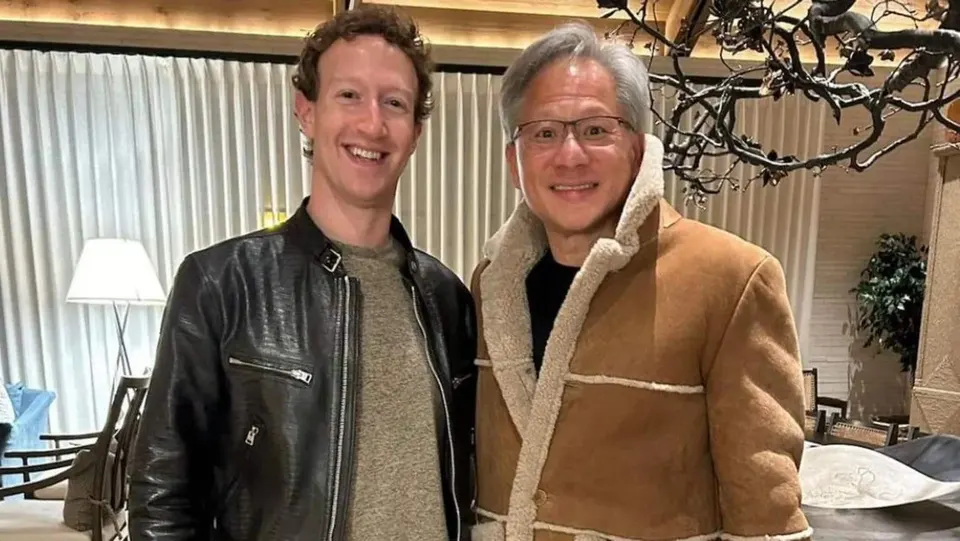
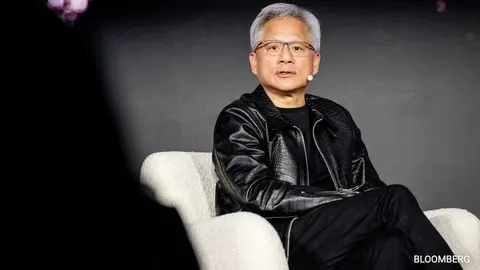
Mr. Huang's presentations are, as a rule, meaningful, polished and engaging. And always with his trademark—the leather jacket, which seems to have gone out of fashion so long ago. “Leather jackets can be a sign of an edge: a willingness to break the rules, to do things differently and to challenge the status quo,” says fashion stylist Sera Murphy. “Jensen's signature style gives him a relaxed, approachable energy.”
Definitely. Interesting, strong personalities still exist—those who not only sketch the future but also stir us.
But where will the New Age biker from the Republic of China take us on his motorcycle? The most interesting part is surely yet to come. In the world of technology, and in the world of interesting stories. Of the personalities who paint tomorrow. Bon voyage, 先生 Jensen!
That is what I wrote in May 2025. The most interesting part was indeed yet to come. Only rather unexpectedly.
Chicken and Beer
For the next year and a half the fairy tale went on, just with more zeros. In July 2025 NVIDIA became the first company in history valued at $4 trillion. On October 29, the first at $5 trillion. In the spring of 2026 its value approached $5.5 trillion, and in October Jensen's personal fortune passed $200 billion. According to Forbes, he is now the seventh richest person on the planet.
The day after the fifth trillion, Jensen was in Seoul. In the evening he didn't go to a luxury restaurant but to a neighborhood fried chicken joint he had picked himself. Waiting for him there were Samsung chairman Lee Jae-yong and Hyundai chief Chung Eui-sun, to share chimaek, as Koreans call chicken with beer. The next day, shares of Korean fried chicken chains jumped.
At the end of the year TIME magazine named the architects of artificial intelligence its Person of the Year. Among them are Sam Altman, Mark Zuckerberg, Elon Musk and Lisa Su, but at the center of the story stands Jensen. In March 2026, on the stage in San Jose, he showed the next generation of chips, Vera Rubin, and announced that he expected at least a trillion dollars in revenue from his chips for 2025–2027.
The Dark Side of the East
On October 29, 2026, the New York Times published a story nobody at NVIDIA wanted to read. American agencies had for over a year been investigating the Singapore company Megaspeed. According to the paper, it had bought $4.8 billion worth of NVIDIA chips in two years and was renting out computing power to Chinese giants such as Alibaba. The suspicion is that this way chips banned for China were reaching it after all. The story also featured the name of Alice Huang, a former executive at Megaspeed, along with the claim that she and Jensen are close. “Jensen's meetings with Ms. Huang are nothing unusual or unexpected,” NVIDIA replied.
It soon emerged that American officials had also prepared a classified memo. According to it, Alice Huang works for China's Ministry of State Security. Beijing denies it. The chairs of three congressional committees demanded a closed-door briefing from Jensen. On November 8 he sent a letter to his employees and also published it as a press release. “I was unfaithful to my wife,” it says. No names, no details, with an apology to his family, colleagues, partners and shareholders. The board launched an independent investigation.
That same evening Donald Trump said Jensen was “a decent guy, but you never know what's going on,” and that in his view he should stay at the helm. The board thought otherwise. On November 11 it accepted his resignation, and Jensen also left the board itself. The interim chief executive is the chief financial officer, Colette Kress. For the first time in its history the company also has a chairman of the board, Harvey Jones, who has sat on it since 1993. The next day the shares fell by more than 10 percent.
The Jacket on the Hanger
How time flies. A year and a half ago I called him terribly boring compared with Pavel Durov and Elon Musk. And he himself used to say that he doesn't make decisions only one person needs to hear.
The story isn't over. The board's investigation continues, Congress wants answers, and NVIDIA is looking for a new boss for the first time since it has existed. Jensen remains one of its largest shareholders. Whatever the coming weeks reveal, thirty-three years in which one man and one company were almost one and the same have come to an end.
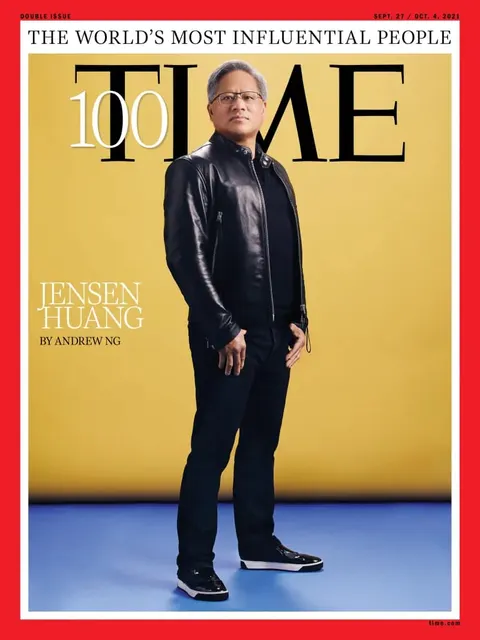
It all began at a Denny's, where as a teenager he washed dishes. It continued in a booth at another Denny's in San Jose, where in 1993 the three founders decided to make graphics chips. It went all the way to $5 trillion and the cover of TIME. Now the leather jacket hangs on the hanger. Will the wizard put it on again?