What happens when 1,000 volunteers, most of them from the world of information technology, roll up their sleeves to build something that could change our society?
I’ll let you in on it: the result of this experiment is positive, and it lays the foundations of a platform that can literally save lives. This digital story is meaningful, and it shows that when different people join forces, backed by a dose of typical Bulgarian stubbornness, they can work real miracles.
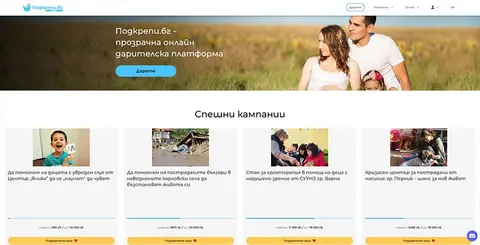
Podkrepi.bg—podkrepi means “support” in Bulgarian—is a platform that went live only recently. It raises money for worthy causes of every kind, and it takes no commission. The money is channeled honestly and transparently, and that is guaranteed not only by the open face of the whole idea but also by the well-known guarantors who stand behind every cause.
The platform was built through the hard work of volunteers, but it is also turning into a social experiment of sorts. It grew out of a good idea that sprouted online and refused to die, despite the countless obstacles it met along the way. And it still promises bigger news to come…

If next to every good programmer…
…there stands at least one more, they will surely find something to quarrel about, and if a third one shows up, the first two will come up with some especially rude meme to mock him with for months. At least that is how you might imagine relations in the guild work if you wander into the community’s most popular Facebook group—DevBG.
And yet it was right there, almost two years ago, that a post appeared which started this story.
October 2020: on national television it becomes mercilessly clear that HelpKarma, one of the most popular donation platforms, has been grossly misusing the money it collects. A huge share of it has gone into the pockets of its founders, which taints the whole venture and threatens to stain the entire ecosystem of giving.
And that can be a matter of life and death, especially in our country, where institutions clearly don’t work the way they should and, very often, a person or a group of people need help simply to survive.
Many calls follow for a new place that would restore trust in giving. In DevBG, the group’s administrators post an appeal for anyone willing to join the discussions. To get to work, as volunteers, building a new platform and promoting it. To let people who set money aside for good causes know that their donations go where they are meant to.
The road to hell…
…is paved with badly written code. And good ideas easily fall victim to their collision with reality.
Fortunately, and unexpectedly for many of us, Podkrepi.bg is already accepting donations for its first causes today. The venture has taken its critical first steps and shown that it is possible. That a platform of this scale can be built on a voluntary basis by a group of people from different professions, united by a cause.
At the start, in just a few months, no fewer than 1,000 volunteers signed up, says Georgi Ivanov. He is an entrepreneur and a marketing and HR specialist, with serious experience in large software projects and in communication within the popular programmers’ group. He has been part of the core from the very beginning, one of the people who never gave up—and, as he is keen to point out, there are quite a few of them. (You can read about everyone who contributed significantly to the venture here.)
So people responded quickly, and from a remarkably wide range of professions. The sign-up form asked them to list their skills in detail so the organization could run as smoothly as possible. Programmers signed up—specialists in all sorts of technologies—along with people experienced in marketing, designers, managers, financiers, lawyers, doctors…
Which, on the one hand, is wonderful: a system like this certainly needs the work of every one of those professions. But most of them have little room to contribute until at least a first version of the product exists, until the people who build the software platform itself have done their job. Yes, the programmers…

2 + 2…
…sometimes equals far more than the usual answer. The way this story unfolded proves it. But not at its beginning, when the sum of the work of the supposed 1,000 professionals who had signed up and agreed to help was approaching zero.
“We didn’t realize what we were up against,” Georgi admits today. “When we saw how many people had signed up, we decided that was more than enough. We didn’t realize that half of them had roles that wouldn’t have any work for at least a year. The others were real beginners who couldn’t be useful without a core of experienced specialists. And to top it off, a battle broke out over which technologies to use.”
The first difficulties came when the technologies for building the platform had to be chosen. As someone who earns his living in exactly this field, I can tell you that today there are countless technical solutions that have to fit together like a puzzle to build such a multilayered project. And the trouble often lies in the fact that programmers specialize in one technology and can’t be particularly useful outside it.
At first the team decided to look for an unconventional answer to this first big problem: a modular system that would use different programming languages and technologies, so that each volunteer programmer could contribute with whatever he or she knew.
It quickly became clear, though, that the idea couldn’t work and was only paving the way for even greater chaos. So the team settled on using the tools already familiar to as large a part of the team and the registered volunteers as possible.
“We thought there were more than enough people willing to help. But most volunteers showed up once, did one or two small things and vanished. We were probably part of the reason—at the start there was serious chaos that we didn’t manage to sort out fast enough. But none of us had any experience working with such a large team of people who had never met in person and were working remotely. Besides, most of the active volunteers could spare two or three hours a week, and it turned out that 15 to 20 of them got about as much done as one full-time person,” Georgi says.
“Out of those roughly 1,000 who signed up, a core of 10 to 15 people eventually formed, plus another 20 to 30 who took an active part at different times. People watching from the sidelines wondered, ‘What are these guys dawdling around for so long?’ without realizing the nature of volunteer work, or that it’s not just a matter of coding a platform—you have to build a whole organization to maintain it, develop it and expand it.”

Iliya built himself a hut…
…and we all know how that turned out, as the old Bulgarian saying about best-laid plans goes, but it must have been easier for him, since he took on the hard job alone. It turns out that keeping enthusiasm alive is much harder than giving birth to it.
“It’s hard, because you can’t hold anyone accountable for volunteer work. Obviously it isn’t people’s first priority. You have a family, a job, and the moment a real problem comes up there, of course you’ll turn to it at the expense of the volunteer project,” Georgi reflects.
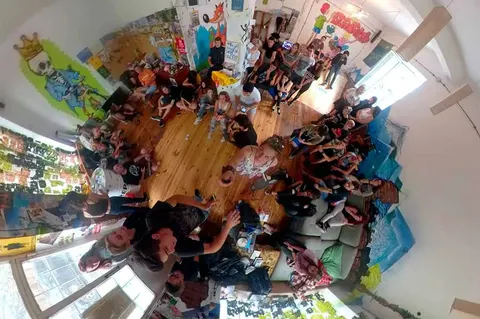
The team holds online meetings every Wednesday at 7 p.m., discusses how things are going and makes decisions. There are hard stretches when only a few are left “pulling” the thing forward while the rest are swept up in the daily grind. At some points only three or four of the 1,000 volunteers take part. On top of that, all of this happens against the backdrop of the pandemic; the team has met in person only twice.
But what matters is that the spring never runs dry, not in the December holidays nor in the timeless lull of summer. There is always someone to carry the work on, even when the others are squeezed by circumstances. “There were a few people who simply wouldn’t let the energy die. And whenever they sensed that work was pressing on someone, another person would step in right away. We have no leader, we’re all equal, and the credit is shared equally,” Georgi says.
The situation became critical in January, when the venture fell seriously behind schedule. That was when SoftUni, a large Bulgarian software academy, came in as a partner, connecting the team with 12 hand-picked graduates who both learned in a real environment and, through their hard work, helped make things happen. Thanks to the experience they gained, almost all of these interns had found jobs within just two months.
If you’re afraid of bears…
…you don’t go into the software business, to bend the Bulgarian proverb about staying out of the woods. And if you’re afraid of hate, you don’t post in the DevBG forum (I am, I confess).
The people behind this platform, however, are not. And so, little by little, things got going. In each area a core of sufficiently experienced specialists emerged to bring order. Many of them are company founders who can afford a bit more flexibility in their working hours and have seen enough to know what needs to be done.
The software side of the project is open source, and anyone can join in. To the team’s surprise, even two Indians and a Japanese developer contributed lines of code. And one of the modules is entirely the work of… a 12-year-old programmer, a student at SoftUni!
So today the other volunteer professionals are also bringing their experience to bear. The platform is raising donations for its first five causes. And here comes the next big step: selecting the campaigns that will receive support.
To earn more trust—on top of all activities being tracked and documented in detail, with full accountability—the Podkrepi.bg team meets every organizer in person and, when needed, visits on site. Various expert councils, medical and technical among them, are being formed right now, and a new feature is that every campaign has guarantors.
On the one hand, these are people who have already worked with the organizers and want to back them; on the other, they are sometimes celebrities who can help with their popularity. Among the first on the list are the singer Grafa, the rapper Ustata and “the Superhuman” Georgi Nenov (you’ll find the campaigns here).
A friend in need…
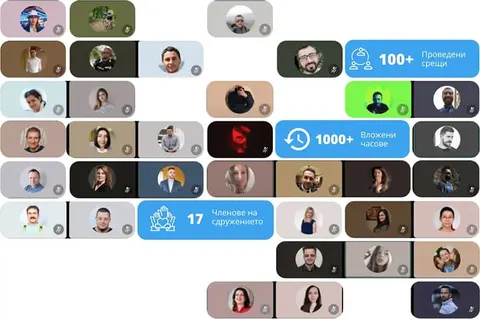
…is still being sought; it’s always good to have even more friends.
“The project was a big bite to chew, and it still is,” says Georgi Ivanov. “From the very beginning, our idea wasn’t simply to code a platform and set it loose to live online. Most of us have experience in this field, and we know you have to build a serious organization behind a project like this, and only then can it start working.”
One of the next big goals is for Podkrepi.bg to reach more people and for the media to spread the word, so the machine starts turning. According to Georgi, this will begin to happen naturally once the first campaigns are successfully completed. “Trust is earned through transparency and results—it’s not enough for people just to hear about us and see us. In this field trust is extremely hard to earn, but it’s everything. It is our main motivation, and it’s the goal of the project: to restore trust in kindness, in fundraising campaigns and in charitable organizations.”
At some point a few people will probably be hired full time, but until then everything keeps running on volunteer work. The team still needs help; right now the most sought-after are people with experience as front-end and back-end developers (the technologies used are listed here), DevOps engineers, project managers, as well as marketing specialists and people experienced in evaluating and monitoring campaigns.

Unity makes…
…and so, here it turns out that it really does make strength, just as Bulgaria’s national motto promises!
“For me, the most impressive thing about this project is that people who didn’t know each other came together and managed to turn all that energy of hating and ‘how dare they be so brazen,’ of grumbling and complaining, into something that builds. The biggest thrill isn’t so much that the platform appeared as that we created a serious organization standing behind it, and as long as we’re alive and well, I have no doubt it won’t disappear in a year. I’m very pleasantly surprised by this civic experiment, and I’m really curious to see how far it will go,” Georgi Ivanov sums up.
So now the ball is in each of our courts. Take a look at the first projects; maybe you’ll find something that moves you. You can join as a volunteer, or persuade the company you work for to become a regular donor. As long as you have the will, there are many ways to help.
Sometimes, in defiance of stereotypes and negative expectations, when we are together, miracles really do happen.