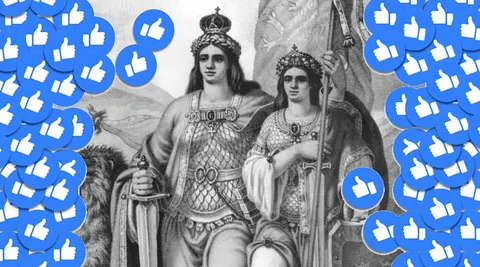
September 6. Uprisings are planned in many towns. The government of Eastern Rumelia is to be toppled in a peaceful coup… but everything falls apart. The news lands in the wrong Facebook group, and off it goes. “These people know nothing.” “You’re Nikolayophiles!” “Servants of the Padishah.” “Evryth1ng iz cle4r 2 me.” “Shame!!!!” “Bai Ganyos…” “Lira-takers.” “Yellow-cobblestone snobs” (and the yellow cobblestones haven’t even been laid yet). “I may not know much, but…” “Whoever thinks like that can unfriend me right now.”
Could any of the most meaningful events in our history, whose undisputed benchmark is the Unification—the day in 1885 when Eastern Rumelia joined the Principality of Bulgaria—have happened in the age of social media?
In a time when the online world shapes our consciousness even more than our offline being does, is it really worth repeating the famous line:
Unity Makes Strength?
Of course, even when our national ideal was a good deal clearer, there were still people like Kiriak Stefchov and Ivancho Hadzhipenchovich, the traitor and the pompous windbag from Ivan Vazov’s classic novel Under the Yoke.
Yes, the internet is fertile ground for building a constructive community when some idea “hits the heart” of a critical mass of people. But that is the exception.
It is far easier to find a reason to quarrel with someone than to do something together. All the more so online. Because the internet world is built to divide us and turn us bitterly against one another.
Unity is an abstraction, a utopia. We will always hold different positions that collide, but… isn’t it a value all the same?
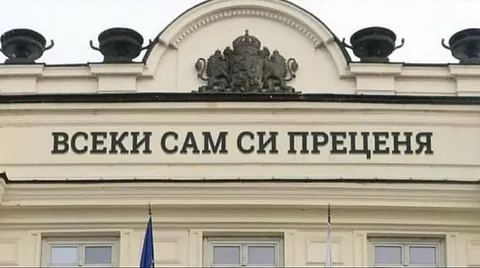
If the search for what unites us, for shared goals and ideals, is not a priority and a starting point… then what are we celebrating today? Why do we keep those three words on the brow of the building—the National Assembly, Bulgaria’s parliament—that is supposed to be inventing our future?
The Abdication of Truth
Why is it getting harder and harder to find common ground, why? Do we have more to split between us? Is it really that the internet simply makes us feel more significant, godlike, as the psychologist Ani Vladimirova puts it?
If unity, rallying behind shared ideals, is a utopia, then what hope is there for truth? By definition it is a utopia too; it cannot be absolute.
Life online reminds us of this every second, while slyly whispering to us between blinks that we, and only we, know it. That we are smarter and better than the others. That our truth is the Truth. As the conductor Nayden Todorov captured it, “the false sense that our opinion matters.”
All of this has its own logical history, one that leads from journalists far onward to influencers. Buried under the information spewed out every second by apps, traditional media, advertising profiles and made-up characters, we lose truth as the utopia that leads us to the other utopia—that of unity.
United by the InterNOT
Truth isn’t fun, it isn’t interesting, and at the same time we all get the illusory sense that we possess it. And we know this piece of the puzzle well as the filter bubble.
Not only social networks but all networks catch us like sprats, with a perfectly clear message—they make us rejoice at how right we are by surrounding us with the opinions of the like-minded. And, less often but just as inevitably, with the denial, the rude words that will drive us mad. That is how a net for sprats works, and we, unlike the sprats, even know it well. We simply pay it no attention.
It wasn’t a sprat but a whale, caught by a journalist, went a joke from the Copper Age about a film from the Stone Age. Unlike the sprat, though, we climb out of the virtual net and think it hasn’t changed us. All the while it makes us bitter and divides us. It draws more red lines, tightly covering the ones that exist in real life too, and adds a few more for color. Self-irony drowns in crude humor.
Malice, aggression, hatred. Hate.
To Love and Hate with Passion
Early in the morning the voivode, the rebel commander, waited until the very last moment for his men to board the steamer at the port of Giurgiu. He had described the event clearly on Facebook, with exactly what was expected; 5,000 people had marked themselves as interested, 500 as going. And not a single one came—only the TV cameras, which had also seen the event. “Oh well, at least there’s a chance that if someone googles my name one day, a football team won’t come up first,” the poet told himself.
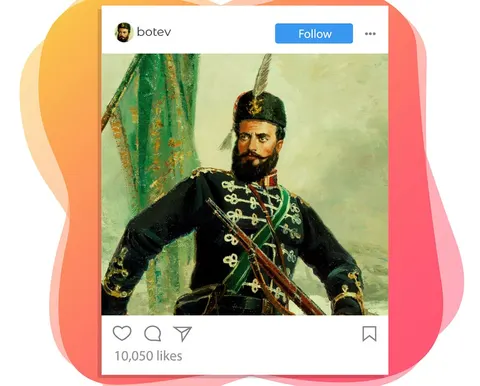
Who, if not me, knows the most about:
a) Politics
b) Covid
c) Amber Heard vs. Johnny Depp
c) Boyko vs. Kiril vs. Kornelia vs. Radev vs…
If “Amber versus Johnny” is more of an emotional call, we often launch crusades on subjects that demand deep, specialized knowledge.
“You’re stupid.” “No, you are.” “You’re the mafia.” “No, you are.”
Like in kindergarten, except, alas, the teacher isn’t there.
And so, from the personal to the public, we arrived at the apotheosis. Having lost our point of support, the ability to talk to each other, we have reached a political position in which the people we elect can speak to one another only when cornered by self-interest. Otherwise they need a night of sleeping on it the wrong way, a catharsis, before they fall in love or into hatred.
Or is that just a pretext? How would we know, when it is no longer the reliability of information that moves us? Just the short headline, the split-second emotion, like a fast carb.
Parties and politicians actually play their role quite precisely: to embody our opinions. With aggression for its own sake, a superficial attitude, a lack of dialogue. Yes, none of this happens only here, but here we also have the historical sediment that helps us split apart, fault lines built up over generations. Add to that an inadequate media environment in which quality journalism, quite plainly, is not a priority.
A Rebel Band with a Traitor
Conceived as the platform that would connect the world into one, the internet quickly turned into a machine for inequality. And dramatic differences—in social status, rights, representation—very quickly divide us emotionally too. Being really cannot stay apart from consciousness. This process is global as well, but we can see it very clearly here at home, for instance in the argument over what programmers do and how they do it, and whether their financial status grants them some other kind of status too.
If there is anything sadder than the division itself, than our inability to form shared ideals and dreams, it is that this phenomenon increasingly feeds the very processes that give rise to it. There is no sign of what might stop the avalanche, while it profits everyone who has a hand in how it is built. The politicians, who whip us up against one another whenever it suits them. The platforms, giant companies with the power of states, which live off our ever deeper entrenchment in our bubbles.
Somewhere in there lurks the much-talked-about artificial intelligence, only not in the role of the Terminator or a scarecrow. Rather as a constant, everyday companion that is becoming an ever more perfect weapon of manipulation, pitting us against one another. And firing our own data while doing it, loaded with the billions of bullets from every click and scroll we have ever made anywhere on the web.
One by One
The monk gathered his courage and posted his little book online, hoping to reach the “unwise fool” who cares nothing for his own history. And he realized at once that he had made a mistake. First came the little laughing faces, then the comments that he had copied from Mavro Orbini, Caesar Baronius or Sparotok. And then it got scary. The champions of the idea that we are Thracians showed up and immediately got into a fierce fight with the fans of the autochthonous theory… The monk thought and thought, and turned off the comments.
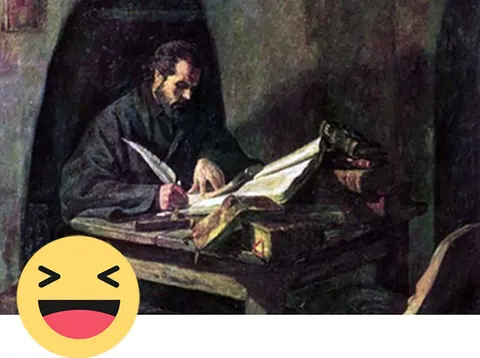
This is where the pandemic comes in, locking us for a long time into our even narrower bubbles. Instead of reminding us how much we actually miss the most human things, it hurled us into the web with full force. Where it is harder to hear the opinion of a colleague whose political views differ from yours, and the bubble reigns.
And so, in this shortage of normal human communication, amid the clash of generations, with the added weight of a life of scrolling and the lost will and ability to read long texts, nuance fell victim. Superficiality and extreme positions gained at its expense. And, of course, all of it worked against unity in any broader sense.
A Written Word = A Thrown Stone
We live in a time of invented, one-day unions, like the one for or against vaccines, and of one-day parties and politicians who latch onto them with their little proboscises. For or against North Macedonia and its road to the EU, until in the end, even among the extreme positions, nobody understands what has happened. And they forget the topic, because the Facebook slop has already cooked up a new reason for them to sharpen their swords against those who think differently.
So, is there a solution? Certainly, and it is as simple as it looks. To talk to each other, to look for what brings us together rather than what divides us. To listen to one another. Sometimes even, however hard it is, to shake the hand of the winner from the rival team. To read. To value words and the message behind every combination of words. To go deeper, to step outside our filters. Often, stubbornly and deliberately. Not only to recognize the challenges that came with technology, but to make sense of them, put them in order and solve them the human way.
Is it really that simple? And do we have the collective strength and will?
Measure Three Times…
The khan opened a group chat on Messenger. He had prepared a meaningful lecture for his sons and was just arranging the bundle of sticks… and one by one his sons left the chat. Cringe. Boomer. A Messenger group, buzzing your phone every time. Besides, Facebook is no place for young people. “Maybe I should have tried TikTok?” the khan said to himself. “What I have in mind could make a killer clip.”
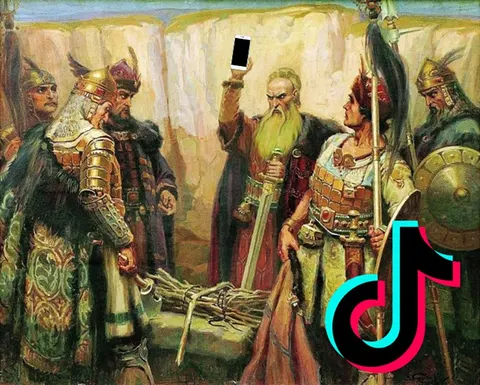
The khan would have become a TikTok influencer with his crystal-clear messages, like the one about the sticks—but would his sons have seen it?
Whether you agree or not, thank you for reading this far. As long as these topics are being talked about, it makes sense to mark today not simply as a day off work but as an occasion for reflection. For dusting off the old cliché, from under which its true meaning emerges.
Unity makes strength.