Capturing the moment means something different now than it did in the days before TikTok. Or does it? These photographs will remind you why photography will outlive social networks.
Long before the digital age, and after it too, we are above all collectors of images. Don't believe me? Here are 10 shots that will remind us why it matters to pause now and then. To look closely, to think, to feel…
That photographs can be much more than a fleeting glitter. Shards of truth, an unexpected story, a reason to make sense of the world.
Rafaelo Kazakov is showing selected photographs from his personal collection at the Sintezis gallery in Sofia from March 22 to April 28, 2023. (More here.)
Why does the event matter? As the collector puts it, “because it puts forward the idea that photography has a body. That there are exquisite platinum prints in the world, where a precious emulsion is applied by hand for a future, one-of-a-kind image. That photography lives a life beyond the screens.”
Mirrors and Windows
—that is exactly what the upcoming exhibition is called. “To collect images is to make a list of your desires and your fears,” he adds. “What you once had, lost, forgot; what you both long for and are afraid of already exists, in finished form, in the images of others. Making them part of your life is less reckless than trying to live through everything yourself, and cheaper than being everywhere.”
His collection gathers images from near and far. “My love of photography lives in its purest form in other people's pictures. I have looked at myself in their mirrors and gazed through their windows many times, and now I hope that with this first public showing of my photographic collection I will find people who will share these small journeys of mine and feel at least some of the joy and passion with which I have collected photographs over the years.”
Ready for 10 (+1) thrilling photographs and the stories behind them?
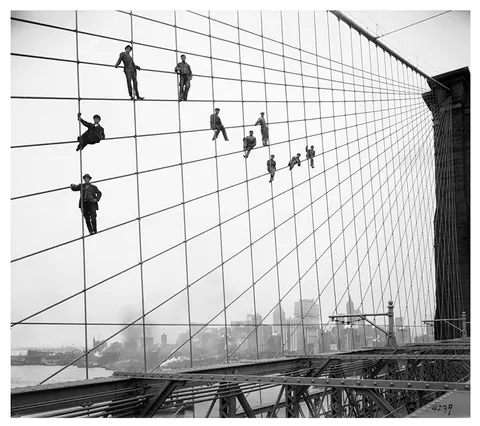
A Job Like Any Other
Eugene de Salignac, Brooklyn Bridge, 1914
“Painters on the Brooklyn Bridge” is the name of this masterpiece, which has an interesting history and an unexpected epilogue. Its author worked as a photographer on the city payroll, tasked with documenting how New York's modern infrastructure was being built. One day, passing by the bridge, he saw the workers perched on the cables, completely unimpressed by the danger.
“That's when he had an original idea,” Rafaelo says. “He invited them to come on a Sunday, when they weren't working, and to wear their formal clothes. They did, they came in hats, suits and vests, the clothes they wore to church. They posed for him gladly—for them the height meant absolutely nothing.”
The photograph is well known to connoisseurs, but it has a sequel. In the 1990s a Bulgarian, Bozhidar Yanev, found himself in a very important post: he was responsible for the management and maintenance of all the bridges in New York and the surrounding region. Even so, he admits that… he always dreamed of being in the workers' shoes, of climbing up the cables, yet never had the chance because of the strict regulations.
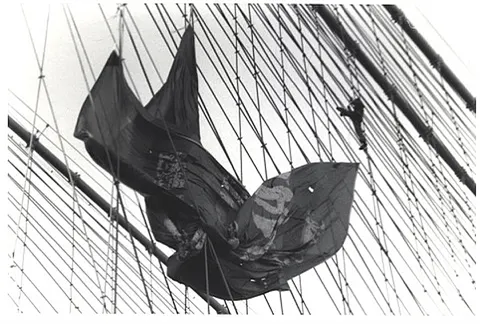
One day PETA, the animal rights organization, staged a protest, and one of its activists climbed up and hung an enormous banner. “Bozhidar used the moment as an excuse to finally climb the bridge, which was utterly unnecessary and risky to his life,” Rafaelo says. “A few years later a man knocked on his office door and brought him this photograph as a keepsake. He told Bozhidar that he had been on the bridge's pedestrian walkway that day and had photographed the self-assigned aerial expedition of our adventurous engineer—who, by the way, is also a photographer.”
The Navel of the World
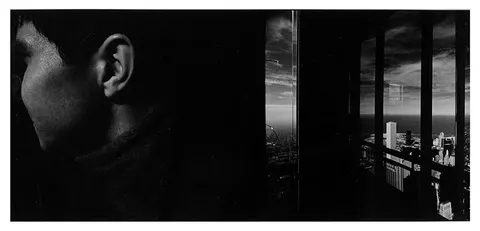
Antoni Georgiev, New York, 1987
“Antoni Georgiev is one day younger than me, but when we met in the early '80s he was already an accomplished photographer, while I was just taking my first steps,” Rafaelo says. “Along with the friendship that grew up between us, there also took shape an unspoken, amorphous bond between teacher and student.
A stay of a few weeks in the United States in 1987 produced a series of photographs remarkable in both quantity and quality, which I loved then and still love today.”
Before emigrating to Denmark in 1989, Antoni gave Rafaelo several boxes of original prints made by the author himself, and that was how the collection began.
On the Edge of Life
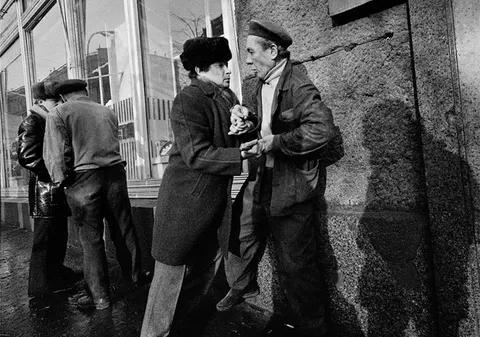
Gueorgui Pinkhassov, USSR, 1981
“Sometimes the camera shows us how weak human vision is,” Rafaelo says of this photograph. “Gueorgui Pinkhassov pressed the shutter at the very moment the fellow on the left was driving a chisel into the other man's stomach.” Attempted murder!
As Pinkhassov tells it, “at that moment I saw nothing. I walked past without slowing down. My shadow, head bowed, was also caught in the frame, as proof that I was no witness. Although this was one of my first attempts at street photography, my reflexes didn't let me down.
Gradually I became convinced that the decisive moment is not the skill of choosing a moment and calling it decisive, but something else entirely. The moment decides, not you. Your role is to trust it and not get in its way. To stop controlling it—and then it will stand before you with what Cartier-Bresson calls ‘the moment of truth.’”
And how does the plot of the photograph unfold? Well, the man survived.
The Moment Is in Us, and We Are in the Moment
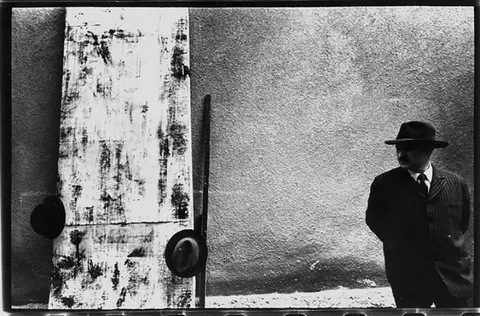
Yordan Yordanov (Yuri), Mexico, 1981 (probably)
The same year (maybe?) as the previous shot, on the other side of the world. “This print has no signature and no title,” Rafaelo says. “As far as I know, it is the only one.”
“Thirty years ago I would have loved to find out: are the hats hung up, or are they flying; which cousin of Godot is the mustachioed fellow waiting for; is this place really Mexico or not… But today I know that knowledge can be deadly to the fragile life of beauty. For me ambiguity is one of the most important things in the world—in photography, in art, in the thought that nothing is ever what it seems.
The frame says nothing. It is full of ambiguity, it is all ambiguity. We don't know the place, we don't know the moment. Who is this man? Are the hats flying, or are they an advertisement for his shop? Ambiguity and confusion are sometimes very important,” Rafaelo reflects.
I have something to add here, too. My novel I dodeto... (And Until...) is about the man who made this photograph, Yordan Yordanov (Yuri), and I wrote it precisely by asking myself questions about the unexpected past, about ambiguity and the stories sealed inside a single picture…
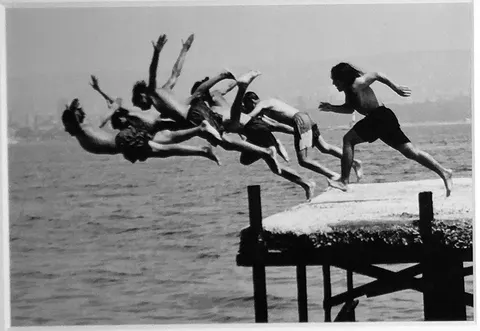
Fly, Fly…
Tsvetomir Trankov, Varna
“The Varna photographer caught this shot in the way Pinkhassov describes—the photographic reaction is preconscious, a pure reflex,” Rafaelo says. “The decisive moment won't be captured unless the photographer presses the shutter with a sense of it in advance.”
“This is one of only seven or eight photographs in my collection of people jumping,” the collector adds. “Heights terrify me, and perhaps these pictures are the flip side of my fear—fascination…”
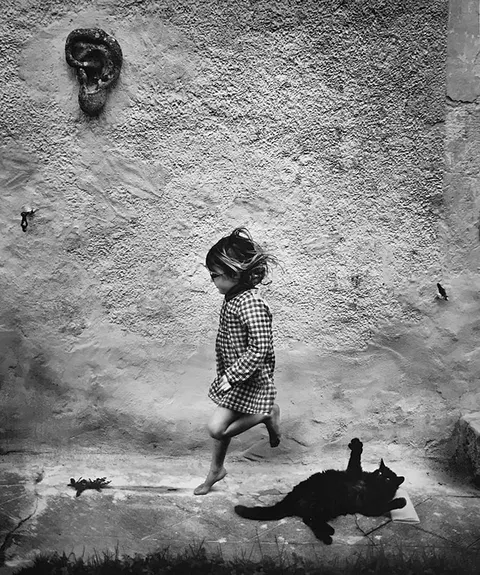
My Family and Other Animals
Alain Laboile, Southern France
“The photographer lives in the countryside, he has a house with a big yard, and in his pictures you can see the wildness and freedom of his six children,” Rafaelo says. “They play, run around naked, hit each other, cry, fight. A sense of freedom, and alongside it a sense of pain. The intoxication of freedom granted so early, which can mean so much to a child.”
Laboile's series is truly remarkable, because his aim is to delight in and document what happens to his large family “at the edge of the world, where the transient and the universal of childhood meet.”
“Very beautiful, genuine, human photographs, which prove that a photographer's best chance is to work from the heart, from what is closest to him,” Rafaelo says. “When you photograph the things you love, the things that hurt you, that's when it works.”
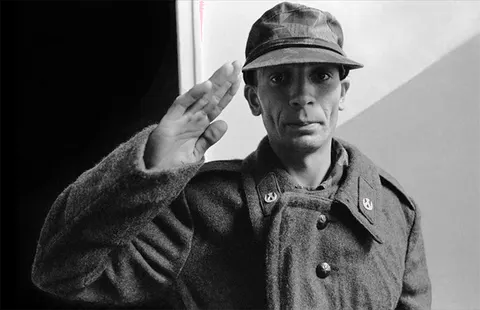
We Shall Build a Factory…
Garo Keshishian, the series Construction Troops (1981–1994)
“There can never be two identical photographs,” Garo Keshishian said when he was a guest of Digital Stories. This is precisely the series most people know him for, because it shows an unexpected phenomenon.
It began in 1920 under the government of Aleksandar Stamboliyski, the agrarian prime minister of the day, when all young men were obliged to perform compulsory labor service, working without pay for the good of the state. Many countries later borrowed the idea, and in Bulgaria the construction troops became a unit where men from ethnic minorities and people branded politically unreliable were gathered together.
Garo Keshishian followed their story through his lens for decades. “I worked very hard to win the trust of the boys I photographed,” he recalls. “I managed to capture their daily struggle to preserve what was human in themselves amid inhuman living and working conditions. Blatant ethnic discrimination is visible throughout the whole series. But the strongest driving force, the thing that made me come back again and again, was compassion, my sympathy for these boys whose only guilt was where and when they had been born.”
“The boy saluting in this picture is 18,” Rafaelo says. “To me this is a portrait of the guilt Garo talks about.”
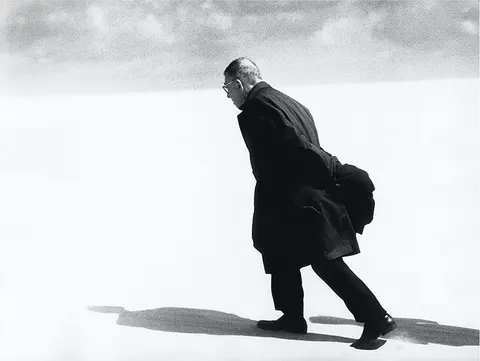
Sartre on the Beach
Antanas Sutkus, the beach at Nida, Lithuania
The best-known photographer of the so-called Lithuanian school made his most prized pictures while still very young. Here, on the beach, he photographs one of the great figures of the twentieth century, Jean-Paul Sartre, when Sutkus himself was only 26.
“I'm very curious whether, when he took these pictures, the photographer was consciously thinking about existentialism, about human loneliness, about alienation,” Rafaelo wonders.
“Hell is other people.” Sartre's words are worth recalling, too—Sartre, so expressive, practically flying in this photograph. Words that also tell us a good deal about the times technology would bring. “It is enough for one man to hate another for hatred to spread, little by little, to all mankind.”
“The Sartre print in this exhibition came to me with bad luck: it started to yellow just ten years after I bought it directly from Sutkus. At the beginning of this year I gritted my teeth and allowed myself to fix it again and wash it thoroughly, hoping to stop the process. Now at least five years have to pass before I find out whether I've succeeded…”
Yes, collecting takes patience…
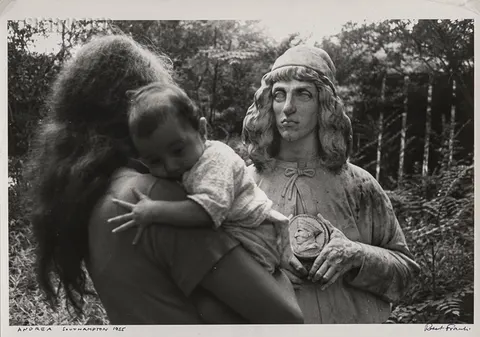
The Angel's Gaze
Robert Frank, 1955, Southampton
Does a person ever know what is coming, do they suspect it, do they hope to escape it?
“Our mind often modulates the emotion of a photograph in light of what happened later,” Rafaelo says. “For me Robert Frank's picture of his daughter Andrea and his first wife, Mary, is saturated with a foretold tragedy. Because of the knowledge that 19 years later Andrea would die in a plane crash.”
Robert Frank himself, the legendary Swiss-born American photographer, lived to the age of 94 and died in 2019.
What might the angel have told him in that moment…?
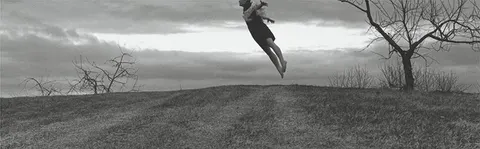
Requiem
Anne Arden McDonald
“Anne and I have been friends for quite a few years now. She is an example of an artist who is not merely devoted but doomed to her own art,” Rafaelo says. “Her flying self-portrait is one of my favorite photographs of all.”
Before we part, let me mention once more that you can see much more of Rafaelo Kazakov's collection at this impressive exhibition.
“A good collector knows from the very beginning that you cannot own art, only experience it,” he says.
“As a passionate music lover, it matters more to me to be able to hear a piece of music than to have it recorded. One of my enormous fears is that somewhere in the world there is music I know nothing about, more shattering than Mozart's Requiem. In a work on that scale the air is sculpture, stone is water, and the rhymes are eternity. But it might not be music; it might be a photograph. If anyone knows anything about it, please write to me. I don't want to buy anything, only to hear it. Or to see it…”