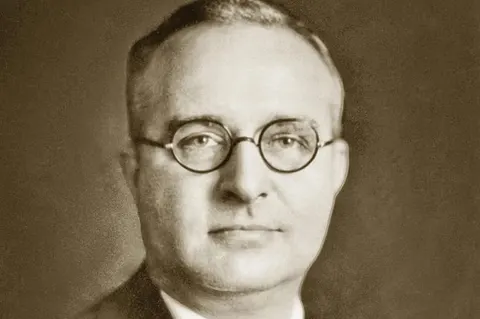
You certainly know what the road to hell is paved with. If you have any doubts, just ask Thomas Midgley Jr.
Technology changes our lives at breakneck speed, and its creators—inventors, programmers—are the heroes of our day… At least that's usually how it goes, until it turns out that some innovation the world greeted with incredible enthusiasm is lethally dangerous. You know, for instance, about cocaine, originally sold as a cough syrup.
And yet there is one inventor who rode a wave of fame for many years, revered as a genius, while in the meantime… he created not one but two technologies that later turned out to have cost human lives. The damage they did affects the entire planet and will still be with us for generations to come.
The story of Thomas Midgley Jr. is worth recalling every time we cheer the latest huge breakthrough in artificial intelligence or any other technology. Because it shows just how important it is to weigh the risks before we take flight on the wings of enthusiasm. How important it is to think about and discuss the big questions technology puts before us, the ones we never seem to have time for…
A Whiff of Bitter Almonds
So what were these two deadly inventions? Be patient—you certainly know them well; until recently they were part of all our lives.
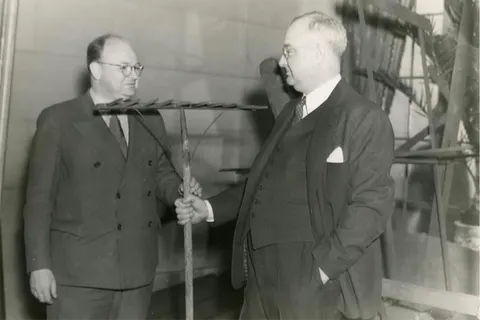
Thomas was born in the small town of Beaver Falls, Pennsylvania, and dreamed of becoming an inventor from childhood. It ran in the family: his father, whose name he bore, held a number of patents for automobile tires, and his grandfather invented the toothed circular saw blade that every craftsman still uses daily.
The young man followed in his forebears' footsteps and graduated from prestigious Cornell University. He studied mechanical engineering, though he was destined to spend his whole life on chemistry, to win every top award in the field and to remain chairman of the American Chemical Society until the end of his days.
He quickly landed a job at a large corporation. His boss, Charles Kettering, was impressed by his skills and invited him to the new company he was founding—DELCO. The firm grew fast and before long became part of the General Motors conglomerate. If you drive in Bulgaria, the name may sound familiar: in Bulgarian, делко (delko) has become the everyday word for an important engine part, the ignition distributor.
It was precisely cars that the company focused on. And our “hero” Thomas took on a task that was especially promising and important at the time…
Reinventing the Wheel
In the 1920s the automobile industry suffered from a serious problem: existing fuels ignited too early, which quickly wrecked engines. So scientists entered a race to find the ideal new substance—and the winner was destined to be none other than Thomas Midgley Jr.
For a long time he tried adding all sorts of things to gasoline… without success. He tried iodine, camphor, aniline dye, even melted butter. He proved stubborn and kept working his way up and down Mendeleev's periodic table. Until at some point he found the “ideal” solution—adding tetraethyl lead (PbC2H5) to the fuel suddenly solved the problem…
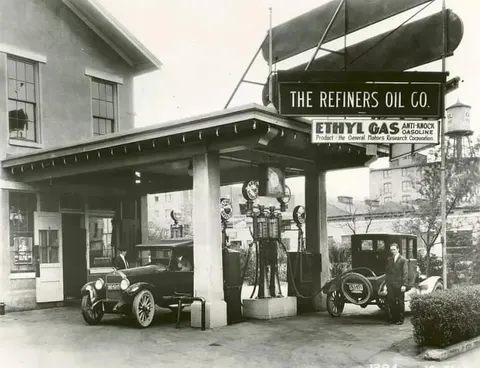
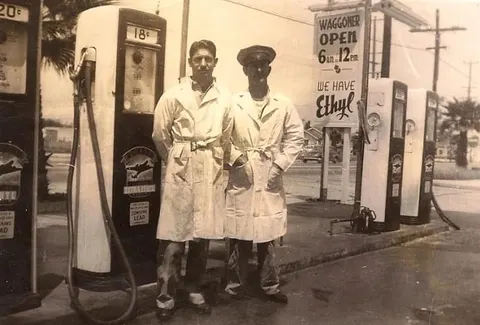
Yes, you've guessed it: Midgley's first great invention was leaded gasoline, which we all used in our cars until not so long ago.
Success quickly brought the discoverer fame, even though another working solution had been devised at the same time—adding ethanol to the fuel, exactly what has replaced lead today.
A Poisoned Remedy
As far back as before the Common Era, Dioscorides, one of the fathers of medicine, noted the harmful effects of lead on people—that it causes tremors and even mental illness. Midgley's patent met fierce resistance from the scientific community, which warned that using the substance carried serious risks.
Thomas and his colleagues launched a series of demonstrations to prove it was completely harmless. Soon General Motors and Standard Oil set up a new company—the Ethyl Corporation—which began selling the new fuel. For the sake of image, they even avoided the word “lead” at first and used the trade name TEL, from tetraethyl lead.
Of course, the whole affair had an obvious commercial side. One simple fact surely mattered in choosing the lead solution over the clearly cheaper, more accessible and safer ethanol: leaded gasoline could be patented and bring in huge revenues for many years.
Something in the Air
Despite protests from many quarters, General Motors spared no expense on a massive campaign to push its product. And our hero played a central role in all of it. Whether he truly believed that all the arguments about lead's health risks were false… to put it bluntly, whether he sold his soul or simply ended up cast as the useful idiot, we can only guess.
Within a few months, at least 15 workers at a leaded gasoline plant died of poisoning, and others developed serious mental problems. But once again this did not stop the corporation.
It was well known that even a teaspoon of tetraethyl lead causes fatal poisoning… but the inventor and his allies insisted that the substance never leaves the car. And even if it somehow did, it was by then safe.
At the next demonstration Thomas washed his hands in the substance, and once he even rubbed it all over his body to show how harmless it was.
The Steadfast Lead Soldier
After yet another performance he ended up in the hospital, but would not admit it was poisoning. In 1923 he went on vacation to Florida to recover, having discovered that “my lungs are not in good shape, and it's time to drop work for a while and get a large quantity of fresh air.” Maybe he wasn't so innocent after all—what do you think?
Despite doctors' protests, in 1925 a federal commission approved the patent, paving the way for Midgley's deadly (and lucrative) solution.
Just a decade later, profits from leaded gasoline reached the sum, unthinkable for the time, of $300 million a year!
Gradually it spread across the whole planet and reigned for more than half a century before its dangers were finally recognized.

From “Hosanna” to “Crucify Him!”
Over those years there were dozens of campaigns and studies pointing to the danger. The difficulty was that the average concentration of lead in the air really wasn't high, but that was far from the full picture.
In 1972 at Harvard, Prof. Herbert Needleman, an experienced pediatrician, began looking for the causes of a rise in a number of illnesses among children. He had long suspected that the culprit was lead in car exhaust, but couldn't find a way to prove the link. Lead accumulates mostly in bone tissue, and, as you can imagine, it's not easy to collect enough bone samples from a given population.
At least not until the professor came up with an ingenious solution: he began collecting the baby teeth children had lost, in areas at different distances from busy roads. The pattern proved astonishingly precise—lead levels in kids living near roads were five times higher than average. What's more, these children had a significantly lower IQ, and their grades at school were poor.
At first many doubted the experiment, but gradually the data piled up and up. It is even believed that the boom in juvenile crime in the US in the 1960s was linked to lead fumes (and indeed, the figures dropped after leaded gasoline was phased out).
It happened slowly, but it gradually happened all over the world. In Bulgaria, leaded gasoline was last sold in 2004, and Algeria became the last country on that list only in 2021.
Heavy Metal
Midgley the inventor never got to hear the bad news, because he had passed away much earlier. Before leaving us, however, he managed to create one more invention that, until recently, was in all our homes.
After the triumph of leaded gasoline, Thomas enjoyed his “well-earned” wealth and genuine fame. For a few years he was vice president of the Ethyl Corporation, then stepped back but kept collecting hefty dividends. He won all the most prestigious chemistry awards in the US and became something of a philanthropist. They say he was a kind man—during the Great Depression he hired people simply to give them some income, even when he had no need for their work.
He himself never stopped working. By the end of his life he had produced another 115 patented inventions. One of them was, once again, tied to a major problem for an entire industry, which the leading chemist rolled up his sleeves to solve.
In the 1930s there was still no good technological solution for the substance used in cooling systems. The compounds in use were either toxic, or explosive, or both—accidents were frequent and serious.
What did Thomas come up with? He turned to various compounds of fluorine and hydrogen until, after just three days of experiments, he found exactly the right one—dichlorodifluoromethane. Gradually it caught on under its short trade name: Freon.
The inventor once again stepped into his signature role of showman. At the annual meeting of the American Chemical Society he gave a demonstration in which he inhaled the gas and exhaled it onto a lit candle—proving that it was neither poisonous nor flammable.

The Toxic Duo
Well, this time, fortunately, he turned out to be right about the gas being harmless. But only as far as people were concerned. Freon proved to be an extremely dangerous agent that destroys the ozone layer—perhaps the most important link protecting life on our planet.
Fortunately, science moved a little faster here: Freon was banned, the ozone layer dropped off the list of dangers to us as a species, and its thickness gradually recovered.
Either way, the “refrigeration breakthrough” made Thomas an even bigger star; he was ranked alongside Edison for having created two of the solutions that made technological progress possible.
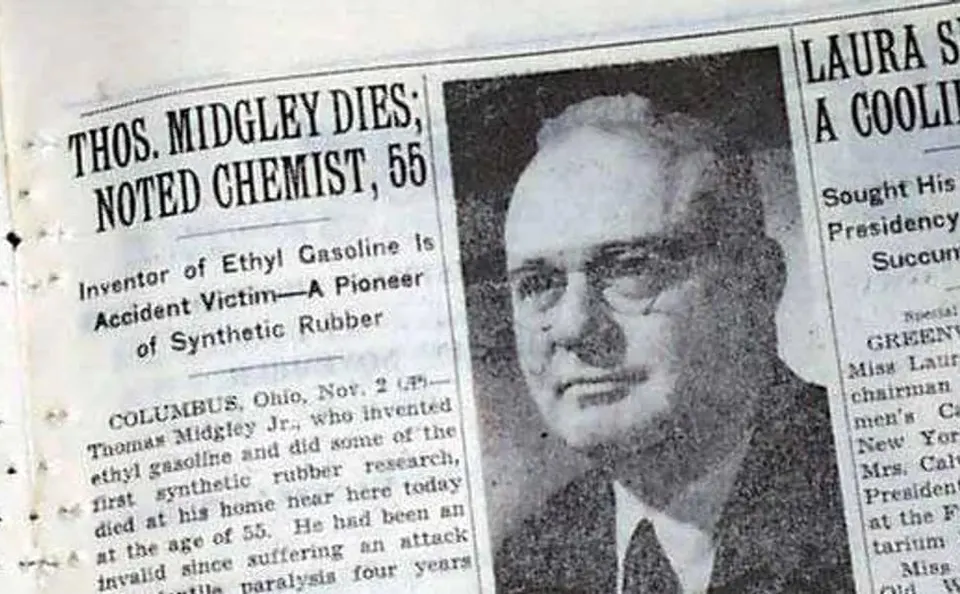
For better or worse, he never lived to see the collapse of his second great innovation either, because he left this world on November 2, 1944. By an irony of fate, thanks to… a third invention of his own.
In the 1940s he fell ill and was paralyzed from the waist down. He said it was the result of polio, but today's historians believe the lead experiments certainly played their part. In any case, Thomas, a man used to making life easier for people and for humanity, built himself a special device. Using pulleys and ropes, it allowed him to get up and lie down on his own.
One day, however, something went wrong: the man became entangled in the ropes and was strangled.
…or the Modern Prometheus
Although both his great innovations outlived their creator, their consequences will outlive all of us too. Because of residues in the environment, it is believed that generations of people across the Earth will still carry higher levels of lead in their bones. And although the ozone layer has recovered, scientists say the damage to it is part of the mix that led to climate change, whose fruits we have yet to reap.
Still, the inventor did receive one indisputable distinction that remains in force. The historian John McNeill said that Midgley “had more impact on the atmosphere than any other single organism in Earth's history.”
Whether his fate stirs pity or outrage… matters less than the lessons it holds. When corporate interests take precedence over science, the risks to people grow. When we rush ahead without analyzing the consequences, they can even be deadly.
Aren't these associations especially important right now? When technologies like artificial intelligence place before us enormous opportunities, but also enormous abysses…