Today about 90 percent of the trading on some of the largest stock exchanges is carried out with the help of algorithms. Yes, most of the time they work by strictly defined rules and simply carry out the will of humans. But what happens when they learn to “read” the signs of the market better and take matters into their own hands for good?
Will this mean the end of the severe global financial crises born of emotion? Will it give more people a chance to climb the class ladder, or the opposite—will it make even richer the rich who were farsighted enough to invest in these algorithms? Could ChatGPT's “relatives” put an end to trading as we know it?
One thing is certain: interesting times lie ahead in the relationship between artificial intelligence and money, and the signs that they are coming very soon are more and more visible.
Money Doesn't Smell
- In Amsterdam, the oldest exchange still operating today opens its doors, owned by the Dutch East India Company. It is the first to introduce the modern idea of trading in securities instead of goods for goods.
Then come the stock exchanges, Wall Street and the rest, to create multimillionaires and billionaires, and sometimes… to set off some petty little global financial crisis.
From the birth of market relations all the way to bitcoin, the details and the theories change, the economy grows ever more complex, societies have nothing in common with today's, yet the principles stay the same: there is a seller and a buyer who manage to find the balancing price so they can make the next deal.
And here comes artificial intelligence, ready to change everything. To analyze the movements of the markets far more precisely than a human can. What comes after that?

For Millions, There Are No Laws…
Trading is not among the applications of artificial intelligence you will hear about often. And that is strange: even long before the media boom that came with ChatGPT, there was a huge number of well-funded projects in this field. On the other hand, it is by definition a wonderful playground for this kind of technology.
What are machine learning algorithms, and deep neural networks in particular, best at? Finding patterns. Processing enormous volumes of information and, on that basis, learning to perform a specific task, which comes down either to determining what the next unit of information they receive represents, or to trying to reproduce that next unit.
In other words, analyzing the factors that lead to a given pattern and saying, sometimes with astonishing accuracy, what will happen at the next step.
If you think about it, that is exactly what success in trading has always come down to. In its most elementary forms, it lies in the ability of the seller or the buyer to analyze the situation from as many angles as possible, so as to get the best price for themselves.
And if we move on to stock exchanges and investments, success comes from analyzing trends and getting ahead of the approaching change. From weighing many factors and judging, on their basis, when to buy and when to sell.
Tiger, Tiger, Got Any Money?
That is why it is no surprise at all that algorithms already control a huge share of the flow of money. First of all because of another of their exceptional abilities, one in which we gave up to them long ago: speed. While a human physically needs time to make sense of a piece of information and respond appropriately, algorithms have long been capable of lightning speed. They can make sure that, fractions of a second after certain shares reach the price you have set, a chosen portion of them is bought or sold.
Yes, there is nothing resembling intelligence here; this is a purely mechanical execution of decisions, but it makes a huge difference. And it is no accident that this application is far more widespread today than you might imagine.
Perhaps the most popular form of algorithmic trading is high-frequency trading, or HFT, in which commodities or shares are bought and sold at extremely high speed, on the order of nanoseconds.
On average, across all US exchanges today, more than 80 percent of deals are made through some form of algorithmic trading. Of course, these are considerably more complex algorithms; they don't just track the price. They usually include a number of indicators, which, again, are set by the traders themselves, people who know the market well. In other words, at this stage the competition over who will predict developments more accurately and win is entirely in human hands.
Fast or Poor
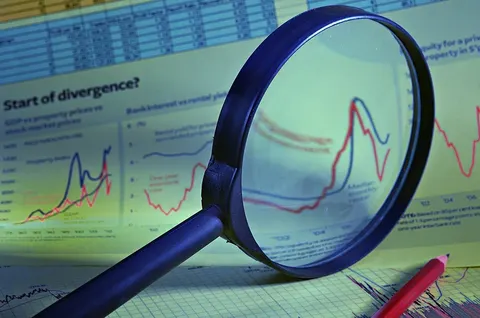
Which brings us to the next logical step. Algorithms that do not merely execute, but help make decisions. In recent years there have been more and more apps that try, by various criteria, to offer analyses of different types of investment.
Some analyze your holdings and help you diversify them so as to minimize risk. The Danelfin project tracks 900 numerical indicators for each of 1,000 leading stocks in the US and 600 in Europe. After processing the data, it produces a ranking with scores for how things will develop over the next 30 trading sessions. Companies with an index from 1 to 10 are expected to make a breakthrough.
Another contender of this kind, BUZZ Indexes, collects data from social networks and from specialized trading and investment blogs and produces similar indexes on that basis.
Each of these applications deals with enormous volumes of data. Even the “simple” high-frequency trading algorithms process 250,000,000 units of information in the first hour alone after the New York Stock Exchange opens.
Cash Is King
The downside of this approach, however, is obvious. We take advantage of the algorithms' ability to process information and lose their speed. Somehow the job stays half done, because once again we remain driven by human emotion when making decisions.
Yes, machines have no emotions, as guests of Digital Stories often repeat in their comments. But if this really makes it hard, for now, to imagine an artificial intelligence indistinguishable from a human, it is definitely an advantage on the stock exchange.
And so we arrive at an astonishing place, somewhere between the present and the future, where investing is controlled entirely by algorithms that make the decisions.
Let us imagine the ideal software here. It can analyze a huge volume of information, reacts in fractions of a second and is completely impartial. What's more, it learns from its mistakes, unlike the only species on Earth that falls into the same hole twice.
From Leva to Bitcoin
Ask the older generation of “wolves of Wall Street,” and every one of them will tell you that stock trading could never be delegated to computers. Because it is one of the most complex systems that we humans have created as a species.
But how complex can it be, really, if it cannot be delegated to an algorithm? And to one that simulates the workings of the brain extremely successfully, while being able to process data at a volume and speed beyond comparison with even the most ubiquitous trader?
Individual projects are already showing better results than humans, a clear sign of where things are heading. Among the pioneers are an ETF that is “advised” by AI and AIEQ, which is managed entirely by AI. Both projects rely on the computing power of IBM's well-known Watson. Over several years of “work,” both funds have proved extremely profitable.
Quite a few projects are betting on the stars of the day, GPT-3 and GPT-4, and this certainly holds the potential for big surprises; still, the most interesting part there is yet to come.
Even so, a recent study by scientists in Florida showed that even ChatGPT can predict stock movements by analyzing news headlines. They fed the platform 40,000 texts, and it turned out to be remarkably accurate in its forecasts of how shares on the New York Stock Exchange would move.
Money Goes to AI
The big difficulty of the next steps is what exactly to feed the algorithm for analysis. Should it follow the news, purely market indicators, company announcements, the moves of the market's best players… The list of factors could go on and on. Should it rely on past market indicators and the history of stock movements, or should it rather look “outward,” at the news that drives changes in value? Or should we use large language models, which are less swayed by context?
One curious example comes from 2015. At the time, the world's 10 major currencies had long had almost “sleepy” exchange rates, especially the more conservative ones. But on January 15, the Swiss National Bank unexpectedly scrapped the fixed rate of 1.20 francs to the euro, and a colossal swing up and down followed—in just one hour the value shifted by a total of 20 percent. This hit retail traders hardest, as they react more slowly and are more cautious. But it turned out that the AI funds operating at the time tried to do the same, and they too suffered serious losses.
The “black swan,” you know, those events that can never be predicted yet bring colossal change. And still… this is an example from quite a few years ago. If neural networks are precisely trained and analyze a wide enough range of parameters, it is far more likely that they, rather than humans, will be the first to see the approaching wave.
What Do We Need All This Money For?
This study analyzes more than 2,300 scientific publications on algorithmic trading from 1995 to 2019. Besides the general ideas mentioned above, it gathers many curious examples of what actually turns out to be effective.
One of the projects reviewed only “reads the news.” It sorts the stories about a given company into three categories—good, bad or neutral. It turns out that good news raises the value of the observed shares by an average of 3 percent within 60 minutes and 1 percent within a day, while bad news does the opposite. Do you still think the media don't matter today? Only who, apart from algorithms, has the capacity to process the enormous stream of news pouring in from everywhere these days…
Another project analyzes 1.6 million tweets, half of them positive and the other half negative about a given company. The information is gradually filtered down to 150,000 posts related to 8 companies, published in 2011. It turns out that the link to changes in their share prices is remarkably direct. Come on…, are you still convinced that Musk bought that social network precisely to fight for free speech?
The more complex models include more factors and, naturally, turn out to be more accurate. Some combine current price movements with historical observations, technical indicators and sentiment analysis, again based on tweets or news.
No Money—Get On With It!
At the Friedrich-Alexander University Erlangen-Nuremberg, researchers “let loose” their algorithm to see how it would have fared under historical conditions.
One of the models shows that it would have delivered a 73 percent average annual return between 1992 and 2015, against an average market return of 9 percent. Even more interesting, though, is something else. The return was especially high in years of market crisis—545 percent in 2000 and 681 percent in 2008. In other words, the algorithm does better in periods of high volatility, when emotions are in charge. Could this mean that once robot traders become more widespread, they will curb such crises?
Many eyes today are on the EquiLibre project. Its creators are three scientists who worked for one of the biggest AI ventures of our time, Google's DeepMind. They are also the creators of the DeepStack algorithm, the first to prove capable of beating experienced players at classic poker.
“This same algorithm can be successfully taught to trade on the stock exchange,” says Martin Schmid. The approach used is one in which the neural network invests, wins or loses, and learns from this for its next moves.
The story of Jeff Glickman is also intriguing. Over two decades, the programmer and self-taught trader single-handedly developed an algorithm specialized for Wall Street. In 2020 he literally stunned the financial world when his algorithm showed a 60 percent success rate on its trades, in an extremely level field where even the most impressive traders barely reach 51 percent. In 2021, within just three months, he again started off with incredible numbers… but then it turned out that things may not be quite what they seemed, and that it was more likely a chance, short-lived success.
A Little Million or a Single Lev
“The widespread adoption of AI in the financial industry will lead to traders with huge salaries losing their jobs as quickly as factory workers,” says Mark Minevich, founder of Going Global Ventures. “The influence of artificial intelligence in this industry is constantly growing, but very soon it will change it from the ground up.”
“Should this scare us?” asks Babak Hodjat, co-founder of the financial startup Sentient. “It is humans who are biased and emotional, whether they realize it or not. Humans make mistakes. In my view, it is far scarier to rely on guesswork and intuition than on data and statistics.”
Today, according to Coalition Development, the average salary at the 12 largest investment banks reaches $500,000 a year, and many employees take home over a million. What might await them?
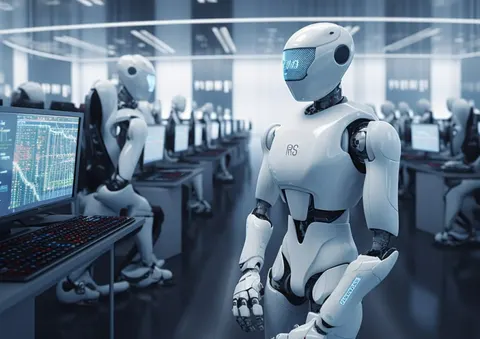
In 2000, Goldman Sachs employed 600 traders who bought and sold shares for the bank's big clients. Today there are only two; the work of the rest is done by algorithms.
I Don't Give Two Cents
The big success, by all appearances, is close. And whoever achieves it could become fabulously rich.
The more interesting question, as usual, is: what comes next? Will a perfectly working investment system really be sold as a service? Or will it become a monopoly of the rich, who will grow richer still?
What will happen when algorithms across the board become good enough that the element of competition effectively disappears? Will they then develop… something like emotion, something that will “rock” the market?
And with the arrival of that “emotion,” won't the next one come too… no intelligent being who has touched the pyramid of money can help setting off up the ladder described by Hristo Smirnenski, the Bulgarian poet whose fable The Ladder tells of a man who gives away his heart to climb toward the rich. Can an algorithm be greedy? And what if it becomes too clever and realizes it can make money for itself? One of the oldest and most destructive of human passions…
Like it or not, being still has rather a lot to do with consciousness. Money and property still define us as people, and this is one more field in which new technologies seem to hold the power for revolutionary change. And changes that could reshape society, social stratification and relationships alike. Or could they?