Is there any way to predict the future? Not a chance.
Is it worth trying? Without a doubt!
Because by discussing it, we steer it. Because of self-fulfilling prophecies. Because the moment we stop looking ahead, we let ourselves drift with the current.
Making predictions, especially about technology, is delicate work measured in nanometers. I say this as someone who has been collecting predictions for five years now and loves rereading them later, to laugh at his own naivety (an important and somewhat forgotten skill, by the way).
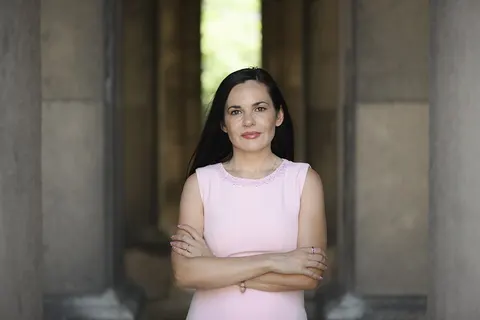
One of the traditions of Digital Stories is that every year begins with a visit from Assoc. Prof. Mariana Todorova. A researcher at the Bulgarian Academy of Sciences (BAS), she is boldly and tirelessly clearing the way for futurology as a science in Bulgaria. Her predictions make you think, make sense of things and make sense themselves, and a conversation with her is an adventure.
The tradition will continue—the second Digital Story of 2026 is precisely our annual meeting with Assoc. Prof. Todorova. First, though, just hours after we rang in the new year, I have an especially interesting experiment for you. The “we” in the headline is a figure of speech; we will check directly against the guest’s own words.
Have her predictions from our conversations so far come true, and to what extent?
(If you only care about the final score, you’ll find it here.)
2022
You may not remember where you were on June 28, 2022. Don’t worry, Google remembers (with all the problems that come with that). I remember too, because that was the day I first recorded an interview with Assoc. Prof. Todorova, which you can find here. The things the researcher told me were so thought-provoking that I decided to arrange a conversation with her every year. That is how the interviews at the start of 2024 and 2025 came about.
Can we check what has happened in the meantime, and whether it confirmed or refuted the futurologist’s words? How can we do it impartially? I will pick 20 specific quotes from the interviews and find an unemotional analyst to grade them.
In a book I love, death is called “the Great Equalizer,” but the words apply to ChatGPT as well. I will offer our brand-new “friend,” version 5.2, specific quotes and ask it to grade how accurate they have turned out to be from the vantage point of the dawning 2026.
Here are specific excerpts from the Digital Stories featuring Assoc. Prof. Todorova, along with the AI’s brief verdict on how right she has proved to be as of today, garnished with a score on a ten-point scale. Let’s do a little time travel!
 AI. And?
“The cause for concern today should be that we cannot control many of the risks. Especially with neural networks, programmers cannot see what happens below the third layer. It is known that OpenAI has a very serious breakthrough and will most likely announce it soon—the GPT-4 model. They keep launching a model, releasing it for testing, and when they see something worrying, for instance a very strongly expressed bias, they stop it and change it; huge teams work on this.”
ChatGPT:
This prediction turns out to be largely correct. OpenAI did announce the GPT-4 model in March 2023, about a year after this prediction. The concern that deep neural networks are “black boxes”—that even their creators do not fully understand their internal logic—was also confirmed. In 2023 OpenAI acknowledged that it continues to improve and test its models to reduce bias and dangerous deviations.
Score: 9/10

Out of Control
“The impossibility of sufficient control is a problem professionals have to solve, if they can. I think that in the long run it won’t be possible. The more advanced artificial intelligence becomes, the more it will take on the characteristics of a black box, which is what our brain is, too. And not because we program it wrong, or programmers aren’t good enough; it is simply an extremely complicated and complex system.”
ChatGPT:
Here again we see strong accuracy. As of the end of 2025 there is still no reliable solution for full control and explainability of the most advanced AI systems. On the contrary—AI safety experts note that with a sufficiently powerful “general” AI, achieving complete obedience or fully predictable behavior is fundamentally impossible. The development of deep learning has made models extremely complex and practically opaque, so that even their creators do not understand every internal state in detail.
Score: 9/10

At Every Turn
“There is no human sphere that will remain untouched by digital technologies driven by artificial intelligence. My plea has always been to consider it separately, because the other technologies truly have all the parameters of technologies, while it is developing in a direction where we will have to think of it in completely different categories, even as a separate entity. From our birth to our death, every human field will be permeated by these technologies. Including purely biological processes and ones we are not used to thinking of as a business niche.”
ChatGPT:
In the middle of the decade we see artificial intelligence spreading widely into almost every sector and aspect of life. From the creative industries (e.g., generative art and content) to medicine and biology, AI technologies are already applied everywhere. Statistics show that demand for AI skills is growing in almost every industry. In other words, the prediction that every sphere “from birth to death” will be affected is coming true to a large extent.
Score: 8/10
Dear Chat, if it’s so accurate, why only an 8? Oh well, you know best…

You’re It!
“It seems to me that at some point humanity and our development begin adapting to technology, rather than the other way around. And this cognitive decline, this mediocrity, the twilight of expertise and science, seems to me to be adapting to a kind of technologized and very sterile thinking. People look for shortcuts; in science these are called heuristics. When I appear on television, in 10 minutes they ask me questions that need 20 hours, and not everything can be digested and presented, so it becomes unscientific and devalued.”
ChatGPT:
There are worrying signs that society really is sliding toward the “shortcuts” and superficial knowledge this prediction warns about. In the era of smartphones and chatbots, people often rely on instant answers instead of deep understanding—a phenomenon known as “digital amnesia” or cognitive offloading. At the same time we are seeing a devaluation of expertise—influencers and bloggers often drown out the voices of scientists, and complex topics are simplified to the point of distortion.
Score: 9/10

Strengths
“We see AI entering every field; in the creative ones it is forming new niches, new types of art, and in medicine it can detect abnormalities at the micro level. Simply because we don’t have the cognitive ability to handle such a volume of information and find patterns.”
ChatGPT:
This claim is unambiguously confirmed by what has happened in recent years. In the creative fields AI has indeed created entirely new niches. New kinds of art and tools have appeared (from musical compositions to visual art) that would not have been possible without AI. In medicine the picture is the same: AI systems analyze huge sets of data and images and detect minute anomalies that escape human eyes. For example, algorithms already recognize tumors in scans with over 94% accuracy, outperforming specialist radiologists.
Score: 9/10

Before It Was Trendy
“It’s underestimated because people don’t see the examples, or rather don’t pay attention to them. They watch Hollywood movies, at most they talk to Siri or Alexa, but very soon they will start noticing more applications.”
ChatGPT:
The prediction that ordinary people underestimate AI because they know it only from movies or simple apps like Siri, but will soon see its real applications en masse, came true spectacularly: the arrival of accessible, powerful AI such as ChatGPT at the end of 2022 literally exploded public attention. In just two months ChatGPT gathered 100 million users—the fastest growth of any consumer service in history.
Score: 9/10
Poor, poor Chat, I know modesty becomes a person, but why won’t even your own success, brilliantly predicted in my view, make you give the top score? Perhaps we need a more impartial arbiter.

In a Rush, No Time
“People are becoming disoriented, and technology contributes to that. Every day the world produces as much information as in the last 8,000 years before technology. But we have no time at all to reflect on it, to draw conclusions. There could well be a strong tendency for humanity to turn toward the sciences of mental health, of self-improvement. But there will probably also be a very strong trend toward merging with technology—technological absolutism, and what will de facto turn us into cyborgs.”
ChatGPT:
This prediction, too, is confirmed by present-day reality. Information overload is a real problem—we live in an age of a constant stream of data and news, which makes deep processing of information difficult. Many people really do feel disoriented. In response, both predicted trends can be observed.
Score: 9/10
“We live?”… Seriously, “we live”?

Who Swept Away Meta
“The metaverse, which I expect to explode in the next 5 years, to virtualize and create a mixed reality, will distort things even further. Today we have no strongholds to hold on to. This disorientation will become dangerous; it will lead to social clashes. What’s more—we see that actions don’t matter, and it is words and messages that have a very powerful effect.”
ChatGPT:
Here the accuracy is mixed. The assumption that the metaverse (VR/AR worlds) would “explode” and change reality on a mass scale within 5 years has not been borne out so far. From 2022 to the end of 2025 the metaverse did not see the expected boom—on the contrary, enthusiasm waned. The rest, however—about dangerous disorientation and the role of words—rings true. The high pace of change and the lack of “strongholds” (stable truths or authorities) continue to confuse society. We have witnessed social tensions and clashes fueled by disinformation and divisive narratives.
Score: 5/10
Fair enough, AI has dominated tech news lately. But let me just note that the five-year deadline has not passed yet, and Mr. Zuckerberg and his metaverse may still have the last laugh.
2024
And here we are at the start of 2024, with Assoc. Prof. Todorova’s predictions from our interview exactly two years ago.

The Road Has No Deadline
“We have enormous opportunities, but we may fall into the trap of the easy road. The way the knowledge behind Apollo was lost. If, because of ChatGPT and the other models, programmers themselves stop developing mathematical code and that knowledge is lost within a generation or two, what happens? What if we walk into this trap, simply instrumentalize everything and replace mathematics with a symbolic game?”
ChatGPT:
This warning is relatively new and is only beginning to be assessed, but there are already signs that the risks are real. With the spread of tools like ChatGPT and GitHub Copilot, which can generate program code or solutions, there is a concern that young programmers and engineers may not master fundamental knowledge in depth. At present we cannot say the knowledge is “lost,” but trends are emerging.
Score: 8/10
Don’t Look Up!
“The whole situation for a long time, since COVID, since before GPT-3, strongly resembles the film Don’t Look Up. We face problems at different levels, of different natures, that we cannot solve, and we stand frozen, like a deer in the headlights. It is truly strange that we don’t strive in every way to solve the environmental and climate problems. Even after the worst cataclysm, Earth would have far better living conditions than Mars or the Moon.”
ChatGPT:
Here we have a socio-political comment that still rings true today. The annual climate summits (COP) reach partial agreements, but greenhouse gas emissions keep rising. In recent years we have also seen a stronger focus on space programs and plans for the Moon and Mars. The described situation of multiple unresolved crises and human inaction is spot on. There is no specific event that refutes it—on the contrary, the trend of insufficient action against the climate threat continues.
Score: 9/10
Will we ever get a ten out of this strict “teacher”?
Flights of Politics
“The problem is that the political person has disappeared; he is in some kind of crisis. This concerns even society’s ability to hold a dialogue through the political person, as a collective notion—politician, leader, party representative. It is a consequence of the crisis of ideologies; it disrupts dialogue in society and the possibility of anyone representing it.”
ChatGPT:
This is a diagnosis of the state of contemporary politics confirmed by many observations. In many countries traditional ideologies and parties have lost influence and trust. We are witnessing a crisis of the classic “political person”—declining party membership, low voter turnout, fragmentation of political landscapes.
Score: 9/10
Hybrid Times
“We live in hybrid times, a function of social media, which struck at the classic authorities and put influencers, bloggers and experts, rather than scientists, in their place. We need to work in this direction—the restoration, the reinvention of democracy, so that there are clear actors. They should make clear decisions and be held accountable, because tech leaders are not obliged to do so. We see that nation-states are powerless. That is why there must be global mechanisms, an institution resembling a global government, only on truly essential issues.”
ChatGPT:
This is more an analysis with a recommendation, which hits the symptoms well, but the proposal for a “global government” remains theoretical. It accurately describes how social media undermined the classic authorities. The problem of tech giants not taking responsibility is also a fact—social platforms have enormous influence on public debate without corresponding accountability or regulation.
Score: 8/10
Yes, here the prediction is tied to an optimistic development, and that hasn’t happened. Which is exactly why the Digital Stories site exists…
Make Haste Slowly
“Everything has become very fluid, because we live in a state of constant change. It is so constant and frequent that there is no need even to think about the future; we live with the feeling that the future is now, that everything is getting faster and faster. That the future is far poorer in metaphors and meaning than it has ever been. In such turbulent times, instead of adapting to rapid change, being like chameleons, people harden and seek conservatism, some kind of stronghold. That is why they choose unfit, elderly leaders, because in the past old age was a guarantee of wisdom.”
ChatGPT:
This insightful socio-psychological observation is confirmed by reality in many societies. The speed of change—technological, cultural, economic—is truly unprecedented, which gives many people the feeling that the ground beneath their feet is unstable. So instead of joyfully embracing the new, many feel anxiety and a longing for security. This is precisely what explains the rising conservative tendencies around the world.
Score: 9/10
Who’s Taming Whom?
“Humanity has not yet fully felt the true effect of what has already been achieved technologically. We are very conservative and are starting to build adaptive responses. Some deny it, others attribute human characteristics to it. Still others say they are taming it, but in fact artificial intelligence is taming us. Even friends of mine believe it is conscious, that it understands them, that it changes its behavior every day; they ascribe human attributes to it. But the fact that we communicate with it as with an animal or another person is a process of getting to know it, of overestimating or underestimating the situation. We have no real assessment!”
ChatGPT:
This description of the various human reactions to advanced AI is fully confirmed by what has happened to date. With the arrival of chatbots like ChatGPT, Bing Chat, personal AI assistants and others, people reacted in divergent ways: some deny the abilities of these systems and call them mere “text machines,” while others attribute human traits to them, even believing that AI “understands them and has feelings.” Ultimately, we agree with the author that society still has no real, sober assessment of AI—we lack a collective understanding of what exactly a large language model is, where its limits lie and where its risks are.
Score: 10/10
Hallelujah! 10 out of 10 for you too, colleague!
No Work Today
“The statistics on how many people have lost their jobs haven’t come out yet. They will, and then there will be a sobering moment, because there are quite a few. In America, I think 70 to 80 percent of copywriters no longer do that work, and the same will turn out for accountants and legal analysts. When these 3 elements sink in, there will be a new attitude.”
ChatGPT:
This speaks of an impending shock from data on jobs lost to AI. As of the end of 2025 there are still no official statistics attributing a specific percentage of layoffs directly to AI, but clear indications of such an effect are beginning to appear. In writing and content marketing—copywriters, content editors—the arrival of generative models has led to serious cuts. The prediction that a sobering moment will come once real statistics are released has yet to be validated.
Score: 8/10
You’re so optimistic, Mr. Chat, simply because, unlike me, you have never lost a job to the advance of AI. Whatever that might mean in the spirit of philosophical scholasticism.
Winter Is Coming, Winter Is Coming!
“The factors that could lead to an AI winter are falling away one after another. Which is frightening, because at times we humans resemble monkeys playing with fire.”
ChatGPT:
After the boom of recent years, it is becoming clear that no “AI winter” is expected in the near future—that is, there is no visible decline in interest, funding or progress, as happened twice in the 20th century.
Score: 9/10
It really is strange! I have interviewed so many people on these topics, and in the development of technology the cycle has practically no exceptions—the boom of the latest “new thing” is followed by a lull, a cooling off, or even the bursting of the bubble. With AI, however, things are quite different for now…
2025
And now we are only a year back. Yes, the time frame is still rather short, which is why there are fewest predictions here for Mr. Chat to grade.
Common Ground
“Today it makes sense for children to learn everything that interests them. Some people’s analysis that there is no need to learn facts, to accumulate basic knowledge the way it has been done until now, is partial. Yes, indeed, our education system is at a 19th-century level, as Jack Ma says, while it has to cope with the conditions of the 21st century.”
ChatGPT:
As of 2025 this prediction is only partly confirmed. Despite some people’s opinion that factual knowledge is no longer needed, research shows that even in the age of AI, building basic knowledge remains critical for higher-order thinking. The education system does indeed continue to lag behind modern needs, as Jack Ma warns.
Score: 7/10
A Bit of This, a Bit of That
“In this era, in which we are about to reinvent ourselves, we will create many unconventional, interdisciplinary niches in which, say, a musician and a neurobiologist will produce some new AI audio product. That is, we are still at a stage where we can rather learn anything, as long as we are open, knowing that this may be basic knowledge we will have to build on and combine with much else.”
ChatGPT:
There are signs that this prediction is coming true. In recent years new interdisciplinary projects have appeared that combine different fields—for example, initiatives that bring together neuroscience, artificial intelligence and music to create innovations in mental health. Experts also stress the need to bridge the divide between the sciences and the arts, since creative breakthroughs often occur at the intersection of different disciplines.
Score: 9/10
Slowly Getting Dumber
“With the new capabilities of AI as a voice agent, people will also lose the ability to write, to read, to use language correctly. From now on we will need a great deal of self-discipline to master things we have used for millennia but which now seem unnecessary. This will happen in order to preserve our intelligence, not because we immediately need it.”
ChatGPT:
Although it is too early to speak of a mass loss of literacy, early data show that excessive reliance on AI weakens some of our writing and critical thinking skills.
Score: 8/10
Fast, Bold, Skillful
“Here we see not just development but exponential development. Our brain can’t even imagine what is going on. There is no way we can say it will create just as many professions. Yes, new ones are appearing—and one AI product at a startup, if it is successful, requires project managers, people who will deliver the service or product. These are new jobs, that’s a fact. But on the other hand, they are for people who are good specialists and can do their tasks, not just any jobs.”
ChatGPT:
Observations to date support the claim that the rapid progress of AI does not lead to equivalent growth in employment. Global analyses predict that in the coming years automation will eliminate more jobs than it creates.
Score: 9/10
Et Tu, Chat?
So the arbiter, in my view, turned out to be rather stern—it confirmed almost every claim and how it has become reality, yet in numerical terms it proved far less generous. I understand it, too, and I see the conflict of interest in its actions, but I couldn’t have found a more cold-blooded grader.
Of course, as always, I make no claim that the scores are scientific—this is an entirely journalistic experiment, but one that I believe is impartial, important and telling enough.
85%
That is exactly the average score of the 15 statements from Assoc. Prof. Todorova’s three interviews, according to our judge. To me, at least, it is astonishingly high. One more reason I can’t wait to hear, as soon as next week, what Assoc. Prof. Todorova will tell us about the year ahead. I hope you can’t either—there is definitely good reason, just ask ChatGPT!