We often dwell on digital technologies that send us far ahead, into an almost fantastical future. Not long ago, for example, we talked about whether immortality is possible.
This time we'll talk about something even less likely than the end of death. Just imagine… Sofia becoming a modern, clean, tidy, well-organized city, connected to nature and attuned to the needs and wishes of its residents.
We'll talk about a concept from the future that uses technology to… take us back to the past. The regenerative city is an approach that seems to fit remarkably well into the solutions to all the current thorny issues of how we care for the places we live. Time to take flight on our imagination while keeping our feet firmly on the ground.
People and streets, a city like a city
During the pandemic, quite a few people supposedly went back to the villages… which really would have been wonderful. It will be interesting to see what the fresh data from the national census say (once the hackers and the usual bureaucratic dawdling allow it), but either way, the trend apparently didn't turn out to be all that strong or lasting. Sofia got a breath of fresh air while the rest of us were holding our breath in the first months of the COVID chaos, and then slowly but surely went back to its usual cluttered, clogged and overcrowded self.
In any case, the issue isn't Sofia. It isn't Bulgaria, and its general problems aren't so different from those of other big cities around the world (topped off, of course, by the undeniable carelessness of those who run things here).
So let's dream a little.
Regenerative cities are the new concept that is talked about a great deal in the West in the context of all the main problems of modern megacities.
They aren't a specific solution but a framework, a logic within which the specific solutions for each town or city can be arranged.
Where nothing else can happen
except falling in love
What is a city? Is it just the sum of all its buildings, arranged in the optimal way with good infrastructure? The best possible balance between concrete and green?
It is far more the sum of the stories of all the residents who are born, live and die in it. Think about it: would you describe your hometown in buildings, or in things that happened?
This is the first point of the concept of regenerative cities. They care not merely about the sum of rules and statistics but about the stories of individual people, which become the leading factor. So it's no surprise that in countries where the approach is gaining ground, many architects are delving deep into design. And many specialists in various fields of design are getting involved in planning. The two disciplines are increasingly drawn to and complementing each other, and the main meeting point is the individual human story.
In building a regenerative city, as many stories as possible are recorded, classified, analyzed and taken into account in every subsequent decision.

I live on the top floor,
in an attic right beneath the stars
The core idea of regenerative cities is to build a connection between how settlements are organized and the natural processes that take place in them.
The architects behind the approach say that so far we have taken an industrial approach to urbanization. It has always been driven by how to optimize resources so they satisfy the greatest possible number of inhabitants.
At some point, though, all this leads to other problems, such as overdevelopment, dirty air, transport troubles and sanitation woes. Not to mention how much more vulnerable the urban environment turned out to be when suddenly all public activities had to shut down for months. And those are precisely the resources believed to draw people to cities.
And your electric globes
shine so festively in vain
And they really do draw them, to a very large extent. Today UN statistics show that 54.4 percent of people live in cities. It may not sound impressive, but most of the remaining percentage is dominated by developing countries, which are quite likely to change as well over the coming decades.
Cities today cover 2 percent of the Earth's surface but account for 78 percent of the planet's energy consumption, producing more than 60 percent of our total carbon emissions.
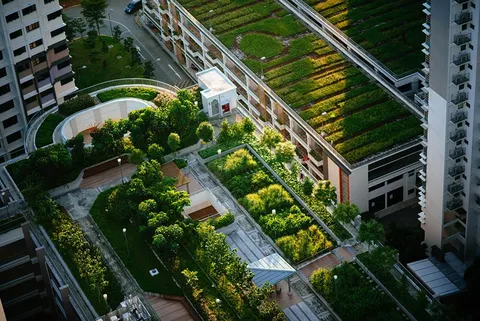
Of course, as has been fashionable for the last quarter century, regenerative cities also rely on a connection with nature. The next factor in building them is taking into account the natural processes of the landscape in the particular region. Huge buildings shouldn't block the natural flow of the winds. It is always important to have enough space set aside for greenery, for parks, for whatever stands up to an over-urbanized reality.
The city sleeps in soundless darkness
“The basic principle of regenerative cities is to restore the relationship between settlements and the natural systems they depend on.” The words belong to one of the founders of the idea, Stefan Schurig.
In his view, what we need is a model in which cities combine and balance social, economic and environmental factors and bring them into symbiosis. One “that creates a good place for people to live, stimulates cultural life and brings an element of creativity to solving problems.”
To put it more metaphorically, and in the spirit of technology, in recent decades the priority in urban planning has been the hardware, not the software. Compliance with strict rules instead of flexibility and attention to detail. And in many cases this harms people's lives as a whole, through a series of problems that are almost universal. Such as using private cars instead of public transport and bicycles; concrete instead of greenery; standardized architecture instead of an individual approach; more offices at the expense of housing; malls instead of cultural spaces.
For a long time all this was an engine of the economy, which is entirely understandable. In the least developed countries, city-based economic activity provides on average 55 percent of gross domestic product. That figure rises to 73 percent for middle-income countries and to a whopping 85 percent for the most advanced. That's why the economy easily becomes the priority at the expense of individual comfort, the natural environment and other factors.
Come to Sofia, come, come.
Come to my city of song!
In many countries, and not only in the West, the peak of this phenomenon is long past, and more and more measures are being taken to bring cities closer to the regenerative model, while here not even the crisis has tamed the opposite trend.
For now, quite a few places around the world embody individual elements of the principle, but there is still no example that covers it completely.
Quite advanced in this respect is the Living Future project, a general framework according to which concepts for regenerative cities are developed. Thanks to it, those in charge get guidelines for planning, designing and building new residential spaces that foster a symbiotic relationship between people and every aspect of the urban environment.
There is a similar example in Russia. Since 2014, work has been under way on the idea of “living cities.” More and more towns are joining, with the goal of reaching 1,000 by 2035. To be designated a “living city,” a settlement must fully meet the criteria for its layout being attuned to the needs of people and of nature. It must sufficiently apply the latest scientific advances in planning. For now the criteria are a bit abstract, but more and more specialists are joining the movement's forums, and maybe one day this will lead to serious progress.
Like a violet island
in moon-silver waters
One of the first cities to announce it would adopt the regenerative principle as its foundation was Wittenberg in Germany, back in 2013. Iowa City followed in 2014, and there the results so far look far more impressive. The local project is called “Ecopolis” and includes both a complete reorganization of construction and an entirely new urban plan. Green technologies are everywhere, and there is much more greenery. The energy balance tips in favor of nature-friendly technologies.
Bicycles are being introduced everywhere, too. Here Iowa City draws on the experience of Copenhagen, where 50 percent of all trips are made by bike and a population of 520,000 owns 560,000 bicycles.
Gradually, vegetable gardens are appearing in Iowa City, even right in the center. The goal is for the city soon to produce 40 percent of the food its residents need. Yes, the process is long and complicated, with neighborhoods renewed one by one, but the result is worth it.
All this is happening after Iowa City suffered badly from a flood caused by poor planning, and the local authorities realized they had to try much harder to get in step with nature.
Let's hope it doesn't always take some cataclysm to get politicians moving on issues like this…
Sofia, Sofia, my little London
Ideally, the regenerative city uses every opportunity to develop. It works on the principle of a closed-loop system. It purifies more water than it uses and responds quickly to every change.
Sounds like a utopia? For now it definitely is, admit even some of the creators of the principle. Still, it's a very sensible framework, even if the ultimate goals are met only partially at best.
So we've dreamed together, and now it's time to return to reality. I hope you'll forgive my examples about Sofia; they certainly apply to many Bulgarian (and not only Bulgarian) cities. It's just that this is my city, I like it, I breathe with it (even when the air is like cotton wool). And I stubbornly believe that before humans finally set foot on Mars or achieve immortality, we'll have not just an entire neighborhood with intact paving tiles, but an approach to urban planning along the lines of the regenerative city concept…

Inspire Change
If the topic has intrigued you, I'll leave you with news of an upcoming event. If you've made it this far, the idea of regenerative cities must be close to your heart (online, nobody has time to read to the end). And maybe you have something to say, something to think through on the subject, or you want to learn more?
From October 1 to 3, 2021, you can take part in the Bulgarian edition of the hackathon on the UN Global Goals (Global Goals Jam Bulgaria). Regenerative cities will be the event's leading theme, together with design that shifts from egocentric to ecosystem thinking.
“Hackathon” means many things; in this case it's a gathering of people with similar interests who discuss a given case and compete in teams to come up with the best solution.
It was the hackathon's organizer, Stefka Peykova, who drew my attention to regenerative cities. She is a designer with wide-ranging interests who has worked in England and Canada and is now based in Australia.
After attending a similar hackathon herself, she decided to organize the event in Bulgaria from the other side of the globe. Again remotely, she founded the organization “Inspire Change” to hold a Bulgarian edition of the global initiative every year.
From discussion to solution
This will be its second edition. The partners are WWF Bulgaria and the Institute for Circular Economy, which will set specific cases for the participants to work on. Bulgarian youth delegates to the UN and young psychologists will take part, offering their perspective on how humans have grown distant from nature. There will be talk of the circular economy and of using nature to solve problems.
Participation is free, and you can sign up here.
The point is anything but symbolic. As mentioned, the teams will tackle real cases, and besides competing, they can offer entirely real solutions. The partners are organizations on which solving concrete problems of urban planning and our relationship with nature actually depends.
What's more, this year the event is being held in more than 80 cities on every continent. In the end, the best projects are gathered into a large document whose aim is to share good practices in this field from all corners of the world.