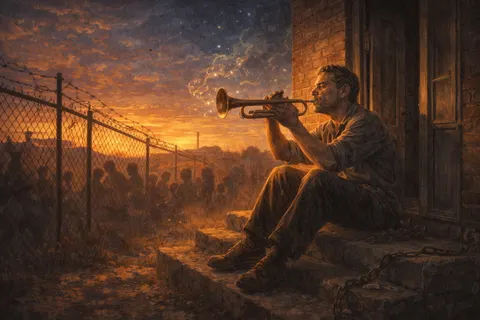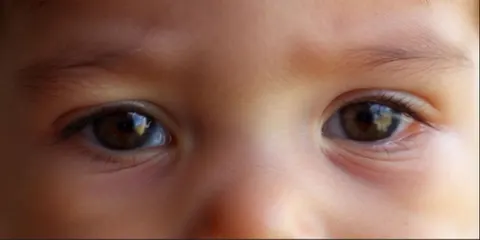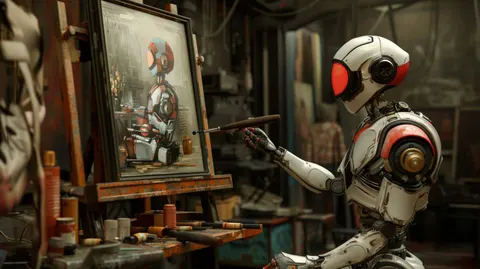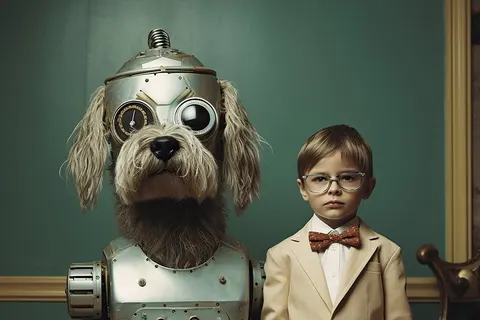
Look at them: so real… and at the same time so fantastical. You feel like diving into the world of the Dome, which both resembles ours and is completely different. Better or worse? It seems to lack the simplified, binary view of everyday life. That view has been replaced by fantasy…
Every new technology that changes our lives creates its own new arts, or gives familiar forms the next big chance to develop with new means, to reach more people, to move us in a more contemporary way. Without losing their essence, of course.
Aren't we on the threshold of that step with artificial intelligence, too? Projects like the Visual Dome, in my view, give an unambiguous answer. Even if algorithms generate books, songs and films indistinguishable from human ones, art, for now at least, will remain ours. Because without it we are nobodies, just scrolling, zombified creatures that are in no way superior to those very algorithms.
But what if we do find the way, if we learn to use these so fundamentally different technologies for something new? For art that moves us… Here is the answer!
A Never-Ending Tale
Perhaps it makes sense that so many sacred buildings since antiquity have used the dome in their architecture. The truncated, hollow sphere somehow seems to concentrate, gather, sum up.
“Everything begins with the dream of a reality,” goes the motto of The Visual Dome. And also: “You'll wish you had lived here.” This whole invented world is the work of one person, assisted by algorithms.
“How would I describe my work? Honestly, I don't think I can call this world ‘work,’” says the author, who goes by the initials TR, in his only interview so far. “I've fallen completely in love with it. It's a big piece of my mind in visual and written form. One that seems to keep evolving every day, and I adore every minute of it.”
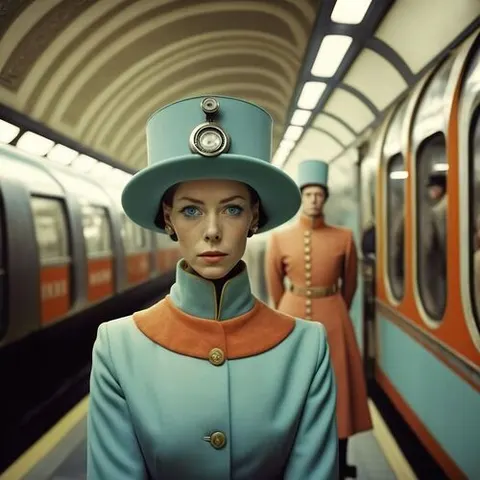
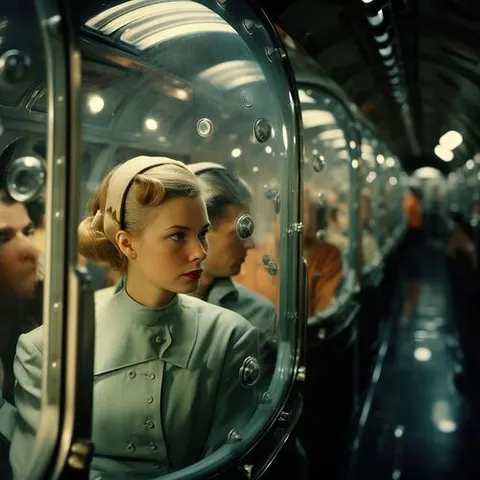
So what, in the end, is the Visual Dome? A utopia. A world born in one artist's imagination and brought to life in images and stories thanks to technology. Only so interesting, so spectacular and… so beautiful. Rendered in a style closest to steampunk, yet in soft tones, without all its industrial roughness.
Are we on another planet? No, rather, as its creator himself puts it, this is “a society not all that different from ours, but bursting with life and character. A cracked mirror version of Earth. A place where even the mundane is thought-provoking, where even a trip to the hairdresser becomes a visual feast for the senses. You can get lost for a minute, an hour or a whole day.”
Immersed in Utopia
But how do you go about inventing… an entire world? Well, why not? A person is only as big as their dreams. You may remember the story of the two brothers who claim that with their game Dwarf Fortress they have already simulated 50.04 percent of life… Well, the creator of the Visual Dome has also built a whole rich history that he keeps adding to, with images, details and short stories too. True, the latter may not overflow with originality and literary merit, but they end with the original note “Written the classic way.” Meaning the algorithm didn't create them. That's how far we've come.
Well, this story was written the classic way too… I'm joking, of course, I just asked ChatGPT to go in and tell me what it saw… I'm joking that I'm joking… Yes, somewhere around here my joke got too flat, and I've probably convinced you that I also use the “classic” way.
Still, the very fact that it is getting harder and harder for us to tell it apart from the “new” way, and that we have to spell out the difference, gives one pause.
In that sense, the author has added no such note to the images anywhere, nor to the story he has embodied behind the Visual Dome. But let me invite you on a safe stroll through this brave new world. I promise we'll come back unharmed.
The Turf of the Neighborhood Liberal
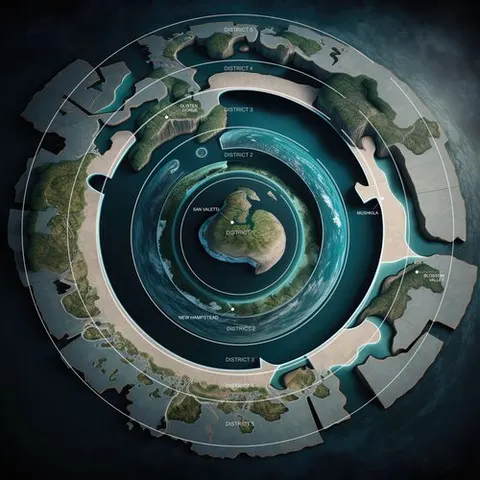
At the center, of course, is the symbolic dome. It's no accident that this is where the central zone lies, District 1, where people live in wealth upon wealth, surrounded by modern gadgets. They don't need to work; it's enough for them to contemplate life and create beauty.
Perhaps this is the moment to note that in this world time does not exist. Which may be there to remind us how new a construct it is for our civilization too, and how inclined we are to deify it today… Naturally, the inhabitants grow old, die and new ones are born, but without necessarily being in love with clock hands and calendars.
Beyond District 1, the other 4 Districts are arranged in concentric circles, each one stranger and with poorer inhabitants than the last. As an egalitarian-minded person, I find the author's decision to create such a segregated society odd, but then… who am I to give advice to the creator of a world?
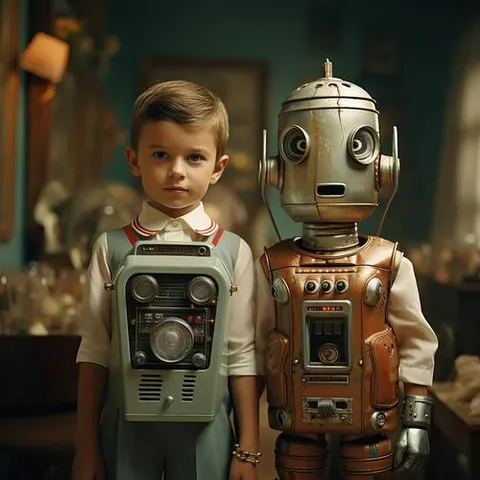
On the other hand, there are no genders, races or different sexualities. Society is organized by bloodlines, some of them fully human and others hybrids—this is where the robots come in. No harm in that; things are heading that way here, too.
Am I, or Am I Not?
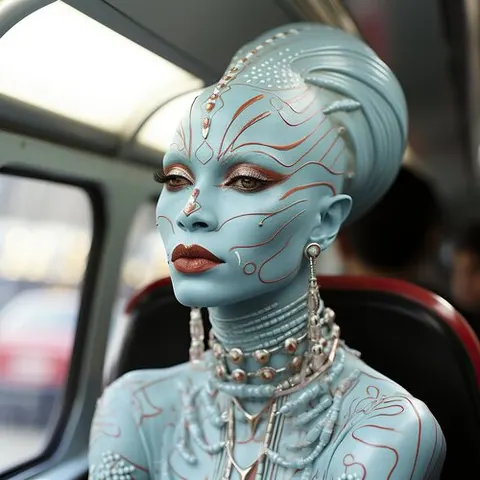
Every person is different: here the cliché comes to life in full force. Each inhabitant of this world is clearly distinguishable from the others, and so is every little robot pet. “You can see it, hear it, feel it and taste it, but you can't describe it,” the creator paints, a touch overwrought but poetic all the same.
A designer's dream! Everything is so finely detailed that each of the 29 million inhabitants is evidently something of an aesthete. What's more, everything unfolds within a single color palette that creates the overall feel… here the creator might even have some advice for the newly elected mayors back in Bulgaria (unless the palette runs from light to dark gray—that one we've mastered well enough).
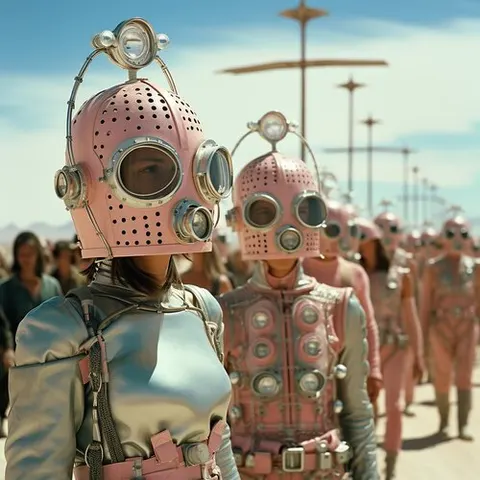
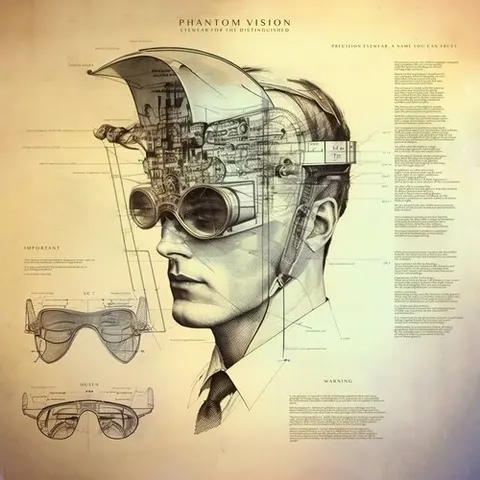
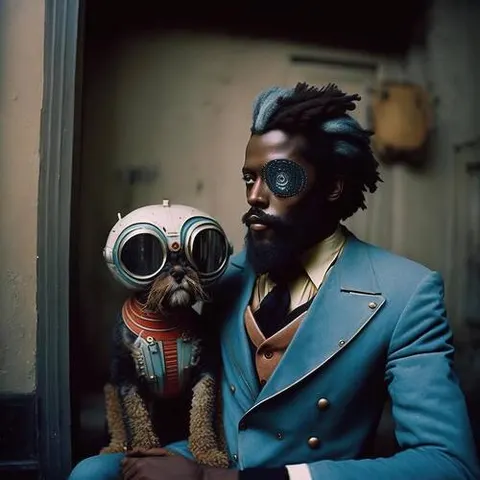
“Domers” don't like to go bareheaded; nearly all of them wear masks, helmets or goggles. Wicked tongues might point out that it's harder for algorithms to draw hyperrealistic faces than masks, but let those tongues stay put in our boring world over here.
Another Time, Another World
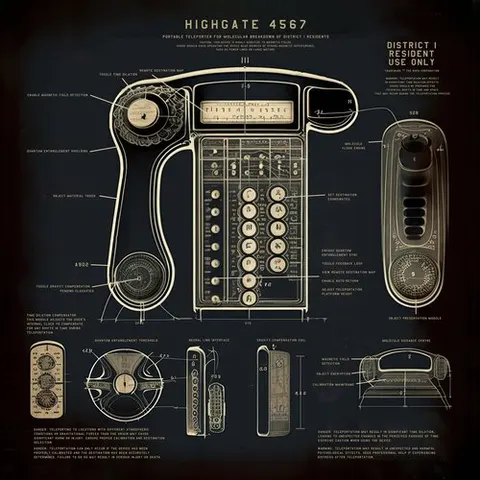
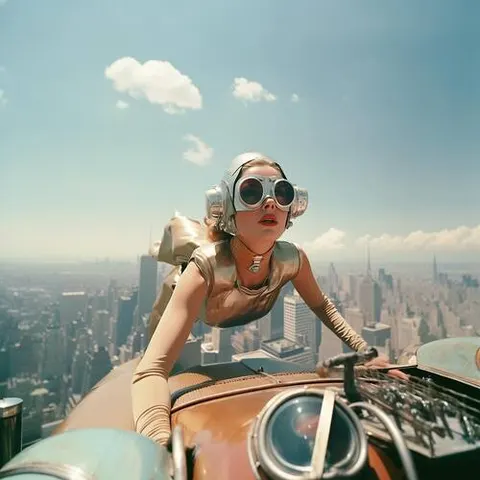
Technology has supposedly developed along the same trajectory as in our world, and yet many of the images take us back to the past. “The technology is more advanced, yet in appearance the Dome's machinery looks rudimentary. Want to capture your dreams at night? Just record them into the system. Need to teleport from one district to another? No problem, if you're rich. Printing food and medicine, sky bikes, smart pets,” the description greets us.
It's very curious why in this world every technology is restricted to certain Districts. Or why, of the 29 million current inhabitants, most are middle class, and more live in the first two regions than in the most run-down ones. Here not only the egalitarians but the Darwinists, too, will have something to say; I won't deprive them of the pleasure.
To their delight, there is at least an aristocracy: the “primal” bloodline, 98 percent of which, naturally, lives in the first District. The third holds the main farming and manufacturing bases, and the farther out through the Districts you go…, the merrier it gets. In District 4 a large part of people's livelihood comes from petty crime, and everyone's dream, of course, is to move up. Whereas the 5th is a pure domed Wild West…
And which District would you settle in? You can even take a special quiz (it recommended the 4th to me).
Paradise Around the Next Corner
There are three climate zones. The wealthy in the central District have secured themselves a life of 2 seasons, while the heat and tropical storms are left to the proletariat. Nature is well preserved, huge reefs protect the land zones, and everything ends in an ocean that keeps expanding. Whether we are on a planet or a plate, the story doesn't say.
Each region has its capital. Since I'm going to be a resident of District 4, mine bears the poetic name Mushkila. “A frontier town that sprang up so that illegal activities could be carried out in it. Its life force pulses through its labyrinthine dead ends, hidden alleys and grimy apartment blocks.” Well, I once spent an evening in Lyulin, a sprawling housing estate on the edge of Sofia, so I should survive.
“The city's dark secrets are locked in its veins: a vast world of tunnels.” Like the Mining Museum in Pernik, the old coal town near the capital? Okay, I've been there too.
“I'm consumed by the Dome,” writes one of the visitors. “And that's not a figure of speech. I dig into this alternate reality, dive into each of the five districts that make it up, and keep discovering terrific surprises. This is much more than an artistic offering built with the help of AI; it is pure art, a philosophical-existential challenge that, if you trust it, takes hold of you.” Well, Lyulin isn't bad either, honestly.
We're All Under the Dome
Perhaps the secret really is that it shows us such familiar motifs, only made into art, enriched, colored, passed through the senses. Whether the creator's or the algorithm's… only an algorithm knows.
But the venture evidently fulfills its purpose, as its creator says when asked why he makes his life so complicated instead of just drawing pictures. “I wanted to create an alternate world where everyone feels welcome, no matter who they are. A place where we can get lost, escape the stress and anxiety we all feel far too strongly these days. Even if it's just for a fleeting minute.”
TR is definitely pleased with what he has achieved. “Without sounding arrogant, I think the concept works. The Dome has only been online for a few months and it has already won a lot of followers. People really connect with this world, and I can see why. We spend so much time on devices, phones, laptops, games, TVs, usually watching or reading content that doesn't make us feel any better. More and more we need a place where we feel welcome, absorbed, understood, where we have fun and get excited to see what happened during the hours we weren't there.”
Dome-ticulous
In his view, artificial intelligence is simply a tool. “Not everyone can use it well, just like the tools we already have in our world. In the right hands, though, it lets us push the boundaries of our creativity to places that simply didn't exist before. The budget alone that I'd need to make a single image of the Visual Dome as a physical shoot, with actors, set design, wardrobe, location, props and so on, would leave me broke in under 5 minutes!”
And so we come to the question. Will algorithms then learn to create on their own? “I strongly believe that if you take the human creator out of the process, it's very unlikely AI will surpass our art. Yes, it can copy Rembrandt's style very well, but I still don't believe it can become the next Rembrandt. When I work with AI, there's a symbiosis. We complement each other. Sometimes it gets things badly wrong, and most of the time that result is awful, but every now and then it adds something extraordinary that I hadn't even imagined. The symbiosis is what makes working with AI exciting, and I believe it will keep getting better!”
Beauty Leading the People
But, damn it,… what's the point of creating an entire world out of nothing, of drawing image after image and adding to its story?
Absolutely none, just pretty pictures.
But does there have to be a point?
It might, for example, simply look good… Or let the imagination loose. And what if somewhere out there, in the middle of the Dome's world, sits another Creator, like the one who in turn draws our world with his imagination?
Either way, virtualization is advancing. The metaverse may not look like what Zuckerberg imagined, which genuinely pleases me. But sooner or later we will find ourselves more and more in ever more virtualized environments. I, for one, would be glad if that took me (with a return ticket, for now at least…) to a place like the Visual Dome.
So it turns out that people and algorithms, hand in mouse, can create meaning. And beauty…, and wasn't it beauty, as Dostoevsky promised, that was supposed to save the world?
This piece is part of the new issue of Dolce Far Niente magazine