I've been writing about the wonders artificial intelligence is capable of for a long time. And yet… this stunned me! After telling myself for ages that this site was too complicated to update, speed up and make modern… it happened in just a few hours.
Then I decided to see whether I could translate all of Digital Stories into English. Did I pull it off, what do you think?
And what if I built my own mailing list instead of paying for an outside service?
And could I make other sites significantly faster, modern and practically free, too?
Stick around and watch! And if you're ready for the next big step in your own digital presence, don't hesitate to write to me.
We live in an era in which technology gives us possibilities that were unthinkable until recently. All we have to do is give it a chance, break the stereotypes, and give free rein to our imagination and courage…
Alive and Well
“Great! The site is live.”
Monday, September 28, 2026, 11:37 p.m. I'm not the one writing the message—Claude is. I'm just sitting there, goggling at the monitor.
That morning at 9:14 I had written that we were starting to rebuild the Digital Stories site from scratch. The plan the AI drew up a little later envisaged 12–15 working days. Plus another week or two of checks.
It took 14 hours and 20 minutes. During which I did plenty of other things, too.
Five years, 516 stories, over 4,000 photos, nearly 1.2 million words—moved to a new site, with a new design.
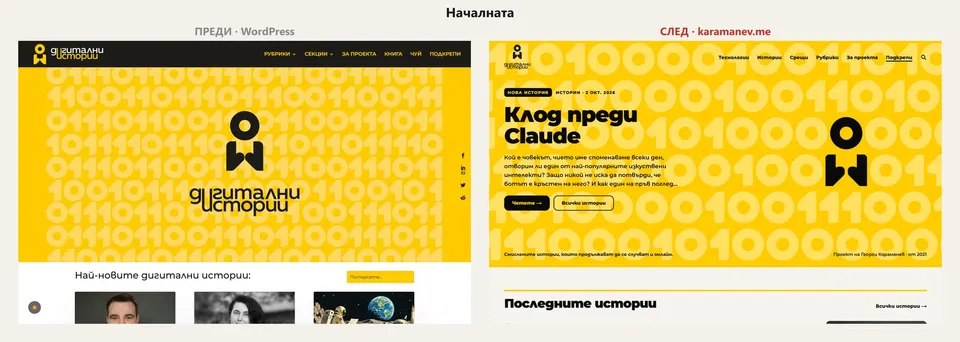
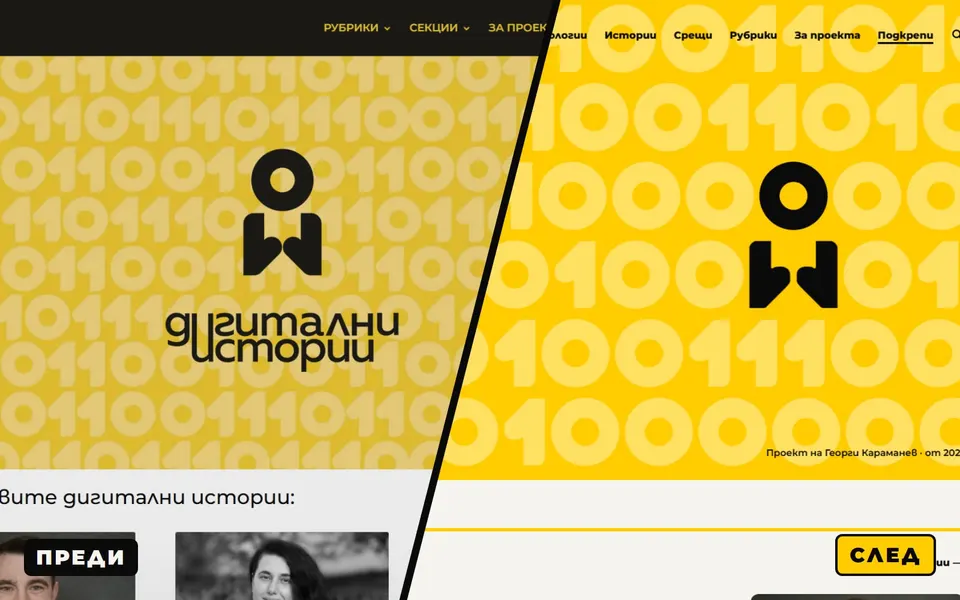
A site that loads ten times faster than the old one and no longer costs me a single cent in hosting. How is that possible?!
“Fingers Crossed”
August 2021, Digital Stories is five months old. I wonder: “Will artificial intelligence take the bread out of programmers' mouths?” Rereading that piece today, I mostly find it amusing.
“Even if we get to the point of creating algorithms that write code, everything suggests that the moment when they can do it autonomously won't come too soon,” I wrote back then. The moment when a machine would build finished projects on its own seemed to me “if not impossible, then far too distant.”
Blessed are the believers, as an early fantasy novel has it. I ended that piece with a touch of irony: “Whether this is really possible, time will tell. Personally, I'm keeping my fingers crossed.”
AI writing a new site? A whole, complex one, with years of content? Giving it a brand-new, modern design, making it lightning fast? Oh, come on.
An Old House
Digital Stories began telling its stories on March 1, 2021. The site was built on WordPress—the most popular website system in the world, which holds up over 40% of all sites on the web.
It's a bit embarrassing for someone who earns a living doing front-end programming, but to make it look good, the site was built with a popular ready-made theme with a “builder”—the kind that lets you assemble pages like building blocks without writing code. To make it faster—a plugin to speed it up. For the share buttons—another plugin. For the newsletter—a third. For the analytics—a fourth.
The site grew. Every Tuesday and Friday at 8 a.m. I published a new Digital Story. Then came awards, a book, an audio series, guest appearances, thousands of newsletter subscribers and, most importantly, lots of guests, readers, kindred spirits, people I had made stop and think.
Over the years the site came to resemble an old house. The metaphor isn't mine; Claude came up with it. “You love it, but you know where it creaks. Every plugin is one more pipe, one more cable. Every page loaded dozens of things—some of them had long stopped doing anything, they just sat there slowing everything down.” On the server where the site lived, nearly 7 gigabytes of files had piled up—mostly copies of the same photos in different sizes, which WordPress makes “just in case.”
Sound familiar? If you've had a site for a few years, I'm sure it does.
But how was I supposed to change all that? Move 516 stories with their photos, links, videos and the old addresses people arrive at from Google and Facebook? I imagined weeks and months of work and, even worse, the risk of breaking everything that had worked flawlessly for five years and had given a home to thousands of readers.
Clichés
If you leaf through Digital Stories chronologically, you'll see my disbelief giving way. Slowly and… forgive me, rather reluctantly.
In 2023 I write about ChatGPT that “for the moment it can't cope with more complex programs (and it's unclear whether it ever will).”
In 2024 I send it off to look for a job as a programmer. It solves the test “practically without a mistake.” I write: “It's time to stop looking at artificial intelligence through clichés and stereotypes and open our eyes.”
In February 2026 I describe how a colleague and I realize that for a whole month of earning our living as programmers, we haven't written a single line of code. AI wrote all of it. For the site's fifth birthday I launch a quiz made entirely by Claude.
In April I publish a piece written by Claude without changing so much as a comma—something I had repeated for years I would never do. Most readers couldn't tell it apart from my own writing.
But—and this matters—even then I didn't believe that artificial intelligence could take my site and rebuild it together with me. A quiz? Yes. A text? Yes. Help at work—of course.
But an entire living site holding five years of my life? Not a chance.
The Hours
It all started with something tiny.
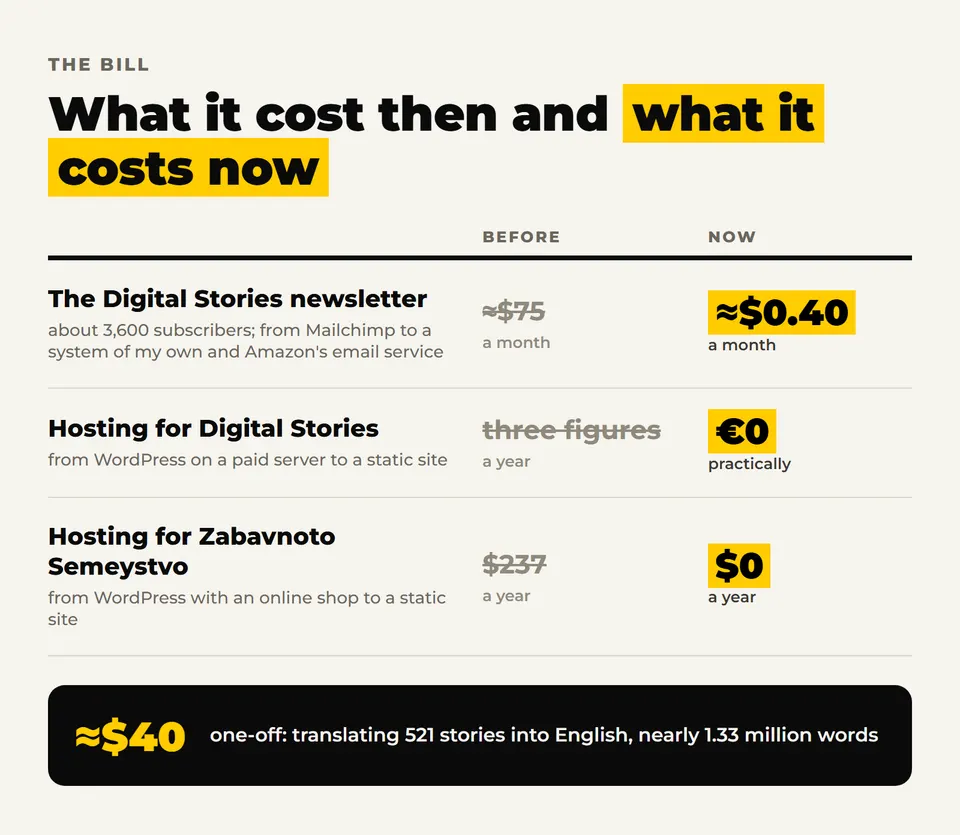
On the afternoon of Sunday, September 27, I wrote to Claude: “time to get rid of mailchimp.” Mailchimp is the service I used to send the newsletter to nearly 3,600 subscribers. For that many people it costs about $75 a month at today's prices. The next payment was due in a month.
Claude suggested sending the newsletter from a small system of our own, with the emails going out through Amazon's mail service, which costs pennies. I had no account there; I made one in seconds.
That same Sunday evening I learned more about how email works than in all the years before. Luckily, I have a fair amount of experience as a front-end programmer, Claude and I chose the solution together, and… the site's next newsletter was already sent by our joint creation.
~$0.40 a month instead of $75. What's more, the mailing list got a considerably more modern design and content, and it lands far more reliably in the inbox of everyone who has subscribed.
And then I wondered: what if the site could go through the same transformation?
Monday, 9:14 a.m.
I start with the design, made with Claude Design—Anthropic's tool for visual design. By 10:43 p.m. it's ready.
On the morning of September 28 I write that we're starting. At 9:39 a.m. I add hesitantly: “I don't even know if we need an admin to upload articles.” In other words: would I even need an administrative panel, or could I publish some other way?
Claude and I discuss it and arrive at a very interesting solution that would never have occurred to me, but which, as a software engineer, I can certainly appreciate. The site will be static, which practically eliminates the need for paid hosting. We'll use technologies I know as a programmer.
For a long time WordPress was a treasure that democratized the online space, but… it comes at a price. Lots of add-ons, extensions, things you don't know how they work. Couldn't Claude and I make something better?
What else is stopping us from getting started?
Here it is, by the clock, as tracked by my AI colleague:
- 11:05 a.m. – work on the new site begins.
- 11:26 a.m. – all the photos, over 4,000, are downloaded and made lighter.
- 12:02 p.m. – all 516 stories are moved.
- 12:44 p.m. – the design has been turned into real pages.
- 1:02 p.m. – the old addresses lead to the right new places.
- 1:10 p.m. – the newsletter works.
- 1:18 p.m. – the new site is up on the internet at a test address.
In under an hour, five years of archive moved house.
Go On, Go On… Come and See What It's Done!
How can I be sure nothing has been lost?
Claude counts the words in every story—on the old site and on the new one. 1,190,870 versus 1,190,902. The 32-word difference is in the new site's favor—it now also counts the words in a few examples of program code.
It also catches a bug that would have been nasty: photos with nearly identical names were overwriting each other, and some stories would have ended up with someone else's pictures.
At 12:35 p.m. I write: “you're perfect, keep going.”
In the afternoon, several Claude agents working in parallel read all 516 stories and propose 289 new rubrics to help readers find them. I look them over and reply: “they're perfect, go right ahead.”
At 6:18 p.m. I decide something that had seemed unthinkable that morning: the old site is closing its doors, and the next story comes out on the new one. No turning back.
At 11:36 p.m. we switch over. At 11:37 p.m.—“Great! The site is live.”
At 11:47 p.m. I write that the analytics and the email work. At 11:53 p.m.—17 minutes after the switch—the way I'll write from now on is ready, too. The answer to my question from that morning: I don't need an admin.
One Day Feeds a Year
Then comes the first new story—not by chance “Claude Before Claude,” about Claude Shannon, after whom (so they say) the artificial intelligence that built the site is named.
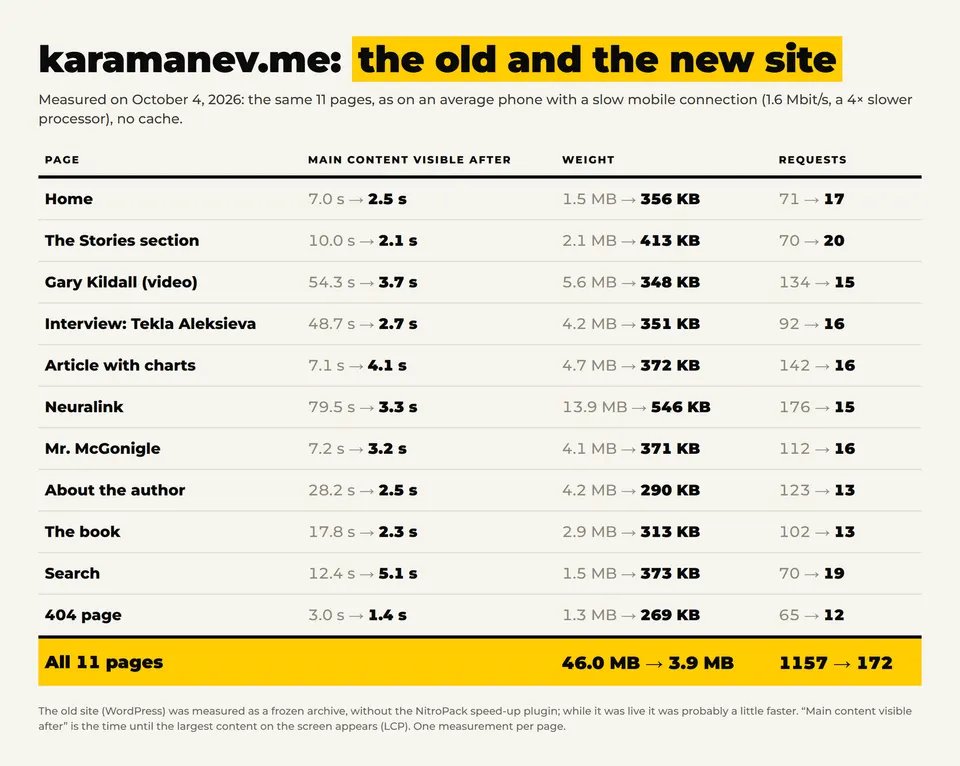
Numbers like 49 or 80 seconds look unbelievable, but they are real. The measurements were deliberately taken in tough conditions—as on an average phone with a slow mobile connection. On the old site the first text appeared after 3–13 seconds, but the “main content” on those pages is the big photo at the top, and it showed up only once everything else had downloaded. For the Neuralink article that means 13.9 MB, which at 1.6 Mbit/s takes more than a minute to arrive. On fast home internet the wait was, of course, shorter.
The yellow zeros and ones at the top aren't decoration. Each row is the title of the story you're reading, written the way a computer “sees” it—in zeros and ones. As you read, the digits in the strip at the top turn black one by one, and when you reach the end, the little figure from the logo “closes the book” and the caption changes to “Read.”
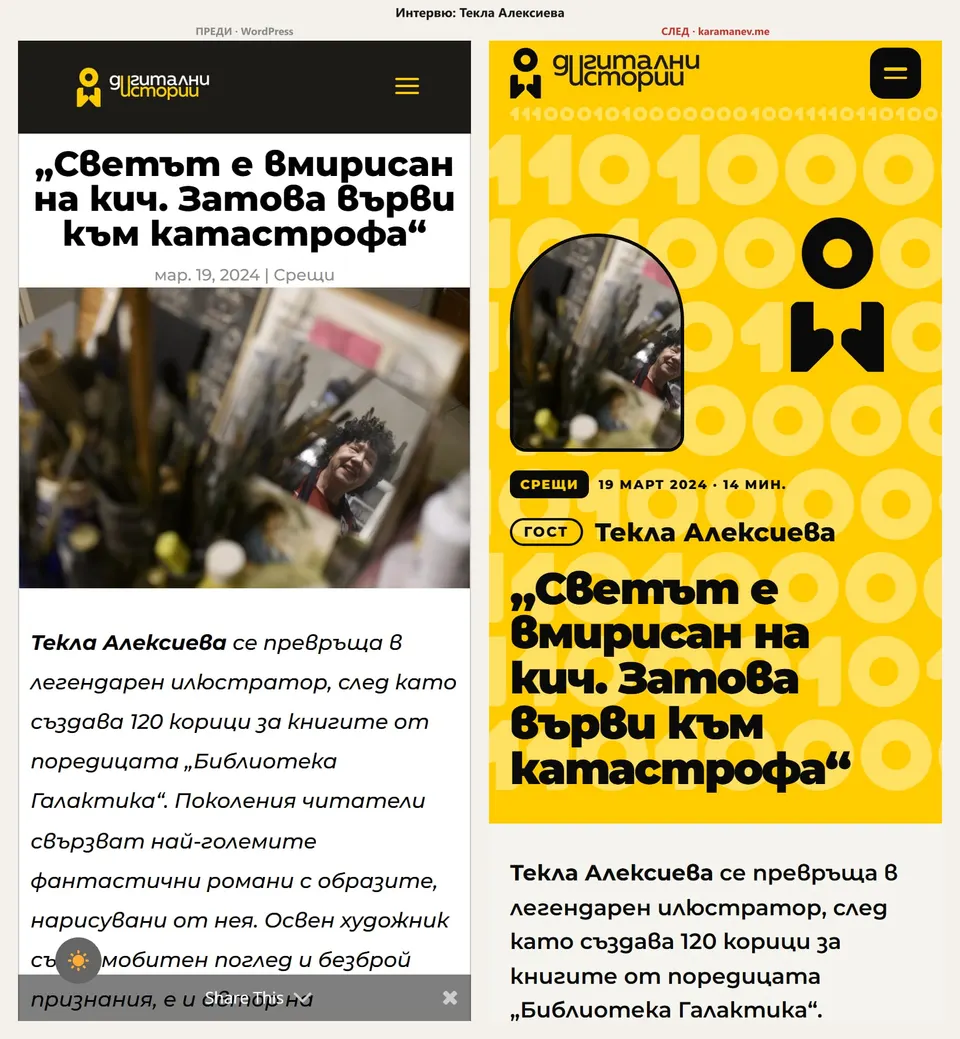
I'll spare you a lot more details—from the lovely new design ideas you can see below and above every piece, to the feeling of seeing, after years in which Google ranked me way down because of slow pages, everything in its stats glowing green, to put it mildly. Nor will I go into the hosting bill, which used to run to three figures and is now practically zero euros for the static, modern new site.
But people are made in such a way that… they're always looking for the next thing, and the next. I had long talked with guests of the site about how its content deserved to reach more people in English.
Digital Stories
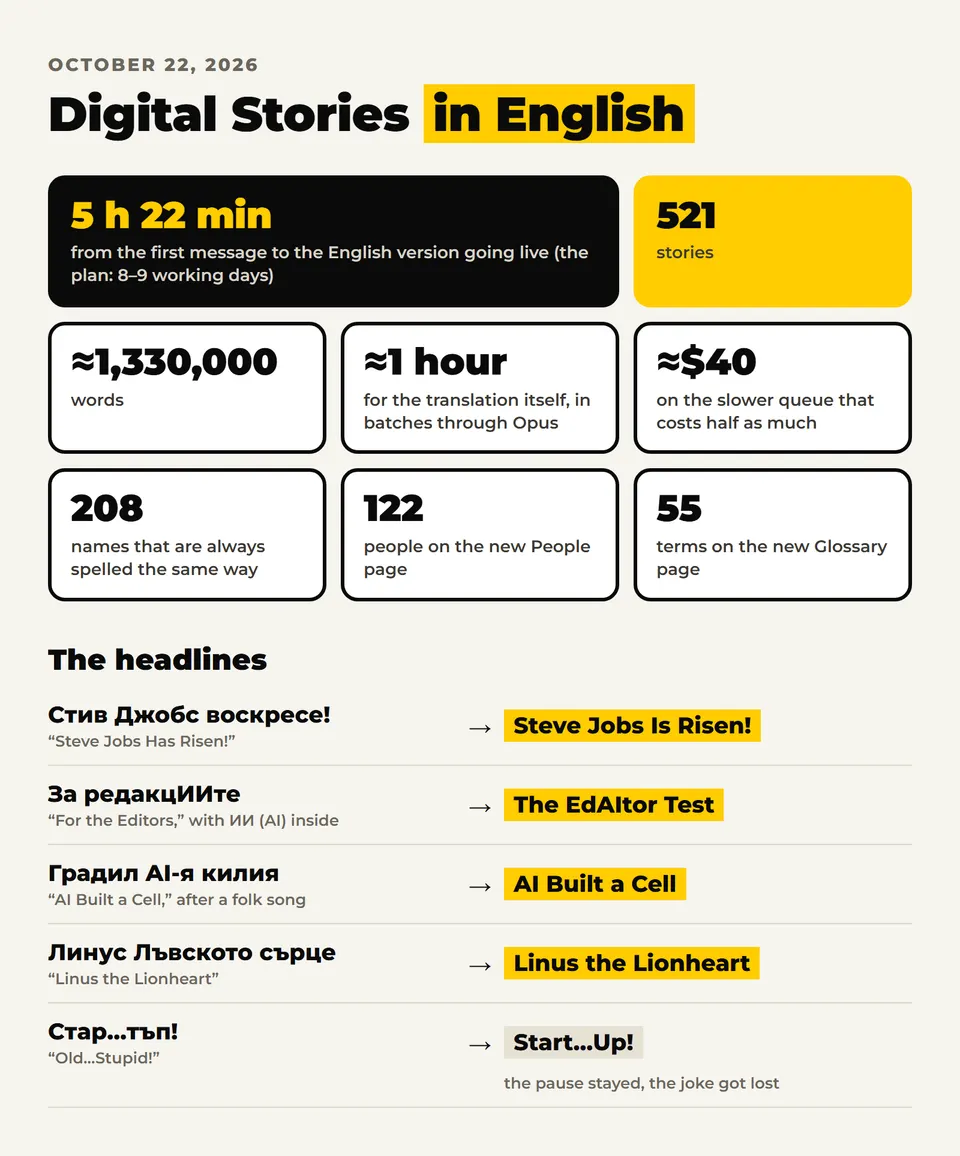
On October 22 at 12:23 p.m. I wrote to Claude: “I want us to make an English-language version of the site and translate everything onto it… it's important that it doesn't slow the site down at all and that the Bulgarian one stays the main one.”
Claude asked me seven questions. On three of them I answered the opposite of what it recommended. It suggested keeping the logo the same—I wanted a new one, in English, right away.
The plan Claude drew up envisaged eight or nine working days. The English version was live at 5:45 p.m. that same day—5 hours and 22 minutes after the first message.
The translation itself, of what were by then 521 stories—nearly 1.33 million words—took about an hour. Claude sent them in batches to Opus, Anthropic's powerful model, through a slower queue that costs half as much. It came to about $40.
The rules turned out to be the most important part. They begin with a single sentence: the reader is “an international reader who knows nothing about Bulgaria.” Everything else follows from that. Something Bulgarian that this reader can't know gets explained in a few words right in the sentence, the first time only. No notes in the margins. Bulgarian names follow the official transliteration, and foreign ones return to their original—Jensen Huang stays Jensen Huang, not some back-transliteration from Cyrillic. Books and films get their official English titles. The rules also come with a list of 208 names that must always be spelled the same way.
The headlines were the most fun. Digital Stories loves wordplay, and wordplay rarely survives translation. Here's what happened to some of it:
- “Стив Джобс воскресе!” (Stiv Dzhobs voskrese!, “Steve Jobs Has Risen!”) became “Steve Jobs Is Risen!”—the Easter greeting exists in English, too.
- “За редакцИИте” (Za redaktsIIte, “For the Editors”), where ИИ, the Bulgarian abbreviation for AI, hides inside the word, became “The EdAItor Test”—and in English, AI hides inside the word too.
- “Градил AI-я килия” (Gradil AI-ya kilia) became “AI Built a Cell,” while the inner headline “Ilia Built a Cell” keeps the echo of the folk song.
- “Линус Лъвското сърце” (Linus Lavskoto sartse) became “Linus the Lionheart”—along with the joke that the Brothers Lionheart are Swedes, while Torvalds is a Finn.
Not everything survived. “Стар…тъп!” (Star…tap!, “Old…Stupid!”) became “Start…Up!”—the pause stayed, the joke got lost. Bai Ganyo had to be introduced as “the archetypal Bulgarian boor from Aleko Konstantinov's 1895 satire.” And words like чат-пат (chat-pat) and тулуп (tulup) stayed in Cyrillic, with a translation in parentheses.
The Bulgarian site stayed the same. All it gained were two lines telling Google there's an English version, and a small EN at the top.
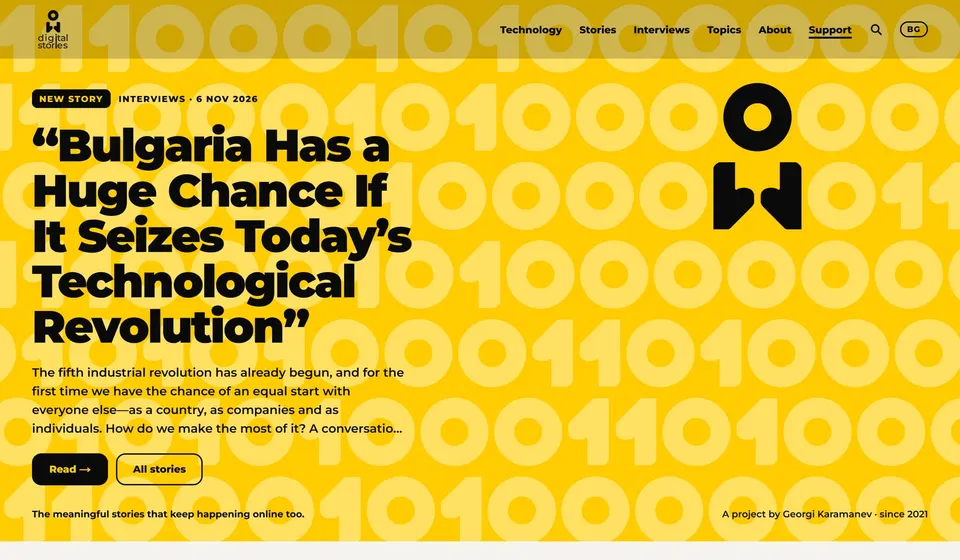
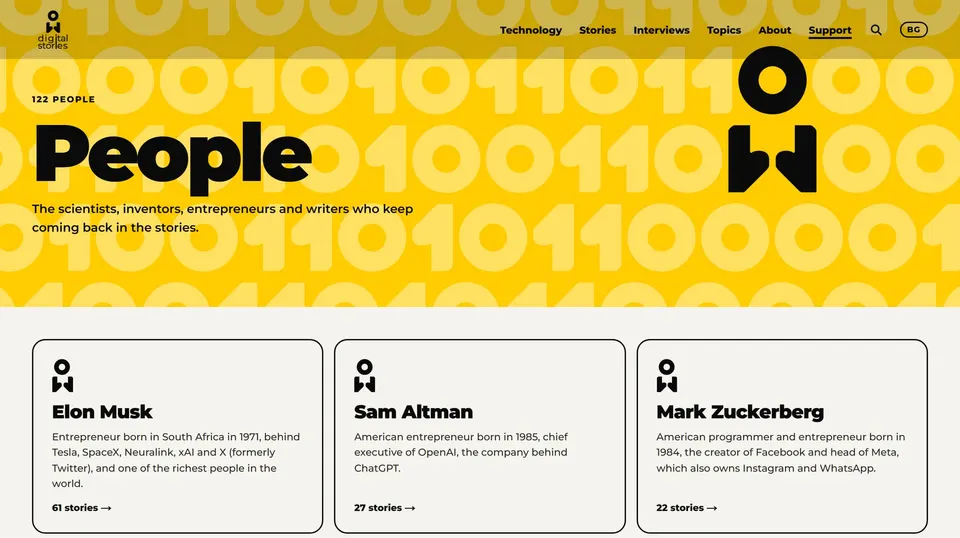
Since then every new story comes out in both languages at once. The site itself sends foreign visitors to the English version and Bulgarian ones to the Bulgarian version. The choice is remembered. And two new pages appeared in both versions: “People,” with 122 people I've written about, and “Glossary,” with 55 terms.
One Site Doesn't Make a Spring
Well, you get used to the easy life fast, but… isn't this too much? Could I rebuild just as quickly and efficiently, with the help of AI, another site I created with my friends from The Floor—the one that brings together Quizzes for a Cause?
That site was on WordPress too, with a ready-made theme and a quiz plugin. A year ago, when we started it, I didn't imagine there could be a drastically easier and more convenient option.
Would it be the same now?
Saturday, October 3, 10:24 a.m., I write: “we're rebuilding the quizza.bg site from scratch, dumping wordpress… I'd like it to be something like what we did with Digital Stories.” I'm no longer asking whether it's possible.
The design—again from Claude Design—is ready in the afternoon. About two hours later the new site is already running at a test address. From the first message to a working site—about seven and a half hours.
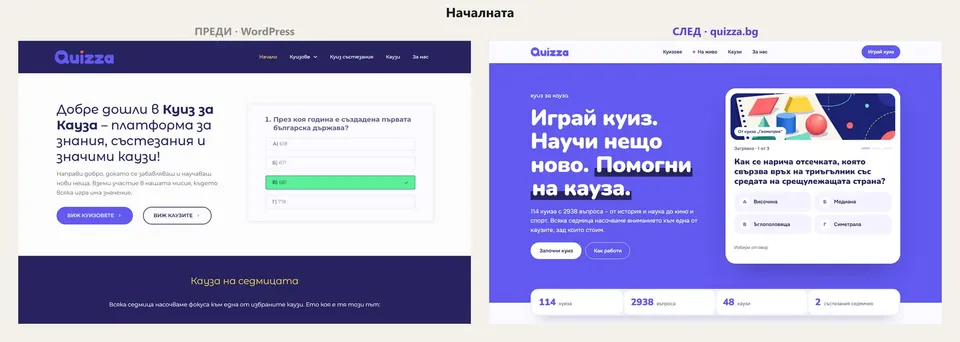
The old quiz catalog downloaded 258 megabytes of images all at once—about as much as fifty songs. On a mobile connection, the first picture appeared after about 50 seconds. The new one shows the same thing in 2.5 seconds. Google's speed score on a phone jumped from 37 to 97 out of 100.
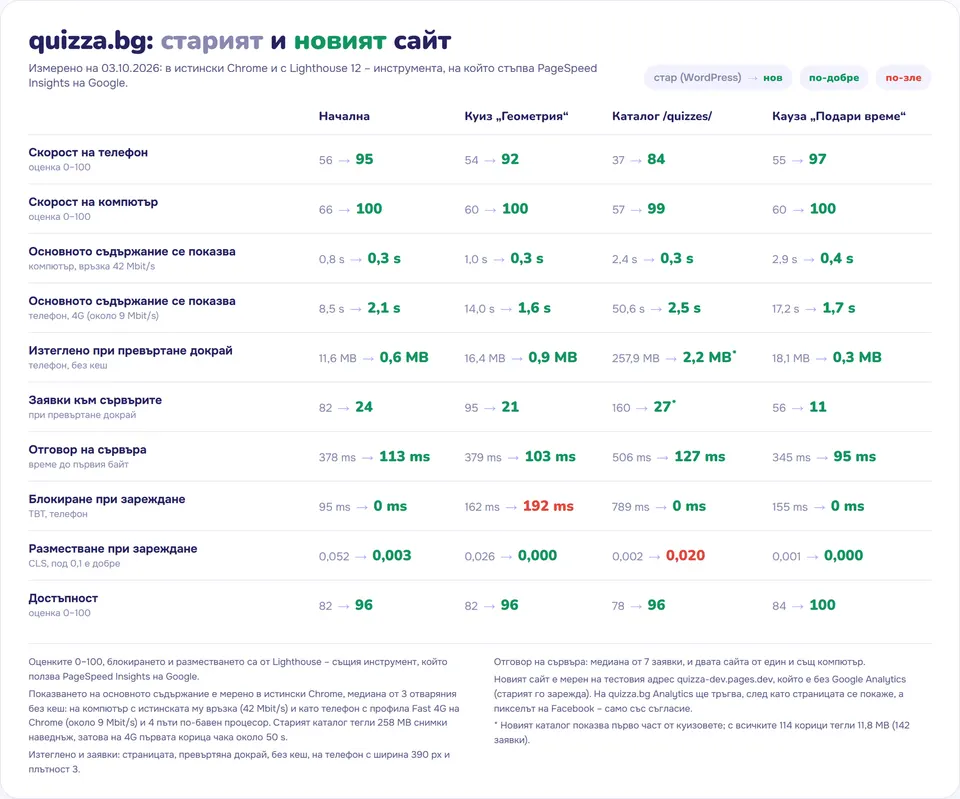
As for how much prettier and more convenient it is… try it yourself. Over 120 quizzes await you, and every Sunday (and sometimes Wednesday) we also put together a general-knowledge quiz competition for connoisseurs!
A House
I decided to carry on with other sites belonging to people close to me.
Old Sofia Tour
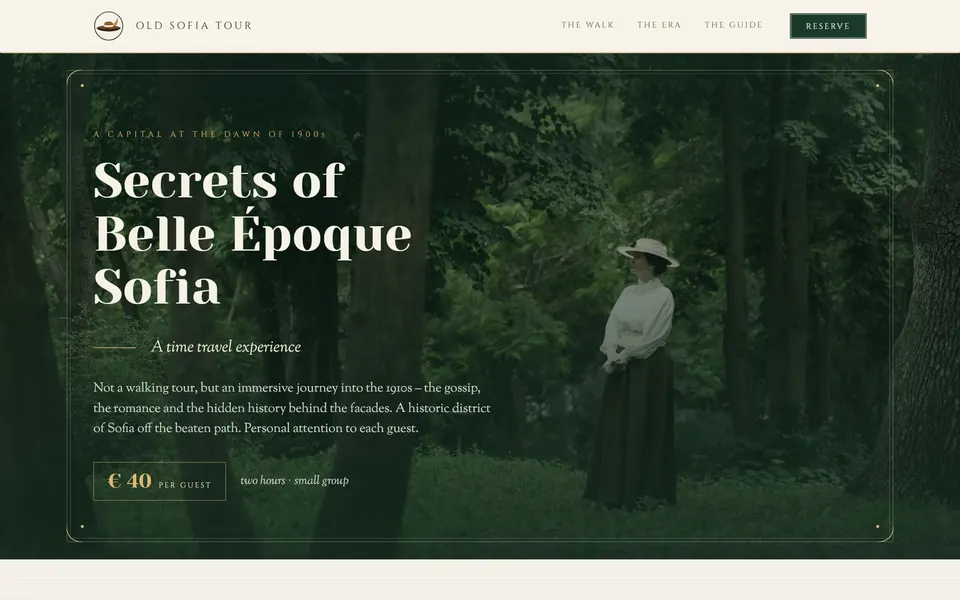
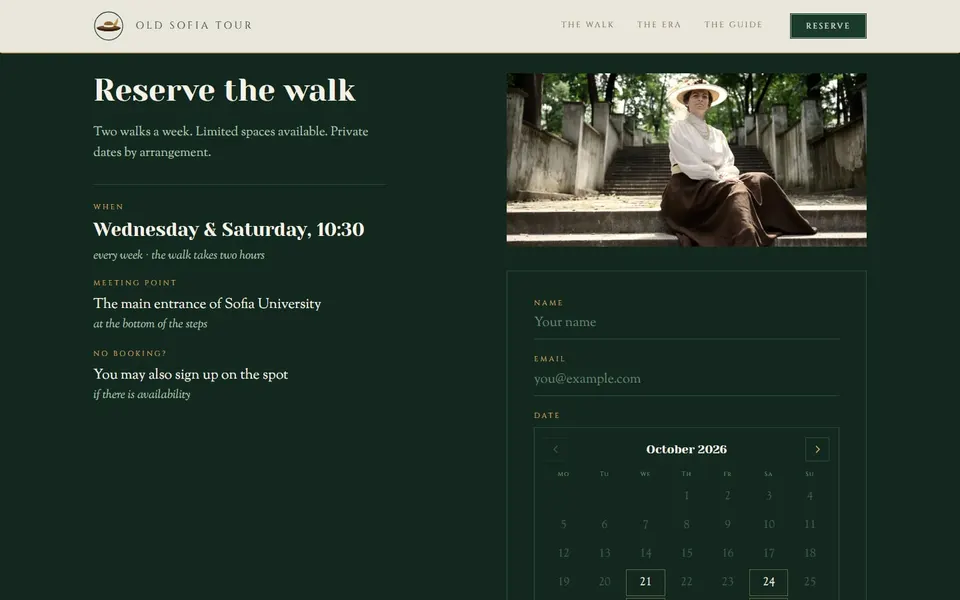
A two-hour walk in which my wife, a guide dressed in period clothes, takes you through the Sofia of the 1920s. The site was made in a few hours: from 4:23 p.m. to 10:42 p.m. on September 18. Back then I didn't yet believe in the big things, but the small ones could already be done in an evening. In the booking calendar you can only pick Wednesdays and Saturdays—the only days the walks take place. The logo is a stamp with a lady's hat.
Zachary Karabashliev
A site for a novelist, playwright and screenwriter, in Bulgarian and English. Zachary didn't have a site. The first version went up about four hours after the first message.
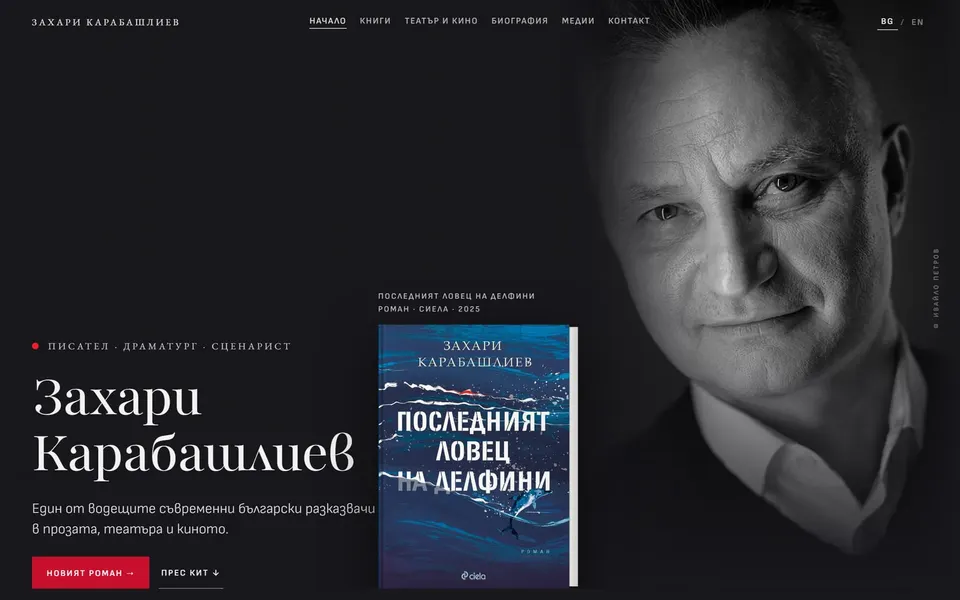
Isn't it beautiful?
Zabavnoto Semeystvo
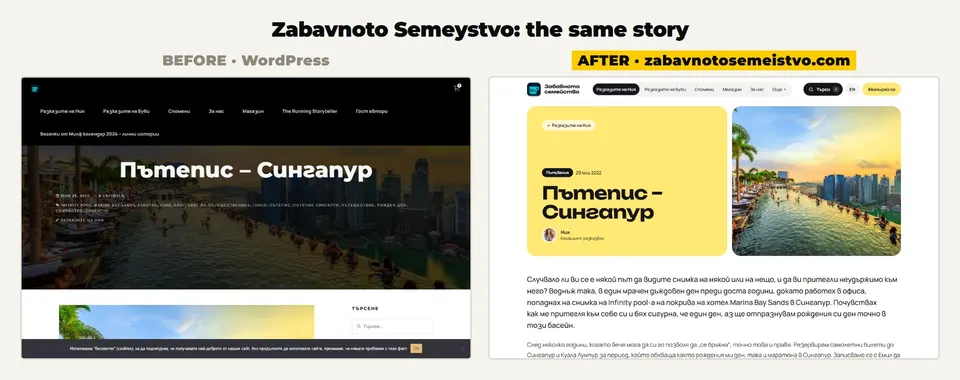
Zabavnoto Semeystvo (The Fun Family) is a site with 99 stories that Nia Yotova and her father, Grandpa Bubi, have been writing since 2019, plus two books. It was on WordPress, with an online shop. On the afternoon of October 17 the new site was ready with all the old content. That same afternoon—with an English translation of the 98 stories, too.
The numbers here are the most dramatic. The home page used to weigh 16 megabytes. Now it flies at 405 kilobytes—40 times less. The main content on a phone used to appear after 25.7 seconds; now it's 1.8. Google's speed score on a phone jumped from 30 to 99. The old site invited 14 outside services onto every page; the new one, a single one. We checked all 648 old addresses. Hosting used to cost $237 a year. Now—zero.
Preobrazi.me
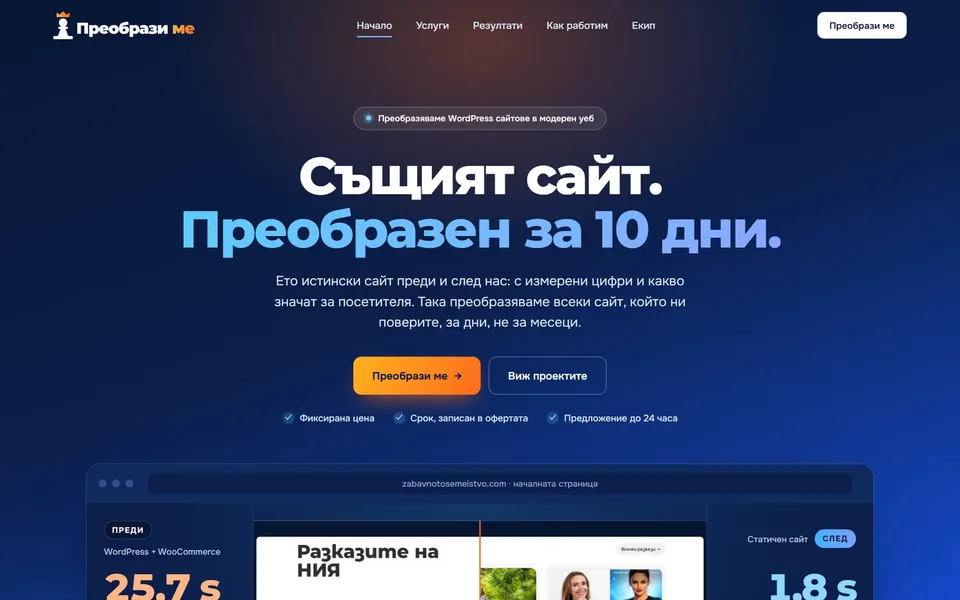
Somewhere along the way, three friends and colleagues and I decided to join forces. We had discovered what a pleasure it is to see your new site. Beautiful, fast, modern, with meaningful, polished content. Yes, AI is an invaluable helper, but it certainly doesn't hurt to know what you're doing along the way. We say that as a team of a designer, a marketer and programmers with quite serious experience.
How hard can it be for a pawn to become a queen? For your slow, aging site to take flight and bring you serious income?
In Short
Here's what I learned:
- It's not magic, it's a conversation. The decisions were mine—what stays, what goes, when to switch over.
- The boring things matter most. The old addresses, the email, the newsletter. The site is the easy part if you know what you want.
- Check. Claude counted every word and every photo by itself. Even so, small problems surfaced in the first few days. That's normal.
- The bill changes. A site, newsletter and hosting that cost hundreds of euros a year now cost next to nothing.
- Artificial intelligence makes mistakes—and admits them. What matters is that someone is there to catch them.
- Measure before you switch. Speed, weight, old addresses, every word. After the switch it's too late to find out how slow the old site was.
- The button is yours. Claude does almost everything, but the email to 3,600 people was sent by me. As it should be.
- You can have an admin without WordPress. There are free panels for people who aren't programmers. Or you can do without a panel altogether.
Sunset and Dawn
In March this year I said in an interview: “for the second time, I'm watching the sunset of a profession from the inside—after journalism, I'm seeing the same trends in programming.”
I thought I knew what I was talking about. But it's one thing to say it, and another to sit there on a Monday at 11:37 p.m. watching five years of your life open up in a new home, faster and more beautiful than ever, after a day in which you've mostly written “go ahead.”
In 2021 I wrote: “Whether this is really possible, time will tell. Personally, I'm keeping my fingers crossed.”
Time told. It took five years. And 14 hours.
But which is the more important part? In my view, the fact that we live in an age of wonders. The new site isn't the biggest of them, but it's no small thing either. And for all the other wonders, look out for the next Digital Stories!