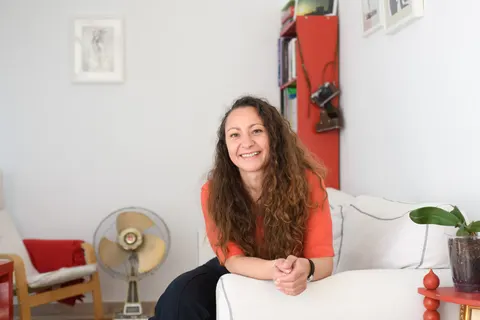
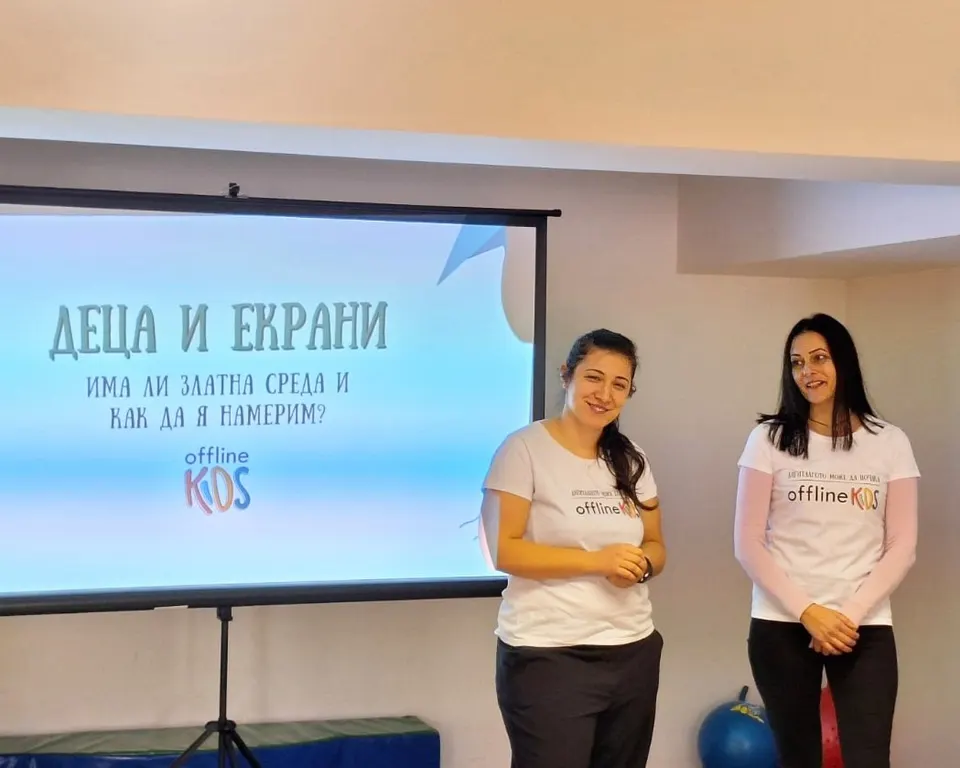
How do we lead children who are already too absorbed by the internet back out of it? That is the great cause of Alexandrina Georgieva. A programmer with serious experience, she now heads the Offline kids foundation, whose mission is to help parents in their search for balance.
When can children’s encounter with technology turn into a problem? How do we find that oh-so-difficult balance? How do we introduce children to technology without it coming at the expense of basic human skills they will need in the future? If we notice that a child spends hours in front of a phone or a tablet, is there a way back?
It is time for a most curious personal story and countless valuable tips for every digital parent. For everyone who believes it matters that children, from time to time, find themselves offline as well.
The series “Digital Children” continues. I am looking for the important points of view and the useful advice that can help us as parents and adults. Your opinion matters too! Take part in the survey, and let’s paint the picture of parenthood in digital times together.
– Your story is a very interesting one. You worked as a programmer for quite a while, and then you created a foundation to give children back their offline experiences. How did that happen?
– I started programming while I was still a student, and I had six or seven years of active work in the field when I went on maternity leave. My thoughts on the subject started a little before that. One day I was just sitting at the computer, black screen, colored symbols. I had some super boring task, and I thought that this can’t be all there is to life. Here I sit, my whole day passing in front of a screen. I felt I needed something more.
When I went on maternity leave, I remember the first walk with my little one. He was two weeks old, the first sunny day after winter. We go out, I had decided I would enjoy the break, I wouldn’t pull out my phone for every little thing, and
I was shocked to discover that I had actually forgotten what it is to simply enjoy the time, just like that.
I started thinking about it and realized that, without noticing, I had reached the point of trying to fill every single free minute with something. If there was nothing to fill it with, I would just pull out the phone and look for what was happening somewhere. That is how I began to think about the influence of technology—on us and on our families. Especially in a situation where everyone has a TV in their own room so that we don’t disturb each other’s movies. And above all, about how it affects our children. I remembered our own childhood, how we spent all day outside with friends, going out, free. When we had nothing to do, we would start ringing doorbells: “Come out.”
Whereas the children I knew now didn’t know their neighbors’ kids at all.

– I’m sure almost everyone in our generation of parents has similar thoughts, against the backdrop of the online brain assault. And yet you didn’t stop at the idea—you took the next big step.
– I was thinking about it constantly. When my little one was seven or eight months old, I told myself: “All right, we won’t stop digitalization, our children will live in a technological world. But there are things that need to happen before they get to screens. Things they need to learn, such as how to communicate with others, how to look them in the eye, how friendships are made.”
Not to mention all the creative processes that need to happen and that will actually stay in their memories. Yes,
children won’t remember their best day in front of the TV or the phone; they’ll remember the experiences they have with us and with their friends.
That is how the idea for a Facebook group was born, where we could share ideas for offline activities with other parents as an alternative to screens. Instead of offering screens, we would offer games.
I kept thinking about the subject, reading, observing, talking to people and getting into their situations. That is how I realized that
we face a very big challenge as parents. Especially when children grow up and things slip out of our control.
– Definitely! That is exactly why I started gathering this series of texts.
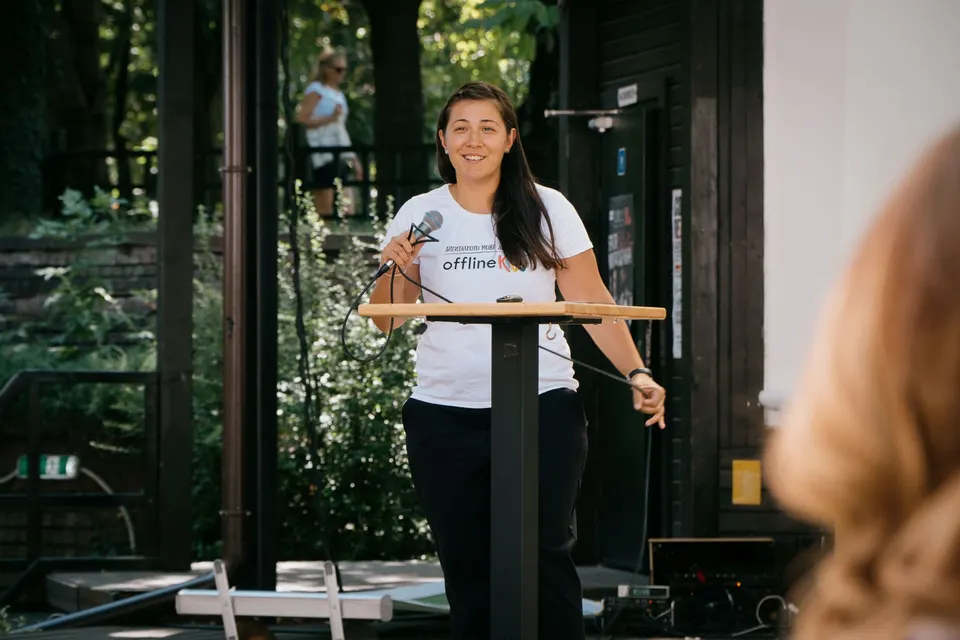
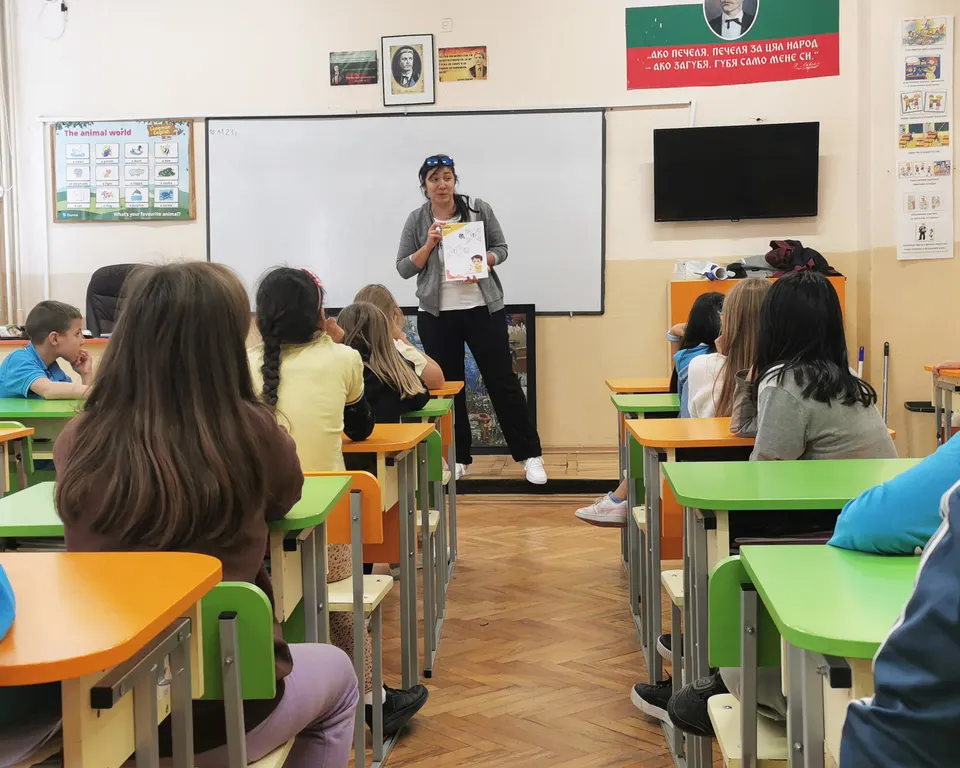
– So I decided to create a blog first, and later the Offline kids foundation, whose mission is to help more families find the balance between the real and the digital. Our message isn’t that technology is something terrible—on the contrary, it can be a useful tool. But how we use it matters a great deal, and alongside that we must develop the most human skills in children.
Online there are endless arguments for and against screens. That isn’t the question. The question is the way they are used, and that is devastating for children.
A year ago, statistics came out on children’s screen time in Bulgaria. It shocked me: children between 0 and 2 years old spend 2.5 hours a day on phones alone! On top of the TVs, tablets and other screen stimulation they are exposed to. And 40 percent of these babies are on TikTok—an app meant for ages 13 and up, and there is even talk right now of raising the limit to 16.
Forty-four percent of children have a TV in their bedroom, which is also devastating. According to scientists, a large share of the negative effects of screen time come from the fact that it disrupts the quality of children’s sleep.
The usage is alarming! Our first goal is to inform parents about it, because it turns out many of them don’t know. Second:
to help them believe that there is something they can do.
From what they tell me, parents often think it’s already over, all is lost, and they just go with the flow, giving a three-year-old four hours of screen time.
The third is to equip them with practical solutions for what they can do instead of carrying on with the screen. That is the hardest task, but I believe there is a solution.
– So you stopped programming and devoted yourself entirely to these three causes.
– I spent five years on maternity leave with two children in a row. After that I had to go back for financial reasons. But somehow I already had a very big inner conflict. One of the reasons I began thinking about all this was that I myself had very serious addictions, first to TV series and then to social media.
For seven years I literally couldn’t fall asleep without a series playing next to me. Without it, all the anxious thoughts, fears and worries flooded me. My brain had adapted to such a degree that even after two hours of failed attempts, the moment I put on something on my phone, I fell asleep immediately.
It was very hard to break the habit; the first week I literally didn’t sleep. But afterward, once my brain adapted to the change, everything changed.
My headaches went away, the pain in my eyes, my mood lifted, my creativity and motivation came back.
I’m ashamed to say it, but everything I had blamed on the children turned out to change once I started getting good, sufficient sleep. Knowing that, it was very hard for me to go back to eight hours in front of a computer.
It was during COVID, and I had to be alone at home. Another problem I was battling was that, because of living online, I had lost the ability to communicate with people. For a whole five years I didn’t want to stand in front of another human being and communicate normally at all. Being left alone at home again felt like ten giant steps backward.
I want to do something far more meaningful, and I believe what we do with Offline Kids is just that. It was hard, but I decided to let myself go with the flow of a digitally minimalist life.
– Don’t you miss programming? It can actually be a pleasant and engrossing pursuit.
– Sometimes I miss it, but other things matter more to me. Usually the people who contact us are those who already
in some form feel guilty for having offered a screen, see the negative effects and suffer a great deal from what is happening.
The feeling that we have managed to help such a person take even one step forward in the process is far more satisfying than knowing I’ve written the perfect function.
– But how is it that, on a mass scale, we really fail to realize such a huge problem? Even in your case, quite a few years had to pass before you started thinking about it, and many people never reach that stage at all.
– What frightens me is that
we are so used to reaching for screens in every free minute that we are on complete autopilot and don’t think about anything.
Very often we don’t realize the consequences of what we are doing to our children. You know, these technologies can be so absorbing that we don’t see what is going on around us.
I’ve seen incredible things. For instance, a child was banging his head on the ground and gave himself a bloody wound trying to get the attention of his mother, who wouldn’t stop digging through her phone. In the end, when she finally noticed him, she slapped him for hitting himself. We have very serious problems.

– But how can we, as a society, really not notice? Isn’t it obvious? What’s more, the trend, in my view, is for screen time to keep growing every year, for children too.
– I’m almost certain that in most cases we do realize it. It’s just that
choosing the harder path—having your child live with screen limits—requires a lot of sacrifice.
On the one hand, we hand over the phone when the kids drive us completely mad—either we’re exhausted or under a lot of stress at work, we need a little quiet, and that’s the quickest fix. We justify ourselves with our own need, which is valid and real. On the other hand, I think there are also many irrational fears, for example that the child will end up isolated or fall behind their peers. I hear this from parents of three-year-olds. And when I ask them how they develop the child’s tech skills, they say: “We put on a cartoon for him.”
For me there is a huge difference between giving a three-year-old a phone with YouTube or TikTok and actually teaching them how to use technology deliberately and with some purpose.
– What steps did you go through to overcome your own screen addiction?
– I did it in very small steps. If I had decided to go on a total detox all at once and start a new life, it would have been very hard.
Perhaps the realization itself came after each small step. I made the first change when COVID began and the media constantly published the numbers of the sick and the dead. I felt very anxious, and at some point I realized I was taking that anxiety out on the children. I decided to stop following any news—we don’t have a TV, I only followed it online—but I stopped, and by the second day I could feel my anxiety dropping. I still had the essential information—what the bans, restrictions and news were—but I got it from relatives who passed on the most important bits. When I saw how much better I felt and how it affected my children,
I decided to take the next step—to sleep without my phone. That changed everything!
Once I was convinced how little I had grasped the impact, after all these changes, I decided to take the next step. With a solid foundation and the motivation that it works, I left social media for a month.
That too was one of the hardest things. It was still COVID, everyone was staying home and it was much harder to meet in person. And sometimes our emotions are irrational. When I stopped going on social media, by the second day I felt as if all my friends were ignoring me. It was completely absurd—I was the one who had taken the step—but the initial withdrawal of three or four days had to pass before I could really begin to understand what was happening and find alternatives: how to meet my need for connection and communication in a richer way, not just through text messages.
I began calling the friends I used to text more often, and gradually we started meeting in person, once it became possible.
Communicating face to face turned out to be so much more satisfying than what I had grown used to—chatting—that when the month was over, I didn’t even feel like going back to social media.
I did go back for the Offline Kids page and because I wanted to publish information on the subject. I set myself very clear rules: I log in once a week, schedule posts and allow myself five minutes or so to reply to messages. Because I had been through the detox period, through finding alternatives for meeting my needs, it was much easier for me to set limits.
Perhaps the key here is that I truly gave myself time to find a way to meet my real psychological needs.
– Which, of course, is individual. I don’t limit myself on social media because I do a large part of the things that matter to me there; otherwise I would most likely do it too—I see a very serious logic in digital minimalism. But aren’t we doomed from now on to be a minority, those of us who set such boundaries, both for ourselves and for our children? Controlling screen time is an individual decision, and society clearly doesn’t recognize it as an issue.
– It’s possible. These days I’ve been thinking how hard it is for a digital minimalist to exist in an environment where everyone prefers to give in constantly to the pull of technology. Because we really do function differently. At least the people I talk with who are committed to digital minimalism look for more depth.
– And they have concentration… And those, I believe, are the skills that will set us apart in some way in the future.
– We may well be a minority. I think more people are waking up and choosing to use technology more consciously, including for their children. But I don’t expect us to outnumber the rest.
– I’ve long liked this comparison with food a lot: in purely evolutionary terms we had to get more and more, and those who could do so survived, and later that turned into a problem. It’s the same with information; we’re easily lured by fast carbs, by scrolling. And in both cases the problem is more complicated with children, for many reasons. Once a child has put on weight, it’s much harder to do something about it, and the same goes for information addiction. If a child is used to spending hours every day in front of a phone and the parents realize there’s a problem, what is the way forward? What does the “diet” look like?
– For me,
the main solution to the problem as a whole is for us, as parents, to be more engaged with our children, to spend more time with them, to talk to them, to teach them values and to think critically.
And perhaps to slowly win them over to our side.
First comes the realization: we are not fighting against the child, but for the child. We cultivate values in them so that other, more meaningful areas of life can become important. Then we help them understand the influence of technology. That happens by teaching them to think critically, to reflect on their own experiences, by telling them stories. But about characters who are neutral to them, because when we comment on their own behavior, all their defense mechanisms kick in and it’s entirely natural for them to deny it.
But when we tell them about one child’s technology addiction and what it led to, they will look at the situation more calmly.
When it comes to winning them over, there are two main approaches. One is gradually reducing screen time until it falls within some limits. That can be quite challenging and hard, because it demands a lot of engagement from the parents.
At first we offer some alternative in the form of shared time—board games, books, sports. We increase the time in which the child feels comfortable away from the information stream. At some point we teach them to set goals and plan their time on their own. Because
part of the problem is that children have nothing to do with their free time and fall back on whatever is easiest.
The second approach is a digital detox: for a longer period we take away all screens, and then, once a certain time has passed, we reintroduce them with very clear boundaries. This approach works well with younger children or with those who have asked for the change themselves.
But with both approaches it is very important to teach them to meet their needs in real life—for communication, for socializing. I often hear this as the motive for turning to screens. One particular boy told me: “I realize the negative effects constant gaming has on my life, it’s true. But at home and at school everyone keeps telling me how stupid I am.
Online is the only place where I get good feedback about myself and feel good.”
Boundaries are one thing, and they matter, but at the same time we have to look closely and search, case by case, for the root of the problem. Why do these children turn to their devices so excessively?
It is important to keep in mind that when the problem runs deeper, the support of a trusted specialist will be needed.

– And it turns out the reasons are quite varied…
– Definitely. Sometimes children feel lonely and try to escape their discomfort. At school everything they do demands an awful lot of effort. Another reason is the way we talk to them. Many parents say: “You’re a zombie, you’re a screen kid, you’re a problem.” When we project that identity onto children, they accept it as normal. And they have nothing else to do but what we have said about them.
Another is the lack of boundaries. We ourselves can’t control ourselves, so we can’t expect a small child to achieve self-control at five or six. The idea is
exactly like teaching them to ride a bike: we hold the seat until we see they’re starting to balance, and then we let go. It’s the same with technology.
We can’t just hand them a phone and expect them to learn to use it in a useful and healthy way on their own if we aren’t there.
Especially with older children—13 or 14—setting abrupt boundaries would more likely backfire, because it seriously breaks the bond between parent and child. There, again, the goal is to win them over to our side in finding the solution. And the first step is to spend screen time together. To show genuine interest in what they do, what they like and why, what this game gives them, why they like this influencer. To talk, without interrogating, about their experiences there and what those experiences give them. Sometimes in the conversation both the children and we adults realize things we hadn’t noticed.
– Shouldn’t we have done our job before they become teenagers? Because then it’s much, much harder…
– Yes, that’s the ideal scenario: when children are small, they have very strict limits. And when we use a screen, we do it deliberately, knowing why. It’s better to watch a family movie on a Friday night and discuss it afterward than simply to offer a screen so the kids sit still and keep quiet.
Alongside that, we talk to them about values from the very beginning. And once we have cultivated values, our conversations can rest on the trust we’ve built. Then we teach them, we get them to think about how technology can help them live by those values—and how it can do exactly the opposite.
Communication is an example. Technology can help us stay in touch with someone close who lives abroad, and that’s wonderful. For babies, there is scientific evidence that video calls don’t have the same negative effects as, say, cartoons.
At the same time, all these technologies,
if we use them to escape the person who is next to us right now, even unconsciously, do the opposite job. They don’t bring us closer; they push us apart.
– I also think that fixating on a specific number of hours of screen time can be misleading, even though there must be limits. We don’t have a TV either, but I bought a projector precisely because I think it’s useful to watch a good film once a week and discuss it. That even compensates for the loss of focus and concentration, the negative effects that otherwise come with technology.
– There was a study showing that even the youngest children can develop empathy by watching a particular cartoon, but this happens only when there is an adult talking to them about what is happening on the screen. In other words, the screen should be an aid, not a substitute for the important things.
Personal example matters a great deal. Let’s set ourselves the goal of at least one hour every day when the children come first and our phone is left somewhere far away. If something truly important and urgent comes up, let’s tell them, so it’s clear that it is. Let them see that we aren’t scrolling aimlessly, just for the sake of it.
– I miss the times when children played outside too—in Sofia and in other towns and villages. Do you think we can get back there?
– I think we can, with a little more mindfulness.
I choose to believe we can. If we believe the opposite, woe betide us…
So far in the series “Digital Children”:
Coming up:
- What will education look like tomorrow? – Evgenia Peeva, founder of Teach For Bulgaria and director of SoftUni Buditel, a school named after the buditeli, the National Revival enlighteners
- How did we harm two generations, and can we find the middle way? – psychologist and children’s author Slavi Stoev
- How has technology changed motherhood? – Krasimira Hadzhiivanova, creator of Mayko Mila (Dear Mother)
- Why and how does humor save today’s parents? – illustrator Neda Malcheva
- What is it like to be a father today? – communications specialist Mihail Stefanov
- Children and books: why is this bond more important than ever? – Val Stoeva, creator of Detski Knigi (Children’s Books)
- Meet… AI – an experiment in which I will introduce my children to ChatGPT.