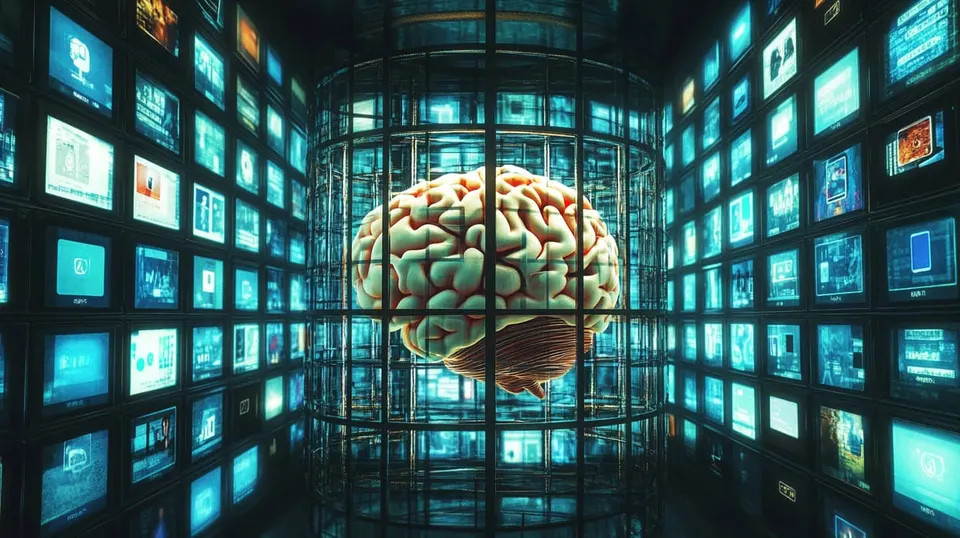
Our brain has developed over the course of evolution, gradually getting used to a changing environment… and then came Facebook, Instagram, TikTok. Suddenly we find ourselves in a world for which our most important organ turns out to be completely unprepared. And it copes… as best it can. It tries to adapt, but there is no way this can happen without a breakdown.
Not a breakdown, a catastrophe. One we cannot even take in, because we cannot stop, think, talk it over. We are too busy moving on. Scrolling, browsing, bickering… Like a hamster on a wheel.
Anders Hansen is a Swedish psychiatrist who is not afraid to raise the big questions of today's technological age. Precisely the questions that are the reason the site you have landed on exists. Hansen is read all over the world, and fortunately so—because if you find the time to reflect on the messages he leaves, it will certainly help you pay attention to the questions that really matter.
That matter to every one of us.
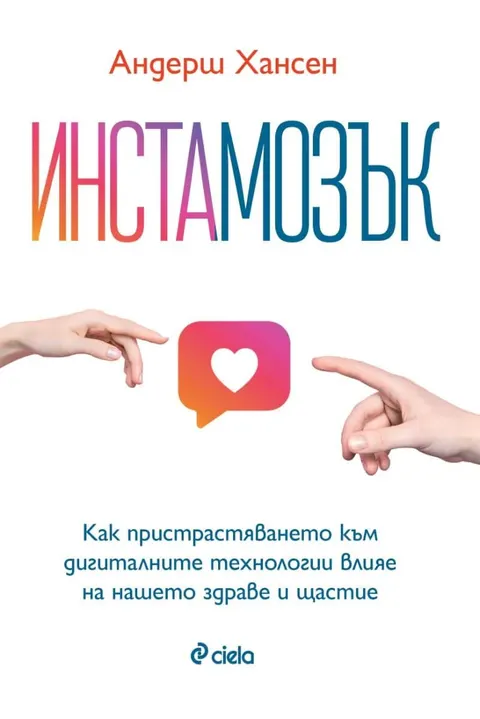
His new book is called Insta-Brain; it recently came out in Bulgarian and brings together so many important topics we like to avoid. If you read it, your brain will thank you. I have tried to gather 10 key points.
Ahead lie no fewer than 10 headings ending in an exclamation mark (forgive me!)! Because it is definitely time to be amazed, to wake up, to think! And Dr. Hansen gives us plenty of reasons to do so.
1. Cut the Wireless Cord!
“If we were left without our mobile phones, our world would collapse—40% would rather lose their voice for an entire day (really!) than be parted from it. Wherever we look—downtown, in the café, in restaurants, on the bus, at dinner, even at the gym—everyone is looking at their phone. Whatever our opinion on the matter, we have become addicted!
On average we use our phones for 3 hours a day. Of course, some spend less time on them and others even more. Is there anything the heaviest phone users have in common? When scientists studied the mobile habits of nearly 700 students, they found that a third of the participants in the experiment were so addicted that they could not stay away from their device even at night. As a result, they were tired during the day.”
That we are addicted is beyond dispute. We can easily see it in so many signals around us. And what are we doing about it?
Anders Hansen takes us down the path of long evolution, in which we are merely the last few dots in a vast sequence of 1,500 generations through which human development has passed. Hundreds of generations lived quietly and calmly, with barely any information about what was happening beyond a radius of a few dozen kilometers. They knew their few neighbors, they had serious but rarely changing basic stimuli…
Until suddenly we find ourselves in a world where information bombards us. Our “friends” number in the hundreds of thousands, and the battle for our attention is fierce.
And a clear parallel emerges. Once, in evolutionary terms, it was important to try to eat as much as possible, to stock up, to devour as much food as you could. Today, in most of the world, food is abundant, and suddenly it turns out that the hard part is holding back. Without noticing, we have to reverse the goals of several thousand years of evolution, and for now we do not seem to be doing particularly well.
Exactly the same thing is happening with information. Only far more fundamentally. And far more dangerously than even the health problems that come as a natural consequence of obesity.
2. Don't… Like!
“Justin Rosenstein, an American in his thirties, decided to limit his use of Facebook and abandoned Snapchat altogether, comparing it to heroin in terms of its ability to create addiction. To cut down on his phone use, he installed an app designed so that parents can limit their children's mobile habits.
Rosenstein's move is particularly interesting given that he is the one who created the ‘like’ button on Facebook. In other words, the man behind the ‘like’ believes his own creation is too tempting, and in one interview he gives the impression that he almost regrets it: ‘It is very common for humans to develop things with the best of intentions and for them to have unintended, negative consequences.’”
We do not know where we have ended up. While the next technologies loom, artificial intelligence is here to rebuild from the ground up the foundations of everything that makes us human… while we still cannot figure out where we have ended up.
“Like.” I “like” things too. Is it bad to “like”? Not at all, just as it is not bad to like, without the quotation marks. Only the likes, those tiny gestures of approval (or outrage, or laughter), turned out to be much more than a tiny gesture. They are a convenient tool of manipulation, negligible in scale but enormous in power. On the one hand it breeds addiction, manipulating us at the most obvious level, that of our hormones, so that we rejoice, lie in wait, keep watching. On the other hand it deprives us of real conversation.
I don't know about you, but I don't like it, and I don't “like” it either.
3. One Thing at a Time!
“People can't multitask very well, and when people say they can, they're deluding themselves!”
Earl Miller, professor of neuroscience at the Massachusetts Institute of Technology
“Our brain has the incredible ability to run many processes in parallel, but in one particular area our mental capacity is extremely limited: attention. We simply can focus on only one thing at a time. What we actually do when we think we are multitasking is switch rapidly from one task to another and back again.
When you are listening to a lecture and writing an email at the same time, impressed by your ability to do both at once, the truth is that you are instantly shifting your attention from one to the other. The switch itself takes only a tenth of a second, but the problem is that your brain lingers on what you were doing before. When you move to the email, it will still be devoting some attention to the person giving the lecture. The same happens when you leave the email for the lecture.”
We cannot multitask. This comes from someone who multitasks constantly and will hardly manage to stop. Our brain is built in a way that needs time, calm, context. Yet in digital times, time turns out to be a resource draining away at lightning speed, and we keep piling up and piling up tasks, reasons to think, to remember, to react… which is simply not the human way of coping.
Our brain can work on many tasks in parallel. And yet it has the limitation of holding our concentration on just one. And as long as we try to change that, we will lose more and more time, forgetting the next details, the next tasks.
4. Remember!
“The ‘Google effect,’ also known as ‘digital amnesia,’ is when our brain decides not to learn something it believes is already stored somewhere. For the brain, it is more important to remember where it can find the information than the information itself. But the Google effect doesn't just stop us from remembering facts. In one experiment, participants were asked to visit an art museum, photographing some works and only looking at others. The next day they were shown pictures of several works, some of which they had seen in the museum and some of which they had not. They had to try to remember whether they had come across the works in the pictures during their visit.
It turned out that they found it easier to recall the works they had not photographed than the ones they had. Just as our brain decides not to learn sentences stored on a computer, it seems it also doesn't want to remember something that has been photographed. Instead it takes a shortcut: ‘Why remember the artwork itself when it's in a photo?’”
“I am young, but I remember no youth,” wrote Hristo Botev, the nineteenth-century revolutionary poet. We keep delegating, delegating the next important things to technology. I have written here about photographs that change their meaning, about memory and oblivion, about the ease with which we hand over our memories, and about the complete change in the way we get our information, which is so directly tied to our memories too.
And yet all this looks even more thought-provoking when seen through the eyes of a psychiatrist who also speaks from experience.
Memory matters. Partly because “who controls the past controls the future.”
And partly because it is one of the main traits that make us human. Traits that should lead us forward.
5. Think Three Times, Post Once!
“You are hardly the only one who has ever written something on Facebook and later realized you shared more than you intended. Not only do we communicate with more people through social media, we also share more about ourselves, because we don't see the people we are talking to. According to numerous studies, we readily reveal details about ourselves online that would otherwise seem too personal to share face to face. This is probably because when we stand in front of someone and can see their facial expression and body language, we hold back: ‘Oh, he looks a little skeptical, I'd better not say any more.’ Without the possibility of feedback, self-censorship disappears. That is why we can easily share something personal with three hundred people on Facebook, but not with three people in real life.
In a study involving nearly two thousand Americans, it turned out that those who were more active on social media felt lonelier. Whether they actually were lonelier is another matter. As we know, loneliness cannot be measured by the number of friends, messages or calls—it is a matter of feeling. And it seems this is exactly what the participants in the study felt.”
Dr. Hansen also describes experiments suggesting that a person, however hard they try, can build some meaningful connection with no more than 150 people at a time. Beyond that, the limit is simply set by the constraints of our brain, which we never stop challenging with each new technological provocation. There is no way to have 5,000 “friends,” know who they are and maintain a full relationship with each of them.
Digital inequality arrived there, in the online world that supposedly appeared to give all of us equal access to information. And indeed, each of us has incredible access to information. But did we turn out to be ready?
Our limitations can become an advantage too, can't they? Only for that to happen, we need to approach them more consciously.
All while it is so easy, so pleasant, so important to speak out online on every new big issue!
“The false feeling that your opinion matters,” as one remarkable guest of Digital Stories so aptly put it.
6. You Are the Product!
“The global advertising market brings in over 400 billion euros a year, and it has moved from newspapers, television sets and billboards to our mobile phones at lightning speed. This is not at all surprising, given how our brain works.
Digital marketers take advantage of all this. They know that your attention is glued to a device that supplies your brain with hundreds of small doses of dopamine every day, and that your thirst for information about the people around you means your brain is always ready to store new facts. They also know it will form positive associations—both consciously and unconsciously—with the message they want to convey to you. They achieve this by placing ads strategically within the stream of digital information you are flooded with.”
You are what you read.
Let me say it again, just in case, since we all read in a hurry and have no time to go deep.
You are what you read.
You close the ad before the video and that's it, you are free of the manipulation. Not at all—it is only just beginning.
We leave enormous, continuous and entirely voluntary ultra-detailed electronic dossiers of ourselves on the web. The algorithms are ever more perfect at the task of reading, recognizing, interpreting and using them.
At the same time, we find ourselves spending hours of our lives every day online on platforms that are free. Exactly as free as the cheese in a mousetrap.
7. Grab Your Swimsuit!
“An information tsunami! Every day, 2.5 trillion units of information are created. One trillion equals a billion billion! Such a large number is unimaginable, but perhaps it would be easier to grasp if we consider that every single minute 187 million emails and 38 million messages are sent. In the same time, 400 hours of footage are uploaded to YouTube, 3.7 million Google searches are made, half a million tweets are posted, and a million photos on Tinder are swiped right or left. And this is happening faster and faster with each passing day. But the brain that has to absorb this tsunami of digital information is the same as it was ten thousand years ago.
To cope with this tsunami, we need to suppress the impulse to reach for our phones every minute and to click on links that take us away from the articles we are reading.”
I won't reach for my phone. I won't reach for my phone. I won't reach for my phone… But what if it's something important?
8. Think!
“The fact that each successive generation has a higher IQ is known as the ‘Flynn effect,’ after the New Zealand professor James Flynn. But it is not due to digitalization alone: roughly the same rise in IQ has been observed every decade since the 1920s, and back then there was neither television nor the internet.
Since the late 1990s, however, Flynn has noticed a worrying pattern: this growth has slowed in the Scandinavian countries, and the average IQ is falling every year. The decline is not that dramatic—0.2 points a year—but within a single generation it can reach 6 to 7 points. That would be by no means an insignificant figure. Flynn assumes the same will happen to the rest of the world.”
This is a topic on which many Digital Stories are still to come. Intelligence is an important criterion that changes and is easily redefined. You may not remember, but the most intelligent woman on the planet has been a guest here too!
Or perhaps it is connected with our development as a species, with happiness, even with reproduction?
And yet, by all appearances… progress in technology does not necessarily make us more intelligent. And then comes artificial intelligence, while we have less and less of the natural kind left to oppose it, balance it and make sense of it… this topic is too important; expect more essential strokes on it soon.
9. Wait a Minute!
“Digitalization is outpacing research into its effects. If you want to learn about the findings on the impact of today's digital lifestyle, you will have to wait a few years. By then, of course, technology will have developed even further, and unless the trend of the past twenty years changes sharply, we will be using phones and computers even more often. And if you want to find out how the digital lifestyle of 2023 has affected us, you will have to wait until 2027.”
Anton Donchev told me this a full 15 years ago. We carry in our pocket a device and we do not know where it will take us. We carry in our pocket an entire Universe, a volume of information that a generation back no one would have imagined could be taken in.
5G didn't kill the pigeons, the waves from cell towers didn't wipe us out, even the vaccines with chips didn't manage it. And yet technology has changed us drastically, imperceptibly, perfidiously, fundamentally. While there was never time to sit down and make sense of it, talk it over, show what had happened. And what next?
10. Protect the Child!
“The journal Pediatrics warns that children who spend too much time in front of tablets and phones instead of playing fail to acquire important motor skills they need in order to later learn mathematics and the theoretical sciences.
The American Academy of Pediatrics urges limiting children's access to tablets and phones, especially if they are under 18 months old. To me, the phrase ‘under 18 months’ sounded absurd, since children that age can't even talk properly, and some can barely walk! But I quickly realized the recommendation is not ridiculous at all, given that 80% of two-year-olds actually use the internet regularly.”
Soon we will talk in detail, in a series of articles, about the huge topic of children and technology; look for it in January.
Meanwhile, when it comes to technology, we are all children. “We are all children of Mother Earth,” wrote Hristo Smirnenski, the Bulgarian poet of the 1920s. And we are in the role of children who must quickly come to their senses and grow up. Not give in to the shiny toys. To the deceptive convenience, to the fast carbohydrates.
Technology, and the way we embrace it, deserves a far more serious and thoughtful conversation.
If you don't believe me, you can see for yourself in the book Insta-Brain, where you will also find useful advice on how to limit the damage, how to preserve your brain, your calm, your balance—practical and tested.
Online, you are what you read. Don't stop reading. But don't stop stopping while you read, either. So that you can think…