Have you heard of… cyberpsychology? At last there is a field of science that studies how we interact with technology. Is it changing us as a species? What are the biggest challenges it puts before us? Is its rapid development an inhuman challenge or, on the contrary, a natural turn in evolution? These are all questions whose answers I have been looking for in more than 300 digital stories, and now the time has come for the cyberpsychological point of view.
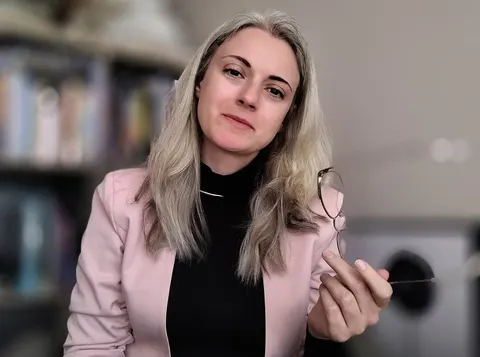
Elena Tsankova holds a PhD in psychology, earned in Germany, and continued her research in Bremen as a postdoctoral fellow. In 2020 she returned to Bulgaria and began work as a researcher at the Bulgarian Academy of Sciences (BAS), with the ambitious idea of paving the way for this new and so important field.
In recent years she has studied how people get to know each other online, as well as communication between humans and artificial intelligence (AI). She researches human behavior in the context of evolving technologies and describes herself as an experimental cyberpsychologist.
We will talk about rushing and awareness. About the “uncanny valley,” where our perception of a technology grows more and more positive as it comes to resemble a human, until at some point it gets so close to human that it is perceived as eerie… And about the calm, philosophical point of view that helps us make sense of and accept the big changes.
– “Cyberpsychology” sounds more than interesting and wide-ranging. But let's start from afar: in your view, what has life online changed in us the most?
– It has changed us, and keeps changing us, in many respects, and one of them is the social one. Humans are social beings and need contact with other people. In evolutionary terms, that contact took place in immediate proximity, in physical space. Suddenly, with life online,
the element of physical space falls away and people begin to feel isolated.
We probably felt this most sharply during the COVID-19 pandemic, when life—work, school, free time and so on—had to happen mostly in virtual space. Many people began showing signs of depression. On the other hand,
people with more introverted tendencies felt relieved as the social pressure was released.
The need for everything to happen online also led to a boom in technologies, some of which likewise aim to connect people and support the social element.
Another way life online changes us is speed—with online communication and the connectedness it allows, things happen faster and faster. On the one hand, this speed makes it possible to get more work done. On the other, people often fail to adapt in time, and that leads to a great deal of stress.
Life online, with its growing speed and volume of information, is linked both to the “closeness-isolation” paradox and to two other interesting, opposite phenomena—FOMO, the fear of missing out, and JOMO, the joy of missing out.
– I often think about speed myself… And about communication moving online—without working from home, this site would not exist. Can we say that technology is already changing us as a biological species?
– We haven't yet reached the “cyborg” stage of science fiction… But there are already bionic and robotic prostheses, which are definitely a step forward in integrating humans and technology.
If we can speak of a change at the biological level related to technology, for now it lies more in how the brain organizes its functioning—for example, functions such as attention, working memory and so on—and it isn't so noticeable from the outside.
– Which brings us to psychology. What are the biggest changes in the human psyche since the boom in information technology?
– It's hard to speak of big changes; they aren't that grand or noticeable from the point of view of evolution or time.
But changes can be seen both in a positive direction and in a not-so-positive one. As we said, technology changes brain functions such as visual attention, memory, language and speech, social cognition and others.
Too much screen time is linked to developmental problems in children and to mental health problems in adults.
Then again, the appropriate use of technologies such as virtual reality can be an excellent tool for diagnosing and treating certain mental illnesses. More about their influence on the human brain can be found in this interesting scientific paper by Hoehe and Thibaut from 2020. It is important to approach the use of technology consciously and purposefully, because after all, the idea is for it to help people. And here it's also worth noting that people are not passive victims of technology—they are free to decide how they will interact with it.
– Except they don't always have the time to think about these things. That's why this site exists—so we can talk about exactly that. You mentioned rushing. Technology develops exponentially, each new breakthrough comes faster than the last, yet we remain linear beings. How can we get out of this seemingly doomed collision?
– Again, from an evolutionary point of view, it's far from surprising—humans became what they are today as the result of long development. And although our brain is extremely adaptive, it isn't realistic to expect it to change at the speed at which technology develops… From a more philosophical perspective—
is this really a collision, and do we need to get out of it? What if it's a natural process, a logical next stage of our development?
– What drew you to this line of research?
– As a scientist, I have a responsibility to society. I took this path out of a desire to help the public understand the interaction between humans and technology. I believe that a better understanding of this dynamic would ease the digital transition, which is already a reality and is set as one of the main directions of European and global development for the next decade.
– Is there a hidden side to the way technology changes our lives, one we aren't aware of at all?
– I wouldn't say anything is deliberately hidden… Anything can stay hidden if we aren't aware of it. What's needed, rather, is awareness—with technology and in general.
If we notice that something is changing our lives in a way we don't like, we have the opportunity (and the responsibility!) to take measures, both as individuals and as a society.
– Are we gradually getting used to the idea of what artificial intelligence actually is?
– That's a key question in my current research program—I hope to be able to share some interesting findings on the subject soon. At this stage I can say that it is highly likely that
factors such as culture, education and personality traits influence the way we think about artificial intelligence
and lead to the formation of stereotypical ideas about it.
– Those wretched stereotypes… they really are very sturdy. Could an AI like ChatGPT really be a good psychologist for the masses?
– I don't think it could… A good psychologist works with an individual approach, adapted to the person in front of them, and in that sense isn't “mass.” Yes, artificial intelligence could adapt its approach on the basis of algorithms. But a good psychologist also has qualities such as emotional intelligence, empathy and sensitivity to barely noticeable social cues (for example, in nonverbal communication), which at this stage haven't been achieved in AI.
Here the topic of affective computing and affective AI becomes interesting too—creating technologies that analyze and simulate (but do not yet experience) human emotions.
– In that sense—do you think the day will come when we accept it as a person?
– It's possible—it depends both on technological development and on political decisions and regulations aimed at public safety, such as the European Union's AI Act.
It's important to take into account all kinds of legal consequences (for example, copyright, cybercrime and so on). And once again my favorite philosophical perspective—in order for someone to be accepted as a person, are qualities such as consciousness, feelings… necessary?
– What are the biggest psychological difficulties in working with AI?
– Perhaps the sense of the “uncanny valley” (“Uncanny Valley”; Mori, 1970; Mori et al., 2012)—a phenomenon in which
our perception of a technology grows more and more positive as it comes to resemble a human,
until at some point it gets so close to human that it is perceived as eerie. Often, for instance in a dialogue with a large language model, this feeling of excessive humanlikeness creeps in, leading to discomfort.
– That reminds me of the notorious Roko's basilisk… What are the biggest fears AI confronts us with?
– Becoming redundant in the current model of the world… Being overpowered, defeated by our own creation…
– Can we fight these fears? And should we, if they are justified…?
– Fear is a natural human emotion in the face of the unknown—it's thanks to fear that we have survived. But, as in most cases, it's all a matter of balance. To a certain extent fear helps—that's why regulations like the ones I mentioned are drawn up, to protect society. But at the same time it's important not to let ourselves be guided by unfounded fears. That is, to have a good understanding of the risk for the sake of protection, but also to keep developing.
Often, in response to these fears, I like to say: “But why not imagine a different model of the world? A world in which we are neither defeated nor redundant? We imagine that AI will have human motivation, but what if it acts differently—not to overpower us, but to cooperate and help? We see the loss of work as something negative… But
would a world in which work is either unnecessary or of an entirely different nature really be so terrible,
a world in which we are free to devote ourselves to the things we love?”
– A very sensible and logical point of view! Progress in technology, a better way of life, are leading us toward social changes we aren't ready for. Toward falling birth rates, questions about disappearing professions. Can we prepare, and how?
– Against the backdrop of human development, these changes aren't surprising, and in the long run they're hardly that dramatic either. Perhaps the problem here is more the speed at which they arrive… Preparing for them requires an adequate response from society—steering policy, education and so on toward the new professions and social changes.
– Only I don't think that's happening. From the comments on my articles I can see how many people underestimate the progress in this field, while most of the rest are overenthusiastic. Are these extremes logical when we encounter something new? Can we avoid them?
– The polarization of public opinion is another entirely natural human phenomenon, and it is often seen when we come up against something new and potentially significant (and sometimes not so significant…). We can avoid these extremes through being better informed and gaining firsthand experience with AI. Of course, we need to be motivated to avoid the extremes, and
the way people behave in various online discussions hints that perhaps we aren't…
– Alas. Is it a challenge to humans that algorithms can now create texts and images that are indistinguishable from ours?
– To some extent… But are they really indistinguishable? Here's an interesting scientific paper on the subject from 2023 by Miller and colleagues. Sometimes they are too perfect, and that hyperrealism can be felt… There is a certain charm in imperfection, which we like and expect in art; it's also called wabi-sabi.
On the other hand, art evolves, and with the development driven by AI, new perceptions and expectations will probably emerge and gradually take hold. Again, it's a matter of time… Perhaps the challenge is to traditional notions of art…
– I say “indistinguishable” because that's what a modest experiment of mine showed. And will this change how we regard creativity?
– The idea of co-creativity is gaining ground—
joint creation between a human and AI, which relies on the unique abilities of each side.
This is definitely a new model that has the potential to change how creativity is perceived, and probably how it is regarded too.
– Recently I had a conversation… with myself. Should I be worried or excited?
– A very interesting experiment! It raises so many thoughts…
Such a model has a lot of potential—it could help us look at ourselves from the outside, see a solution to a problem that eludes us, lead to new ideas. On the other hand, it could also lead to severe discomfort, to “losing” oneself and getting lost in oneself… With excessive use it may even become pathological…
Here AI, much like genetic engineering and clones, prompts us to ask whether there can be a “second self”—perhaps up to a point, but every living organism or learning algorithm will inevitably set off on its own unique path of development… So do we then have a “virtual child” in the form of this language model?
– Do we need to change drastically to get used to the current stage of technological development? Or is there no need, because generations are coming that will be ready for it inherently?
– From an evolutionary point of view, there's no point. To reduce our inner conflict and make life easier for ourselves,
we can simply accept things and how they develop (because they will probably keep developing).
In the long run—yes, the coming generations will definitely have a completely different predisposition toward technology. Once again, a natural course in the development of things…
– Could we arrive at a world in which we communicate only online?
– Anything is possible… Perhaps the question is rather “When?”
We see interesting interpretations of the subject in cinema (for example WALL-E) and in literature (Sum: Forty Tales from the Afterlives).
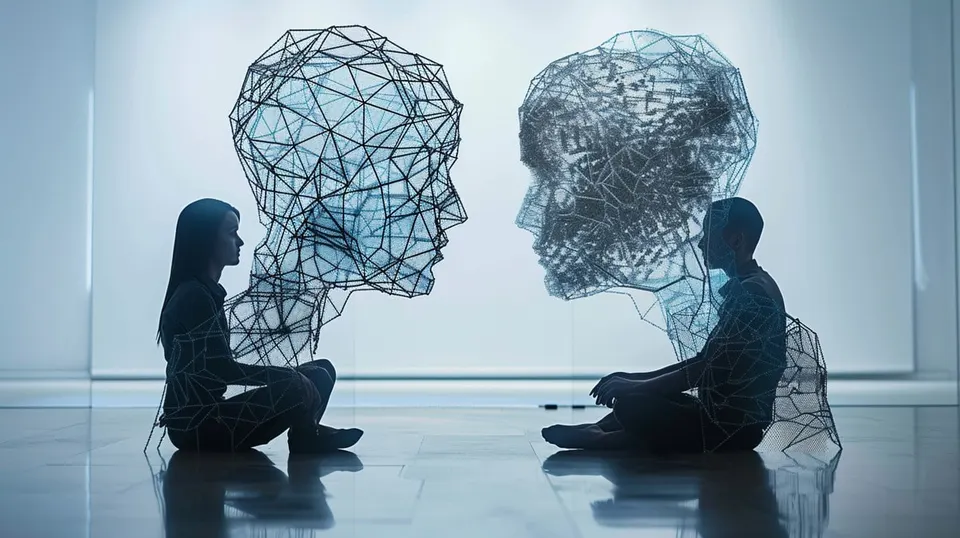
– You also have a professional interest in presenting science in an accessible way… Forgive the blunt wording, but isn't that battle lost?
– No, and that's why I'm taking part in this conversation.
This battle is far from lost! The profession of “science communicator” already exists, as do specialized training programs on the subject (such as the course “Science Communication in Bulgaria” run by the magazine Balgarska nauka (Bulgarian Science)). And besides being every scientist's responsibility, presenting science accessibly is built in as a core component of the model for modern project proposals—scientists receive funding to carry out research and in return popularize their findings among the public. In this way, science today is far more accessible to society than it was in the past. Today society also has the opportunity to take an active part in creating science through the “citizen science” model.
– Bulgarian Science really is a great example of this. And what is your personal motive—why is it important for us to come back to science?
– Science and society depend on each other—science leads to progress of every kind, but it is impossible without society's support (financial and otherwise). And the reverse—society cannot make progress without science. But
for the science-society interaction to work well, there needs to be understanding between the two.
That's where science communication comes in.
– Is there a technology you can't wait to see invented?
– No, I let science surprise me—it always manages to, and always in a positive way…