Where does magic hide today? Will we ever lose the power of the word? When does our connection to the past help us understand who we are and why we are here? Why does journalism already seem surrendered to the algorithms? Should artificial intelligence learn about us from books like The Brothers Karamazov? And what might it make of the stories of today's guest?
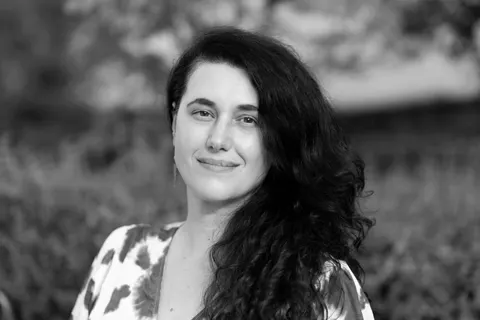
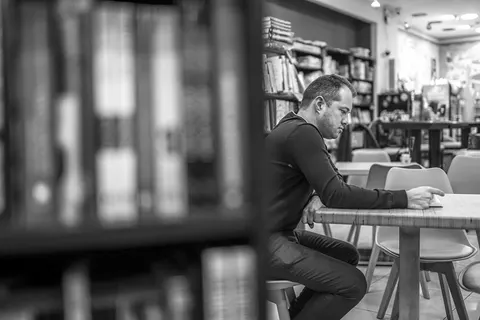
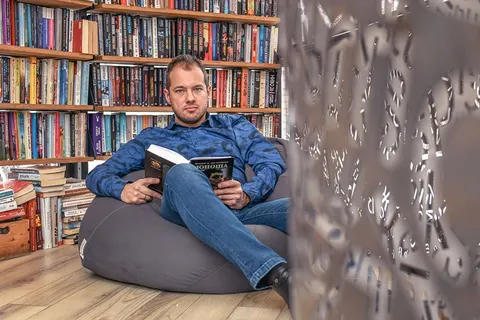
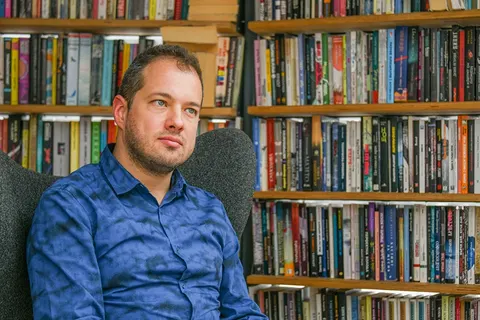
Nikolay Terziyski is a young writer who offers his own deep, contemporary take on eternal themes. His style is linked to magical realism, and for good reason. He has mastered the forgotten skill of painting with words stories that are thrilling, intertwined, realistic and enchanted. His books bring historical layers together and draw parallels between generations and fates. And, above all, they reveal a master of the word with a magical eye, one who gives the reader a great deal.
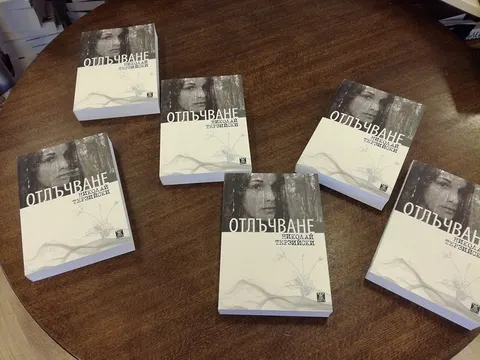
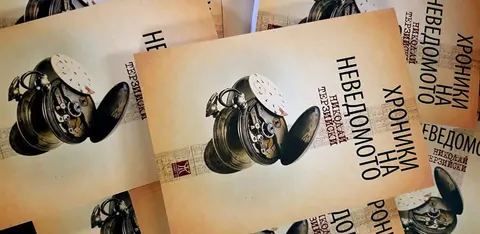
Nikolay won the Yuzhna Prolet (Southern Spring) award for Otlachvane (Excommunication) and is the author of two more novels, Hroniki na nevedomoto (Chronicles of the Unknown) and Zvezdi pod klepachite (Stars Under the Eyelids), published in 2022.
With a bachelor's degree in journalism and a master's in philosophy, he works as a television journalist and screenwriter.
– Is the power of the word still alive today, the way it has always built our existence?
– Of course it's alive. The word will always be alive. Whether it lives in old, dusty pages or in a smartphone's earbuds.
The word has the power not only to change our lives—it creates them.
Words, as the carriers of meaning, are the greatest treasure our Creator has given us, whether we're talking about God, the Universe or evolution. The word is the most perfect bridge between people and between the times we live in; it has the power to plant ideas, to destroy worlds, to create lives.
If there is any problem with the word today, though, it's that words get worn out.
Their meaning drains away from endless repetition. But that can't kill the word, because it is like a living organism: if one cell—one word—dies, another immediately takes its place. Because without the meaning the word carries, our life is impossible.
– Have all the powerful stories already been made up?
– Absolutely not! If all the powerful stories had been made up, that would be the end of the world. Years ago, when I was starting my first novel, Excommunication, I often asked myself things like that. Did I have anything new to tell people, the latest generations of a humanity that has been asking the eternal questions for centuries? Wasn't I somehow repeating the great writers I love, reread and learned from? Did I need to write at all, when so many brilliant minds had already looked for answers to the questions that occurred to me and gave me no peace?
When the book was finished and I held it in my hands, I still couldn't give myself a definite answer to all those questions. But once it reached readers, I understood.
There is a point in telling these stories. There is a point in continuing to dig into what we know, and what we don't know, about human beings.
Good books are the ones that are smarter than their authors. Because they reach beyond the knowledge of an ordinary person who handles words and puts them in the right order. We authors are only intermediaries for these ideas, which come from who knows where, and who knows why.
– I, too, find many interesting answers to those questions in your novels. And I think one should never stop looking for them, or stop writing. But at a time when we read long texts ever more rarely and with ever more difficulty, what gives you the strength to keep writing exactly that kind?
– Writing long books isn't a strength for me. It's a weakness. One of the sweetest, loveliest weaknesses. If we're talking about strength, things are quite different. I don't have the strength to stop writing once an idea has taken me over completely. I fall into a kind of fever, and the computer pulls me like a magnet.
I have never sat down in front of it by force, just because I felt like writing something. I start when it's become impossible for me to resist the idea.
I have to move in and live inside it, and tell it to people.
The length of my novels is the fruit not of effort but of giving myself entirely to these ideas.
– “No, now is not the time for poetry,” writes Vaptsarov—Nikola Vaptsarov, the Bulgarian poet executed in 1942—while writing poetry. There is a lot of poetry in your prose, too. Where does it come from? How do you manage to keep it alive in the prosaic times we live in?
– I'm not a poet. And if some parts of my books sound poetic, that isn't deliberate either. It just had to be that way. The idea asked for it. The character composed it, or lived it that way.
That's how the book's narrator said it, and the narrator is almost never me.
My job is to serve them as best I can—the ideas, the characters, the narrators. To let them breathe, live, get angry, cry, sing, even argue with me. I don't put limits on them. They can say anything. If I start holding them back, nobody will believe their stories. And those stories, made up as they supposedly are, are completely real to me.
– They are real, since they come alive in the reader, and that is above all the narrator's skill. Why, at a time when stories are supposedly everything and sell best, are capable storytellers so scarce?
– I don't agree that capable storytellers are few. It's just that the incapable ones are far more numerous.
I say that with a wink, of course. As a keen reader, I think our literature has had wonderful storytellers in recent years. Time will show which of them managed to write books wiser than themselves, to leap above everything else. They may not be the ones who are most popular today and sell the biggest print runs. Or they may be.
Time gives the true verdict on every art. But we do have good storytellers, and that's why we should read them, seek them out and discover them.
– How are love stories on Instagram and TikTok different from those of our grandparents…? And are they actually different?
– Here's how I understand the question: is there a difference between writing “I love you!” in a letter, say, 100 years ago, and in a message on one of today's social networks?
Perhaps the only difference is that the letter will travel for a while, during which the other person won't yet know about the love. Whereas on our smartphone the message might even wake us from sleep. Actually, that difference isn't so trivial. Love used to happen like that—more slowly.
And slow love is a more beautiful love. It has time to catch its breath.
To gaze at the sunset, or to close its eyes and dream. That's why, when I write stories about that old, slow, beautiful love, the sentences are different, the word order is different. Today love happens fast. Click, and done.
The smartphone even offers to finish our words and sentences for us, so we may not have to type that “I love you!” ourselves. It's not as beautiful, but for all this reasoning, “I love you!” is still “I love you!” no matter when, how or where it was written, shouted or whispered.
– Everything today is definitely faster, and getting faster still. All the stimuli push us not to close our eyes but to strain them more and more, to stare at screens and scroll. What do we lose this way?
– The screen is a killer of imagination—that much is clear.
Today everything is served to us ready-made. We say “mountain” and show a “mountain.” We say “river” and show a “river.” There's no room for making things up. For mistakes and confusion, if you like, because those sometimes carry beauty too. But when we close our eyes, we can invent the mountain, and the river, and everything else. Give them life, through ourselves.
– “Life comes not from truth but from sorcery,” you write. Since technology pulls us deeper into the prosaic side of existence, is there room for magic today?
– Magic lives inside, in the human being. We are part of it and we carry it within us.
It creates us and we create it. Like the chicken and the egg. Magic is what we don't know but carry inside us. Magic is in our thoughts when we close our eyes. True, technology has lately been outpacing people's inner development, but it can't stop magic from staying inside us.
– Does everyone have stars under their eyelids?
– Of course. Try an experiment if you don't believe me. Find a quiet place, relax and close your eyes. You'll see them. They're there, because every human being is born with the power to create.
– Why don't the stars inspire us today as much as they did when you and I were children?
– Today we live in big cities and keep complaining that we can't see the stars. But, as I said, they're inside us. Nobody needs to show them to us on television and explain: look, these are stars. Everyone has to find the way to their own stars, to contemplate them, to invent their own constellations, to ask: “What are they?” “Where are they?” “Why are they?”
Many of the stars we think we see and believe to be real have already vanished. They are a memory, the past. And yet they exist, because their light keeps traveling. Isn't it the same with the people we love and lose? That's what the stars should teach us—nothing is gone forever.
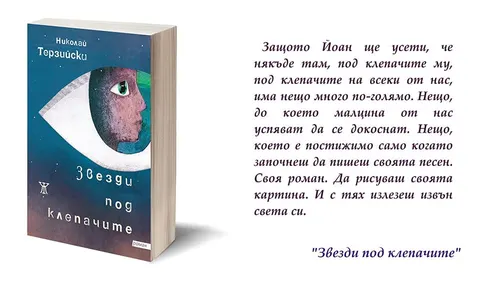
– Your novel Stars Under the Eyelids is also about the people we lose; you wrote it right after losing your father. “You are the man who swam across the sea and brought me the sun”—that's one of the most beautiful personal dedications I've ever read. What are the most important things he taught you?
– There are so many that I couldn't possibly list them. Some of them I'm not even aware of, but they're inside me. But if I had to say which seems most important, it is precisely this—
to throw myself into the sea and believe I can reach the sun. For the ones I love.
– You often look for parallels between generations—ours, our parents' and their parents'. Why?
– Every idea of mine, once it starts turning into a novel, leads me toward that big context. With Chronicles of the Unknown I went back to 1688, told the story of all the centuries that followed, and even allowed myself to step into the future. That gave me a chance to peer into the human being and the human condition beyond eras and epochs. Into what unites us. Of course, that way the differences, contradictions and mismatches stand out too.
Literature has this ability to dance with time, to rethink it, even to finish inventing it. That is a huge advantage of fiction, and I would never give it up.
– Against the backdrop of this undeniably necessary look at the past, lately there's been a not entirely thought-through fashion for returning to one's roots, a form of patriotism that isn't very sincere or deep. What does it mean to you for a person to return to their roots?
– When I started writing my first novel, Excommunication, I was telling the life of a character whose world is falling apart because of his separation from his wife and little daughter. It was the inner torment of this character, named Samuil, that made him ask questions we ask ourselves less and less: “Who am I?” “Why am I here?” even “Why am I me?”
It was the desperate search for answers to those questions that led Samuil, and me too, of course, into the past. Toward the roots. Toward his grandfather's tales, toward the memories of his ancestors. So that we, together with Samuil, could arrive at the idea that each of us is a fragment. Of something unimaginably vast that began long ago, something that won't go away with us but will go on living long after us.
So that we understand we are just small links in a huge process that is hard to comprehend.
And realize that those ancestors who lived long ago, years and centuries back, are part of us. They live inside us and through us.
– Today, when, as we said, we're in such a hurry, why is it worth glancing back at the past?
– Not just for the lessons. We have to think about our past because it is an inalienable part of us. To make peace with it, if necessary. To accept it. And if we manage to see the beauty in it, to enjoy that beauty.
We shouldn't go to extremes, of course. We mustn't carry the past on our backs all the time, because its weight will make us stoop and we won't be able to see the present, to look ahead, toward the future.
– And can we look at it without stereotypes, without ideologies, without the glasses of one of the two usual, banal extremes?
– I was asked a similar question at a meeting with readers in Varna more than five years ago. It was about Excommunication again. There, the heroine's ancestors come from the two opposite sides of Bulgaria's political antagonism. On one side are the communists who took part in the September Uprising of 1923; on the other are the victims of the regime that came after September 9, 1944, the day of the communist takeover. So the question was: “Since these people are part of her, how is it possible to live with these opposites?” Something like that.
My answer then and now is the same—
our role is to reconcile the contradictions of the blood. And the only way to reconcile the blood is love.
– Can Bulgarian literature do without nostalgia?
– Of course it can. Bulgarian literature has lately been astonishingly diverse. Some people complain that too many books are coming out, but I disagree. “Graphomania” has become one of the most fashionable insults, which is ridiculous. There's nothing wrong with many books being written. Many books being published. Many books being read. All kinds. Genre or philosophical, historical or chick lit, nostalgic or cynical… all kinds.
Over the past three years, because of my work as a journalist and the program I work on, I've read nearly 150 Bulgarian books, most of them brand new. We truly have wonderful authors working in different directions. What could be better?
– As long as there's someone to read them… But now we also have another, unexpected competitor. Does it worry or excite you that artificial intelligence is starting to create ever more accomplished texts?
– It neither worries nor excites me. It amuses me. A while ago I even listened to a Nirvana song created by a computer years after Kurt Cobain's death. A song produced by analyzing all the band's old songs.
I genuinely had some fun, but I never played it a second time. That's a good example
of what artificial intelligence can do when it comes to creativity.
– Which will we hand over to the algorithms first, journalism or literature?
– I hope my fellow journalists won't take offense, but
journalism has long been ready for it. It's already an algorithm.
Without being much of an expert, I could even sketch a sample mechanism, with elements like ratings, audience expectations and the demands of the media owner. It's sad, but it's a fact. Especially in the most mainstream media, which attract the most attention. As for literature, it simply won't be literature if it's made by algorithm.
– What is the most important thing to teach artificial intelligence before it becomes general, before it turns out to be “smarter” than us?
– Not to repeat our mistakes. If you ask which mistakes, I wouldn't have time to list them all. I can give just one example: the 20th century. On the other hand, though,
can we really teach artificial intelligence to love and to hate, to be as contradictory as a human being?
And if we can't teach it to love and to be contradictory, how could it possibly become “smarter” than us?
– Which book is it most important for it to “read”?
– The Brothers Karamazov. Then we'll see what this artificial intelligence is really worth!
– And what would it learn from yours?
– I hope they'd confuse it. Because they, too, contain and combine our contradictions. Because inside them are questions I believe artificial intelligence cannot answer. By the way, from everything I've said so far anyone can tell I'm not much of a fan of artificial intelligence, especially when it comes to creative abilities and the big questions. I don't know if I'm old-fashioned, but I'll always bet on the human being, despite all the madness humans have created.
– Not long ago a guest of mine, Nikolay Genov, put it aptly: literature can save us from the future. And if the future arrives in full force, that will mean the death of literature. What do you think?
– Literature can do anything. I believe that deeply. It can not only save us from the future. It can invent a different future. It has done so more than once. It will keep doing it, just as it has invented the past and the present. Literature stands above time, and that is its greatest advantage.
– You say you've spent your whole life writing questions. What are the most powerful questions you've written?
– The ones in my books. They spring from inspiration, from ideas, from digging deep into meaning. They stand there unanswered. Because that is their power. Because my characters felt an absolute need to shout them out to the world. And the answers—those will come from the readers.
– Today is Nikulden, St. Nicholas Day, one of Bulgaria's most beloved name days, and Christmas is approaching. You and I both appear in the anthology Nashata Koleda (Our Christmas), which brings together 17 colorful stories by just as many different authors. In December magic seems to fly all around us and miracles seem close. What kind of miracles do we need today?
– Christmas seems to open our senses to miracles most successfully. The very word Nativity—could there be a stronger reminder of what the greatest miracle is? But I ask myself something else: why, during the rest of the months and days of the year, do we close our eyes to miracles? They're there. Everywhere. But if there's no one to see or feel them, what use is it that they exist? That's why I
believe we don't need miracles; we need the senses to perceive them.