Who were the Proto-Bulgarians, and where did our ancestors come from? What can new technologies tell us in the search for an answer? Are we heirs of the Thracians, did we come from the distant steppes, or are we Sarmatians? How did genetics turn out to be the next great scientific leap, one that has given us so many answers about the past?
What is the origin of the Bulgarians? Why does this question stir us so deeply and drag us into fierce arguments a millennium and a half later?
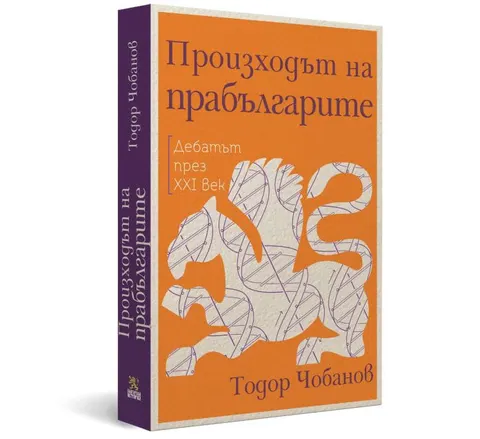
This topic became the most-read digital story on this site, and at the same time a book came out by the historian Assoc. Prof. Dr. Todor Chobanov—Proizhodat na balgarite – debatat prez XXI vek (The Origin of the Bulgarians: The Debate in the 21st Century). The edition by Balgarska Istoriya (Bulgarian History), a publisher and popular-history project, offers the essentials of the modern view. Which is why there are so many more important answers worth adding.
How did science reject all the numerous theories about our origin except one? In what ways do we resemble the Proto-Bulgarians? What do we know about our ancestors today, and what have we learned with the help of technology?
– What made you turn to this particular subject?
– This subject has been central to Bulgarian archaeology for as long as it has existed as a branch of historical knowledge—for nearly a century and a half. And before that it was present in the inquiries of European scholarship for at least as long again:
from the 18th century onward, science has studied, with scientific methods, the past of the old peoples of the continent, and of the Bulgarians in particular.
On top of that, it was highly controversial in academic circles, at least until recently, which makes it all the more interesting. It was also a favorite subject of my academic supervisor, Assoc. Prof. Stefka Angelova—an astonishing person and a superb scholar, who sparked my interest in Late Antiquity, the period when the Proto-Bulgarians took shape.
– Did you find an unambiguous answer to the question for yourself? Can we say there is some kind of consensus among historians today?
– Our job as scholars is to seek answers not for ourselves but for society, by summarizing masses of data and adding new ones. Personal inquiries and interests cannot replace the public duties of historical knowledge.
The principle, moreover, is that the material leads us, and that is what I have done in my latest book, The Origin of the Bulgarians: The Debate in the 21st Century.
A consensus, at least in Bulgarian medieval archaeology, has been built largely thanks to the enormous achievements of our late colleague Rasho Rashev. For years he gathered the data on the Bulgarians in the Hunnic and post-Hunnic era—what later became Old Great Bulgaria and, finally, Danubian Bulgaria.
Abroad, things are still lagging a little, but recently the Encyclopaedia Britannica changed its article on the Proto-Bulgarians, based on a study of ours from 2019 with ancient genomes from various sources. We expect the outdated views on the subject to be abandoned in all the major scholarly schools around the world in the coming years, and this process is already visible.
– What did they change?
– Their article on the Proto-Bulgarians, whom until recently they described as Turkic, now also lays out the Sarmatian hypothesis. The change came mainly because of the genetic data.
– An interview on this subject on this very site, which is about technology, became the most-read piece. Why are people so passionately interested in the origin of our people nearly a millennium and a half ago?
– It is normal for everyone to wonder where they come from and where they are going. Besides, we are
in a period of heightened instability and uncertainty, and people want to draw emotional calm from the past.
But sometimes this urge becomes too strong, and then things get muddled. The past is a wonderful teacher for the present and the future, but it cannot take over their place in our minds.
Our first and main task is to live as good people here and now, and to draw valuable lessons and moral frameworks from the past.
– And why are we so obsessed with proving how ancient we are?
– Some people, or even groups of people, need to escape the problems of the present, or their own problems, into fantasy realities or even fantasy versions of the past. It makes them feel better, calms them down, dulls their anxiety. It is something like Fromm’s “escape from freedom,” a kind of captivating self-deception that is more pleasant or more interesting than the objective truth, or even than banal everyday life… Other people are bored or dissatisfied with their professions and look for a stage in the seemingly easy field of history. And there are far more dangerous obsessions than wanting to be the first humans—around the world there are thousands of people consumed by the idea of dangerous aliens, reptilians, the flat Earth, and so on.
– Why has the autochthonous theory, the idea that we have always lived here, become so fashionable among “online experts” in recent years?
– It has always been around in one form or another, here and everywhere in the world. It is a consequence of how the human mind works. Wherever there are people, there are some among them who want to be the first in a given place. From the old pun “etruski—eto russkie” (“Etruscans” read as “here are the Russians”), through the “Illyrism” of Mavro Orbini with the Slavs as the first people, and other such notions, to the drive to present Cleopatra, a Greek woman, as an autochthonous ruler of local African origin.
Besides,
various groups and players invest heavily in “Thracedonism,” just as they once invested in “Macedonism”—the push for a separate, non-Bulgarian Macedonian identity—with the aim of eroding Bulgarian communal consciousness and creating separatism.
A society confused about its history and identity is easier to manipulate, or even to conquer in a military situation.
The natural interest in the Thracians and their culture is exploited in an underhanded, mostly commercial, way. The Thracians were an earlier wave of Indo-Europeans, but, just like the Proto-Bulgarians, they were conquerors and settlers who came into contact with the local population and formed new communities that are fascinating for history. For some, though, they are simply a chance for easy profits with large print runs. People who would not pass even their first-year exams churn out pseudo-scholarly works, and thousands of others buy them and accept them uncritically.
– What do we really know today about the origin of the Bulgarians that we did not know a decade ago?
– We know a lot, because
science has acquired new and powerful methods—from laser systems for recording inscriptions and images to genome sequencers
of the third generation, with powerful software for comparing populations. In recent years several new necropolises have been excavated here, and quite a few in Hungary, Ukraine, the Caucasus and elsewhere. So the empirical base is growing noticeably, which allows for more solid conclusions.
– Why do we focus so much on the origin of the Bulgarians alone, and not on the other ethnic groups that also became part of the First Bulgarian State?
– Because they were the most important, and because, unlike the Khazars, the Avars and many other mighty peoples, they did not merely survive—they created lasting societies and states. Because they created our state, too—Bulgaria—and a substantial trace of them remains in our genome. Because they managed to build models of partnership with other peoples and became co-creators of Orthodox civilization. In short—because they are fascinating to study in every respect, and they inhabited fascinating regions.
– Which theories were once current but have now been rejected?
– The theories are all sorts. Finno-Ugric, Hunnic, Turkic, local, “Gothic,” Sarmatian, a more distant Iranian one—the so-called Bactrian—and so on.
Most have been rejected because they are highly speculative and rest on scant data, mainly linguistic.
In the 18th century, for instance, because of Volga Bulgaria and a few titles, they were thought to be Turks or Huns of Turkic origin. Some of the theories contain grains of truth. But by and large, until the middle of the 20th century, when the Proto-Bulgarian necropolises began to be discovered, it was all mostly a collection of speculations based on individual words and terms.
– Can a subject like this be examined apart from politics?
– It can, as long as science is not handed down postulates like the communist-era one about “the developed Slavs.” Since 1989 scholarship in Bulgaria has worked freely on this subject, and around the world people like Maenchen-Helfen and other great minds have never been victims of any suggestion or dictate.
– Compared with the neighboring peoples, do we know more or less about our ancient origin?
– Some 97 to 98 percent of today’s Europeans share a common Indo-European origin and an interconnected history, so it is hard to speak of more or less in that shared history. Some have simply achieved more historically and culturally, others less.
– How has technology helped in recent years?
– It supplements information and provides new kinds of information that simply did not exist twenty or so years ago. Genetics, for example, has displaced anthropology with its mathematically precise data. We have access to practically the entire scholarly literature, including unfamiliar sources and studies.
– What is the short answer—Turks, Huns, Sarmatians? Or are there no short answers in science, unlike on Facebook?
– In science there are objectively verifiable answers with many nuances, often like a palette of many colors bleeding into one another,
and the truth is that we, today’s Bulgarians, went through a complex and lengthy process of ethnogenesis in the past, with various components taking part. Our forefathers themselves—the Proto-Bulgarians—went through several stages of ethnogenesis.
– Did genetic research change the paradigm on the question of origin, or rather confirm what we already knew?
– Of course it changed everything, because through it we can now test the two main hypotheses that have survived the trials of time—the Turkic and the Sarmatian. Genetics comes down quite unambiguously in favor of the second. It also lets us date the stages of contact quite precisely.
– “Sarmatians” is certainly not a very familiar term. What do we know about this people whose heirs we turn out to be?
– The Sarmatians are not a people but a vast group of tribes, mainly from the Iranian branch of the Indo-European peoples, related to the older Scythian tribes. All these diverse tribes—Scythians and Sarmatians—left solid traces in the genetic and cultural heritage of today’s Europe, and especially of Eastern Europe.
The name of the Danube, for example, is probably of Scythian origin, from the word for “water.” The subject is endless, but even in our everyday language, in ordinary words like kuche (dog), bate (big brother) and tate (dad), we find traces of the ancient peoples you are asking about. But we archaeologists always prefer a different kind of trace—the artifacts of the past and their makers are our main occupation.
– As technology develops, can it give us more answers about the origin of the Bulgarians? In what direction should we expect them?
– Right now, in partnership with Harvard University, we are building a database of fully sequenced genomes. Besides the Bulgarians, we will be able to dive into subjects such as the Thracians, the Slavs, the population of the Roman era, and so on.
– What do we know today about the proportions of the “three ingredients”—Thracians, Proto-Bulgarians and Slavs?
– In my book I have described everything available so far on the course and scale of the contacts and the mixing. It cannot be told within a single interview. But we can give the broadest outlines: that the Bulgarians are predominantly Indo-Europeans, that the Proto-Bulgarians were far more numerous than was once thought, and that they had early contacts with the Slavs.
– What are the biggest questions that remain open?
– The mixed elite, the spoken language or languages, the early contacts with the Slavs, and others. The role of the Hunnic ruling clique, the origin of the Slavs themselves.
– If today we have a relatively clear and dominant theory of the origin of the Proto-Bulgarians, what does the history of these ancestors of ours look like before they came here? How far back can we go in the search?
– Separate studies have yet to be written on the most ancient history, because
only now, with the help of archaeology and paleogenetics, will we be able to identify the cultures to which the roots of the Proto-Bulgarians before the 5th century are linked.
– How do ancient and present-day Bulgarians differ most genetically?
– We closely resemble the medieval Bulgarians, and the Proto-Bulgarians as well, but they lack our Slavic component and the signal from the local population.
However, we are able to distinguish the signals and date their appearance, and we can state that the “Proto-Bulgarian line” is very strongly represented in today’s Bulgarians.
– Based on what we know, which modern peoples are our closest “relatives”?
– Modern Bulgarians occupy a special, borderline place in the map of European populations, together with the other Balkan peoples, especially the Romanians, the North Macedonians, the Croats and others. We can say that the Proto-Bulgarians and the Slavs left us a noticeable closeness to our present-day neighbors, with whom we have had, and still have, long-lasting contacts at the population level.
– Archaeological finds, genetics, onomastics, linguistics, ancient sources—which of these gives us the most information in the search for our origin? And since they complement one another, which “weighs” more as an argument?
– Ethnicity is a cultural category; it exists in people’s minds, so history and archaeology are the leading disciplines, and the others are complementary.
– Among the hundreds of scholars who have contributed to the answer—your book alone has almost 40 pages of bibliography!—do a few stand out as the ones we owe the most?
– Unquestionably, names like Stancho Vaklinov, Veselin Beshevliev, Rasho Rashev and others are the ones to whom we owe the core of our systematic knowledge. In a sense, the book was created in their honor, and especially in honor of Rashev, who was and remains for me the greatest and most prolific researcher of the ancient Bulgarians. Had he not died tragically, he would probably have produced even more fundamental works like the ones I have built on in my own inquiries.
– What, in your view, is your book’s most important contribution to the subject?
– That for the first time all the archaeological data have been brought together and combined with a substantial volume of genomic data into a large, systematic picture. And that a team of reviewers and consultants worked toward this result, helping me to prepare and present, for the first time, various models with data.
– After everything we know on the subject today, should we drastically rewrite the textbooks from which this period is taught?
– Corrections are needed, but “rewrite” sounds rather radical. By and large the essentials are there, but some aspects need correcting.
The textbooks are broadly accurate as far as the medieval history of Bulgaria and the Bulgarians is concerned.