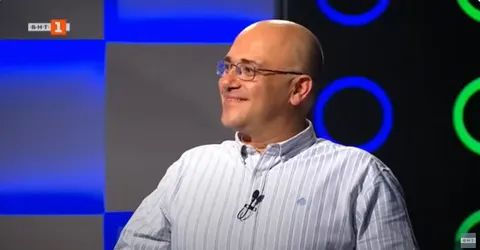
Why is it worth knowing the past better? There is hardly anyone who could answer that with more authority than today's guest. Not only is it his calling to spark young people's interest in history—it was also his remarkable memory that turned him into an unbeatable record holder in one notable field of knowledge.
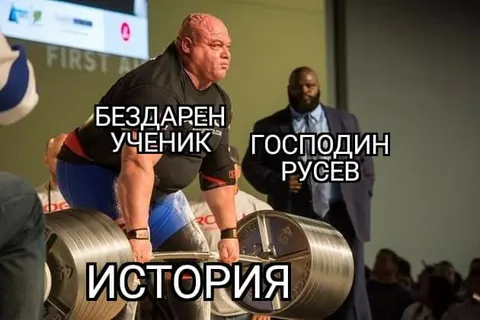
Boris Rusev won an incredible 34 games on the quiz show Posledniyat pecheli (The Last One Wins) before deciding, of his own accord, not to go any further. And to return to his true calling as a high school history teacher at the 31st Ivan Vazov School in the capital, Sofia, known to everyone as “the Bastille.”
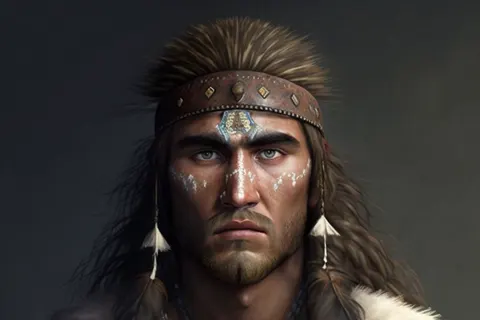
Talking about history is so fashionable today. But… why? And why does it keep dividing us rather than bringing us together? How do we awaken young people's interest in the past, and why is it important to know it? Does the love for it pass through personal stories, through the fates of our ancestors? What will future historians say about today's strange times? Is it true that… Khan Krum, the ninth-century ruler of the First Bulgarian State, decreed that thieves should have their hands cut off?
It is not true. And we will look for the answers to the other questions together with the champion who set an unbeatable record.
Meanwhile… why not check whether you can tell some commonly accepted claims about Bulgarian history from ones “made up” by artificial intelligence? Try it here—this experiment is going to produce some interesting results!
– How did you end up in history?
– Oh, I've always loved it. My mother and father both studied Russian philology, but my father also has a second degree in history. Somehow he nudged me toward it; he used to explain a lot of things to me.
I also have an interesting family history. My great-grandfather fought in the First World War, my grandfather in the Second. I remember Grandpa Rusi—that's why I'm called Boris Rusev—telling me what it was like on the Salonika Front. I was in third grade, he died in 1985, I didn't understand much, but
all these things he told me, that he had bathed in the Aegean Sea, back when it was Bulgarian, made a deep impression on me.
And later, when I was becoming a historian, I realized—he hadn't lied to me.
He told me how the French had taken his uncle prisoner, and how they in turn had captured some Senegalese. All of this fascinated me. He was born in 1899—the nineteenth century!
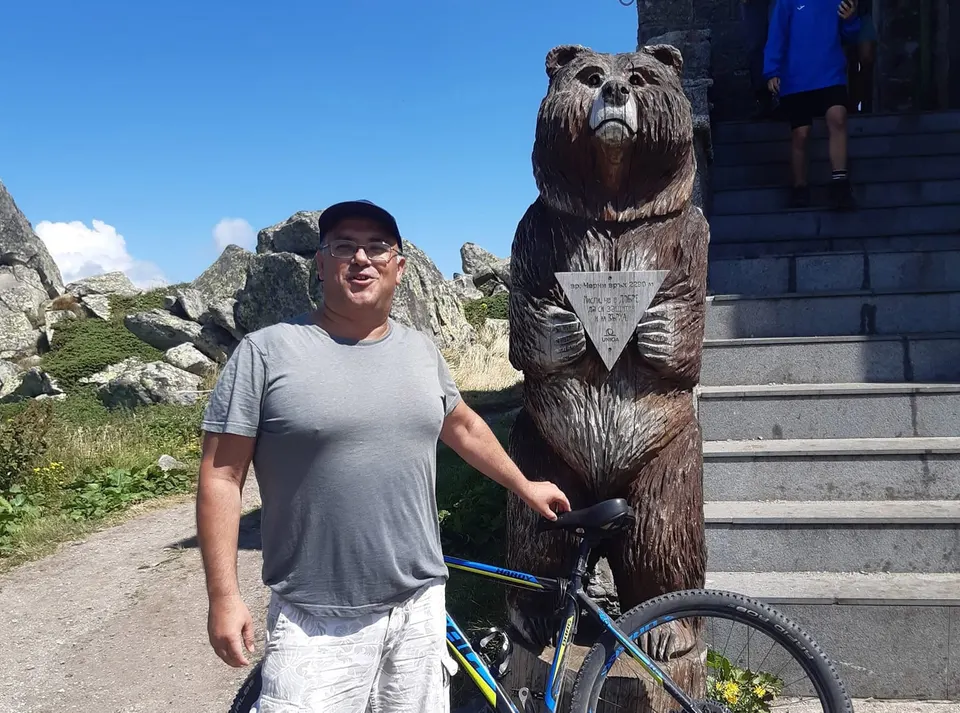
– I understand you very well. My great-great-grandfather, also named Georgi Karamanev, was killed in the First World War. Anyone who digs a little into the past will find things that interest them…
– Every pear has its stalk, truly. We don't come from nowhere; everyone has some past, some history.
– I find it impressive, and also encouraging, that this is becoming fashionable. I see it in literature—books like Zachary Karabashliev's Rana (The Wound) or Viktoria Beshliyska's Nishka (Thread) are being read and are moving people. I recommend them to everyone, especially if they haven't yet given the subject much thought.
What's your favorite historical period?
– I love contemporary history most of all, the twentieth century.
– Isn't it the hardest? Precisely because we can't yet write it in a way that's even somewhat balanced.
– Yes, but it's a field we can still plow. Everything else has been plowed. For Khan Asparuh and Cleopatra, the historical sources are clear; we know what happened. Whereas here more and more new documents keep coming out. Of course, the opposition you're talking about, between the different interpretations, is very strong. The subjective approach to history.
Truly good historians, though, try to speak impartially.
What I like about the twentieth century, what draws my attention to it in particular, is that this history, what happened recently, directly concerns our lives. Whereas Cleopatra's milk bath has nothing to do with our existence today.

– And yet most often we take pride in things like the oldest worked gold in the world, even though it was made by a civilization with which we have no demonstrable connection.
– In Egypt they have even older artifacts, the pyramids. I've been there and I saw how this people, who created those great works, is now sunk in poverty.
Many nations take pride in the past because they have nothing to boast about in the present.
I want to get away from that model. Yes, I'm a historian, I love history, I'm proud of my people's past, but we can't rely on that alone.
We have to look for the milestones of our own happiness and well-being.
– Alek Popov once told me that all of today's problems, our great dividing line, were born when Vazov died. Somehow we split in two and carry on by inertia to this day.
– I would put the dividing line even earlier, in the Bulgarian National Revival. In the split between Russophiles and Russophobes. For and against the prince.
1921, when Vazov died, really is a distinct boundary. With the First World War, the thing that united us died—the national ideal. After it we have no national ideal; it has been debunked, shattered. It even becomes unpopular to be a patriot, a nationalist.
– Just as now, these categories set people sharply against each other in public life. Can't we build a national ideal again?
– This world is so complex right now that we can't possibly have just one national ideal. One person's ideal is to succeed in a united Europe; another tries to find it in the past, to multiply it.
Somehow people back then seem to have been more candid, more sincere with each other. And they believed that what had happened on March 3, 1878, and on September 6, 1885, would happen again.
Those were the dates of Bulgaria's Liberation from Ottoman rule and of its Unification with Eastern Rumelia. People believed that, in some other way, the remaining Bulgarian lands would be united too. That they would be able to come together with their brothers and sisters who lived under foreign oppression.
Now, though, we're talking about unification again. Many of those Bulgarians outside Bulgaria are in fact in a united Europe. Until recently, borders were much harsher. Not even a bird could fly across. Bulgaria was isolated after the First World War; it had been on the losing side.
– Can we be impartial about the twentieth century? Because here we are divided again, and anyone will tell you: at the start of the century we were flourishing, everything was wonderful, but then 1944 came. Or the opposite—1944 came so that we could develop.
– I think that if we asked a 100-year-old German woman whether things were good in good old Adolf's day, she would say yes, they were good, because she was young. But in fact there are parameters that show how “good” it was and how bad it is now.
Yes, comparing ourselves with other European countries, today we're last in the EU. But the question is the cornerstone we're looking from. We live better than back then. The problem is that many of those who form their opinions today are frozen in the past and don't want to change.
Of course, that past had its positives, its good moments. In space exploration, say, successes in sport, but on the whole our industry wasn't nearly as competitive as people make it out to be. Our agriculture could only export within the socialist bloc.
What gives us opportunities now, in modern Europe, is competitiveness. The possibility for each of us, based on how good we are in our field, on our own personal path, to grow, with no ceilings to hold us back.
In my view, if you're honest now and work hard, of course there will be obstacles, but your chance of succeeding is greater than before. The very fact that you had no right to private enterprise limited the possibilities a great deal.
– Is that really so? I think there are barriers today too, they're just different. More insidious, more rooted in a capitalism that isn't suited to today's technological age. And all of this has led to an unprecedented brain drain from our country.
– It's a process seen in many other countries before us. A huge number of Spaniards and Portuguese emigrated to France in the 1960s, and then came back when living standards rose. On the other hand, we can't restrict people. It's better to create conditions so that they return, rather than lock them behind a fence so they can't get through.
– Of course. The question is how to create better conditions.
– This transition lasted too long. If we had stepped onto the path we're on now more quickly, the gap between us and the Western countries wouldn't be so wide.
Polish emigrants have long been returning to Poland, the Czechs too, because it isn't worth living in a country where you have to pay rent. But we're on the right track. Last year more people came back than left.
– My technology site now has more than 400 articles, and the two most read are about history. Why are we so absorbed in that direction?
– Because history is being politicized.
This very history of the twentieth century.
We're constantly trying to find some roots of our present in the recent past.
And to understand, right there, why we are as developed or as underdeveloped as we are.
History is very often used as an argument in disputes. And instead of bringing us closer, it divides us. We have to admit that. Weak historians use history as a tomahawk to hack down their opponent. I remember the first time I went to Serbia. They started asking me questions—whose is Krali Marko, the legendary hero claimed by Bulgarians, Serbs and Macedonians alike, what about Macedonia… That's not the positive side.
We make the same mistake. When some boy or girl from North Macedonia comes along, we immediately start with “You're Bulgarian, admit it!” That's no way to do it.
We have to find a common language. They will decide what they are. Yes, we know what the history is, and there's no dispute there.
But if a person feels they are something, nobody can tell them otherwise. We mustn't force people. They themselves will become what we'd like them to be if we're more well-meaning. If we approach them by setting a good example and not looking for arguments for supremacy, for grandeur in the past.
Because anyone can bring up the Battle of Achelous in 917 in an argument with Greeks. And the Greek will say, “We crushed you in Samuil's time.” The Serbs crushed us at Kyustendil… That's no way to go on.
Some time ago I was a teacher in Targovishte, and there were quite a few Turkish and Roma kids. I had a very good student, a Turkish girl, who told me, “I really like Levski and Botev! But when I have to talk about them, I feel awkward. Because often in the hallways, half joking, half serious, the other kids say to me, ‘Why did you people hang Levski?’ I haven't hanged anyone. I have nothing to do with those things in history.”
In that sense we have to be very careful. Because by pinning collective responsibility on a people, we in turn risk being condemned for something else.
– That's true. The story of the Bulgarian Jews… Or Germany's history in the twentieth century as a whole. I don't know if you've come across the story of Chergar—a blogger who wrote “Levski's Last Letter” as an opinion piece, as a provocation. But it gradually began to spread as undisputed truth. At one of our recent countless elections there was even a call to vote with it.
We love talking about history, but… online we seem far too gullible.
– That's the fight against fake news, against lying websites. Very few of them do it for fame or notoriety; most of them do it deliberately, with the intent to do harm, to inject false information into society.
First of all, people don't want to hear things they don't like.
They don't want to look closely at the four question marks in “People????”.
That's Vasil Levski's famous note from his notebook, full of bitter doubt about his own nation. Meanwhile people want to see us as a projection of Levski, not of Bai Ganyo, the archetypal Bulgarian boor from Aleko Konstantinov's 1895 satire. Of course, there are many people who have taken up Levski's legacy, but Bai Ganyo-ism is everywhere. This Bai Ganyo-ism, in which you're a great Bulgarian if you beat your chest and shout “Bulgar, Bulgar!”, is somehow triumphant.
And that's sad. Because it's easier to fling yourself into the pool than to risk your life beyond the little vials of rose oil.
To have a mission. It's hard to have a mission. It's much easier to be a consumer of other people's goodies.
Somebody once said that the Bulgarian loves freedom, but only if it's served to him on a platter. Somebody else should die for it, somebody else should sacrifice himself, somebody else should take the risk.
– But how do we become more serious, better prepared on historical topics? How do we check our sources? You come across some fact about what Khan Krum did… how do you find out whether it has a historical basis?
– By reading different sources, at least two or three. Speaking of Khan Krum, for example, there's a myth that he cut off hands. It's not true. That's been proven, and yet it's taught from early childhood, from first grade. Very edifying. He cut off hands. But everywhere, in the Suda, the Byzantine encyclopedia, it says he broke the hand. Because if your hand is cut off… you could also lose a hand in battle. How would we then tell the liar, the thief, from the war hero?
Yes, Khan Krum is a great ruler not because he cut off hands, but because he united the people through common laws, which served as a guide for the future of the First Bulgarian State in its pagan period. He laid the foundations.
Things have to be checked. We have to look for more sources. We mustn't trust everything. These are supposedly harmless myths; we repeat them like mantras. But they lead to more serious problems.
– That's exactly the next topic on this site. We'll talk with a colleague of yours about some of the popular myths. But is it really so hard to tell the truth apart? I'm running an experiment like that right now. And I think the way forward is still to turn to authorities, to specialists. But history is a science you can easily talk about convincingly without being one. With chemistry, for example, you can't…
But can there be objective and impartial history at all, or is it doomed to be a subjective science?
– The further back in time we go, the more objective and impartial it becomes.
In ancient Egypt there's no left and right—so that someone who supports one side could say which pharaoh he likes better.
The closer it is to us in time, the more we tailor the past to ourselves, sewing it on like a pocket to our historical or political coat.
And we think that if it's good, we'll sew it on so that the patches don't show. If it's bad, we'll attach it like some foreign element. We'll say it's small and insignificant, we'll unpick it, we'll throw it away. Or we'll make excuses that the cut wasn't good.
In that sense, yes, authorities are very important. The facts are important too. There's no “I want it, I don't want it,” “I like it, I don't like it.”
Things happen the way they happen. Nothing personal. It's just history. Whether we like it or not.
– And yet, very often it's written by the victors. For the First Bulgarian Empire, for example, we have to rely on our greatest enemies, who can't possibly be impartial.
– Yes, they definitely write in an appalling way. I've read quite a few Greek sources: when we defeat them, it happened by chance. And when they win a battle: “Behold, God granted Basil II the Bulgar Slayer the opportunity…”
We have to sift, to think critically about the sources too. Unfortunately, we didn't write much ourselves, and we learn thanks to what they wrote.
They write about their own history, and we learn what was happening in Bulgaria only when the two states were at war.
We know much less about the periods when we were at peace. And still, in that rivalry, Bulgaria definitely has something to be proud of. This is the Eastern Roman Empire, and we're in its backyard. We build a state on its territory.

– We even save them—another historical cliché that will come up in the next digital story.
– And then we spend 170 years under their rule. Another interesting thing in history. And they too were under foreign rule.
Only the Japanese have never been conquered. The Mongols take China and Russia, the Normans the English. Everyone has been conquered at some point. In that sense, though, everyone has also brought in something from the foreign experience—both the good and the bad.
– We come to an unpleasant question, to which I expect an unpleasant but honest answer, the kind Georgi Bardarov gave me. Is war really a natural phenomenon for human beings? History supposedly ended, yet wars keep happening, so close to Europe…
– Yes, Francis Fukuyama proclaimed the end of history… Well, it won't come anytime soon.
I have a different theory. That the end of history will come when women in Saudi Arabia go out in short skirts.
Then there will be absolute peace. Everyone will be able to dress as they please; there will be no religious, political or historical barrier holding people back. To pray or not to pray, to go about however they like.
– In Iran they wore short skirts for quite a while. In Afghanistan too, supposedly, but things quickly go back. It's still not universal…
– Yes, it has to become universal, to become final. For now it isn't, because many governments,
many policies need a rival, an opponent, an enemy, otherwise they don't hold up as concepts.
They have to justify themselves with the other side. “I wouldn't be demanding such sacrifices from you if it weren't for them! In the name of God we must…” But most people aren't that intelligent. They can't see that they're being manipulated.
– On the other hand, we're all naturally manipulable and don't even realize to what extent. What do you think the history textbooks will say in a hundred years about Bulgaria in its current period?
– I think it will be a deeply contradictory period, but that despite the mistakes made at the start of the transition, we finally found, historically, the right path of development and bet on it.
The other thing wasn't natural, not having a market economy. We were cut off from normal development for 45 years. I don't mean anything negative by that; I'm saying what I think.
I don't like revolutions. I love reading about them, telling about them, but I'm a bit like the English. After the English Revolution of 1649 there were no more revolutions, only evolution. No upheavals like in France, rivers of blood, Delacroix. There are two paths, and in my view they chose the better one.
– I'd like to share your optimism that we're on the right track, but frankly I wouldn't reach that conclusion. And maybe we can't do without the other path? Maybe it's the one that moves us forward? If we stick with those two nations—without the French Revolution, wouldn't we be missing so many of the achievements of the modern world?
– That's true. In the long run it matters, but…
– …just don't be there.
– Exactly. But here we didn't even have a revolution, just being driven into a dead end and a very slow way out of it.
– Is it worth remembering facts today that seem pointless to us? Algorithms already remember for us, and that strikes me as an underestimated risk. For you it was useful, sure, when you go on quiz shows and show yourself as knowledgeable, but… Why do we need to know, say, the capital of Madagascar?
– By the way, I was in Madagascar this March… Yes, we can look the capital up. As a teacher, I rely less and less on facts. Dates matter, but many kids tell me they don't like history because it's just memorizing dates.
Is that so important? No, what's important is knowing the processes.
The science of processes is called history; the science of dates is chronology. Whether we're liberated on March 3 or April 5 isn't that important. What's important is that the processes are such that they will lead to our liberation.
Of course, we have to remember March 3. But fixating on dates for their own sake leads to problems. The human brain has a certain capacity for memory. What's important is to remember the process of how things happened. It was hard for me as a student too; now I know about 5,000 dates by heart… There was a Chinese man who knew 50,000 phone numbers in Shanghai. So what?
– Once upon a time we all knew quite a few phone numbers; now we don't bother, and I think this is changing us as a species, as a civilization, and not for the better.
– I had a student—we were at the seaside, and after the disco he had slipped away with a classmate behind the teachers' backs. They went for a night swim. It was 4:30 a.m., nothing had happened to them. But they undressed, went into the sea… and their clothes were stolen, along with their phones and money. And there they were, stark naked! He couldn't even go out and ask someone to call me; he didn't remember the number. No one to bring them clothes… They made it back to the hotel in great shame, having torn two beach umbrellas, waddling like penguins.
– You never know when some seemingly useless piece of information will turn out to be important. And that's also how art is born. I think creativity is the layering of knowledge in our heads…
– Yes, you have to know the facts, but when they weigh you down, that's not okay, in my view.

– Besides, they can be quite relative. Like the famous year 681.
– It's been accepted for a hundred years. Before that, Vasil Zlatarski wrote 679. But what if it was 680? Or was that when the Battle of Ongal took place, and the recognition came later… What does it matter? What matters is that from the end of the seventh century there's a new state.
– You teach young people… What's most important for awakening their interest in history?
– I often ask them about their personal stories. So that they understand that history isn't something that happened long ago, to some imaginary nations and peoples who have nothing to do with us. To tell me their own personal story, to immerse me in the world of their grandmothers and grandfathers.
I very often have them do an interview with a historical figure. It's outside history proper, but it's a really good method. They come alive—they'll interview Columbus, Tsar Simeon. I have such funny interviews… You can't imagine!
To do an “interview” with that figure, you have to look for sources. Lots of sources, so that you can be objective and your interview can stand out.
I also go on with my own personal story. My great-grandmother was from Stara Zagora. She was born in 1901, and she told me about her grandmother, born in 1875, and how during the Russo-Turkish War she carried her mother on her back all the way from Stara Zagora to cross the Shipka Pass; the little girl was only two. And thank goodness for the opalchentsi, the Bulgarian volunteers fighting alongside the Russians—they made it to Gabrovo. Her grandmother's legs were crooked from running, a woman of 25 or 30.
“If they had been caught, they would have been slaughtered, and there would be no Mr. Rusev, children, to teach you this lesson.”
– That's exactly what history is—a part of each of us. My grandmother, too, escaped the Siege of Leningrad as a child on the last train; otherwise there would be no Karamanev and no Digital Stories… The past is very important, and it's worth all of us peering into it more, wisely and calmly. Thank you for this conversation!