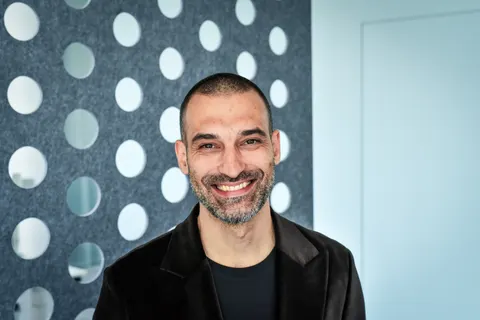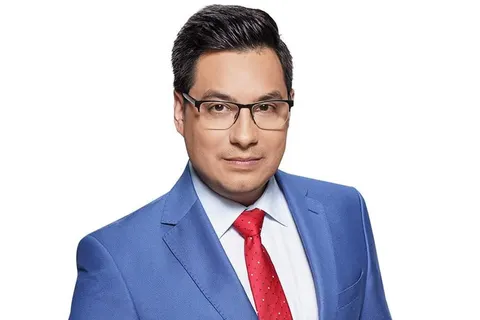
Svetoslav Ivanov is a landmark journalist, reporter and host because he looks not only for what is topical but for what is meaningful and deep. For the stories that can move us, the ones that show that making television can still be an art.
Now in his tenth season as host of the show “120 Minutes” on bTV, one of Bulgaria's largest private television channels, he is the author of books and documentary films, of memorable interviews with world-famous figures and with the most “ordinary” people. He has specialized at the UN and at Harvard and has won countless journalism awards.
Together with him, we will look for some of the curious and some of the important answers. What would he ask his interlocutor if the one facing him were a perfect artificial intelligence? What are the greatest dangers this type of technology poses to society? Why do people who hold different opinions so often end up in an “online prison” today? Will we manage to create an algorithm that tells moving stories like Ivo Ivanov, the bTV reporter celebrated for his touching human-interest stories?
– If the one sitting across from you were an artificial intelligence said to be perfect, what would you ask it?
– Some time ago I hosted a big forum with people from your field, and the head of the artificial intelligence department of one of the largest IT companies in the world came onto the stage. He told us how they test the level AI development has reached through a game of poker. They gathered the most famous players in the world and set them against the algorithm. The prize fund was several million dollars, but the poker players had something at stake too—they could lose money as well. In the end,
the humans won, because the AI turned out to be incapable of bluffing.
So, in my view, wherever we think we can apply AI—in science, in medicine, in industry—there are things like human relationships, character, thoughts… That's where it won't succeed.
A human is a human; AI is something that should serve us. For good.
I don't know what question I would ask it… Maybe I'd ask: “Have you ever felt sad?”
– And would you be frightened if it answered “Yes”?
– No! It would make me even more curious, and I'd probably get it to tell me when.
– Quite a few of the people I talk to about these topics believe we can build an algorithm indistinguishable from a human being. It's a fact that these technologies surprise us more and more with their impressive progress.
– Certainly. But I
think there are boundaries that make every human being unique and inimitable.
There are certain universal gifts from God that remain reserved territory for the human soul. AI may be perfect one day—it gets better every day—but it is the human soul that shapes it and, I hope, always will. Because humans will stand above artificial intelligence; people are the ones who create it.
– More often, though, it is created by companies that aren't sufficiently regulated, and from an ethical standpoint it isn't clear what they might be putting into it.
– Now that is dangerous, but I think such regulations are still to come. Perhaps the ethical norms and rules you're talking about will be the most important part of those regulations.
– Do you think we can invite it into journalism, at least to do some of the “tedious” work for us? To write our news briefs, for example?
– Yes, I do. I don't know whether it will be able to write news briefs, but I believe that
AI will be our weapon against fake news and disinformation.
The world is still losing that battle. It has turned out to be far fiercer, with far more serious consequences, than we imagined. Just 10 years ago, we as a guild and a profession, and our audience too, underestimated fake news. We often told ourselves, “Oh no, that's fake news,” and didn't take a given claim seriously, however fantastic it sounded.
You remember that years ago Facebook's algorithms allowed information written in the newsroom of a major global outlet and information written in some basement to look absolutely identical on the interface.
– And it's still not as different as it should be.
– True. But there was a time when Facebook even let you change the photo or the headline when you shared the piece itself. That astonished me. I said to myself, “Good Lord, you can share an article from a major outlet and change its meaning!”
And the world today is very fast.
We dig deeper into what we read less and less often.
There are studies showing that a large percentage of the audience reads only the headline, especially on social networks, and so they comment on it, or on the sentence the page administrator wrote above it to announce the piece. On the other hand, journalistic formats keep getting shorter because of the hurried times we live in.
That means one big skim across the surface.
Clearly we won't be able to cope with false information on our own. And here artificial intelligence is something I believe will back us up. A lot of work is being done in that direction, and one day we'll see concrete results.
For now we're losing this battle, but this is a war. We fight every day.
– Shouldn't the initiative come more from society? For people to become more demanding about the information they receive…
– It's a bit like building immunity. You have to get used to the mindset that everything you read anywhere should be questioned. What I fear, though, is that in today's world of division and extreme emotions, everyone shuts themselves away in their own bubble of like-minded people who think the way they do. Unfortunately, the algorithms of social networks, and of search engines too, give you even more of what you want to hear. Not information that could give you a more balanced, realistic picture of the world, but even more of your own stereotype, which locks you in a cage. And so
people who hold different opinions are now in something like a prison.
They have no contact with one another. And when that contact does happen, the aggression begins. Debates are louder, hysterical, full of harsh language and insults, which is very hurtful. I say this on a purely human level—it's deeply wounding, and it's not constructive for society either. But these are things that are being worked on, especially since the US presidential election 6 years ago.
– The filter bubble and online hate are among the very reasons this site exists. But are we doing enough? I don't see anything of the kind…
– Here the concrete solutions have to come from the technology companies.
– But it's not in their interest to offer them.
– I don't know whether it's in their interest, but they are obliged to—they have a duty to society. I don't in any way think they are responsible for fake news and the like. But until now they have claimed that they aren't media in themselves, merely platforms. I don't think that's so. After it emerged, during the previous US presidential election, that only a few dozen people in the US worked in Facebook's trending topics department—the people who can use AI to inject certain topics—I think the solution has to come from them as well.
– What's your personal recipe? How do you step out of your own bubble?
– I try to listen to people. When I'm in a dialogue with someone, I like to listen more than I talk. But right now I feel the division, and even though it's a fact, we all see it, it hurts me. I feel we've reached a point where even arguments,
reasonable arguments, struggle to convince the person across from you.
It's ever harder for someone to change their position on an issue. Quite the opposite: they're ready to dig in and defend it. A real verbal war is being waged, not only in the Bulgarian web space but all over the world. And it is fed in various ways.
So we as a society become easy prey for manipulation. There's also a danger that we'll start imposing limits on ourselves about which topics we talk about and which we don't. And that, too, is extremely dangerous for our profession.
– But that has always existed in some form. To a greater or lesser degree, you're always constrained, if only by your audience, because it has certain expectations of you.
– Speaking about these topics, I'm still an optimist.
Building an intolerance for fake news is the job of both the journalist and the audience.
But we are starting to build immunity. I can just feel it.
There's something else, too. When an environment is too hysterical, people start to get tired. You can't thrive amid shouting. In my opinion, the time we spend on social networks will gradually begin to shrink. Because defense mechanisms will kick in inside us, telling us: “Wait… Stay alone with your thoughts for a while. Enough of this shouting.”
– I hope you're right; I don't feel it that way. What would you advise a young person who wants to go into journalism today?
– I tell them that at times this profession is very thankless. But if they sometimes feel an inner satisfaction from the work they do, then it's their profession.
In today's world there are certainly many young people who want to enter our profession with other motives: for instance, they think it will bring them quick fame and a lot of money. Neither is true. To earn people's trust, you have to put in a great, great deal of effort. You know that. And if your motive is fame, that too is a mistake that will lead you nowhere.
Only inner satisfaction can help you endure in this profession. Especially now, in this hurried world. When information no longer flows—it's an ocean, it's a whirlwind.
– Why, at a time when supposedly everything is storytelling, is it getting harder and harder to tell stories? And there are fewer and fewer masters who know how…
– In that ocean we're talking about, there are far too many people who want to tell stories. And the stories get shorter, because we're all in a hurry.
The ever-shorter form is constraining.
There's nothing finer than a beautifully told story. I'd compare it only to a well-written short story, or why not, to a book. It's a craft that isn't for everyone. It's a talent!
But good storytellers will always find their way to the audience, and the audience will find them.
– And still, you don't believe there will be an electronic Ivo Ivanov…
– No, I can't picture it. At the very least, I can't picture an electronic Ivo Ivanov who gets so excited about basketball. But perhaps there will be technology that becomes our helper here too. I hope, truly, for good…