“A minimalist style, repetitions, deceptive simplicity, the sound of a world that is changing, industrializing; the quiet tones can be read both as the last moans of a humanity surrendering to the machines and as the first timid songs of newborn machines.”
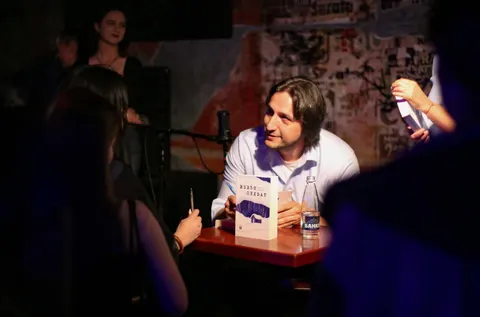
Vladimir Poleganov published his novel Drugiyat san (The Other Dream) almost a decade ago. And some of its strokes now ring prophetic. About how we delegate more and more to machines—our memories, our knowledge, ourselves.
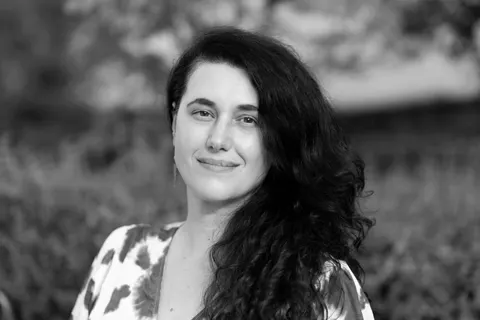
Today's guest is a writer, translator, screenwriter and teacher. And a conversation partner worth talking to about books and the future. About words and machines. About whether literature will arrive too late to remind us what it means to be human and what we must never delegate to machines…
– The Other Dream struck me as a prophetic novel about how easily we delegate to technology. I couldn't imagine it back then, but now it's a very big subject for me. Are we really giving them too much? How did you arrive at the idea that this phenomenon would appear?
– Through myself. I noticed it, and it's a process that still isn't over for me, and somehow I can't beat it. As I get older, I see that it has quite a few downsides.
I simply stopped remembering, stopped writing things down,
because I know everything is very close to me, at hand, I can find it instantly, no problem at all. For the last few years I thought it would always be there. Until the moment when the information simply became too much, and the places it pours out of became both too many and, in fact, far fewer than, say, on the internet 15 or 20 years ago, when there were websites, when search was something completely different.
So gradually I realized that we've handed over a lot—especially when it comes to
what to remember, what to think we know as something learned, and what we've simply stored as a kind of information that might come in handy.
We delegate more and more. And I think this relationship between the human and the machine assistant—phones, computers, even the whole network as one big machine—is becoming an increasingly invisible phenomenon. That is, there's no way for us to track how much of it we see and can control. Because many things we think we've found, or stumbled upon by chance, have been conveniently offered to us by some algorithms that have simply been listening carefully, following our searches.
On the one hand, this helps preserve the magical side of technology, keeps it slightly veiled. And I like that, because in everything I write I start from the position of a person who doesn't know what's going on. Who can't explain things technically, can't understand them as a specialist, and is sometimes too tired to look for explanations. Because I think that's the position of most people who use technology.
– Definitely. But this loss of memory and personalized content bring a lot of problems with them. I do the opposite—I try to understand how they work. But people don't seem to find it interesting or important what they lose this way, because we become easier to manipulate. Once some algorithm chooses what surrounds us, it can lead us into a parallel history. Or manipulate us into voting for someone. And delegating memory is, in a way, the end of creativity, because creativity is having facts or any kind of information in your head and combining it in the right, unexpected way.
– And right now
you think you have those facts, even that you have far more of them than you ever did, but they've been shaped for you in some way.
I'm not saying some people are sitting there pushing things toward you—it's a combination of people, bots, machines, algorithms. Facebook is an example. I try not to spend much time there, not to post there deliberately, but it seems to me that
many people have accepted that place as some kind of pure forum where ideas can be discussed, everyone can speak their mind, even quarrel, get to some kind of discussion.
But behind that is a rather utopian notion, that it's a bit like the old days in Ancient Greece—only the sky above you and real people around you. When in fact algorithms lurk in the shadows, and some of the profiles aren't people. It's yet another place you think gives you freedom, when it's actually shaping you in a not very visible way. I don't know which way it's heading, how it will affect society as a whole, not just the individual.
– It does affect it—disastrously, in my view. So why don't we do exactly that—try to peek ahead? Science fiction used to have that role too. Apart from Ted Chiang, whom I like very much and whom you translate beautifully, I can't think of a mainstream author who looks into these subjects. Subjects that are vital to us as a species.
– That's true to some extent. Ted Chiang really is special in that he picks some big idea that is scientific, tied to technology, and also world-changing or life-changing, but he chooses to explore it from a very personal position. You see things through the eyes of a fairly ordinary person—sometimes a scientist, a specialist, but nothing exceptional. And he always holds that balance between specialized knowledge and what can be understood. He uses the reactions of both sides.
There are other writers too. I think, for example, of Greg Egan, a very interesting Australian author; to some degree Pynchon does the same. But they really aren't so-called mainstream writers who can reach a lot of people.
I suppose this will be one of the themes of so-called realist literature in the coming years, because it moves with a certain delay. It waits for things to happen before the authors' eyes, in their own lives, before it starts exploring them. But I don't think we can keep thinking along
that line where we believed science fiction writers work with the future. They actually work with the present
very carefully, and imagine possible lines and paths. And then the realists work with the “here and now.”
It seems to me we really are in the period of that famous William Gibson quote, that “the future is already here—it's just not evenly distributed.” It appears and disappears; sometimes you can touch it somewhere, sometimes you can't, but it affects you.
– And, as the literary scholar Nikolay Genov told me about that very quote, most likely by the time the future arrives, literature will no longer exist. Might we be too late?
– On the one hand, it seems to me that
literature will always exist, simply because it is the expression of something deeply human,
which comes as an attempt to understand the world, to explain it to ourselves, to tell it. I think there will be literature, but we don't know whether it will be the kind we're used to thinking about. I think
a time of doubles of many things lies ahead—not only our virtual doubles, some imitations of the human, but imitations of human impulses and quests as well.
They will, of course, be directly tied to the demands of the market, because artificial intelligence can already help you write a book, design the cover. There are already author contracts in which writers explicitly agree or refuse to let their publisher use the text to train artificial intelligence. I wouldn't be surprised if some phenomenon soon appears in literature that we later find out was either pure artificial intelligence or a joint project of a human and AI. Whether because some people got carried away, or simply as an experiment.
– I wonder when a famous author will actually admit that their new text was generated by an algorithm.
– There was recently something like a scandal in the romance novel world in the States—that's the biggest publishing industry, it makes the most money and sells the most copies. There was a festival that widely advertised
a workshop on how to write a novel with the help of artificial intelligence, and why that's okay.
Afterward, of course, there was a huge backlash and they took it off the official program, but they didn't cancel it entirely.
These things exist, but they're not very visible yet. The point is not to miss the moment between their being invisible but tangible or detectable, and their merging with our idea of a text written by a human.
– In many ways that's already the case. I ran an experiment with almost 2,000 participants, and it became clear that we can no longer tell written texts from generated ones. Or, as the poet Violeta Kuneva said—her poems were among those people had to identify—perhaps the problem is the criterion, which is why people can't recognize poetry.
But let's look at that moment—you read a story that's supposedly by Ted Chiang, and then it turns out artificial intelligence wrote it. How do you see things going from there?
– As a reader, I'd be interested in why this story appeared, how far and in what sense it's really connected to Ted Chiang. Whether it's some kind of experiment or not.
There are already authors, mostly on the periphery where experimental writing happens, who create texts with the help of programs. Joanna Walsh is an author known precisely for her provocations. That's the first thing I'd look at.
Personally, as a reader, I won't keep following this kind of work. But I'd be curious if it becomes a trend. How do people react, what do they do?
It really is a matter of time. Just as some actors let their image be used. Or an extra in a film may have a clause in the contract saying your image, your expression and your face will be used for other crowd scenes. There will be authors like that in literature too. This touches on an interesting question—what is an author, where does the author end, and
isn't artificial intelligence a natural extension of humanity's relationship with the world through art?
Because, after all, it's something we created. Something that learns from us.
But you're right about the criterion too. It has already begun—you can't tell good writing from bad. With artificial intelligence we have the luxury of saying it's bad simply because it made it. But there are problems tied to critical thinking, to personal experience, to the fact that it's getting harder and harder to judge with certainty and conviction what is what. In recent weeks and months there have been so many cases of people reacting to something that turns out to be made up. This will only deepen.
– Many people think this is the distant future, but what you said about actors was one of the main reasons all of Hollywood went on strike for half a year. It's a sign the technology is already here. But what worries me even more is when the two things we've talked about so far are layered on top of each other—hyper-personalized content, thanks to algorithms knowing everything about us, and content creation. Then, I think, we'll split apart completely. Everyone will have their own Ted Chiang writing for them. What will be left to unite us?
– The problem is also what this means for our connection with the world. Because if everyone is shut inside a model of their own world, the way it's supposed to be, because the algorithms created it, judged it, saw that it's what the person wants—how does that affect personal experience? We are, after all, social beings. On the other hand, there are trends that intensify this alienation;
the detachment comes precisely through these bubbles, which used to belong to groups and communities and lately are getting even smaller.
And when it comes to receiving art—the films you watch, the books you read supposedly being by your favorite authors and directors, but not really by them, simply because they don't reflect their creative will… The distance will shrink entirely until a person thinks they are the world. It becomes rather literal, like the idea that every person is an island. As in science fiction, which can make literal things that used to be metaphors.
It's a closing of the person in on themselves, a kind of enchanted circle that personal pleasure never leaves. And if it's sent out toward some object, it comes back with exactly what you expect. Which is good on the one hand, because it creates a kind of comfort on a very basic level, but on the other hand it's terrifying. And, for example, contemporary music, especially pop music, is also moving along these lines, I think.
– Do you think we can stop the future, and that we should? I don't think we can, but we should meet it in a way that's a bit more discussed, thought through, reasonable—set some boundaries for it.
– I agree with everything you said. We can't and shouldn't stop it. In any case, the future isn't something you can see in its entirety so you'd know how to stop it. Exactly what you said about this awareness, this heightened attention, which, however, requires time and a kind of wider, more stretched-out reaction time. And also space to think certain things through.
So that you can weigh both your own reactions to something and the other person's, see where you might meet, where you'll miss each other and what the consequences will be. Meanwhile, everything we do every day demands that we be faster. To such an extent that
replying to a message is just a reaction,
one that's much shorter, quicker, and you can do it immediately, here and now.
The idea is that you can react instantly, any time, anywhere, that it's good to react emotionally. And that's somehow human, even if you get it wrong. It works because it connects to some very deep notions of what a human being is. But the more the time we have to look, read, think through and carefully check everything shrinks, the harder it will become to influence our present, which is in fact the coming future.
And now, when you think about it, if you decide to join one of the endless, nonstop arguments on Facebook or Twitter, the very time it takes you to get up to speed on everything may equal the time it takes for the argument to pass, so you're left feeling you're outside some community, which, for some people, matters.
– Are we close to the limit of how far we can shrink time? I don't think we can come up with anything shorter than TikTok. My children are little and live pretty far from technology, but if they're not doing something for one minute, they say they're bored. And not just children, all of us are like that. Is there anywhere left for this time to shrink?
– It seems to me too that there's nowhere left. Everything happens here and now—for instance, finding out what's going to happen already in the first chapter, the first scene. Maximum action, or in the first 30 seconds of a song you find out how it will develop, so that you'll listen to the end.
What strikes me, though, is that
alongside this shrinking, there's a parallel growth, an expansion of forms of art that hold you in a different kind of world.
Fantasy and adventure novels are getting bigger, more sweeping. There's almost no action or adventure film under 2.5 hours anymore—astonishing. Only experimental or heavyweight directors and writers used to work at that length. In parallel comes the idea that you can watch entire series, sit down in front of the laptop or TV and not get up until the end.
These are two supposedly opposite trends, but apparently they aren't, since they go together so well. Maybe we really will reach a point where, so as not to be bored, you'll have a nonstop stream of opportunities to react or to engage your attention, your mind, your consciousness. At the same time
that stream will keep you in some closed world modeled specifically for you.
Somehow we're approaching the cliché of the future in which a person wears goggles, stares into some virtual reality, is overweight, their room messy and dirty, but they inhabit some world and live in it.
– That cliché has been around for 30 years, since the days of Jaron Lanier. And in some ways we seem to be getting closer, while in others it still looks so far away.
I think popular opinion, judging by reactions to my posts, is very skeptical of artificial intelligence. I'll soon try to test this with a survey, to see what people really think. But I see many people who are afraid of it, dismiss it or are extremely negative about it. You also studied psychology—is this some natural reaction to very drastic changes? Or fears? Not enough explanation and reflection? I'd say mostly the last.
– Certainly the last as well. But I think
there's a natural reaction to fear something that imitates what you are.
Because creativity, consciousness—these are areas where we are the ones who can make sense of the world creatively, who have consciousness, who can think about ourselves in the past, present and future, in different alternatives. And when something appears that imitates us, fear certainly develops.
It's reinforced by the fact that we live in a culture where far too many images of the clash between human and machine have piled up.
And we also live in a time when nostalgia is very strong. So there's a longing for a pure time and existence, even though there never was such a thing. And a sense that back then people were people, and machines, if there were any, served humans.
We shouldn't rule out the discussion itself, either. It's sometimes tied to purely economic forecasts of how many people will lose their jobs, how many will find their existence all but rendered pointless.
This way, though, we drift further and further from the other cliché—that when machines become smart enough, humanity will be able to step away from its daily grind, its ordinary life, and will have time only for itself.
We'll all become artists, explore the world, write books, paint, while the machines toil and produce for us and keep the world “turning.”
This, of course, isn't necessarily a good thing even in the books it comes from, but it's a persistent cliché.
I think we shouldn't rule out the deep fear that something nonhuman is trying to be human and do what people can do. Once, on a trolleybus, I listened to two schoolgirls: “I wrote my homework with ChatGPT.” “And how was it?” “It came out great. And it's real.” That particular word made a strong impression on me. Some people don't accept that there's a drifting away from the real existence of the human, from their so-called usual context. In their case, from being a student in the classic sense.
– I also tried competing with ChatGPT to see who would score higher on the literature matura, Bulgaria's school-leaving exam. And it turned out to be pretty good. But my other association with what you said comes from Márquez. The fear that when they photograph you, your soul leaves. That the camera takes your image and your soul vanishes.
– It's no accident that in diabolism the mirror is very important, and the portrait—these are extensions of the same fears. That's also why it's no accident that the series Black Mirror deals with things this way. In the beginning, when it turned out you could end up in a labyrinth with no way out, it was quite powerful.
The other fear is that one day it might start doing things better than you. And especially for artists and writers—I'm judging by myself—
there will come a moment when it won't matter whether you wrote it or a machine did.
This fear first appeared, in my view, when a lot of book bloggers began to take over. What happened to literary criticism? It turned out that book bloggers write, read and react readily and with pleasure, while at the same time the so-called serious literary critics and the venues for serious criticism disappeared. And it became clear that neither readers nor even publishers had a problem with one replacing the other. That's when, it seems to me, there first appeared
this fear that it doesn't matter who wrote what, the important thing is that it sells in some way.
Whether economically or culturally doesn't matter. With artificial intelligence the problem will be even bigger—by how people react, we'll see whether it really matters. And then we'll talk about authorship again, but, as you mentioned, it may already be too late to change the future; we may have missed that moment.
– Let's end on something positive anyway. Is there a technology you dream would appear? I, for example, dream of something that would sit in boring programmer meetings instead of me. We're close to something like that, I think.
– That kind of avatar—or let's call them presences—is certainly on the way.
The first thing that occurred to me is the possibility of peering into the past. Seeing it, watching it from the side.
But as for a technology to help you day to day… For me, too, it would be something to do with the various forms of communication. That's exactly where I'd delegate boring meetings too. Certainly something that saves you time.
But it would also be nice to have a technology that doesn't obey completely. Right now there are ways to limit yourself, to use an app only briefly, but it all depends on willpower.
If there were a technology that somehow challenged you to have a stronger will in defending how you spend your time and attention, that would be good going forward. It sounds like a very secret and expensive algorithm that some people with a lot of means would get first, and then everyone else.
– And it probably won't come, because those same people would lose out from it.
– I'm not against technology, I'm not against progress and the future, but I'm more interested in the moments when there's some rupture, when something breaks, and how we react then. Or when it turns out we can no longer react. That's why every time I think in the direction of technology, my thoughts turn darker.
– Mine too. I try to look for balance; I think that's where the reasonable point of view lies. But I lean more toward the negative, because that's what we overlook. There's no need to talk about the positive; what matters is to talk about the risks, about the problems that are so big and yet lie outside the main public debate.
– Exactly. There has to be conflict. Just as for there to be a story, you also need some kind of conflict. No matter how far it's brought to the fore or how hidden it is. But it has to be there, to move things forward…