When did you last spend an entire day away from social media?
Switch off your phones—we’re going “Out of Range.” Out of range not only of mobile internet but of technology as a whole, which has taken over so much of our lives. To look for where the human being has been hiding behind it all.
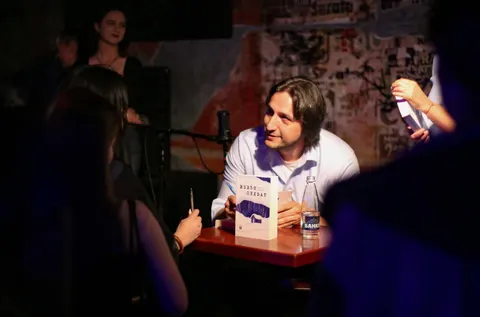
That is the title of the new novel by Evgeni Cherepov, Izvan obhvat (Out of Range), which makes us think precisely about the need for digital hygiene. About slow conversation, about deep stories and themes that cannot be told in TikTok format.
Today’s guest has worked as a security guard and studied civil engineering before finding his calling as a teacher of Bulgarian language and literature. After long wanderings, he has returned to teach in his hometown of Stara Zagora, a city in central Bulgaria.
When does technology become too much for us, and why is it important to think about it? How do we learn to tear ourselves away from the feed and find a balance?
“People have always needed pauses… Just like that, to stop for a moment, to take a step off the highway of their supposedly purposeful lives.”
– How much longer will we be able to afford to stay out of range every now and then?
– It’s a matter of personal choice. And it will last as long as there are professions you can practice without it involving screen time online. Recently I ran into a former classmate from the vocational school for construction in Stara Zagora. An electrical engineer by training, but now he has chosen to be a “tile guy”—a craftsman who renovates bathrooms. We talked about how people like him are getting scarcer, and his exact words were:
“Soon there won’t be anyone left to do ordinary work.”
The “gold rush” that the boom in digital technology set off in so many people over the last quarter of a century pulled them away from non-digital, hands-on technical work.
And now this acquaintance of mine has chosen to be out of range and to make bathrooms. Being in short supply, he can afford a high standard of living, flexible hours that he sets himself, independence. The price he pays is walking around in overalls dusted with tile adhesive—there are no role models like that on Instagram, but our generation doesn’t give much of a damn about that.
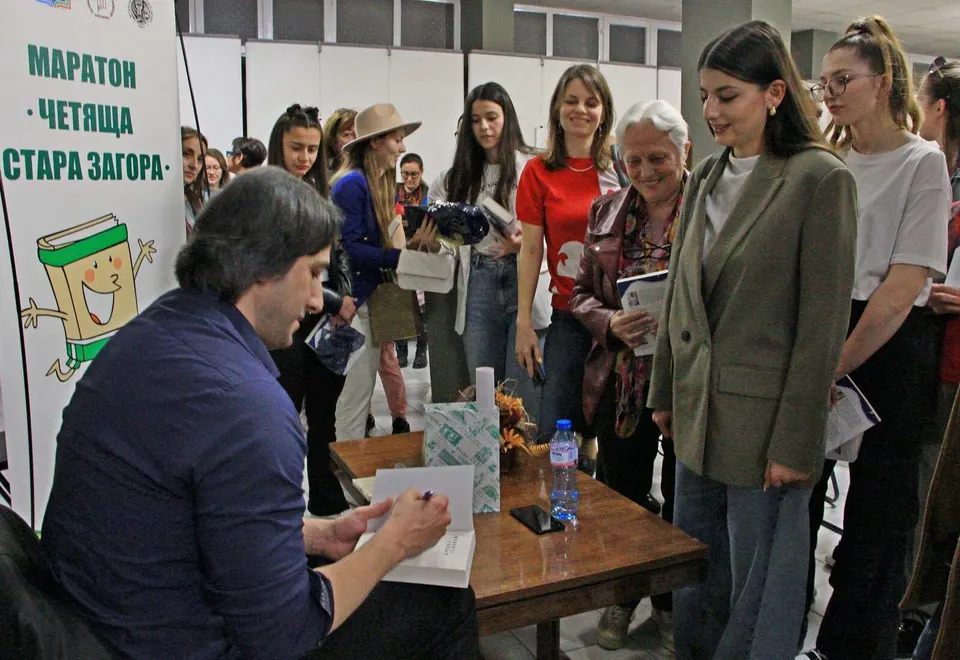
– I often joke, too, that I may have to change professions once again. Only tiles wouldn’t work for me, precisely because they require skills I can’t develop. But why is it worth going out of range from time to time?
– It’s healthy. The sense of connection the global network gives us is wonderful, but only as long as it stays within healthy limits. People also need to be alone sometimes.
And not bombarded by tons of unnecessary information that the brain has to process constantly.
– When does technology become too much for us? How can we tell it’s time for a little digital minimalism?
– If we can’t watch a film of an hour and a half or two without unlocking our phone several times, just like that, out of habit, to glance at it, then we’re already addicted. I deliberately give the example of watching a film rather than reading a book—with the latter, concentrating these days is even harder, once your brain has grown used to the pace of scrolling.
– What’s your personal recipe for a healthy distance from technology?
– Outside working hours, not to wander through the feed for more than two hours a day. I admit I struggle to stick to this self-imposed limit. To older generations those two hours may sound like far too much, while the youngest will laugh if you ask which of them has less than two hours of screen time a day.
– Even worse, I think, is when we don’t realize at all how much time that is… And once we decide to check, it turns out we lose hours in the feed every day. Are there things we should never delegate to technology?
– Perhaps we can delegate everything, but only when there is also the appropriate human oversight.
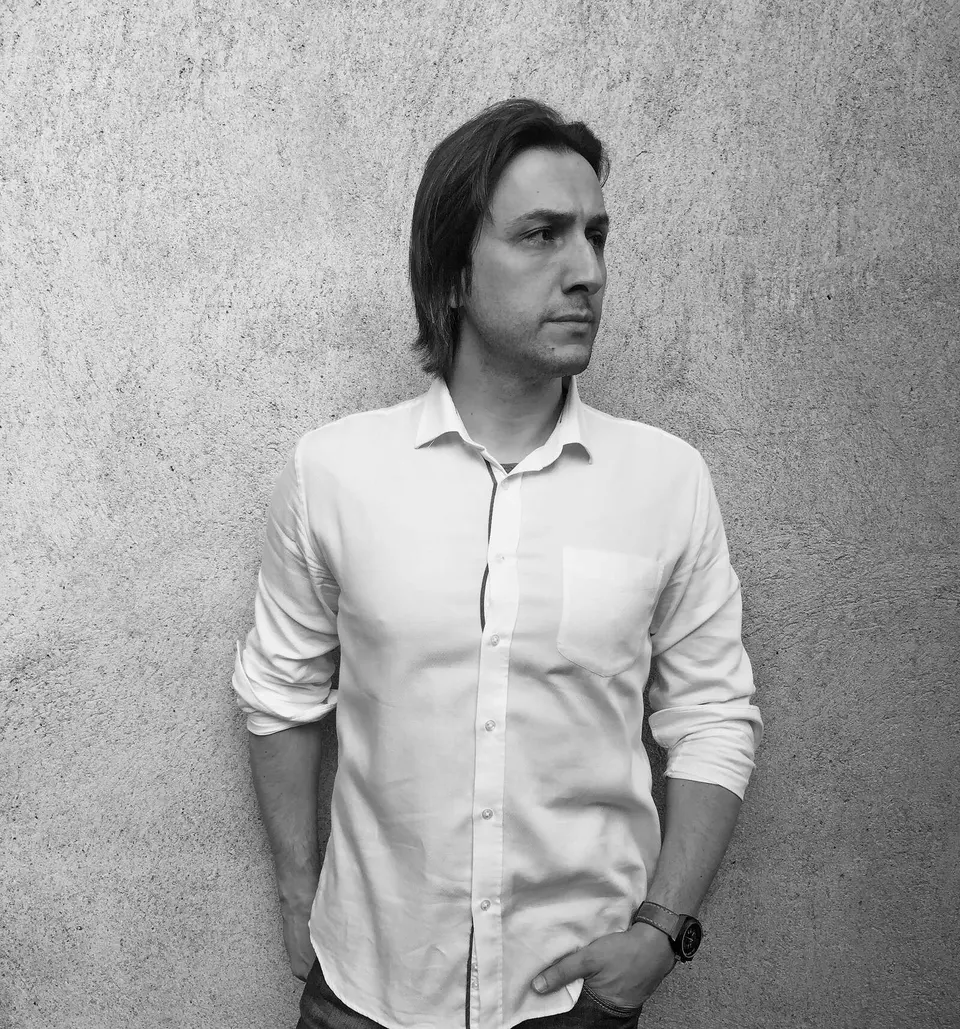
– One of your characters says that today literature, busy looking for new forms, has stopped looking for the human being. And your new novel, in my view, does exactly that—its themes are precisely the ones that move me as a person today. In some ways it reminds me of Pavel Vezhinov, the Bulgarian master of psychological and science fiction prose and one of my favorite writers. So can literature really still help us look for the human being?
– That’s actually mostly what literature does—it talks through the human being in all the nuances of their ideals,
their thoughts, their passions, their ideas of how to live, while searching for the meaning of it all.
If we take off our new clothes, our new ideas of how to live, our new tech gadgets, underneath we’re the same people as previous generations—with our fears, our weaknesses, our need to be loved. They say everything has already been written, but every generation wants to read it through its own “here and now.”
– As long as there’s someone left to read… You’re a teacher and you talk with young people. What moves them? How are they different from the young people before them?
– The virtual world matters to them as much as the real one. For some, it seems,
their online life, their online status, is even more important than the physical one.
Advertising yourself as permanently happy on social media takes a lot of energy and staring at a screen, so you may miss moments in which you could experience real positive emotions. Not being present online in the most popular apps and social networks seems to erase your real existence too.
– Will we ever manage to regain the ability to read long texts?
– You become a good specialist in anything (I’m leaving out digital skills) by reading a great many long texts. On YouTube there are already quite a few videos in English by professionals in various fields that can replace that reading, but the concentration needed to make sense of them is similar to that of reading.

– How do we find a balance in using technology today?
– For me it’s both an intuitive and a conscious process. But then I’m from the analog generation; I take in all technology secondhand, while generations are now growing up with it naturally. Just as we analog generations are learning digital life, the digital generations have to learn analog life.
– Technology has to a great extent divided us and set us against each other. This theme is in your novel too—that analog life might help us here. What’s the recipe for getting people divided today to talk to each other again—divided by generations, by political lines, by the latest hot topic?
– Who knows! Perhaps
the recipe is to listen to each other and to be less emotional in these arguments.
It’s a bit like driving—while you’re alone in the car, you can tell off someone who, in your view, isn’t behaving sensibly on the road, but only because you know they won’t hear you. You wouldn’t say the same words to their face. Probably the lack of direct contact in digital communication leads people in the same way to be less restrained in their emotions and reactions toward the other side. Which, however, practiced online for a long time, may already be carrying over as a habit of behavior into offline communication.
– I think technology takes us over, gradually and imperceptibly. Our knowledge, our memories, our communication… Instead of the other way around—us taking it over, mastering it, making sense of it. Introducing it after we’ve discussed how to do so. Am I being too idealistic?
– I suppose it isn’t fatal for the two processes to run in parallel and for us to keep readjusting to the situation. Once it becomes clear that the rate of anxiety in children and young people grows as their screen time increases—and science already has enough evidence of this—steps must be taken toward the corresponding corrections in society’s understanding of how far this freshly discovered technology should spread into every level of our lives.
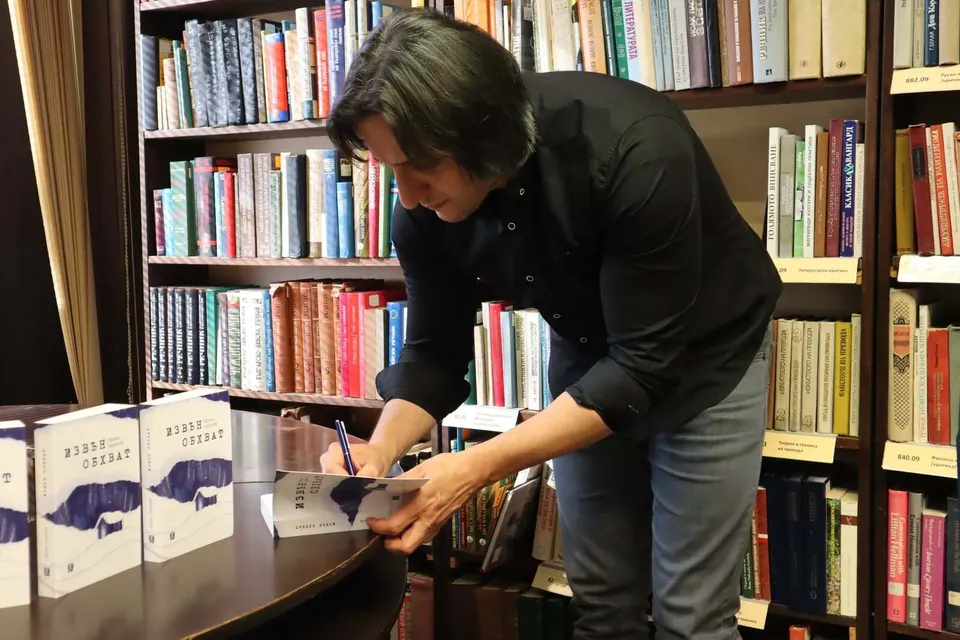
– What do you miss that could never happen again because of technological progress?
– I’ll quote one of the characters in my novel Out of Range: “Back in the day we’d cut ourselves off from the world for whole days, they couldn’t find us. They could only reach you at home or at work. And at work, fine, somehow or other, they’d find you, but why you didn’t pick up at home, nobody could hold you to account for that.” Not that I mind now, when I can see through the relevant app exactly where my daughter is at any given moment.
– What are your plans—when and how do you intend to introduce her to technology, to artificial intelligence?
– She’s had a smartphone for about two years; she’s 11 now. But it’s linked through an app to mine, so I can control the apps she installs and her usage time, and also know where she is. Until recently she had 45 minutes a day; now it’s an hour. I’ve read that children shouldn’t have smartphones until the age of 14, nor use social media until 16. But when they have a class group on Viber where they exchange information about homework and other school matters, her being the only one missing from the group causes me more problems as a parent than making a reasonable compromise.
– The subject of children and technology is very important to me too. But what can a person miss if they go without the feed for a day or two?
– A panic attack, at most. More seriously: it depends on what they do, what trends they need to follow, how fast things change in the field they’ve chosen to work in. My acquaintance the bathroom craftsman won’t miss anything in a day or two, and I think we should all envy him deeply. Me, not so much—
I can afford that luxury too. I believe everyone can still afford it.
– Has time really sped up? How can we, with our human linearity, keep up with the exponential pace that comes with technology? Can we slow things down, or is that battle lost?
– What has sped up is the multiplication of the volume of information we have to process. And this is where the battle comes in to sift the information that matters to us from the digital noise gushing from everywhere. We humans are adaptable creatures—once, in an information technology class, I was taught how to make directory trees in DOS; now all the lessons I’ve developed are in the cloud, and I can “pour” their content straight onto the board through the classroom’s multimedia projector. That’s a convenience you shouldn’t run away from.
Technology has made life easier in many directions. We actually live very well. The dangers come not from technology but from how people use it. Both on a personal level—filtering out the noise and using what’s useful—and on a global level—abuse, disinformation and so on. Once, science was elevated to a cult, and technological progress was thought to be an inevitable good. The two atomic bombs over Hiroshima and Nagasaki seem to have rethought that narrative and sowed in humanity a fear of the scale of technological advance as well. But let me say it again—
the dangers come from people, not from technology.

– Why, in the art of recent decades, do we so often struggle to describe the present day? More of the strong novels and films, at least in my opinion, look toward the past…
– I, on the other hand, love reading books and watching films about precisely the present day. Living through it from someone else’s point of view too, which enriches my picture of our times and makes it more colorful; some make me think about things I hadn’t arrived at on my own, while others reassure me that I’m not the only one who thinks and feels this way.
I’m curious about the present day, not the past, and that’s why I write on contemporary subjects.
I respect other people’s right to be more curious about the past. But writing about the past also seems a touch safer—yes, the research you have to do on the era in question is considerable, but you stay in the shade, sheltered from accusations and canceling by some fashionable ideology over an accidentally dropped word or a character whose views are archaic compared with today’s colorful situation.
– When will there no longer be any point in writing and reading?
– When we’re dead.
– Have all the strong plots and characters already been invented?
– Maybe. But as I said a moment ago, every generation wants to read its own nuanced take on those plots and characters in the time and world it now inhabits. Connecting them to already established works perhaps brings the reassurance that not everything changes and that we humans are still the same. That’s where literary references to the classics come in.
– What do you dream of?
– Calm, harmony. To be out of range of worries about things I don’t have the resources to do anything about anyway.