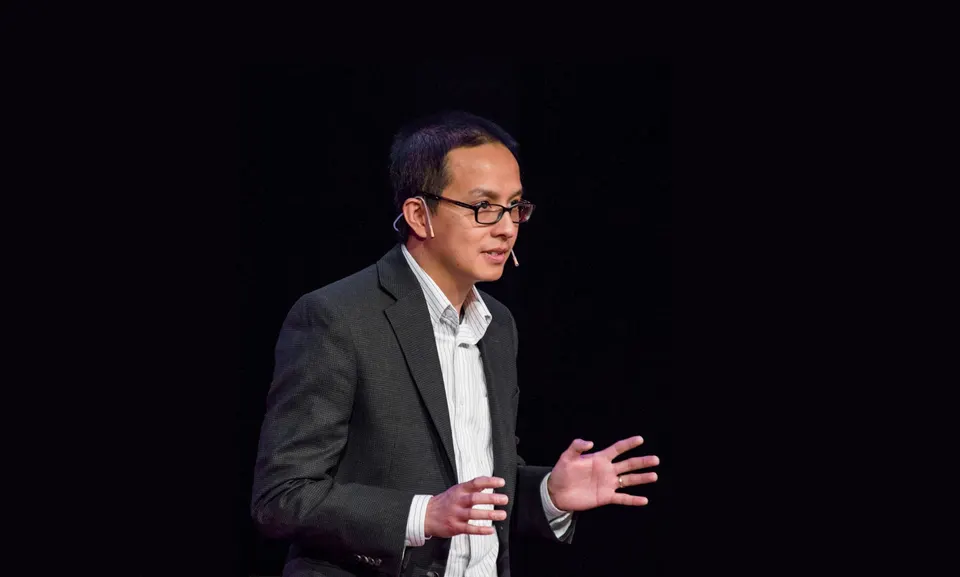
If you follow Digital Stories, you know very well who Vu Nguyen is. A former journalist at The New York Times and a top-level IT specialist in the US, he and his wife decided to move back to Bulgaria after their son started calling the laptop “grandma” one day. Vu won the audience's affection on the Bulgarian edition of MasterChef and ran his own restaurant for a while. And today he is back in the world of information technology, but here, in Bulgaria.
In the meantime, he has become quite popular on the Bulgarian web for his colorful outlook and his interesting musings. That is exactly why I invited him for a chat about the present and future of journalism, about technology, and about the challenges and the bright sides of life in Bulgaria.
– In every interview you give, they ask you how on earth you decided to come back to Bulgaria. I'm more interested in something else, though: is it normal for us as a society to be so astonished by a decision like that?
– I really like it in Bulgaria. The biggest part of the dream of Western Europe and the States has to do with financial security. You feel that over there you run into fewer problems when you deal with bureaucracy, that there's less corruption. But realistically, those things don't affect us all that much. What I personally noticed in the States is that people work way too much. It's an entirely materialistic society, the closest to pure capitalism that a society can get.
At the same time, relationships between people, at least in my circles, stay on a superficial level. Here, when you have a kid, you go out to the playground, you meet 20 moms and the kids play together. In the States there's nothing like that; the option is a special arrangement, a “play date.” To organize one, so your child can play with another child, you very often wait for weeks. If you want to go out to a bar with someone, again you have to agree on it weeks in advance.
People are very busy with their own things, and society breaks apart into small circles.
That's very different from Bulgaria, where any friend can say on a Friday: “Let's go for a drink!” “Sure, let's!” “Let's call so-and-so!” “Sure, let's!” And suddenly there's a gang of 10 of you heading out to drink. Even if you don't know each other at all, somehow you click, you find similar things to talk about. It wasn't like that in the States.
– I've read you saying that for you the other big difference is the chance to take a break.
– Really, there's no social policy at all in that area over there. At The New York Times I had two weeks of vacation a year. Because they're a more traditional company, they also counted overtime hours.
In the 2 years I worked there, I racked up 60 extra days!
Finally I tell them: I want to take a little vacation. And they go: no, better take the money we owe you, but don't stop working.
That's great for people who don't have kids and a family yet. Being young and living in New York is amazing, you're always in the thick of things, you go out, you drink and you work again, you're on top of the world! But the moment our child was born, we realized how little this system supports family values, at least ours. My wife was working literally the day before Adi was born. Then I got 4 weeks of paid leave and she got 12, which for the US is among the highest. The state there guarantees you nothing, and most normal jobs give 2 to 4 weeks.
Can you imagine, man, she's given birth and two weeks later she's back at work?!
Then we had to send the child to a nursery, though it was more like a kindergarten. They gather a lot of kids, and all day long they scream, bawl and sleep. A bit like a child farm. It was tragic, and on top of everything, very expensive.
We're working ourselves to the bone, we come home, the child is crying, we feed him at night, then we're both back at work. The money—super, it was very good, but at the cost of what? So we came back to Bulgaria, and I'm very happy.
– After that, besides MasterChef, you also got involved in a few startups, right? Maybe Bulgaria is seriously lacking that entrepreneurial culture, the urge to start something from scratch?
– I have lots of startup ideas
and I've failed with 5 or 6 different businesses. That doesn't matter. The point is that I learn something new every time.
Yes, most people here have a kind of outdated mindset. One thing is that people are so cynical, they think there's no point in working hard, the result won't pay off for them anyway. They start with: enough work already, they'll pay me peanuts anyway, the boss will screw me over.
Very often there's no trust between the boss and the workers. And there are no dreams
—no sense that you can make something good, no wish to show it off. There are people like that, but not many. It's a fact that there are entrepreneurs, and the ones who are really serious do quite well. We already have successful startups that have raised some quite serious funding.
But that's how things are. We come back from the States and everyone goes: “Are you crazy! How can you come back! Can't you see the misery!” My parents were practically mad at me for several months. All our relatives and friends had that mentality at first. But now, over the last few years, you can see more and more people moving back to Bulgaria.
– Especially with a profession that pays a more “Western” salary, here you can live much better than the general standard.
– That's exactly it! Bulgaria has the lowest standard of living in Europe, and at the same time we have access to the European market. If you're a programmer, or in one of those professions where you can work remotely for a foreign company, your life is much easier. In the last 8 years, since we've been in Bulgaria, we haven't worked for a Bulgarian company either. Either on our own project or freelancing, but it's much easier and better. Europe in general is much more relaxed, everything is calmer and people are more reasonable.
– Do you ever regret leaving journalism?
– I don't like journalism today. Back when I started as an intern at The New York Times, I worked a lot on the topic of lying with data. The principles of “cherry-picking”—how people pick only specific sources of information, specific data that support their thesis. Today that happens very, very often, even in the highest-quality media, everybody does it. In my work I was very careful to follow the rules, to keep things balanced. If the data don't support your story, then it doesn't work! You don't manipulate them to make it fit.
That was just the beginning of everything that's happening now. Today cherry-picking is a very small part of the problem;
people literally lie however they please.
There are so many yellow and gutter media, and they lie mostly because otherwise they can't get traffic. They start screaming with headlines that have nothing to do with the content, because that's the only way they can go viral on Facebook.
And there's an explanation for that; it used to be different. A big part of the traffic went through news portals, and another part of people went straight to the websites of the media they liked, to read and dig for information. Ever since Facebook and Twitter came along, they've become monopolists of traffic; people hardly ever visit a media outlet's site, except through a story that gets shared. In my day the site held 70 to 80 percent of the traffic, and suddenly it dropped to less than 10 percent. You can no longer organize the news the way people used to read it; everyone only looks at Facebook. That's where the whole ecosystem of fake news came from, with all kinds of bullshit that people share. And the biggest media went behind paywalls, which is good, because they survive.
– Yes, but only big international media can afford that; it will never be an option for, say, Bulgaria.
– Yes, one newspaper here now wants 29 leva (about $17) a month from me. What kind of nonsense is that? I pay 4 dollars a month for The New York Times. But paying has another problem too. It means that a very large part of the real, decent content is shaped by readers' expectations. I mean, only the people who are willing to pay and who trust that outlet would pay to read it. And that outlet is expected only to confirm their expectations. I, for one, am not going to go for Fox News or Breitbart, right?
So, unfortunately, a very strong polarization is created in journalism. We have it here too: on one side the daily Dnevnik and Radio Free Europe, on the other the tabloid site Pik and others, and they just scream at each other. I'm a big fan of Radio Free Europe, but
I realize that news is now a very large part of the state's propaganda machinery.
Maybe I was very young and it's always been like that, but I see it as a very serious trend now. And I don't know what good it can lead to. We people today are very polarized and we split over all kinds of topics. There's only one opinion, and my opinion is always the right one—that's awful.
– As we discussed recently in an interview with Prof. Julita Vasileva, online communities today are at the level of fan mobs at a football match.
– And it's even worse when you think about it, that each of us is part of that wave.
– The conditions themselves force you to be. So how can we get out of this?
– I have no idea, honestly. I've talked to my former colleagues at The New York Times, pretty smart people, and they can't think of what could be done. The only option is for that respected, real journalism to gradually come back, journalism that's independent of the government, but also of the public. I mean, it won't be swayed by people, and at the same time it will be critical of those in power. But people are already so set in their ways that whatever you read goes through your own filter.
– That's how you end up in the filter bubble and stop looking for the other point of view for good.
– The only thing that could happen is for Facebook to collapse, or for it to be regulated to the point where it doesn't let all kinds of garbage through. It used to sound like a conspiracy theory, but after the revelations of Frances Haugen, who exposed Facebook's filtering process, it turned out they don't care at all. That they deliberately let through all sorts of fake and dangerous content, because then there are many more reactions. The fanatics who support Trump will buy T-shirts with “Make America great again,” and the left ones with “Black lives matter.”
I'm not smart enough to figure out how this could be fixed, but it's definitely a serious problem. And to some extent I'm glad I'm not in journalism.
– Are there technologies that scare you? Do you think artificial intelligence will bring us dangers too?
– Yes, but not at the level people like Musk keep threatening us with. A lot of people think artificial intelligence means creating robots that become so smart they'll conquer us, that they could reduce the population. I read a lot of science fiction, there are lots of theories. But for me personally, in the short term, within my lifetime, let's say, AI will harm us in a different way, the way Facebook is harming us right now—through manipulating who sees what. With those machine learning algorithms that filter the data and recommend things to you.
Before, you saw specific things you had chosen, and now the machine chooses for you, since there's so much information that no single person could possibly process it. But that brutally limits what you see.
These algorithms are optimized for businesses, for more visits. To get you hooked.
After that they only reinforce your beliefs, because nobody wants to read things that contradict what they believe. My point is that these machines will let what's happening now become more extreme. They'll turn people into extremists, push them to take more radical positions—you're either for vaccines or against them. That leads nowhere good.
– What language do you think in?
– Mostly English, but since I've been living in Bulgaria for 8 years now, I've gotten used to switching some expressions into Bulgarian. But when I write something, it's first in my head in English, and then I start translating it into Bulgarian. Lately I've started thinking in Bulgarian too, but Vietnamese doesn't show up, heh-heh. I speak it with my parents, but with them we talk about more general things.
– Where did the nickname Vunyo come from?
– It's a total joke. I often hang out online with a group of people, pretty funny ones, from all different walks of life, you know them: Annie the Goat, the Flying Goatzilla, all people who aren't on Facebook under their real names but just put up some silly moniker. And since I'm now the representative of all sorts of Asian communities, some half-Bulgarian guy of Asian origin, at first they called me a Mongol, a Chinese guy, a Filipina, Baba Vanga—the famous blind Bulgarian clairvoyant. And I can't remember who suggested “Vunyo” as a tease, and I decided—that's what I'll call myself. Besides, I don't want the people I work with to find me on Facebook, because if they saw the nonsense I post…
– Are Bulgarians racist?
– Oh, not to the extent Americans are. In Bulgaria there's racism on a superficial level. You obviously haven't seen these people, you don't know them, you're stuck with the stereotype that Roma are lazy and the Vietnamese eat dogs. But that's not hatred; it's more that these people are different and do things that don't fit our culture. It's not even so much “I don't like them” as simply “they're different and they scare me.” Whereas in the States a big part of society has a genuine superiority complex. The evangelicals, for example, are very serious racists; they treat Black people literally like slaves, they think they're stupid, monkeys, that they can't cope with work.
But it's not just them; that sense of superiority is everywhere over there. Even with a lot of decent people I've talked to, I tell them: “Look, in Europe people don't think about Americans that way, nobody considers them the saviors of the planet, the greatest heroes; on the contrary, people actually think Americans aren't particularly smart, not particularly educated, and have big egos.” And they go: “What do you mean! If it weren't for America, there'd have been no one to save the world in the First World War, then in the Second World War, then to protect Europe from Russian aggression!”
They have such brutal propaganda that they can't even realize their country is as much a part of the problem as it is the solution. Their nationalism is far stronger than in Bulgaria. Here we have some wannabes who talk like nationalists, while Americans have traditions. Society here is much more diverse, with different opinions and nuances, whereas in the States people are boxed into the same frames, the same stereotypes.
– You told me that you became a programmer because you made a bet that anyone can become one. Do you really think that's true?
– Well, not literally anyone, but I think a large part of people have the potential to work in this field. Because information technology isn't just programming; you have, at the very least, different kinds of design, systems engineering, networking. Or testers, for example—you don't need to study all that much to be good there.
If you have the desire, you can start easily. But
in our field, at least that's how I see it, people who think outside the box are more in demand.
Don't expect to do the same job 20 years in a row, like in some factory. You have to upgrade yourself pretty often to stay relevant, especially if you're a back-end or front-end programmer or a designer. If you don't learn, no chance, man! As a developer I've changed stacks, the technologies I work with, 4 or 5 times. You constantly have to get used to new things. Our profession needs people who are willing to change and to learn. And that's where the mindset comes in, whether you're smart or not. Mental ability isn't just pure math; what matters more is your desire to progress. That's what defines whether you're good in this profession or not.