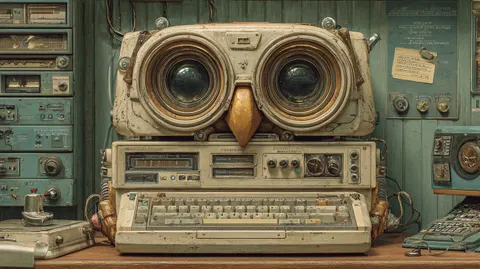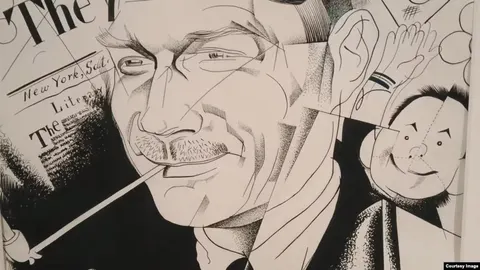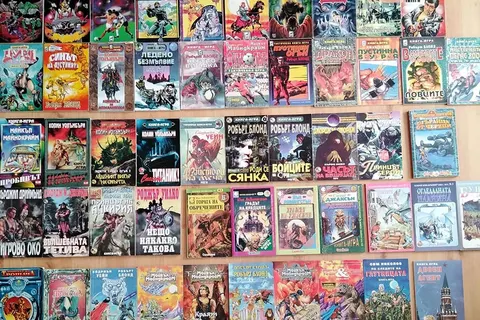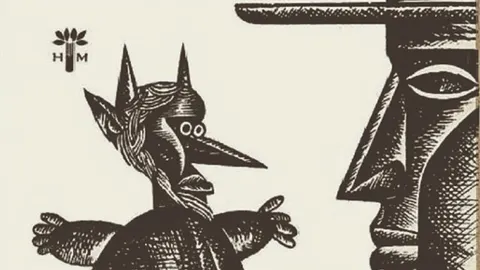
The Cybernet… today we would call it artificial intelligence. Or ChatGPT, who knows. But this one comes from the past, and it is a wonderful poetic metaphor for how humanity looked at technology in the 1960s and how that has changed by our own day.
Reading his verses about the Cybernet, we are here to talk about a half-forgotten but marvelous, wise Bulgarian poet who was ahead of his time.
Poet, mankind has touched the Moon.
With great deeds it has come of age.
But today, as yesterday, the Lie won't say—
“Here, look at me, I am the Lie!”
Secretive and skilled, with practiced art
she deftly gives you counsel,
and you have quietly turned your reverence
for the human person into a cult.
(“Masquerade of the Lie” from the cycle Visiting the Devil)
“Why does a lyric poet become a satirist? The lyric poet dreams; the satirist guards his dreams,” Dobri Zhotev (1921–1997) once said in an interview.
The occasion to remind you of his wise words about technology, and of his story, came from Facebook. Commenting on the Digital Story about Gary Kildall—one of the remarkable pioneers of the computer world—Dilyana Slavcheva mentioned the poet's letter to the Cybernet, and that sparked my interest for the next digital story. And Zhotev's poetry turned out to be so precise and expressive that I will give it the floor more than I take it myself.
One last addition to the introduction: Kildall's story itself was suggested in a Facebook comment. Let's not forget the meaningful sides of social networks, which help meaningful digital stories string together, and help other, half-forgotten ones reach their next readers.
“Quote + quote + quote + copied
is = a wise treatise.
Problem + problem + problem – thought
is = a weighty report.
Chair + pose + name + nothing
is = a great scholar.
And phrase + phrase + phrase x 300
is = one's native tongue.
Couplet + couplet + couplet – talent
is = a recognized author.
Person + diligence + labor + salary
is = a slot on the staff list.
“Not so” + “Then how?” + “Like so!” + “Yes, I see!”
is = a complex debate.
A memo + another + 100 x 1000
is = creative work.
Person + person + person… – and Mephisto
let his hand drop, dejected,
and as if crushed by some weight,
fell silent, leaning beside me.
(“The Dead Man Who Lives” from the cycle Visiting the Devil)
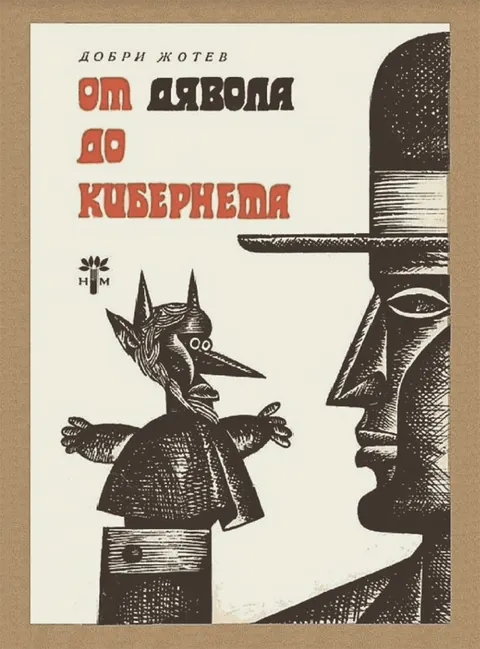
Visiting the Devil and Meeting the Cybernet are two cycles of poems that Zhotev later gathered in the book Ot Dyavola do Kiberneta (From the Devil to the Cybernet). And although cybernetics and today's much-vaunted artificial intelligence are addressed directly in only one of the poems, the future we live in today is there far more.
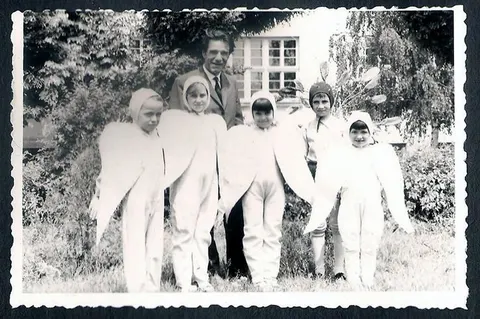
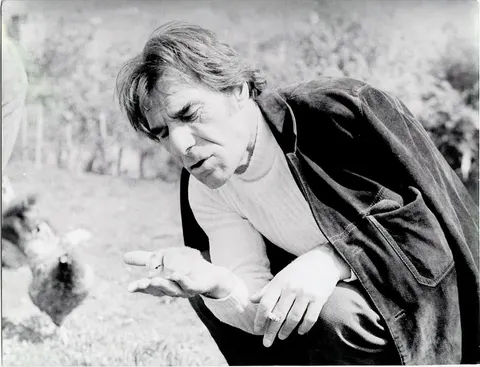
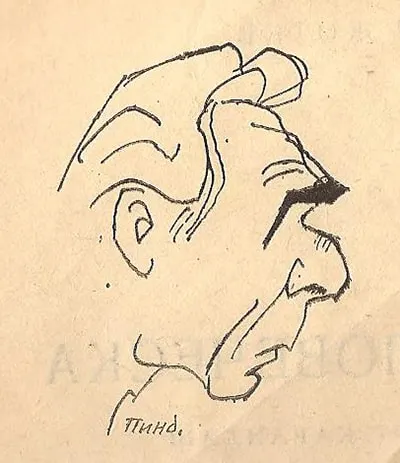
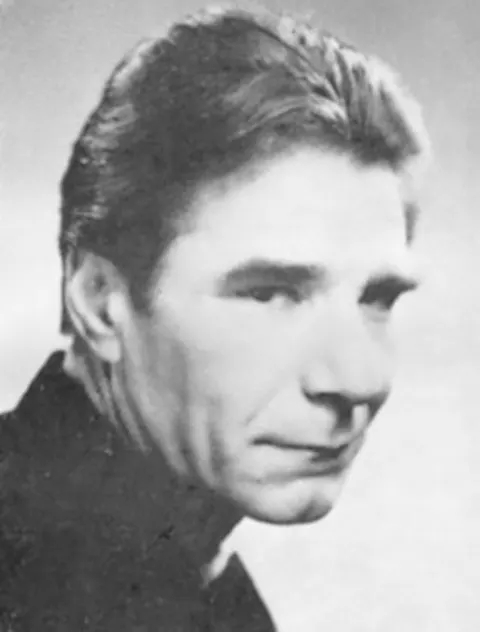
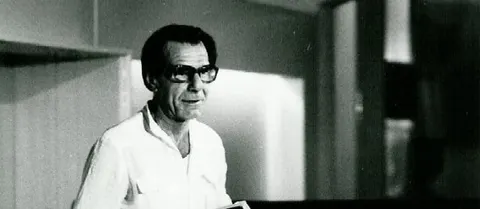
Dobri Zhotev was born in the village of Raduil, in the Pernik region. On paper his name is Dobran, and somehow it suits him very well, I think, looking at his photographs. His surname is Dimitrov; he chose Zhotev as a pen name—Zhota was what they called his beloved maternal grandfather, whose real name was Georgi.
January 24 of last year marked a century since the poet's birth. Needless to say, the anniversary went unheard in the media; Zhotev was never, and is hardly ever likely to be, among the most popular names in this art in Bulgaria, though he deserves to be.
What the reasons are… doesn't matter much. Bulgaria has had great poets; whether it has any today and will have any in the future—ask the Cybernet.
Zhotev's poems, however, keep stirring people. And, at least in my view, keep foreseeing the future. The Cybernet appeared in 1969. Before that, its creator had seen a great deal.
What does it take to succeed?
Be as industrious as a machine!
Let nothing frighten you!
Beware only of your mind!
The mind trips up all efficiency.
Sometimes it makes it impossible.
Beware of the mind!
Don't let it get in your way!
How else could you be infallible?
(“Advice to the Inexperienced” from the cycle “Meeting the Cybernet”)
He began writing as a kid, but his early poems have not survived. While in high school, in 1942, he published his first poems. That same year he was arrested and convicted under the Law for the Protection of the State, the interwar statute used against communists and other opponents of the regime. In his cell, as he later recounted, “beaten and crushed, I didn't write poems, because I had no paper or pencil. I scratched on the wall with my fingernail until I had memorized the poem.”
From Sofia he was moved to the prison in Skopje, from which he managed to escape and became a partisan. He returned to the capital, Sofia, in 1944 and devoted himself to literature.
One of the deep marks he left was in the editorial office of the Narodna Mladezh (People's Youth) publishing house. There Zhotev became a kind of mentor, but more than that—a friend to the next generation of great Bulgarian poets. Names like Konstantin Pavlov, Vladimir Bashev, Andrey Germanov, Evtim Evtimov, Damyan Damyanov.
You don't know how to wrestle with dogma?
Don't stand up against it at all!
It is invincible.
Make it angry—and it turns into a chain,
it tangles around your feet—and that's the end.
It's wiser to coax it.
(“Advice to the Inexperienced” from the cycle “Meeting the Cybernet”)
Beyond that, in the scant online archives about him you will read that he wrote love poetry, satirical poems, short stories, plays and works for children, and that his writing has been translated into English, French, Russian, Armenian and even Chinese.
Later he worked at Starshel (Hornet), the Bulgarian satirical magazine; evidently, with age, satire drew him more. In the mid-1990s, shortly before he passed away, he touched on the computer age once again.
He loved playing the guitar, the violin, the harmonica and the zither. His contemporaries' memories paint him as a bohemian, a wonderful conversationalist and a storyteller at the table. He was interested in astronomy.
The Cybernet rose up before me
and greeted me most dispassionately:
“Salute, I am your future!”
We shook hands—the future and the past—
and the future struck up a conversation:
“I am aware that you have made me
with your human mind.
Aren't you, like me,
a wonderful thinking machine?”
I decided to be polite and replied:
“Naturally, my dear fellow, only
not just a thinking machine—
I am a feeling one as well,
because I have feeling!”
(“Meeting the Cybernet” from the cycle of the same name)
Zhotev considered the cycle Visiting the Devil a kind of birth for himself as a poet. He created it in 1962, and it embodies many fascinating images, and forms too. He said he had fallen into a deep depression over the gap between his ideal and life. And poetry helped him carry on.
“After the brigade movement, I think, not only I but many people like me had to collide with reality, because a mismatch arose between reality and the ideal. Before the Ninth [September 9, 1944, the day the communists took power], while we were taking part in the anti-fascist resistance and fighting against a society that was to be replaced by a new, completely different one, we put into the calculation the class struggle, the expropriation of the expropriators, being that determines consciousness, and somehow we thought that with that the question of the new society was settled. It turned out, however, that our calculations weren't very accurate, because we had left out of them the most essential thing—the phenomenon of man, if I may put it that way.”
The Cybernet was boundlessly amazed.
Its three antennas stood up straight
and bent into marks of wonder:
“What is feeling?!”
“What is feeling?!! My God,
why, it's feeling, simply feeling!
Do you understand me, Future?”
In the Cybernet's iron chest
cold little lamps began to flash.
Chemical reactions and circuit boards
seized upon the spoken word:
“Feeling!
But what is that? — I can't detect it!
Feel-ing! Feel-ing!
There is no such thing!
It remains in the realm of nothing!”
(“Meeting the Cybernet” from the cycle of the same name)
“Man, with all his complexity, with the fact that his psyche is uncharted, pointing in many directions, that he can spring surprises, that his behavior is sometimes seemingly unmotivated… And that this man, with whom everything begins and ends, was the most important thing, and that he cannot be exhausted by our former notions alone.
And we had to collide with unpleasant things—careerism, toadying, frivolity, narrow-mindedness, mediocrity, many things that turned out to be not so easy to overcome.”
I grew angry and shouted, indignant:
“How can there be no such thing?
It's in me, in my heart, right here,
press your palm here and you'll feel it!
And I am not a machine, but a human being,
do you understand, machine?”
My future reached out its hand
and pressed my chest with such a heavy palm
that from the pain and the insult
I didn't notice my eyes welling up:
“And what is this?”
“Tears, what else,” I snapped,
“one of the visible forms of feeling!”
The little lamps flashed again:
“Tear-drops!
But what is that? — Ah, yes, I detect it!
Yes! Clear! Clear — H2O.”
(“Meeting the Cybernet” from the cycle of the same name)
As mentioned, Dobri Zhotev helped some of the great Bulgarian poets of the next generation take their first flight. And he rounded that off with wise words on the subject.
“This business of young and old is very funny. The old have forgotten that they were once young. Our generation was busy with revolution, because that's what the times were like; if the young had been in our place, they would have done the same.
Youth is youth, and it is beautiful. What is terrible is that they watch one thing being said and another being done. Build yourselves armor against that; it is taught by personal example. The easiest thing is to be a judge. With your youth, you must not end up as judges of the old. The hardest thing is to understand others. So try to understand your elders. You have to put up with the wordiness somehow.”
My age, absorbed in cosmic wonders!
My age, go ask your computers
what sickness is and what is health!
(“Depression” from the cycle Worlds of Twilight, 1995)
“The death of every civilization began with the death of poetry,” Dobri Zhotev said.
Well, poetry is alive today, but, you might say, apocryphal. A closed art that reaches wider audiences with difficulty, almost only through music. We have no time for poetry and poets; the Cybernet must be pleased. But let's hope Zhotev is wrong about this otherwise logical judgment of his.
And to finish… sometimes the internet preserves, even without meaning to, wonders, precious little stones. Perhaps the Cybernet has, after all, partly understood what's going on with tears, which are not just H2O. It turns out we can hear Zhotev himself reciting his poem…