Four pairs of mice are released to live as they please. With an abundance of food and water, far from danger and disease. Ready to conquer a vast territory… A mouse paradise!
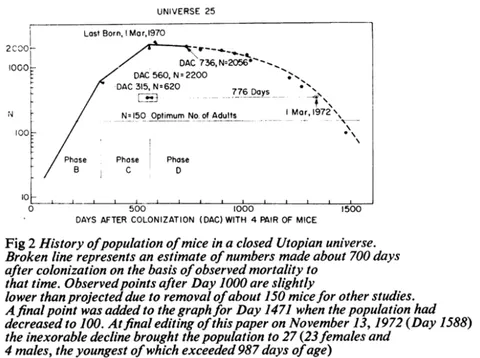
They start breeding like rabbits. Their numbers soar, doubling every 55 days. By all appearances they are living their best lives and savoring every moment. A year later, 620 mice live in “paradise”!
Until suddenly something inexplicable happens—many of the rodents turn aggressive and start wounding each other for no reason. Then the males grow lazy and indifferent, and the population of the mouse kingdom imperceptibly begins to shrink… until it all ends in total collapse.
Could this be a sign of where the natural course of our own life here on Earth is heading?
Researcher John Calhoun’s Universe 25 experiment, carried out half a century ago, has become a huge source of reflection from the 1970s right up to the age of Facebook.
Hello, Big Brother
People haven’t stopped talking about it to this day. Scientists find many gaps and inaccuracies in the experiment, which cast doubt on its results as well. And yet the basic patterns, along with the big philosophical and social questions the experiment raises, keep looking more and more relevant.
How does the experiment unfold? Can we learn anything about people from mice, or is the comparison a stretch? Are the questions posed by Universe 25 more relevant than ever in the age of TikTok and artificial intelligence? The incredible story of Calhoun and his rodents is worth telling, even if “only” to make us think about our future as a species…
So, Universe 25. July 1968: the four young mouse families move into a wire enclosure at the US National Institute of Mental Health. The experiment is led by the biologist John Calhoun, who in previous years had made a name for himself with a series of large-scale behavioral studies on rats. This time, however, he chooses their relatives—mice—for the experiment that will make him famous.
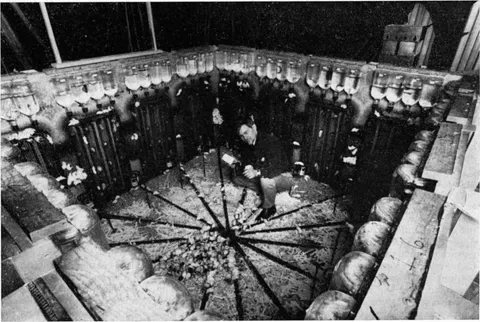
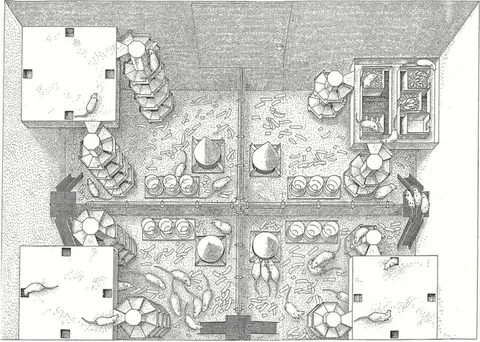
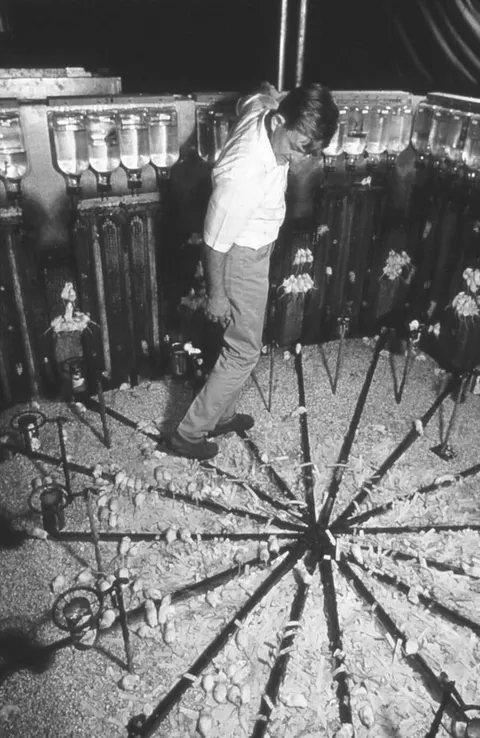
The setup is built from 256 large boxes, each able to hold 15 mice with room to spare. They are equipped with water and food dispensers and everything needed to build a nest. Calhoun says his goal is to create a utopian, ideal place for mice. One where they have absolutely everything they need, where they are even oversupplied and can do nothing but enjoy life.
By his calculations, the space is large enough for 3,840 of Mickey Mouse’s cousins to live in bliss, and the food they receive would be enough even for 9,500!
All Mice to the Assembly
And of course, at first things unfold idyllically. The four couples enjoy life in paradise; Calhoun calls this period Phase A. If you haven’t been in that role yourself, you can surely imagine teenagers raised at home by strict parents, left for the first time to do whatever they like in a huge mansion, and in pleasant company at that…
So we soon reach Phase B, the moment the first pups are born. And true bliss begins—they are fruitful and multiply. From partying we move into conscious idyll! The number of mice doubles every 55 days (given that their pregnancy lasts 20 days and a mother gives birth to an average of 20 pups).
Interestingly, the trends are uneven—in some of the litters… or “mousters,” 111 pups are born, in others only 13. According to Calhoun, this depends on how active the males are.
Gangsta’s Paradise
Then… comes the more interesting part. Day 315: everything turns around, and Phase C begins. Population growth slows sharply and, as Calhoun writes, a strict social hierarchy develops.
At the same time, an ever-larger group of young males appears that fails to fit into the system. They are pushed by the others to the periphery of the former mouse paradise. And they certainly don’t look like inhabitants of Eden—they are bitten all over, their bodies covered in bloody wounds. Calhoun calls them “the outcasts” and explains the phenomenon by longevity. In the idyll of “paradise” there is no natural selection to push the males off the top of the hierarchy—here the “patriarchs” live longer and won’t let young rivals take their place.
In this phase the “outcasts” grow bitter and show more and more aggression, often for no reason at all. After all, resources are still more than plentiful: 620 mice live in the “neighborhood,” and there is room for at least five times as many.
Meanwhile, the female members of the commune become increasingly skilled at fending off the bullies and, as a result, also turn aggressive… but, inexplicably, not only toward the aggressors but in general—including toward their own young. The birth rate drops drastically, and mortality among the young rises. There are even cases of cannibalism. (In some places you may read that homosexuality also becomes much more frequent, but this is absent from the original paper.)
Still, the number of mice keeps growing, reaching 2,200—well below the maximum that “paradise” could house.

King Rat
And so we reach Phase D, when the mouse Sodom and Gomorrah unfolds in all its horror. Calhoun himself uses a biblical allegory for this moment, calling it “the phase of the second death.” The first comes when the spirit and society are destroyed and keep living only by inertia. Then it is only a matter of time before the second arrives to finish off the physical body. For this period Calhoun also introduces another term that has become popular in the social sciences: “behavioral sink.”
The number of a new type of male mouse rises sharply—the scientist calls them “the beautiful ones.” They no longer have wounds or scars; they simply live. They don’t fight for females, don’t argue over territory, don’t do anything except eat, sleep and groom their fur. Gradually the ladies stop paying them any attention at all, the birth rate falls to zero, and three years after the start of the experiment, life in the mouse paradise comes to an end. There are 120 mice left, all past reproductive age. In their mouse refuge, they are forced to watch the sunset of paradise lost in their hopeless old people’s home…
A few months before this happens, a colleague of Calhoun’s moves some of “the beautiful ones” and some of the ladies to a new home, but it changes nothing. Evidently, after “the first death” they have lost every instinct to continue the line, to be happy, even to survive.
Mish-Mash
And so Universe 25 (named because it is Calhoun’s 25th behavioral experiment) comes to an end, only to become a legend.
In the 1970s, overpopulation becomes a fashionable topic for the first time. That is why Calhoun’s experiment falls on fertile ground, and when he publishes his study in Scientific American, the media quickly pick up its main message.
The researcher’s specialty is ethology—the branch of science that studies animal behavior. But his big and much-disputed idea is that, if we observe the development of other mammals, there is no logical reason not to see principles that apply to humans too.
We’re just social animals, aren’t we? Or, in Harari’s newer definition, “simply hackable animals.”
Mousing Around
It’s worth saying a little about Calhoun’s earlier experiments, too. As early as the late 1940s, he raised rats in a fenced area of 930 square meters, where their numbers could have reached 5,000. And yet the population peaked at 200 rodents, then stabilized at around 150. The rats didn’t spread out evenly but gathered in colonies of 12 or 13—according to Calhoun, this turned out to be the optimal size for a social unit in which a hierarchy can develop.
Then, in the late 1950s, he settled rats again, though not so spaciously. He divided 48 animals into four groups of the “optimal” 12, with the two end groups having no contact with each other.
It was precisely these two poles that were conquered by strong males, each gathering a harem of 8 to 12 ladies and driving the other males toward the middle. And there the bacchanalia began—aggression, frequent fights, beating the young, a complete lack of desire for sex…
Long live Jordan Peterson, you might say. Never mind that this isn’t about his beloved lobsters. Or perhaps it’s food for thought on topics like totalitarianism, democracy…?
A Michelin Star
Over the following years, the fame of Calhoun and his experiment grows. But so do the criticisms. First and foremost, against the idea of drawing direct associations between human society and a biological species so different from us. Against his use of unscientific terminology and his failure to meet the strict requirements for documenting an experiment.
Some of the objections are more than convincing. For example, his records note that when Phase D sets in, the mouse paradise is still cleaned only once a week—so it is entirely logical that infections would develop from the leftover corpses. Infectious disease is indeed another argument against the experiment. According to his critics, Calhoun didn’t track or document carefully enough the health of his test animals, which may well have been wiped out by a pandemic virus.
The scientist also admits that in summer they lived at temperatures above 32 degrees Celsius, which definitely affects behavior in this species.
One more criticism sounds more than serious. Calhoun didn’t document in detail the origin of the first eight inhabitants. He writes only that they came from a certain laboratory, and that’s it. In that case, though… they were most likely related to one another anyway. And if we picture the following years, in which the mouse society grows explosively but within the genes of just eight little animals who, on top of everything, are relatives…? The consequences of inbreeding were known to science long before Game of Thrones. Genetic mutations are certainly one of the very likely explanations for the degeneration of life in “paradise.”

Mice and Manuscripts
What’s more, from Calhoun’s day to ours there have been… thousands of similar mouse colonies. Yes, for better or worse, scientists still rely heavily on the cute rodents, both for testing new drugs and for a range of other scientific tasks. And such societies grow and flourish without anyone seeing a trace of “outcasts” or “beautiful ones.” The bigger “farms” “produce” up to 10,000 mice a month!
All in all, the scientific community is quite skeptical of Calhoun’s conclusions, yet they keep parading through the media, today in the role of yet another dubiously confirmed piece of life wisdom shared on Facebook.
So much for the joy for Jordan Peterson, too, because according to his forerunner, the path to our salvation as a species isn’t tradition and conservative beliefs. “Our success as humans so far has been due to the fact that we have honored deviation more than tradition,” Calhoun says. “Changing the stereotype has always held a slight edge over conforming to it. Now we must diligently seek out those creative deviations from which the next step in our evolution will emerge. This may guarantee us an endless future, in whose realization we can take part.”
Could that have turned out to be technology?
Click
When the experiment was presented, some media outlets didn’t hesitate to predict that, if we applied the results to human society, our end as a civilization would come around 2010.
“The Earth is overpopulated. Someday we’ll be 5 billion! How will our mouse paradise overflow when there are more of us!”—such were the media leitmotifs of the 1970s that helped make the experiment famous.
And yet we passed that fateful threshold before the end of the 1990s. Today we have even reached the next milestone—there are now eight billion inhabitants of Earth…
And where has technology taken us in the meantime? We not only have as much space as we want, food, cocktails… By “we,” of course, I mean the inhabitants of the countries of the Northern Hemisphere; alas, in the south things look different.
But even in the oversupplied part of the world, the “golden billion,” where the end of history had supposedly arrived, we manage, for all the present-day glitter of modern societies, to end up in wars, to hate and kill each other with impressive dexterity and originality… Even for the most developed countries, a solution like nuclear war, which could literally wipe us out as a species, is still on the negotiating table.
Zorro the Mouse
What’s more, it is precisely in the most developed countries that the birth rate is falling, the population as a rule begins to shrink, and it seems the only remaining solution is immigration from the still lagging parts of the world…
As Musk says (and no one could accuse him of not doing his part in this direction), the biggest risk facing humanity is the population decline looming very soon…
Statistical projections show that we will reach 9.7 billion in 2064, after which the number of people will start to fall, to around 8.8 billion by the end of the century.
And overpopulation may not turn out to be a problem after all—today, if we didn’t fight each other, our Earth could easily feed many more people.
Maybe the problem isn’t overpopulation? Maybe it’s the invented values of consumer society, which in our mouse friends take the form of oversupply? The convenience of having everything your species has grown used to valuing, in quantities that far exceed your needs? If we assume that, as far as food goes, we overcome it one way or another, how exactly are we coping with our oversupply of gadgets, of communication, of information?
The Kitten Who Read Books
What if we add to all this the social changes on the way, which we don’t like to talk about? With professions disappearing, with ideas like universal basic income.
And then there is technology’s knack for supposedly bringing us closer while making normal communication ever harder, depriving us of natural human warmth, creating alienation in its illusory happiness.
Could it be that, in the end, despite the progress of technology, beneath all the gloss of modernity, we remain simply instinct-driven mice? Anyone who reads the story of the mouse paradise without prejudice would find some parallels with our development as a species…
Calhoun’s explanation is, of course, too simplistic and naive, which made it, first of all, convenient for the media of the time (and for today’s social media, too). But that doesn’t make the fate of Universe 25 any less instructive, as long as we don’t take it as science. It is certainly instructive, even if only as a metaphor.
Because today, only stories help us think about who we are, what we are. And where we are going…