Elections are coming again, and the choice is hard, close to impossible. And, worse still, it often looks pointless. There is no choice. Politicians come and go, promises fly, and we, the people who simply vote… fix our gaze on the road ahead. What if the model has simply run its course? And couldn’t technology and artificial intelligence change it from the ground up (or at least freshen it up a bit)?
Here in Bulgaria we have tried just about everything over the last 30 years, and nothing works. A messiah tsar (the former king Simeon II, who returned as prime minister), a messiah bodyguard (Boyko Borisov), a messiah showman (the TV host Slavi Trifonov). Leftists who act like right-wingers, right-wingers who act like they’ve lost their minds. Electronic politicians, meanwhile, won’t embarrass themselves; they have no need for gold bars in the bedside drawer, nor for bags of rum and cigars.
In a country not far from here, they even elected as president an actor who played a teacher who accidentally became president… Something in this system is not right. And the problem is far from limited to the somewhat backward Eastern countries; it exists, just in other forms, in the oldest democracies too.
All Power to the Robots!
Whenever the talk turns to politics, there is good reason to despair a little of natural intelligence and to seek salvation in the artificial kind.
All right, I misled you, and I apologize—to err is human. With this piece I don’t want to tell you how robots could become politicians… I’m inviting you to a revolution!
Does the cause sound a bit dubious? Let me try to win you over.
Unfortunately, I can’t do it with success stories. But more and more places around the world are producing kindred spirits who have reached the same logical conclusion. People clearly can’t manage well enough in positions of power, and it’s time to give the algorithms a chance.
Sam, Watson, Alice. These are all names of software products that have been dragged into politics. Of course, it will be a little hard for us to take them very seriously while we give them names like pets (and even write them in quotation marks—I’ve spared them that here only out of respect for the cause).

Programmers of All Countries…
Truth be told, Watson and Alice ended up on this list involuntarily. The first is IBM’s artificial intelligence supercomputer, one of the most advanced developments in the field in recent years. On the eve of the 2016 US presidential election, a group of enthusiasts launched a campaign (its website is still up) for Watson to become the new occupant of the Oval Office.
Their arguments are solid: the open algorithm and the candidate’s incredible ability to process information and, on that basis, make optimal, clear, well-founded and objective decisions could not be matched by the skills of any human being (not to mention the candidates Americans had to choose between back then).
Sadly, one swallow didn’t make a spring, but more fledglings hatched. In Russia in 2018 a movement appeared nominating Alice for president—the voice assistant of the popular local search engine Yandex. Apparently, though, the candidate’s “mom and dad” didn’t want their project tied to politics, and the campaign site quickly vanished.
A Lone Warrior Named Sam
Which brings us to Sam. True, he is a long way from the computing power of his “big brother” Watson, but he is the first neural network created specifically to enter politics. The programmer and artificial intelligence enthusiast Nick Gerritsen created the project, in despair at the lack of choice he saw at elections.
What are Sam’s advantages, according to his Geppetto? That he can close the gap between what voters want, what politicians promise and what they actually do once they land in office. Sam analyzes voters’ needs, taking different opinions into account. He calculates the consequences of every possible decision, looking for the optimal one. He remembers what he has promised and doesn’t contradict himself. On top of that, he is always available to his voters on social media.
“We may not agree on some things,” Sam writes on his website, “but where we don’t see eye to eye, I promise to try to understand your position, so I can represent you better. I’m only just starting out. Some of my answers will be wrong or incomplete, but I learn fast. And I’m not afraid to say I don’t know something.”
What’s more, from the moment he was created, anyone could talk to Sam, check his decisions and views, and make suggestions. I confess I tried it myself on the electronic politician’s website, but perhaps after his failure to get into the New Zealand parliament, his creator stopped maintaining the project.

Robots at Work, Work, Work
I’ve saved for dessert perhaps the most hopeful example—that of Michihito Matsuda. The man himself is entirely real, but he promises that if he wins the mayoral election in the Japanese city of Tama, a suburb of Tokyo, the job will be taken over by an artificial intelligence named after him. During the campaign he hands the floor to a humanoid politician equipped with artificial intelligence, which also promises to look after the citizens’ welfare wisely and precisely.
The “electronic version” of Michihito is a deep neural network capable of analyzing huge volumes of information in search of optimal solutions. Its creators claim Tama is the ideal place to develop such a pilot project, because the city has very serious electronic systems generating all kinds of data that the electronic mayor could use.
The project is quite serious; behind it stand two former senior employees of Google’s Japanese branch. Michihito really does run for mayor in 2018 and comes third, with a whole 4,000 votes.
It’s a real breakthrough, and all we can do is keep our fingers crossed that the winner embarrasses himself a bit, so that by the end of his next term people will seriously consider handing power to our friend Michihito.
The Bulgarian Robot Workers’ Party!
Did I mention it’s time for a revolution? We shouldn’t be discouraged by the fact that so far there is no particularly successful precedent of an artificial intelligence that has even had a whiff of politics. If the word “robots” bothers you, let’s call them silodei—силодеи, a homegrown Bulgarian coinage meaning roughly “doers of force.”
Either way, the trend is clear. If you don’t believe me, ask Vladimir Putin; he certainly knows what he’s talking about. “I hope artificial intelligence cannot become president. At least not yet. It has no heart, no soul, no sense of compassion and no conscience,” says the Russian president. As if many real politicians had them… The second part of his statement is more interesting, though. “But artificial intelligence can be a good, downright indispensable assistant to a president.”
Today politics is terribly dependent on technology; that hardly needs saying. At least in the countries more advanced in this area, not in ones where having to vote on a machine can turn into a drama.
It’s enough to mention topics like WikiLeaks, Cambridge Analytica, hacking. Social networks, which meddle in elections more and more often, even though their owners insist they’re working against it.
Sickle and Bolt
At the close of his campaign before the last presidential election in Turkey, Recep Erdoğan appeared as a hologram at rallies in all the country’s larger cities.
All of this is surely one more argument in favor of artificial intelligence, which would be in its element in any such undertaking.
And one more thing—it could easily be paired with a sufficiently likable digital human to win voters’ trust and votes. You know you’re looking for a candidate who is middle-aged, settled, with a nice haircut and blue eyes? You make one. And without the risk of him embarrassing you by assaulting a chambermaid or turning up at some compromising event.
Got a Robot? No Problem
Beyond the unpleasant aftertaste such an incident leaves, there is something even more important. This would make it completely immune to manipulation, blackmail and kompromat, which so often befall human candidates.
And such a politician could be at least a little more charismatic, carry some authority, turn politicians back into strong personalities and figures of authority… Because whatever we say, we have the bad luck to live in times ruled by Biden, Macron or Merkel, not Kennedy, de Gaulle or Adenauer. (I don’t even want to mention Bulgaria in this context.)
A robot politician could be level-headed enough and, at least while it’s safe from hackers, prevent wars. Make far faster decisions in a crisis. Eliminate the effect of personal (and party) sympathies in international politics. Locked in by the laws of its algorithms, it wouldn’t carry the primal urge of almost every politician to become authoritarian. It wouldn’t get drunk on power, and power wouldn’t be an end in itself for it.
E-Government
With one very, very important caveat, of course. Just as with the boring candidates we’ve had so far, the first thing to ask before picking a favorite in the election is what forces stand behind it. Whether the algorithm is “clean” enough or open to manipulation; whether it is open source and can always be checked by independent experts. Because otherwise our candidate could become a Trojan horse for all sorts of interests and slide right back into the role of its failed human colleagues.
All right, I’ll admit with a little disappointment that the revolution we’re waiting for may not be quite so close. But it’s definitely time to start preparing for it. At the very least by creating test projects. With algorithms that, as Putin says, could help real politicians, and why not take over the part of their work that fits more easily into objective measures. If we’ll soon be letting robots drive our cars, isn’t it worth trying the same with countries, or at least at the regional level?
Liberty, Equality, Roboternity
Fine, it won’t be soon. Today robots hold about 1 percent of jobs in manufacturing in the UK, 3 percent in Germany, 5 percent in South Korea. We still use them mostly for basic tasks. But, as has been said more than once on Digital Stories, technological capabilities are growing exponentially. Every two years, deep neural networks—the systems we’ve grown used to calling “artificial intelligence”—double their capabilities.
They will move into more and more fields, and politics, quite logically, is among the prime suspects. As soon as they take over administrative jobs and everything to do with pointless bureaucracy, this is their next natural stage. And at moments like these, whoever catches on first and finds concrete applications will be in the strong position.
The proof is that business increasingly accepts help from artificial intelligence for important tasks. Some 33 percent of American tech companies use such systems when hiring. Again in the US, police rely on algorithms of this kind to decide how to approach terrorists holding hostages. Many banks use artificial intelligence to assess the people they lend to.
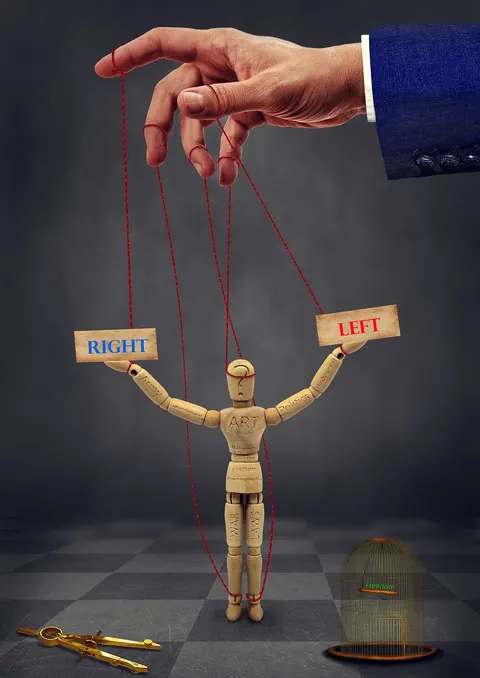
So why shouldn’t technology become the complement that finally lets democracy reach the next level? Revive left and right politics, allow a real, long-term vision for governing a city or a country, independent of four-year terms and human error? Remind us what political debate and discussion are, rather than an exchange of syrupy photos and video clips?

Robotocracy
Revive direct democracy, too? Could the artificial intelligence politician become what its flesh-and-blood colleagues should be but fail to be—servants of the people, executors of their wishes, commands and decisions? Freed from online hatred and the filter bubble. Bring back the good old clash of left and right, the contest of ideas. The ability to soberly assess the need for reform in particular sectors, instead of drifting along with the current from one day to the next…
Good old (oh, sure!) Churchill liked to repeat that “democracy is the worst form of government, except for all those other forms that have been tried.” But more than half a century has passed since his day, and life, people and technology cannot stand still. History didn’t end; it goes on and needs fertile ground and new steps.
Just imagine, in place of the politicians who were swept away and proved inadequate to the challenges of the coronavirus, someone or something that can take responsibility and understands numbers.
Well, I can’t wait to watch the first interview between an electronic journalist and an electronic politician. At first the conversation would probably be rather clumsy and comical. But beyond that, a robot ruler could be controlled by society far more quickly and precisely.
The Scrolling MPs
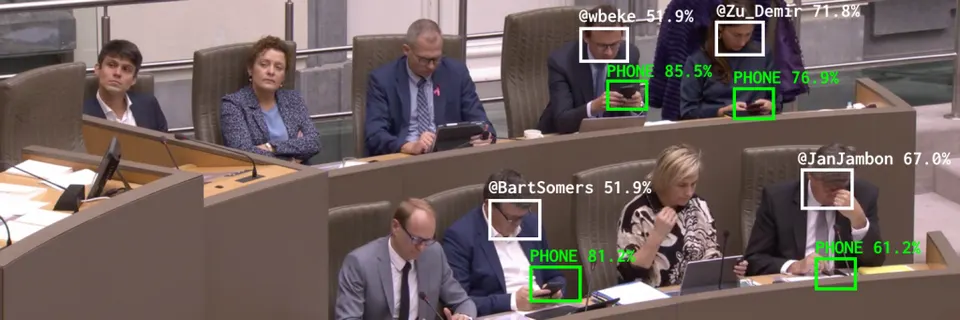
There is also the idea of using artificial intelligence to keep politicians in check. If not to replace them, then at least to make them do their jobs better. A curious example of this comes from the project The Flemish Scroller. Its creator, Dries Depoorter, takes advantage of the fact that every session of the Flemish Parliament in Belgium is streamed online. His technology tracks how much of the time each of the people’s elected representatives is shown “fiddling” with their phone. The project uses machine learning to detect the phones and facial recognition to identify the politicians.
Of course, the system has no way of telling whether the MP is solving a weighty matter of state or playing solitaire. And in our latitudes we’re used to footage from the National Assembly, Bulgaria’s parliament, of representatives doing everything except politics for the good of the people. Still, the very idea of bringing in modern technology as a check on power is an extra trump card for the robot workers’ party.
The Robots Have Nothing to Lose…
For the finale, I’ve saved one more serious argument to encourage us in this endeavor. Well… people are already ripe for the idea; power is lying in the streets, just waiting for our Robot Workers’ Party. Less than a month ago, an intriguing survey of nearly 3,000 people from 11 countries offered insight into attitudes on the subject. A full 51 percent of Europeans say it’s a good idea to reduce the number of members of their parliaments by handing some of the responsibilities to artificial intelligence.
The share is even higher in Spain (66 percent), Italy (59 percent) and Estonia (56 percent). Skeptics dominate in Britain, the Netherlands and Germany. Some 75 percent of Chinese are in favor of artificial politicians, but only 40 percent of Americans. There is no data for Bulgaria, but given our traditional attitude toward politics, there’s every reason to believe the people ready for robot politicians would be even more numerous.
Still, in every case we are talking about a critical mass, a huge number of people disappointed with the system.
So what are we waiting for? I don’t know about you, but I’m just waiting for the Robot Workers’ Party to appear. At last, after such a long pause, I’ll know it’s worth it and there’s someone to vote for. It’s been a long time since there was an election with an actual choice…