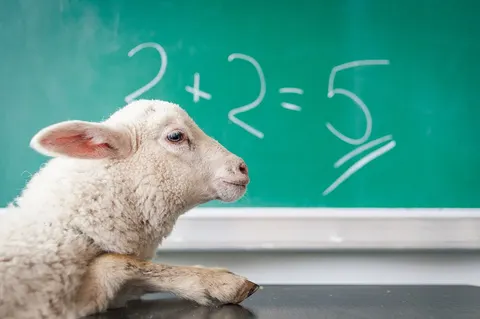
These two have become a byword for how, online and off, the less a person knows about a subject, the more confident they are in their knowledge and the more ready they are to defend it, aggressively if need be. Then comes His Majesty the Hate.
- Those professors think they know so much—let me explain where the coronavirus really came from.
- The Americans walked on the Moon? Oh sure, Kubrick admitted it was all edited footage.
- The Earth is supposedly… a ball? Well, yes, you'll believe anything they tell you.
Psychologists Justin Kruger and David Dunning are the creators of the famous theory that describes so much of today's online communication so well. It can also help us understand the problems piling up in the way we get our information online.
The theory is simple but interesting. You've surely heard of it, but it's worth not only digging a little deeper into its meaning but also learning its instructive story.
I Know That I Know Everything
The “Dunning-Kruger effect” is also called “egocentrism in self-assessment and social judgment.” And in “psychology-speak,” it is “the metacognitive inability of the unskilled to recognize their own mistakes.”
The two published their work at the end of the last century—in December 1999, in the Journal of Personality and Social Psychology. And in 2000 it earned them… an Ig Nobel Prize, the tongue-in-cheek award given to the wackiest scientific research. The kind that amuses with its impressive pointlessness.
Does it sound strange to you that a hypothesis the scientific community greeted as a joke is today an important axiom of communication? It is strange indeed. Perhaps it's partly down to the not exactly catchy title: “Unskilled and Unaware of It: How Difficulties in Recognizing One's Own Incompetence Lead to Inflated Self-Assessments.”
In fact, as they themselves say, the two simply confirmed experimentally Darwin's observation from 1871 that “ignorance more frequently begets confidence than does knowledge.”
Who Knows
Justin Kruger is a social psychologist with a PhD from Cornell and a professor at the business school of New York University. David Dunning is also a psychologist, but from the University of Illinois.
The two say they were inspired by the semi-mythical criminal case of McArthur Wheeler. The man robbed a bank after rubbing his face with lemon juice, believing it would make him invisible to the cameras—just as invisible ink is made from lemons. Well, for some unknown reason, it didn't work, and he was genuinely surprised by his failure.
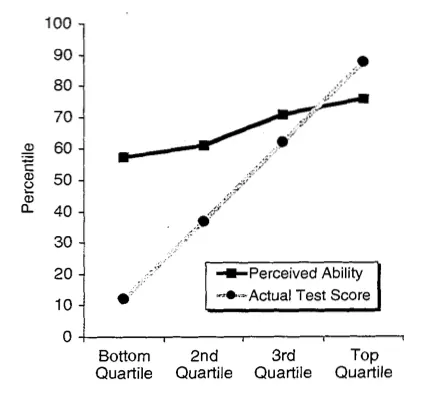
Their study in a nutshell: the volunteers were psychology students from Cornell. They solved problems from all sorts of fields—grammar, logic, humor and many other areas of knowledge. Then they were asked to estimate how well they had done compared with the others. And the gap between the actual result and the self-assessment was recorded.
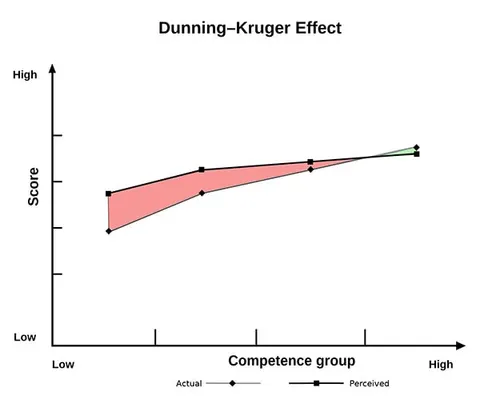
It turned out that the most accurate in their judgment were those who had scored average or slightly above average. Those with weaker results almost always tended to overestimate themselves drastically. And the reverse: the people with the highest scores routinely underestimated themselves.

Oh, I Know That!
The differences prove especially striking among people with the lowest abilities. Those who fall into the bottom 10 percent of a group tend to assume they have done better than 70% of the others.
Why is this interesting? Because it reveals our fundamental attitude toward knowledge. Evidently, when we know a field only superficially, it seems clear, obvious, even simple. We've watched one soccer match and it looks so easy: you kick some ball around, anyone can do that. Physics? Come on, its rules are so simple, why bother with the details. Anyone can become a programmer—what's the big deal, you just sit there and type.
But then, if we decide to go deeper, it turns out nothing is as simple as it first seemed. Once we know how much we don't know, the sea is no longer knee-deep, as the Bulgarian saying about the overconfident goes. We run into more and more uncertainties, into greater authorities in the field who surpass us in knowledge and skill. And this is where we tend to underestimate ourselves.
Don't You Go Knowing Too Much
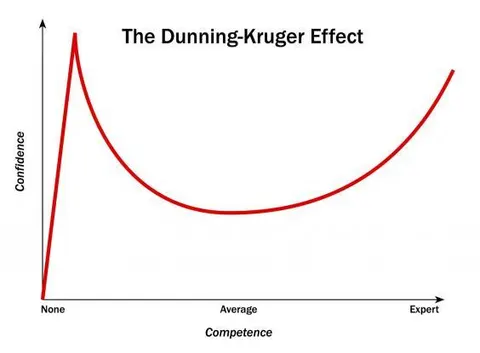
Dunning says: “If you're incompetent, you can't know you're incompetent. The skills you need to produce a right answer are exactly the skills you need to recognize what a right answer is.” And one more important addition: as a result, people who are not competent in a given field are very often more inclined to boast about their knowledge of it.
We can also flip the paradigm. Ignorance breeds more confidence than knowledge does.
Later on, the “Dunning-Kruger effect” became quite popular, and similar studies were done in all sorts of other fields—from mathematics to wine tasting. The trends, however, always turned out the same. Good old Dunning and Kruger were proved right, despite the Ig Nobel Prize their study brought them.
Even Grandma Knows
As Bertrand Russell aptly put it, “the trouble with the world is that the stupid are cocksure and the intelligent are full of doubt.” Ask Lao Tzu, and he'll tell you that “those who know do not speak, and those who speak do not know.”
It's easy to go on from here to how this principle, which has always existed, has proved disastrous for online communication.
Today everyone has a platform equal to that of the media and of the authorities in any given field. And social networks even encourage us to keep weighing in on every new hot topic. Then add the filter bubble. We find ourselves in an environment where everyone shares our opinion, or else holds the exact opposite one. And all of this pushes us to share our views ever more aggressively on subjects we don't know or have barely touched.
Meanwhile, the authorities are more modest, more reserved. Because they tend to underestimate themselves, knowing that the nuances of any subject are always far more numerous than they appear at first glance. A person who is genuinely confident in their position is usually not so extreme and aggressive.
Know-It-All
Dunning and Kruger became especially popular in the years when the American president was named Trump. Yes, unlike the current occupant of the White House, he more or less remembered the names of the people around him, but he was certainly prone to pronouncing the final word on subjects he didn't understand at all.
Searches for “Dunning Kruger” on Google peaked in May 2017, and the keywords remain very much in demand to this day. That's precisely what surprises Dunning most: interest in a study is usually highest in the first five years after it appears, whereas theirs got its chance much later.
Dunning also believes the reason lies in ever-widening social rifts. “People are trying to understand the other side. In recent years political partisanship has grown stronger, it has become crueler and more extreme, and everyone is trying to find an explanation.”
The pandemic, in turn, became a Dunning-Kruger paradise. The fact that the proven authorities themselves turned out to be rather unprepared when it came to communication meant that everyone had their own theories and was convinced of them. And it was right here that vaccination fell victim to the effect, especially in Bulgaria.

Don't Give Me Advice, Give Me Money
As our two friends put it, “the miscalibration of the incompetent stems from an error about the self, whereas the miscalibration of the highly competent stems from an error about others.”
Dunning believes the phenomenon becomes especially dangerous when it shows up in someone in a high position—and one, at that, with no one around to correct them. I wonder what he would say if he had to apply this analysis to Bulgarian political reality.
Perhaps the most important conclusion the two draw is this: all of us do a terrible job of assessing our own skills, abilities and knowledge. That's why we need others as a corrective. “The most important thing is to always have people around you who are willing to tell you that you're making a mistake,” Dunning says. Yes, friends who are honest enough are becoming ever more precious in the age of bubbles.

Expert in Everything
According to Dunning, another of the main problems that have kept his name in circulation in recent years is that we are increasingly blurring the fine but crucial line between opinion and fact. “If you want to become a little smarter, you have to keep reminding yourself that there are things that cannot be a matter of personal interpretation,” he believes.
Today it's easier than ever to find information; we don't need to remember things, knowing that we carry “Uncle Google” in our pocket. “Even so, people seem afraid to say ‘I don't know.’ That's something we've never been able to change in the human mind,” Dunning believes.
And yet there are quite a few voices saying that in recent years we have overestimated the “effect of the effect.” That, purely mathematically, the best performers have less chance of knowing they are the best, and the patterns may be distorted. Even so, at least the lessons are indisputable.

Penkiler
This colorful Bulgarian word, пенкилер (penkiler, a self-styled expert at everything), comes from “painkiller”—a medicine that can cure every ache. Well, there is one proven remedy for all aches, but it isn't much in demand. It's the same with people. Nobody understands everything, and it's good to remind ourselves of that more often. Different points of view are a treasure, but also a responsibility. An expert in one field can offer an interesting idea and perspective as a guest in a completely different one. But not instantly become an authority and the final word.
Then again… final words are not the healthiest points in communication to begin with. With knowledge comes doubt—ask Hamlet. He who increases knowledge increases sorrow—ask Ecclesiastes. He who knows much knows nothing—ask Dunning and Kruger.
So what? Does it help us that our two friends have somehow put their finger on the problem?
Undoubtedly. If nothing else, so that we remember the two of them the next time we run into the toxic side of online communication.
Today (and always) what is said matters less if you don't know who is saying it. Perhaps in time this principle will somehow let us build the next level of how we get our information and how we debate? Might that run through some form of prior assessment of how competent a given source of information is in a given field…
So keep one thing in mind. When you meet yet another person who knows everything about every subject and instructs you on how you should think… don't take it to heart. Remember the words of the wise influencer: “Those who know do not speak, and those who speak do not know.”