Information technology has always tried to imitate nature's most perfect model: the human brain. And now it is on its way to doing so more successfully than ever. To build a computer that runs on living human brain cells!
What happens if we bring together the best of both worlds? The biological, with its evolutionary efficiency and its instinctive, creative imperfection, and the technological, with its ability to derive patterns and build on them?
Biocomputers look like the logical future, and it is no accident that many of the people sketching tomorrow have turned their eyes in this direction. Serious scientific breakthroughs and successful startups in recent years suggest that the next big technological leap may well be coming from here. These are the arguments.
Brainwashed
What is a “computer”? The word is new and modern, right? In fact, it was first used in… 1613, when Shakespeare was at the height of his fame, and centuries would pass before we reached the “brainchild” of John Atanasoff, the Bulgarian-American physicist who built the first electronic digital computer. It comes from the Latin for “to reckon,” and the poet Richard Brathwaite used it for people who could solve mathematical problems faster than everyone else.
Its new meaning appeared shortly before the end of the 20th century—“a machine that calculates.” And today we have computers everywhere: in the phone in our pocket, in our watch, in the machine that charges our fare on the tram and the one that counts the ballots (at least in the civilized world).
Over the last few decades we lived through the boom of silicon-chip computers. They developed astonishingly, never pausing on their climb up Moore's law. They kept multiplying their capabilities, their computing power kept growing exponentially, regardless of wars, epidemics and financial crises.
And yet there are plenty of signs that this kind of technology is close to the limit of what it can do. And as Ray Kurzweil says, when a technology reaches its limit, the next one naturally emerges to take up the baton. Perhaps it is time to turn our gaze back… to nature?!
Sense and Sensibility
Do you know the storage capacity of your own brain? At least 2,500 terabytes of data, according to calculations by scientists at Johns Hopkins University!
And with neurons of minimal size, we can process that data astonishingly fast and efficiently. We have before our eyes (or rather behind them) a perfect information-processing machine (whether we use it to make the world a better place or to squabble on Facebook).
Artificial intelligence. Despite the enormous boom in this field, the brain remains the most efficient data-processing structure in the universe. And perhaps it is time to turn our attention precisely to its capabilities. To the idea of turning living cells into computers, of creating an invention capable of “thinking,” of trying to imitate the ideal example…
Chips made of living cells. It sounds like science fiction and, at the same time, so logical!
I Think, Therefore I Compute
But how do we do it? Scientists have quite a few ideas.
One option is to try to imitate the way our brain works; the other is to try to solve the problems it usually solves. These are the strong and the weak approaches to developing artificial intelligence, which Prof. Preslav Nakov explained in detail and in plain language.
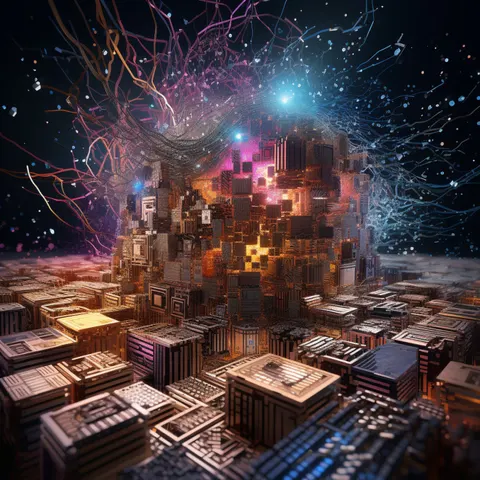
So the idea is to imitate the brain, but how does that work in practice? How do we create some tiny unit of “brain” that we can then build on? With chips it is relatively clear: we always come down to binary code—ones or zeros. Here it is not, which is why, in their first attempts to create something similar but biological, scientists split along three paths.
The biochemical approach tries to do it by somehow feeding in the input and setting the computation in motion so that, in the end, it produces a new substance that tells us whether the result is a zero or a one. The biomechanical approach tries to achieve the same thing by analyzing the shapes of the molecule or group of molecules that come out as a result. Bioelectronic computers come closest in concept to the devices we know, relying on detecting changes in electrical conductivity—just as happens in the silicon world.
Well-Oiled Brains
You may have heard of quantum computers. In recent years the field has developed at breakneck speed, and it turned out that to advance in a world where, besides ones and zeros, there is also something in between, we have to change our worldview and our approach entirely.
Well, it makes sense for the same thing to happen with biocomputers. There are many different approaches, and we most likely won't get by without an entirely new paradigm. Then again, perhaps the knowledge we already have will come in handy?
Are there other approaches? There are, and as many as the imagination of science fiction writers can reach (or at least used to reach)—an imagination that today seems to have been taken over by scientists. In 2021, for example, a team led by the biophysicist Sangram Bagh managed to train the bacterium E. coli to solve a small puzzle made of 2 by 2 pieces.
Bits and Neurons
Have we limited ourselves to silicon, missing many different ways of building computing machines that are more natural?
Much of the hope of turning biological cells into the building blocks of computing machines rests on CRISPR technology. The much-hyped method for editing DNA (which will certainly get a more detailed look in a future Digital Story) has already shown that cells can be genetically engineered to perform computations, producing specific proteins as the output of the manipulation.
Brainy
Nor is recent progress in this field science fiction. In March, scientists at Johns Hopkins University showed for the first time how close we are to biological computers. Using cultures derived from human brain cells, they managed to “grow” cell cultures capable of computing.
To do this, they create organoids—structures that cannot perform all the functions of a real biological organ but are able to carry out a particular task. They are biological tissues grown in laboratories, most often from stem cells, and in this case the goal is to mimic brain cells. According to the scientists, once the technology matures, organoids could be even more efficient than today's computer processors. And they will be especially valuable in precisely the field that is booming so much today—artificial intelligence.
In this context, even the term itself somehow finds a more fitting embodiment…
Too Clever by Half
“We are currently reaching the physical limits of silicon computers, because we cannot pack more transistors into a tiny chip,” says Thomas Hartung, one of the scientists on the team. “The human brain is extraordinarily efficient at processing information, at learning. It is very tempting to harness and model its abilities so that we have a system that works faster and more efficiently than today's computers.”
“Organoid intelligence”—OI instead of AI, the scientists propose.
Organoids respond to chemical and electrical stimuli and can perform elementary computations. Earlier projects of this kind had developed these new computing units to the point where they could play ping-pong. Perhaps it is no coincidence that this pastime is so popular among programmers, too…
How small are they? Tiny for now, only 4 millimeters long, barely a trillionth the size of a human brain… but if their abilities are comparable, that makes 800 megabytes of memory!
The Little Brain
Of course, for now it is all mostly in the realm of dreams. As the researchers themselves say, they are lucky to be working in a field of science that has yet to lay its real foundations. If today we have only 50,000 cells in such an organoid, according to Prof. Hartung we need at least 10 million to reach the goal.
The best way to feed in input and read out output data is still being sought—so far we have only hints of something resembling electronic systems.
But what if we succeed? What if organoids really do turn out to be capable of solving problems, and of working together? Besides a new form of computer and a new paradigm in artificial intelligence research, we will learn far more about how our own brains work. And all of this may also help in successfully treating a number of neurological diseases whose mechanisms we still do not understand well enough.
A Sea of Wits
The first organoids were created in 2010 by Japanese scientists studying stem cells. It was a major breakthrough, because for the first time we had not just the living cells we need but also a structure in which they come together and interact.
“It is clear that we are still at the very beginning,” says Prof. Hartung. “But leading scientists in large teams are already working in this direction. We believe we will develop a technology that will underpin a new era of fast, powerful and efficient biocomputers.”
“While silicon computers are certainly better with numbers, the brain is better at learning,” says Hartung. “For example, AlphaGo—the artificial intelligence that was the first to beat a human at the ancient Japanese game of Go—was trained on data from 160,000 games. A person would have to play five hours a day for more than 175 years to ‘collect’ that many games.
The brain also has an incredible capacity for storing information. We are reaching the physical limits of silicon computers because we cannot fit more transistors into a tiny chip. The brain, meanwhile, works in a completely different way. It has about 100 billion neurons connected by more than 10¹⁵ synapses. That is an enormous difference in capability compared with our current technology.”

Natural Intelligence
The idea, of course, is not new. As long as 20 years ago, rat neurons grown in a lab were connected to a system that let them control a robot. The University of Georgia project drew plenty of attention… and then nothing more was heard of it. Will something similar happen here?
And what if we go further and… you have your own computer, built specifically from your own brain cells? What if we learn to extract stem cells from each individual and then build a biocomputer from them?
And in imitating the brain, might we not end up imitating feelings as well? And common sense, judgment…? The very thing that makes us human and that, so far, is beyond the reach of even our most advanced technologies?
Dreams are free. In the world of technology, where everything moves so fast, it is worth looking a step ahead. And while algorithms still make mistakes and we have not yet found a good way to imitate the brain… perhaps it is worth keeping our own in shape. And using it as intended, with or without the new technologies.