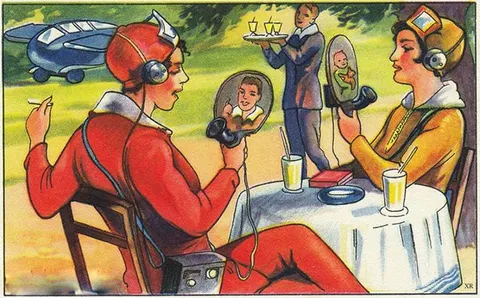
Which Predictions for 2025 Came True—and What Lies Ahead?
In 2015, seven leading futurists laid out their expectations for the decade ahead. In a few hours we will welcome that very 2025, so we can now judge how well they did in the dynamic and turbulent first quarter of the 21st century. Then comes the more interesting part: a look at what the same futurists expect today, especially the ones who turned out to be right, and what the coming years hold according to the people who called the last decade.
 02
“Online, a Little Paranoia Is Healthy”
Can artificial intelligence put an end to the eternal game of cops and robbers? Is complete security online even possible, and is it true that our part of the world breeds remarkably good hackers? Petar Kirkov, the Bulgarian sheriff in today’s online Western, has spent more than 20 years in cybersecurity and is now the national coordinator in the field.
 03
Five Technologies We Expect Big Things From in 2022
Here it comes, just days away! We expect so much from 2022! Not only for it to finally rid us of the pandemic, but also to bring back normal. And we also expect some purely technological solutions from it, each of which certainly has the power to change the life of every single one of us. Still: which are the technological fields where we hope the coming 2022 will be especially hot?
 04
Svetlin Nakov: Today, the Fight for Freedom Is Fought in the Digital World
Svetlin Nakov, the founder of SoftUni, can talk about today's (and tomorrow's) computer world for hours. Engagingly and knowledgeably, with a sense of humor and real insight. Here is what he has to tell us.
 05
How Ratatouille Gave Birth to Bunk Romero
Bunk Romero is a genuine phenomenon: a six-book series that blends the best of crime fiction and science fiction with an authentic sense of humor. Its author, Emil Minchev, is known for the werewolf detective series, but also as the translator of Gone with the Wind, The Hound of the Baskervilles and The Great Gatsby. We sat down to talk about books and the future, about science fiction and fantasy.
 06
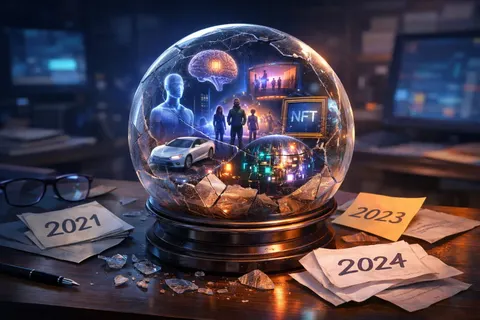
15 Predictions About the Future We Can Laugh At
Trying to peer into the future is a doomed challenge, yet reading tech predictions that never came true turns out to be unexpectedly entertaining, especially when… they are your own. In more than five years, I have published just over 500 Digital Stories. I will invite an impartial observer to assess them and pull out specific passages that have not aged well at all.
 07
Should Robots Be Our Slaves?
Robonomics is coming at full force, and those who adapt in time will gain the most from it. Prof. Stanislav Ivanov, a tourism scholar turned researcher of the economics of automation, talks about the exciting future, the big questions it raises, how Bulgarians already hand robots the same rights and duties we associate with slavery, and why an unconditional basic income is inevitable. Let us take a peek into the future together!
 08
“We Live in a Time of Total Transformation”
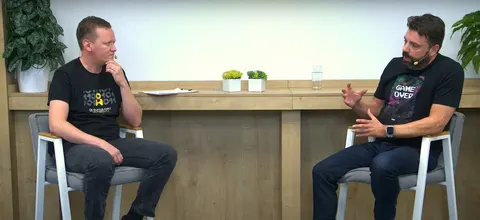
“We are surrounded by a huge number of software systems, we use them in our daily lives, and they were written by mediocre programmers. The way we create software is broken!” “The value of meaningful content will rise, because there is far too much garbage, far too much noise. The only way to preserve ourselves as human beings is to put up barriers. To sift what gets into our heads.” Boris Simandov has vast experience in technology. For nearly 10 years he held a director's position at Chaos Group, one of the most successful Bulgarian IT companies. Today he helps develop the next generation of startups. Together with Rosen Genchev, he created the Facebook group DevBG, the liveliest (and often rather strange) online space where people from the tech world meet. We talk about: – whether we can feel at ease in today's turbulent times – the artificial intelligence revolution we are living through, and the skeptics – the next important step: Sora and video generation – the big challenges and the professions doomed to disappear – the return of truth as a value, and the media of the future – the DevBG group as the best example of why and how democracy doesn't work today.
 09
Iva Gumnishka: Using AI to Give People Hope
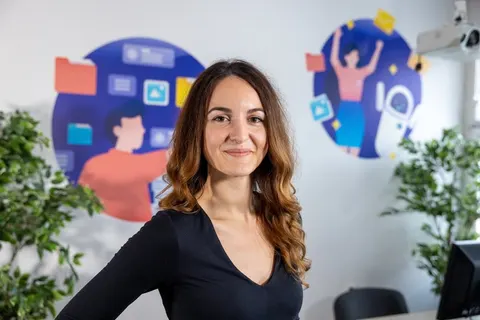
Iva Gumnishka came back to Bulgaria from an Ivy League university with a dream: to make the most high-tech industry of all help the people who need it most, and to make that model sustainable. Her company, Humans in the loop, has spent six years giving work to refugees, people in deep poverty and people living in war zones, from Afghanistan to Venezuela, as they annotate the data that teaches artificial intelligence to see. What does it feel like to give a livelihood to 1,000 people scattered around the world?
 10
Artificial Intelligence and Ethics: 10 Big Questions
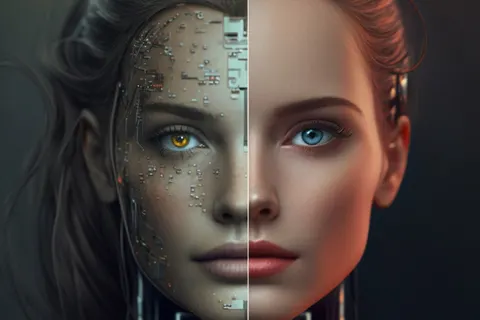
The astonishing progress in artificial intelligence is a fact: technologies like ChatGPT have made it clear that scientists have taken giant strides, and these will go on producing big news. This has pushed the ethical side of such work to the forefront, and the answers may prove vital for each of us and for us as a species. While the European Union and the major powers prepare some form of regulation, the AI revolution is already unfolding before our eyes. What are 10 of the most important questions we should be asking more and more often?
 11
Five Jobs on Their Way Out and Five the Future Is Bringing In
Technology is drastically changing the needs of society, needs that must be met by the daily work of its individuals. Today whole professions vanish and new ones appear faster and more quietly than ever, and although forecasting in so dynamic a field is nearly impossible, we will try to sum things up: which five professions will soon disappear, which five will be most in demand in the near future, and what five professions we can only imagine might one day exist?
 12
2022, Seen from Sixty Years Ago: What Did the Science Fiction Writers Get Right?
In the 1960s Isaac Asimov wrote a remarkable essay containing some astonishingly perceptive predictions. Around the same time, the first issue of the magazine Kosmos ran a similar piece collecting the ideas of Soviet science fiction writers on the subject. What did the writers get right, and where did their expectations fall flat?