What do Mark Zuckerberg and Muammar Gaddafi have in common? Which godforsaken corner of the world will be the last to be “swallowed” by technology? Is it worth traveling the world even now, when we can see everything online? Is it time for a new global dish that brings together… the burger, sushi, the döner and pizza?
Today's guest has been to a bar with Vladimir Putin in the middle of Sofia. I won't give away where he was with Saddam Hussein and Bill Clinton, with Ivan Kostov, Bulgaria's prime minister at the turn of the millennium, and with Mobutu Sese Seko. I don't want to rob you of the pleasure of reading his stories in his long-simmered, richly spiced book Istorii ot rachniya bagazh (Stories from Hand Luggage).
Georgi Milkov can tell a story like no one else. He is one of the few journalists who taught me how to tell stories. One of those who, I believe, will save us as human beings, with their feel for the powerful moment and the telling detail, with their courage, with their many-colored gaze. He is capable of winning a TV reality show and hosting a program about religion, of documenting historical eras and meeting some of the greatest figures (and murderers) of the 20th and 21st centuries.
What might he have to say about the digital? About the riches of technology and what it takes away from us?
– Has travel become more boring since technology took off? We're all on one network now, communication is so easy, planning is more convenient than ever…
– Today, thanks to technology, we've ended up in a cloud where everything seems within reach, a click away. And we can live with the illusion that we're traveling the world while scrolling through Instagram, looking at photos and impressive videos from the most remote places on earth.
We live with the deceptive feeling that the world is within reach.
But in my case, it gives me ideas for new trips. I don't stop at the satisfaction of having seen wonderful things on Instagram; I put little hearts on new places. And when I open the map of the world, it's full of hearts that defiantly remind me both of the places I've been and of the many more I haven't.
Thanks to technology, travel is easier, although many people, in some perversely risky way, stayed in their deceptive bubble and chose to travel only virtually. The pandemic contributed to that, helping to make our lives of solitude even more real.
– How did the pandemic affect your travels?
– It caught me in Cambodia, an extremely fitting country. I found myself in a place I had visited ten years earlier, and back then it was so overrun that you couldn't take a single photo without someone in it. Whereas in Cambodia in 2020 there were no people at all around the famous temples of Angkor Wat, none! I was alone, as if I had just hacked three strokes through the jungle with a machete and the temple had appeared before me.
That feeling was incredible. The people who got to sit on the Spanish Steps at Piazza di Spagna in Rome, those steps that are always swarming with people, probably had the same feeling. They sat in solitude and gazed at beautiful Rome, left to itself. All the tourist landmarks we know look different without people. A place you can explore while surrendering to contemplation, the way Goethe understood it. A luxury we couldn't afford before and can't afford anymore.
Those two years made us think, made us look at the world differently. They also contributed to an even greater rise of technology. In the end, they made us
realize that there's nothing better than reality.
At least for me, because I'm from the generation for whom, however good virtual sex may be, there's nothing better than reality.
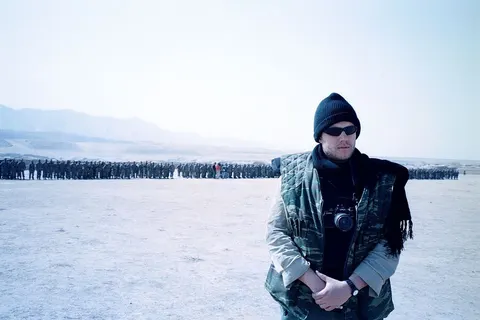
– For now. But apart from sex, what is the most important thing technology takes from us? Maybe truly the most precious thing, our time…
– I catch myself, once I have a profile on some social network, risking wasting all my time smearing my finger frantically down my phone's screen, getting seriously wound up in an endless stream of information that isn't always useful to me.
But it's so annoyingly attractive, like popcorn you only push aside the moment your tongue has swollen from the salt.
Meanwhile, you've been washing it down with Coca-Cola, and the sweet and salty have completely blended into one taste. You've gone through salty and sweet waves, it's so tempting that you can't stop until at some point you've obviously gorged yourself like Bai Ganyo, the archetypal Bulgarian boor from Aleko Konstantinov's 1895 satire. It may be too late, you realize you've spent your time pointlessly, and, extrapolated over the span of our lives and the pointless pursuits we give ourselves to, that could lead you to a hopeless conclusion. That's when you realize you could set aside for a while this device you supposedly can't live without.
After the withdrawal period, when you're edgy and constantly feel as if you're missing the most important thing on the planet, you gradually understand that you're getting back the most precious thing: time with yourself, time for others. Whether they're the people closest to you or new friendships lurking around every corner that you simply never had time for.

– And yet, apart from time?
– Closeness with others. Life in virtual space gives you the deceptive satisfaction that you're surrounded by people and events. Sometimes so you can be impressed and admire, and more often, it seems, so you can tell yourself: “I want nothing to do with these people, they're freaks.” But you keep watching these freaks doing all sorts of nonsense.
This, of course, dooms you to a loneliness that can turn into misanthropy.
It's not good to do that to yourself when you're young. You begin to understand the old people who stare grimly out of the window, snappish and angry.
Because it's as if, out of their loneliness, they've developed a latent misanthropy, a sense that the outside world is the enemy. But it's a different feeling, disguised by the idea that this world no longer belongs to you. Then you realize that when you were young, you did the same nonsense, and that leads you to nostalgia, to a melancholy that has sweetness in it, but no small amount of sadness too.
And so, quite naturally, you develop a cocktail of hostility and fear toward whatever lies beyond the comfort of the firmly shut doors of your own house. While
the world hasn't changed in any way; you have.
That's why the more often we compare the loneliness technology inflicts on us with the loneliness to which, sooner or later, we'll be doomed one day for physiological reasons, the easier it will be to grasp the conclusion.
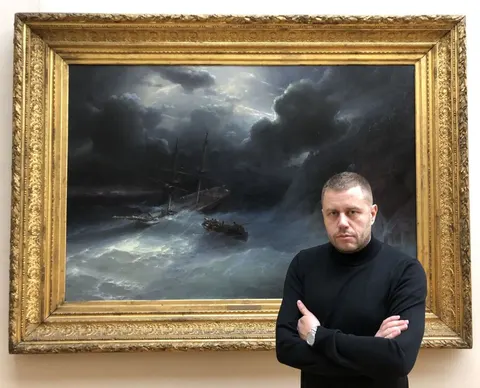
– Digital loneliness… Technology supposedly came to bring us together, yet it often does the opposite. But does it also deprive us of larger-than-life figures? It's as if, somehow, those strong, interesting, thrilling personalities you love to tell stories about are gone. Like Gaddafi or Saddam Hussein, like your beloved African satraps. Only Putin remains, a relic of another era.
– A Pithecanthropus of our times; in a while we'll remember him with a kind of tenderness. The reason is
the technological mush that surrounds us.
We used to live with the idea that there were exotic countries with their even more exotic satraps. Like Gambia's former dictator Yahya Jammeh, who every Tuesday cured AIDS in the square in Banjul, and every Thursday, malaria. Now it seems there are no such people anymore. In Togo, General Gnassingbé Eyadéma is gone; he rarely held elections, but when he did, neighboring Benin always found out, because the ocean washed at least 1,500 corpses onto its shore. Mobutu Sese Seko is gone, that “charming” dictator who wore a little leopard-skin hat and had named his country “Zaire.”
Things in Zaire haven't gotten any better, quite the opposite. In today's Congo, children's future looks as bleak as ever; in North Kivu, thousands of children dig in the cobalt mines to extract this precious metal needed to make our ever more wonderful and sophisticated mobile phones.
It's as if the world has melted into one universal purée, with less and less of the exotic in it.
Because the exotic floods us every day through TikTok, in ever more impossibly stupid clips that lots of people laugh at, like or put hearts on.
Somehow the world has become uniform. Whether you go to the Amazon, to Siberia or to some developed Western city, you'll be watching the same clips of people doing the same things, because that's the fashion. This creates the feeling that we live in a globalized world, eating the same food. Wherever you go, you find
the marks of globalization in the shape of burgers, sushi, pizza and kebab.
That's why restaurants that offer them all together have become so popular, including in Bulgaria; that's what the modern world wants. If it can be constructed into a single dish, I have no doubt that the future of cuisine will appear in that form very soon.
It will be promoted to us by ever more identical-looking gourmet influencers across every possible social network, no matter where we are.
Staring at our screens, we feel as though we're all in the same place.
But that is very deceptive. If you look at your screen a little less, you'll see there are places that have remained astonishingly untouched by globalization. In recent years, I've noticed that I deliberately go precisely where globalization has reached the least. Places where you can feel as if it's before the smartphone era. Which wasn't really all that long ago…
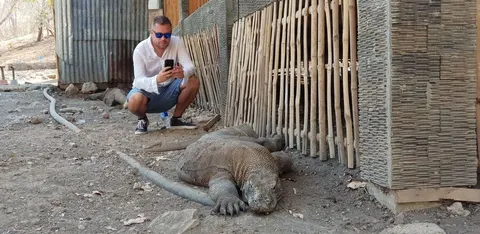
– If someone wants to escape technology, where should they go? What will be the last godforsaken place where it catches up with them?
– If you want to escape technology altogether, it's nearly impossible. Not going online is unthinkable even for someone of my generation, let alone for people born with a tablet in hand. Really, if you want to shake it off, you have to have no smartphone and stay offline. Then you could probably find peace even in a village in the Rhodopes, the mountains of southern Bulgaria; there's no need to go to the Sahara.
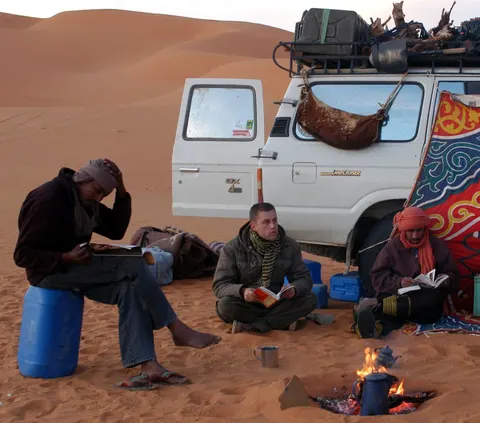
I do know, though, wonderful places in that greatest wasteland on the planet that seem so far from the reality we live in that anyone can travel thousands of years back. Feel like the first human.
The Sahara is an incredible living organism of a landscape, where, in the middle of a sea of sand, you can find yourself in a mountain like a fortress. Black, amid orange sands, and in its depths you can find greenery, meanders, a very unexpected source of life. You have to bring your own food and everything you need. But living in that place and looking up at the night sky,
you can grasp what the planet really is.
We live in light-polluted cities; at night we can make out the Big Dipper, Cassiopeia and two or three other constellations.
If you lie in the middle of the Sahara and look at the night sky, you see an incredible spectacle. What the ancients saw, the greatest show of all for them. So many countless stars, the whole Milky Way. You start to become part of the entire universe, to realize how small you are, how temporary. How you ought to live the time you've been given on this planet.
In the Sahara you can see a cave where the eight planets of the Solar System are painted, along with the Sun and the Moon. It was created by a civilization about which we know absolutely nothing!
We hold all knowledge in our hands through these wonderful devices we call “smartphones” and never part with. The first thing we do when we wake up with sleep-crusted eyes is look at them to see whether someone has messaged, liked or shared. And we don't put them down until we're nodding off.
We consider ourselves an extremely advanced civilization, but there, in the middle of the Sahara, we might come to suspect that something so sweeping could happen to all of us, to our whole highly developed civilization that knows how many planets there are and where they are, that no memory of us would remain on this planet. And after another 10,000 years, some people who have started over and gotten far enough to discover random traces left by us might wonder: “Who were these people who lived thousands of years ago and knew about the Solar System?”
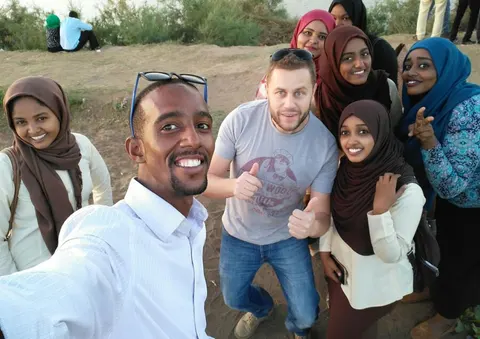
– Do today's tech leaders like Musk, Zuckerberg, Altman and Bezos resemble your beloved satraps? I think they definitely do, in the way they got where they are, in their latent infantilism. In their unscrupulous way of making decisions, wrapped in the requirements of the society in question. In the sense that they're always right and they should dictate the rules.
– In unscrupulousness they probably surpass them. Zuckerberg can outdo even the most backward African dictator, because Mobutu Sese Seko's footprint was, after all, confined within certain limits, whereas Zuckerberg's is global.
I'm not in a position to take stock, draw the line and say who is worse, because we often slide down that slope of generalizing, of drawing quick and extreme conclusions, which I think is wrong.
You go on Facebook and see people every day handing down verdicts with a finality that even the supreme court of the Jamahiriya, Gaddafi's Libya, wouldn't have allowed itself.
There, even after the final instance, there was always some loophole, be it political, religious or a matter of fate, so that things could turn out differently. The categorical certainty with which we hand down verdicts on Facebook every day shocks me.
I'd refrain from the sweeping conclusion of who has made more people unhappy, Zuckerberg or Gaddafi. A colleague and I used to joke, with an almost tender nostalgia:
“Ah, what dictators they had back in the day!”
Truly, the world map has somehow started to fade and turn into a smeared windowpane where you didn't use enough cleaner and everything is the same color. There are none of the glowing images, organic in their density, that the world once had.
Maybe that's for the better, who knows. But evil didn't go away with the end of Saddam and Gaddafi. On the contrary,
it multiplied to an impossible degree, but it became profane, an everyday banality, and we no longer pay attention to it.
We have reason to be grateful to technology. We live in a time when people ought to be living better than ever in terms of material comfort.
That qualification is important, because it doesn't equal happiness. Just as we live in times when we have everything, we also realize that we aren't happy.
In the rut of consumerism you can never be happy, because you live every day feeling that you need something more.
That could also explain the lack of sufficiently distinctive images of evil. It's blurred behind some algorithm, some machine, something unknown to us. It's far easier to grasp if you know that in a certain country there's a dictator in a little leopard-skin hat who is the source of all evil, rather than some global reptilian order.
Today's rather fast-paced life creates, in the background, a sense of insecurity and fear in us. And these fears make us paint vague images of monsters who wish evil upon this planet.
In fact, the monsters are ourselves.
– What's the point of traveling today? It doesn't interest me. Places around the world are becoming more and more uniform, and we can see everything without getting up from the computer…
– I've been traveling for a very long time; it has become second nature to me. And if a moment comes when I tell myself, it doesn't interest me anymore, I've seen everything, that will worry me. However much I've traveled, I realize that
there are so many things to see, to recognize, to discover and to rediscover that even if I did it actively and systematically, another two or three lifetimes at least wouldn't be enough.
I was recently in Turkey, a country we consider familiar, a book we've already read. I thought the southern part of the country, since it borders Syria, was a place I knew and a region I understood. As someone who has traveled and seen quite a lot, I'm hard to impress, but what I saw in southern Turkey impressed me deeply. The city of Mardin, with its old stone houses, restaurants and streets full of people freely drinking alcohol.
The town of Dara, near the Syrian border, far more impressive than Petra in Jordan, far less explored, unknown to tourists. You see a village house, you go down into its cellar and find yourself in a huge underground space, a fifth-century temple! You walk across the meadows, and there are tombs carved into the rocks. The fact that I hadn't known about this place spurred me on to find out what else was around. That's how I reached Harran, a shabby little town that's interesting for its houses with roofs like beehives. Bulgarians have lately been going to Puglia in Italy; Alberobello has become an Instagram landmark. In fact, Harran is the prototype of Alberobello, and there's a historical explanation for that.
Then I went to Şanlıurfa, another impressive city. On its outskirts lies Göbekli Tepe, which a few years ago completely turned human history upside down, because it's the oldest sanctuary. Scientists don't know exactly what it is, but it dates back 12,000 years, to the end of the Ice Age. At that time, people were hunter-gatherers with stone arrows, wrapped in some kind of hides, digging for roots. At the same time, there were obviously other people who built a huge sanctuary of polished, massive stones, carving into them fanciful images of animals and birds, of snakes and scorpions, which archaeoastronomers decode as a map of the starry sky.
Even a trip to Turkey, which looks like a banal tourist destination, can take you on an unexpected journey through time and history.
So if you ever hear me say I'm fed up with traveling, it means something in me has broken down very dramatically, I'm not well and I need urgent help.
– Have you ever regretted becoming a journalist?
– Never! In recent years, journalism has become a profession that, when someone asks what you do, you'd better not answer. We ourselves let the gold standards of the profession be forgotten in the distant past and slid down the chute of quick PR. Into this
endless race for reads, likes and tricks, forgetting the fundamental things for which our profession exists.
I haven't regretted for a single moment that I chose it and that I still go on calling myself a “journalist,” however forlorn, outdated and démodé it may seem.
I like and love this profession, and I believe that despite the frequent reproaches that it's morally obsolete and useless, it has a future. However unclear that may look amid the technological meanders of what lies ahead of us.
These are times of fear that some algorithm will come along and do the journalist's job. I don't believe that will ever happen; I don't believe artificial intelligence, however much it improves, will be able to replace real journalistic work. It will perfectly well replace, and is already replacing, the writing of press releases and bureaucratic texts of the kind the European Commission and all similar institutions churn out every day. I'm “worried” about the jobs of those people. But they're excellent survivors and will find another harbor amid the endless possibilities of this administrative Babel.
Doing real journalism, writing with heart and love, the empathy and the purpose and drive with which we were once taught that journalism should be put at the service of society… I don't think artificial intelligence will ever be able to catch up with that.
– Nor do I; I think exactly the same way. Thank you from the bottom of my heart for this meaningful conversation!