A Bulgarian and his team build the cameras that helped NASA turn its gaze to the Moon, and then to Mars. His designs are used by all the biggest aviation companies, and besides having already “set foot” on our satellite, they fly aboard thousands of satellites in orbit.
In the 1990s Petko Dinev left for Florida, where he started working at NASA. He then founded his own company, which stands out worldwide for its expertise in building industrial cameras.
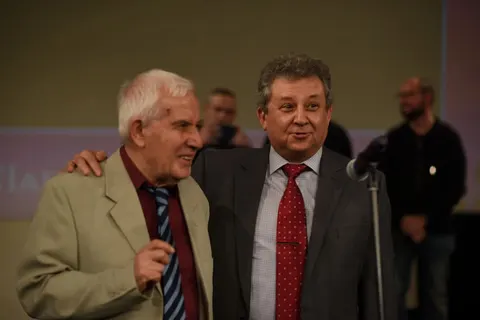
His path began in Kazanlak, a town in the heart of Bulgaria—he is the country’s first gold medalist in physics and a student of the legendary Teodosiy Teodosiev, known simply as Teo. Our guest is also among the main characters of the new documentary Sotsialno silnite (The Socially Strong), which gives the floor to the gold medalists of Teo’s school.
How does a person end up at NASA by chance? How does a scientist build a company that becomes the world benchmark in its industry? How can we change the fact that today half the students at the high school he graduated from fail to scrape even a pass on the math matura, Bulgaria’s school-leaving exam? How do we make science fashionable and give technology a chance? How do we, as human beings, catch up with its enormous growth? We have huge questions to discuss with this exceptional guest.
“Yes, we live in interesting times. Maybe even too interesting. I don’t think we’ve reached the limits of technology. I think we’re still in the overture…”
– So how did you end up at NASA… by chance?
– I worked there for six years. It really was chance. Sometimes life throws chances at us that lead us somewhere. When the changes came—the fall of communism in 1989—my ex-wife and I were senior assistants at the Technical University of Sofia. I was very involved in the elections, I had hope and drive, I thought things would change for the better. But when I saw how badly we’d been lied to, we decided to leave.
My wife read that for the first time any Bulgarian could apply to an American university, but for most universities—the western ones and the Californian ones—the application deadline was the end of January, while in Florida it was the summer.
When she was accepted at Florida Atlantic University, there was no hesitation and we left right away. It turned out there was a NASA lab there
and I went over and introduced myself in very broken English. But for some reason they liked me and took me on.
That’s how it started, in 1991. In 1997 there were budget cuts at NASA, and the head of the lab said it might be worth looking for work, because things weren’t going well. I left and found a job in industry. I’ve always been drawn to making cameras; I’ve been tinkering with electronics since I was very small. I combined that with my knowledge of physics, and now I’m one of the lead designers of the cameras used by NASA, Boeing and who knows who else.
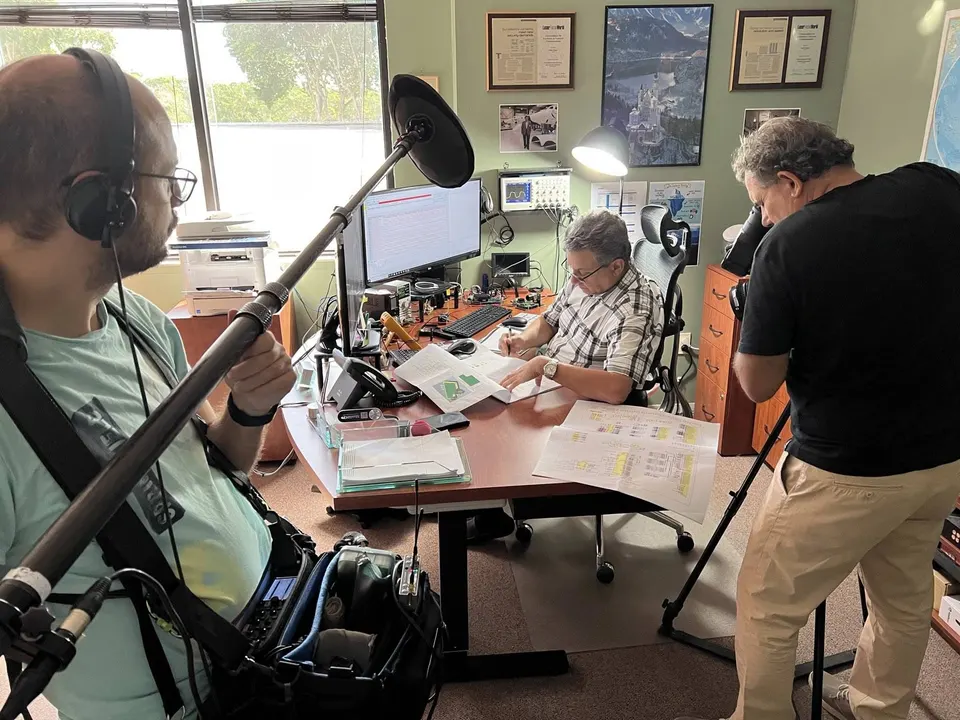
– What makes the cameras you build special?
– Right after NASA I was lucky enough to work at a company’s research institute—the David Sarnoff Research Center. Many of the technologies we associate with video cameras today were invented in that lab. I had the chance to spend two years in the production of sensor arrays—I learned the technology, and that helped me a great deal later in making cameras, because I could optimize the processes.
Our cameras today are very efficient, with very low power consumption, very good quality and lots of features. That set them apart from the mass of companies making standard cameras. My knowledge of optics helped, of electronics, of programming.
I write the code for the cameras; we use lower-level languages, flavors of Assembler.
When you combine everything—knowledge of physics and optics, knowing how the sensor works on the inside, knowledge of electronics—maybe that’s what made the cameras so successful.
– What are these features?
– They’re specific to machine vision. One of the main things that sets us apart is that we built a “double trigger” function. It’s used to measure particle flow, for scientific research on anything suspended in a fluid.
Our cameras are unique in that the time between two frames can be as short as 200 nanoseconds. That way processes can be studied much faster, which is why the five biggest companies in the world are our clients.
The other thing has to do with machine vision. We can select several regions of the sensor in which to watch what’s happening. Beyond that, we managed—I hold a patent for this—to accumulate images with a delay inside the sensor itself. That allowed us to put our cameras on satellites.
Since 2014, when we built the first one, we’ve put over 5,000 cameras on satellites in space.
Everyone comes to us when they want to use satellite cameras—the Europeans, the Americans…
– You’d assume they would go to the bigger companies. Whereas you have a technology that sets you apart.
– At first the big companies were skeptical of us. We started… Actually, I started our company, but I don’t like saying that people work for me; we work as a team. If I don’t write my code properly, they scold me, never mind that I’m the boss.
There has to be an understanding that everyone has to do their job.
So our first successful product was a technology for recording video data on a computer.
For a long time we wondered why the big companies wouldn’t take it as a product, when they needed it. When we talked to some managers, they said they were waiting for us to mature. They’d seen plenty of companies with some unique product that were gone two years later.
They literally waited five years to see that we’d keep going, that we were growing. In 2010 we started working very intensively with NASA, with L3, Boeing. That’s when this activity aimed specifically at space began.
In April 2019 one of our cameras went to the Moon with SpaceIL. Now we’re in great demand for the conquest of the Moon and Mars.
Artemis is an impressive example. Unlike NASA’s first program, Apollo, which was just “we can do it too,” this is a 50-year program. It’s long-term and includes building a space station on the Moon, and another one orbiting it like the ISS, but quite a bit bigger. Many companies are helping with this, and we’re among the active participants.
We’re NASA’s space partner in this area, and we built a special camera for them, for the new rocket. We expect Artemis II to launch into space around the Moon sometime between February and April.
– Why don’t we seem to have this stereotype here, that science can make you successful?
– In the West it exists, but
there it’s seen very positively if you try, fail, and then get up and try again.
Whereas in Bulgaria, in all of Europe, probably the Middle East too, everyone starts pointing at you as a failure, a loser. Maybe that’s the key. The mentality that if you start some venture and fail, everyone will spit on you.
America, on the other hand, is a country of people who came driven by ideas—persecuted for religious reasons, and people who came to escape the dominant stereotype.
– But how can we change the stereotype and make science more attractive?
– Lots of people are now talking about more STEM in education; that term came from America. But that’s technology, that’s chemistry, biology, math, physics. Everything put together.
Unfortunately, in Bulgaria very few people want to study these sciences. It’s the same in America. The students doing computer science and physics are mostly foreigners. Because there, as here, people aim for the majors that can bring them more money—lawyers, doctors, economists; “business administration” is very fashionable. Whether you want to do it from the inside or you go there for the money isn’t clear. And in my view most people now go there for purely financial reasons, not out of an inner calling.
– Yet science can also create business, as in your case. But I think it’s mainly the education system that fails to spark enough interest in these sciences.
– Exactly! You can’t work in technology without knowing math. It was very interesting for me to listen to interviews here with people who want to become programmers because that’s where the money is, but don’t want to learn math.
I just don’t see it.
What algorithm will you create if you don’t know what an algorithm is?
– Especially in the age of artificial intelligence.
– Writing code is one thing—you learn a few basic ways of doing it, but you’re essentially an employee. That will be… no, it’s already been replaced by artificial intelligence.
But if you want to become a good programmer, to create something, you can’t do it without math. There’s simply no way. Yes, math is hard, but it’s necessary.
Maybe the way it’s taught in Bulgaria is that the level is leveled down to the weakest, not up to the strongest. But that way the good students lose motivation.
– Can we regain our position in space technology? Not so long ago we were a factor in this field, and today we have a few but strong examples like EnduroSat.
– Yes, we work with them. I try to proclaim that Bulgaria can come back, but that’s in the hands of private companies. The Space Research and Technology Institute, the KASTRA cluster—nobody talks to anybody. Everyone is on their own, typically Bulgarian. Maybe they expect the state to do something.
Raycho and EnduroSat are doing very well internationally. They’re one of the companies that are genuinely on the high-tech international market. With what they do, with the technologies they’ve created. That shows Bulgaria can do it.
– But how do we get more examples like that?
– Precisely through sites like yours.
People need to understand that in the times we live in, technology is the driving force of everything.
A hundred or two hundred years ago the world was made by industrialists. Now it’s in the hands of technologists. Look at who the billion-dollar companies are right now—Google, Oracle, Microsoft, SpaceX, Facebook, Apple. Yes, they have some product—a phone, software, platforms—but the future is in technology. So if Bulgaria makes the effort, it can. But for that you start at the ground level. First, interest in math has to be sparked in elementary school.
I have one example that is absolutely tragic. At the high school I myself graduated from—the Nikola Obreshkov High School of Natural Sciences and Mathematics in Kazanlak—two years ago 50 percent of the math matura results were fails.
How can a high school with that kind of reputation, which has produced at least 50 international Olympiad competitors, have 50 percent failing math?! What does that say about the others?
– At the same time we have the example of Teo, whom somehow we fail to multiply and to appreciate.
– Not only do we fail. They were even wondering how to kick him out of the school faster. That was a great tragedy, because he had reached retirement age, they kept him on a year or two and just couldn’t wait to get rid of him. That’s typically Bulgarian.
– I’m repeating myself, but… how do we reverse the process? How do we get more teachers like him?
– There simply has to be desire in the eyes. That’s where it starts. Then you have to see those bright little eyes across from you. The ones in first grade, second grade, or in our case eighth,
they’re watching, they want to soak up knowledge. If you’ve got your eyes glued to a phone, it just won’t happen.
– Yet that’s exactly where technology is leading us, along with the thoughtless way we welcome it into our lives.
– That’s the other problem—there’s a huge dissonance between people’s emotional and technological development. The emotional is slower, while technology climbs along its exponential curve. So there comes a moment when new technologies are so far ahead that
most people can’t take in what they could really lead to. They’re users, but on a very superficial level.
– And even bigger problems are on the way. Artificial intelligence took my job as a programmer quite literally. And what comes next…
– My son works in this field—they use AI to create avatars, content. It’s something that’s coming in.
The people who are guaranteed to have work will be the ones who create artificial intelligence.
Many think it’s already done, created, and that’s that. Not true—quite the opposite. The number of programmers needed in this field will grow.
Besides, when people talk about artificial intelligence, very few actually know what it is. Most picture it as a robot that will come and do the work. Judging by the commentary, even in the national media, I have the feeling they have no idea what it is.
– Exactly. That’s why this site exists.
– That’s right. Unfortunately, the media very often just repeat clichés, as if everyone had read from the same little booklet, while the subject is much bigger. So keep going!
– I definitely will, as long as I have the strength. But how can we catch up?
– More attention has to be paid to technology, and less to who was driving at 100 km/h while holding coffees.
The media themselves today are bread and circuses.
The old Roman saying, I think, is in full force. To attract advertising, financial motivation, they give people something that gets watched. What gets watched? The spectacle. The Romans figured that out 2,000 years ago.
– But it also thrives in social networks as a public outlet, now that they have taken over the functions of the media. That’s where the influencers are, the “content creators.”
– Yes, but they’re also mercenary, because an influencer advertises, “influences” whatever they’re paid for. Whether it’s true or not doesn’t matter at all. It’s a distorted reality.

– Exactly. But perhaps we’re close to the limits of these technologies? Take images—what we imagined as a digital camera or video camera 25 years ago, we already have. We have mega- and gigapixels that are excellent for everyday life, and I don’t see where they can go from here in general.
– On the contrary. New algorithms keep appearing. The number of pixels grows, and that is inversely proportional to the optics. The smaller the pixel, the more precise and expensive the optics must be. Look, my phone supposedly has a 22-megapixel camera and I can see everything.
Industrial cameras, on the other hand, have no processing of the information whatsoever; you have to see every single pixel. There’s a parameter called “optical resolution,” and if a lens can resolve 4–5 microns per pixel—those are the good lenses—it’s quite expensive. The ones on phones are plastic. Yes, they have good technology, they’re so-called liquid lenses that can change their shape and with it the focal length, but they can’t resolve the corresponding pixels on the phone. It’s all one big processing job.
The purpose of a phone picture is to look good, so you can like yourself.
There are internal algorithms, filters and whatnot, all to produce a nice picture that has nothing to do with reality.
Another development of the technology is that we’re starting to put AI into cameras. Next week we’ll be at a trade show in Chicago with an AI camera that we’re training to make distinctions specifically in industrial vision.
So there’s still plenty of room for technology to develop—we don’t yet know what awaits us!

– Interestingly, the example of lagging emotional development applies here too. Now we take photos constantly, we enjoy pretty pictures, and after a while we never find the time to look at them. We churn out a huge number of shots, and that has changed their value…
– Yes, a large part of those pictures are selfies—you take 10,000 to pick the one you’ll like and send to your friends. But there’s something else. Companies like Google or Apple process all the photos you upload to the cloud. They try to figure out what kind of person you are, so they can advertise the right product to you. And we agree to it voluntarily. The platforms are very powerful.
Brexit and Cambridge Analytica are an example. It tried, and succeeded, in building an algorithm that could target people literally house by house, knowing their attitudes, in order to feed them the right information. The technology is advancing fast and, unfortunately, most of these companies don’t exactly reveal what they’re doing.
The idea is to sell our data.
– When something is free, you are the product. That’s also a big theme of many Digital Stories. But the point is that these companies are now so powerful that they can censor even the American president. At the same time we supposedly regulate them, while it’s clear the mechanisms allow something very similar to Cambridge Analytica to happen today.
– What’s even more interesting is that they started censoring themselves, which is the biggest oddity of all. It began under Biden and continues now. Just like in the old days, under socialism.
– How can we get out of this situation? My only answer is still public conversation, but that can’t happen while even for that we depend on social networks, and now on AI as well.
– There are new platforms that are less tied up, new search engines, but they’re still limited. It cuts both ways. To be effective, among search engines for instance, you need an enormous database. But how did you collect it? That’s why it’s very hard for a new competitor to break in, because it doesn’t have access to the same data.
It’s no accident that big data is such a big topic. The future lies there too.
– And now with AI we’re repeating the same mistake, handing the important decisions and the monopoly to a few companies.
– It will be interesting, because right now they’re starting to use AI very actively and successfully on the stock exchange. But that can lead to huge fluctuations, because you end up with a string of similar algorithms.
Yes, we live in interesting times. Maybe even too interesting.
I don’t think we’ve reached the limits of technology. I think we’re still in the overture. We don’t yet know what will happen to us.
In visualization itself, in entertainment technology, I think a serious change is coming. Back when I was a kid, people talked about holographic television. I think that may happen soon.
– Mr. Zuckerberg himself claimed we’d soon be living in a metaverse, and then the topic vanished.
– My daughter-in-law works at Facebook. That’s really how he is—he throws himself into something, runs many projects in parallel. Yes, it’s nice to have money. Nothing wrong with that. Especially being a company with a market cap in the trillions is very nice; they can throw resources at many parallel projects.
The smart glasses they were supposed to make went nowhere, but thanks to projects like that, wearable electronics that give you information developed. Out of them came those watches that track your pulse, blood pressure, temperature, and can alert you if something’s wrong with you. That’s a very positive technology.
Yes, many of them wander around, since they don’t have to think about what this or that will cost. But sooner or later something comes out of it and the investment pays back many times over.
Still, let’s not forget that Facebook is a company not even 20 years old. When I left for the United States, there was no internet yet. Netscape appeared, and with 2.4-kilobit-per-second modems we tried to upload something. Thirty years later, look at the level of technology! If back then it seemed to us that everything had already been done…
I don’t know. I think we still don’t know what awaits us.
– Neither do I. I’m sure there are reasons for optimism in these interesting times as well. I, for one, like that space is back on the agenda after being missing for 40 years, even in America.
– Yes, but… it was really Elon Musk who made that happen. When NASA was cutting jobs, Musk had just made billions from PayPal and had the financial means to hire the NASA engineers who had worked on the Space Shuttle. It’s one of the few examples where the state helps you without meaning to. Because in most cases the state gets in the way—here and there alike.
Yes, new technologies for conquering space are one of the hopes. It’s much easier to build semiconductors in space, and that could very easily make our lives here easier. Robotics! It’s no accident the Japanese lead in robotics and robotization, not only on assembly lines but also with helper robots. The Japanese nation is aging and someone has to look after the elderly—that’s one of the positive things.
There is hope, I think. But the bad part is that these robots can be used for other purposes too… Balance again, like the atomic bomb.
– But finding that balance seems to be getting harder and harder. Thank you for this conversation! And to anyone who cares about these topics, I recommend the new documentary by director Nikolay Vasilev—The Socially Strong, which gives the floor to many of Teo’s successful students. They’re worth hearing…