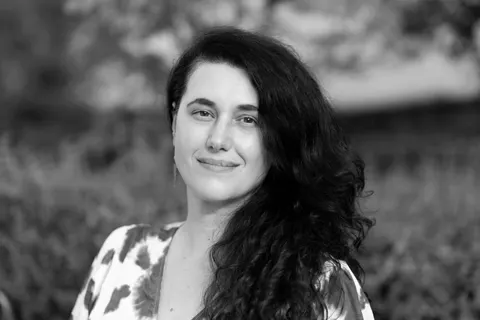
Petya Kokudeva is a silver-tongued master of words who can tell a deep story in a handful of sentences. And, impossible as it sounds, she does it not only for adults but for children too.
Today’s guest is one of those people who never stop traveling—both creatively and physically. Petya set out from the Rhodope Mountains in southern Bulgaria, worked as a journalist for many years, then moved into advertising as a successful copywriter. And over the years she has never stopped collecting the colorful stories she comes across—online and in her books.
A writer with many awards for children’s books, she is perhaps best known for the cult series Priklyucheniyata na Lupo i Tumba (The Adventures of Lupo and Tumba) and the travel collection Pozdravi ot sinyata palatka (Greetings from the Blue Tent). Petya is a citizen of the world who knows what to ask of it.
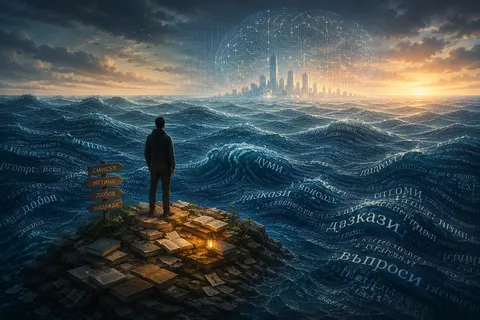
We talk about the road—the one across the world, the one down the feed and the one toward ourselves. The road of each of us, and of all of us as a civilization, along the steep slopes of today, in the light and shadows of technology.
What awaits us around the bend?
– What is the greatest point of traveling?
– The chance to go through hardships, shocks, embarrassments, losses and disappointments in a very natural, thrilling way. It welds misadventure to adventure and trains you to live the rest of your life that way.
A priceless muscle, if it works.
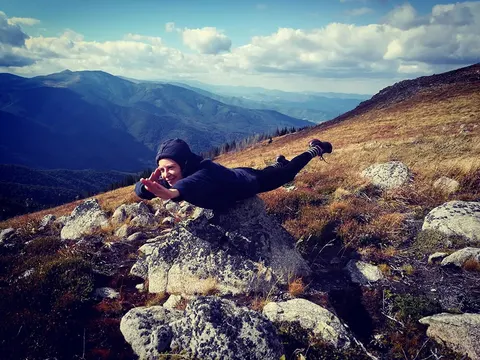
– What can’t virtual journeys give us?
– A very good question. Traveling virtually is like knowing someone only from Facebook. It’s relatively illusory and safe. But the chance that reality will turn out very different from the image you’ve built is more than huge. Every place, with its culture, is far too richly nuanced for you to understand it from a distance. You have to be there, with your senses, with your intuition, with your character above all…
The mind is an infinitely inadequate tool for exploring new worlds.
And one more thing: the world is too wonderful, bright and complex for us to need to finish inventing it virtually.
– How do powerful, moving stories differ in digital times?
– I’ve thought about this more than once, since that word “stories” is now flooding us from every direction. For me personally, a good story is a fragment of the world that I call a “hidden philosopher.” It’s an incident, a detail, a story that—without lapsing into wholesale musing and philosophizing—can
connect with you and make you feel and think at the same time. Not just one, not just the other.
That’s my personal problem with cool, abstract, detached reasoning—it’s very interesting, but it evaporates. It doesn’t sneak inside you the way a touching, intricately woven story can.
That’s why we read and copy out lots of great quotes, yet remain desperate and unenlightened. Clever words on their own can’t reach us and get our gears turning. That’s why I’m sometimes a little sad that the Bulgarian tradition has little storytelling and more philosophizing—we love to play the sage.
– Today there are also purely digital stories, which I think have a different scent, but they too are lived more than told. Do you have one of your own that has moved you?
– Well, I’ll tell you something from literally yesterday. It struck me because it shows how a tiny detail can reveal a broad aspect of a nation’s culture. I’m booking rooms in several places in Denmark right now, because we’re going there. And several times the hosts wrote to ask whether we’d be bringing our own bedspread. A bedspread!
Can you imagine me lugging a pretty bedspread onto the plane?!
But the Danes are famous for their sense of coziness, order, domestic idyll. And to them it’s perfectly normal that even in a rental I’d want something to cover my bed with—something that’s mine and that I love.
– Do words sound different on the internet?
– Yes. I think that
there’s often no context here, no full picture around our words. And everything is perceived as far more black-and-white than it is.
– Are there words that are easier to say online?
– The rude, hurtful, ill-mannered ones. Because you really don’t see what you’re causing in the other person.
– Very often, when I ask my guests about the roots of hate, we end up exactly there, and at how it divides us. Why do negativity and hatred come to the fore so easily online?
– Actually, the opposite comes out too, and to me that’s just as corrupt. People put up hearts, declare their love and shower each other with friendship very easily and very willingly. It couldn’t happen in such quantities in reality, because there it takes far more real effort.
As for hatred, I think that
when you cause someone pain, some of it sticks to you too
—someone else’s pain always stays on you. Online we’re robbed of that—and yes, I say “robbed” on purpose. Feeling someone else’s pain is a sign that you’re alive.
– Will artificial intelligence one day be able to create true art, to write literature?
– For many years I’ve lived with a man who studied robotics and works with neural networks and training artificial intelligence. So yes, I believe that
AI will soon write and translate better than most of us.
But it will never translate like Iglika Vasileva or Neva Micheva. It won’t manage to paint like Nedko Solakov. And it won’t write criticism like Marin Bodakov. Inexplicable, inimitable talents will remain hard for machines to reach. The rest of us, the pleasantly mediocre, will share a school desk with sweetly blinking robots.
– Will we one day manage to teach robots to laugh sincerely?
– I find it wonderful that we’re in a fog about this. Can you imagine if we knew?!
– What is the most important thing modern technology takes from us?
– I think it’s the possibility of devoted attention when we communicate with each other. More and more often I deal with people who tap away at their phones while talking to someone. Or they watch a live presentation and scroll, and the presenter sees it and gets flustered. That creates a huge rift in communication.
– And what does it give us?
– For me personally, the most essential thing is access to important, interesting information. Books, presentations, archives, ethnographic collections, virtual museums, documentaries. All this wealth—far beyond books—I use, for example, for research before I travel.
– It turned out that technology didn’t manage to defeat books; right now even more is published than 10 or 20 years ago. How did that happen?
– What interests me isn’t whether or how much is published, but whether my chance as a reader of encountering a talented book is growing. From what I’ve observed, it isn’t.
Sensitive, well-written books remain rare.
And it’s even a little harder to get to them, because the noise is enormous and the expectations of every book are high. I’d like not to read a lot, but to land more often on the books that are right for me.
– What is hardest for “humanities people” in the digital present?
– One thing is their comparatively weaker general knack for gadgets and machinery. Their interest in them is usually weaker too… The other is that they’re used to working for no money, which isn’t only a hardship but also an advantage.
Doing the things you love even though they won’t make you rich can be very toughening
and meaningful for a person.
– I actually think we overdo the cliché about humanities people, and it limits us. But it’s a fact that in this field it’s getting harder and harder to do what you love and still feed your family. Which humanities professions do you think will disappear in the coming decades?
– Oh come on… I’m proposing the opposite—new humanities professions appearing, they’ll be needed more and more. For example,
a focuser—someone who tells stories captivatingly and trains people to concentrate.
Or a translator from Depressionese—someone who translates to others what a depressed person feels, so they don’t just say, “Pull yourself together, Ivan!”
– Is a copywriter’s work creative? How does it come close to literature?
– It’s creative, but dangerous for a literary person. Advertising communication is a very interesting, turbulent, active occupation, very varied. Only there
the goal isn’t the creativity itself; it goes beyond that—what you achieve with it and whom you achieve it on.
If you imperceptibly start doing that in literature, you turn it into a message. And a message… its problem is that it leaves you no room to reflect and interpret; it tells you what to think and do.
The power of art lies in the fact that you connect with it and carry it on yourself
—with your life, with your head, with your heart. And you carry it on in your own unpredictable way. Many people say certain books saved them, helped them in the hospital, through a divorce, at the hardest moment of their lives. I’ve never heard of an advertisement doing that.
– Is this profession a good option for “humanities people” who see no future in the digital world?
– Yes, this profession trains you in many useful qualities—inventiveness at every level, nimble thinking, listening, a critical eye. But
after 15 years in it, I have a problem with meaning—there are far more meaning-generating occupations
into which a 40-year-old can pour their experience and knowledge.
– That’s also one of the big themes of Digital Stories—the path of truth from journalists through copywriters to influencers.
Are there technologies that make you dream?
– Of course there are. But it’s not so much the technologies as the ideas behind them. I’ve always liked that Turkish app that took their traditional coffee-cup fortune-telling into the virtual world. Real Turkish grannies read your coffee grounds remotely. There’s a lot of spirit and life in that. I also like the Danes’ digital collection of stories from the past—anyone can add a photo or a story to a kind of ethnographic digital museum. The idea, not the technology, is what makes me dream.
– Recently we’ve had something similar here too—Estorium. In that sense: is it more of an advantage or a problem that today anyone can tell a story and reach everyone?
– It’s like with the books I mentioned a moment ago.
Every new book or story is like the glowing notification on Facebook
—there’s something new there, a little red, ooh, how cool, what could be waiting for me! You click and… ugh, it was nothing much after all. This abundance creates intense, frequent expectations of something great, and that expectation makes you disappointed with most stories—because you don’t take them in naturally, without much expectation, the way you do in real life, where they simply happen to you from around the corner.
We live in permanent excess, in boundless abundance—there’s no way that doesn’t create a problem.
– Are social networks really social?
– Yes, for initial contact—to meet people with your interests, with a similar value system. Not for developed, deep contact.
– Have all the great plots in literature already been invented?
– Without a doubt. But there are still many people who will manage to tell them in a way that moves us like never before. The way, not the plot.
– Is the world becoming more boring with globalization?
– No. The world has never been and never will be boring—unless, of course, we’re staring only at our own navel, where there’s mostly navel lint, at most sometimes blue or green depending on the color of our T-shirt.
– What opportunities does the strange time we’ve found ourselves in over the past few years give us?
– Something of such vast scale happening so seismically—on a global and a personal level—is without a doubt transformative. Pain always brings opportunities, only they come with a delayed effect—first you have to get over it, give it some of your time, and then, once it passes, you shake yourself off and see that
the pain left a cake on the table before it went away.
I think we’re in too much of a hurry to answer the question of opportunities—we’re only just about to eat the cake.
– As a dedicated traveler, how did the period when we were all shut in at home affect you?
– It coincided with my pregnancy and the birth of my child. My whole being was in a process of change. So I was simply on a different kind of journey.
– That journey is probably different also because you’re a children’s writer who now has a child. Has anything changed in how you see children?
– My daughter doesn’t inspire me to write for children. Quite the opposite—she helps me be more of an adult, in the good and the bad sense. Writing for children is something else—it’s tied to my existence as a grown-up child. I still maintain, just as I did before I had a child, that
good children’s writers may even be people who avoid children.
It’s something deeply internal and a matter of temperament.
– What has your daughter taught you?
– Endurance—physical and mental. To be gladly content with less, because the more is for her. For the first time in my life, to be able to feel real joy from someone else’s joy—hers. And she has unlearned me of many things, which is no less important.
– When does a person stop being surprised?
– I don’t know, I don’t want to know! Please, please. I don’t feel like dying yet.
– When will exciting stories stop happening?
– When we stop looking for them in others and start digging only in ourselves. A person can truly get to know themselves only through others.
– When we’re at our most crushed, what can give us the strength to smile?
– We don’t always have to smile. Other feelings are natural and useful for us too.
For me the most important thing is to remind myself that every serious life situation—death, separation, loss—never equals just one feeling—darkness, anger, sadness. On the contrary, every such situation is charged with an alloy of feelings, and we’re rarely told this: sometimes death comes with sadness but also with relief; divorce comes with pain but also with calm; loss comes with despair but also with ironies and funny moments. That’s what makes life bearable—that it’s always, always many-sided and rich at every point.
– What story do you dream of telling?
– I dream of writing my book of short fragments from South America, the Faroes, Andalusia, Scotland and other places… I’ve reached page 27. There’s plenty of work left to do in the in-between-baby moments.
– Where would you live, apart from Bulgaria?
– In Arequipa, Peru. In Porto, Portugal. Or in Auckland, New Zealand. But not for a lifetime.
– Which place in the world has surprised you most?
– Years ago I’d have named specific places; now I wouldn’t. Those places have helped me manage to be surprised almost anywhere. That’s also a muscle we have.