Rayko Baychev knows how to say what needs saying with exactly the right words, in a way no one can imitate.
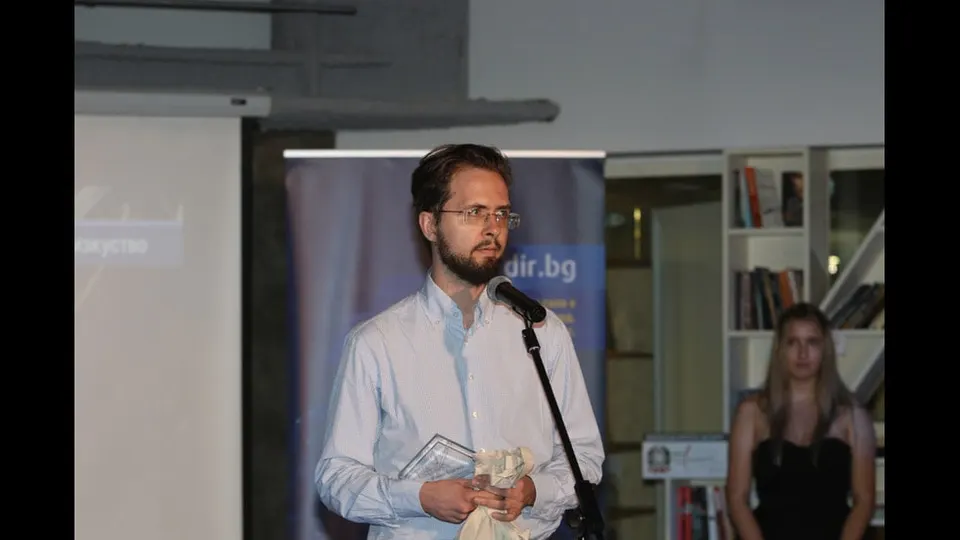
Sometimes you know someone better before you have even exchanged a word. This year Rayko won the Culture and Art category of the Web Report awards, the most meaningful journalism competition in Bulgaria, while the Technology and Innovation prize went to Digital Stories. (More about the competition here.) In neither case was it the first time. Rayko won it for his finely wrought piece “Death and the Cello”.
“In the world of quantity in which journalism currently finds itself, perhaps we need landmarks like these. Because words are subjective, but not as subjective as numbers,” he said at the ceremony.
Only someone who has spent enough years making Bulgarian media, or consuming it closely, knows how inhumanly hard it is for an author to keep reaching for depth—let alone for an artistic approach—in the meat grinder of the daily news.
Rayko knows how to say a lot with a little, in a way no one can imitate.
– What is the truth worth today?
– In the media, at least, the answer looks like a formula. Something like this: accurate facts, penetrated by an analytical mind that skillfully places them in context. For the facts, composure and vigilance. For their analysis, the ability to handle information so that you turn it into knowledge. The truth is worth exactly as much as you are able to perform that exercise well.
We can also widen it toward an interesting metaphor that I like. In his Confessions, Augustine occasionally uses the phrase “the radiance of truth.” Now there’s a fine idea—that truth has a radiance of its own.
It flickers, and it demands that we peer intently and pay attention, so that its radiance can be caught.
– I have long been looking for my own answer to this question and I never find it: does the progress we supposedly seek—the creation of more meaningful, in-depth journalism—come from the writers or from the readers?
– Since every writer is also a reader (I hope), it can’t be anything else: both at once.
But perhaps
to write well, the writer must not always be thinking of the reader.
I’m not talking about an author’s arrogance—something tiresome and often unjustified. There are readers who would write superbly. Some of them don’t, because they have a higher standard that holds them back from taking the risk of graphomania.
I mean something else: that the person writing for the media shouldn’t be a slave to popular, ready-made precepts that picture the reader as a complete fool. For instance: “this will get read,” “this won’t,” “who’s going to read this endless sheet,” “give it a bit more oomph.” There is an expectation of this kind: that the media writer has to get crafty.
To write not with a mind, but with a bad reader in mind.
This underestimation of the reader is at an advanced stage. It is backed by software, too—you know the internet is a place that revolves around semantic hunting grounds. Keywords are hunted, content is stuffed around them, its success rate is measured, and the cycle spins again. It’s not entirely uninteresting. It resembles a computer game. But it has nothing to do with writing a good piece.
– You said something similar when you received the Web Report award this year. That the dominant genres in the media today are “this got lots of reads” and “this didn’t get lots of reads.” It’s easy for me—I write for pleasure and meaning, not to feed my family. But how can we, as writers, really free ourselves from the burden of knee-jerk online interest?
– Only one thing helps, from the headline onward—style. The trouble is that in the media you have to work fast, which means sacrificing style.
– What comes after post-truth?
– Maybe post-truth has already arrived. Notice how fascists have suddenly popped up from somewhere; we’re talking about fascists. You’re just sitting at home, in 2022, being notified by apps about various things, and suddenly you learn that fascists have appeared, en masse. You turn on the TV to see what’s going on—yes, fascists everywhere, parliament is talking about fascists, apparently there were fascists in downtown Sofia and you never even noticed. Why didn’t you notice? Because you’re a fascist.
I’m not naive enough to think that the brave new world means an end to social tensions, to wars, to poverty, to violence. It may even escalate them. But… fascists?
Post-truth asserts its power most convincingly when you see it not in a politician—a seasoned dealer in post-truths—but in an ordinary person. There was a clip recently, a clash by the monument where clashes usually happen. And there, for a few seconds, you can hear the voice of someone who isn’t in the frame. This person is yelling at someone else in a hoarse, convincing voice that disarms any suspicion that it isn’t real: “Hey, fascist! Hey, fascist!” Something in that yelling, seemingly so mundane, struck me. Something from the past was manifesting itself: as if murky, rusty water had burst from a broken sewer pipe and was pouring down the street in front of your eyes. It’s not history exactly, but a carnival incarnation of it; it looks like farce and nightmare at once. Hey, fascist! You start, and look around for cover.
All in all,
after post-truth comes a world in which our thinking is riddled with gaping holes—logical, historical, every kind.
Thought drifts through its reasoning like a ship split open, utterly holed by icebergs. Water is gushing in, waves are slapping, champagne is flying, someone has hanged himself from the mast, the orchestra won’t stop playing, politicians and drowning men are giving speeches… And yet the ship doesn’t sink, no. In fact, the more water it takes on, the more dizzyingly it cuts through the waves.
– In Bulgaria, is the journalistic environment “better,” or the political one? How do they depend on each other?
– The better the journalistic environment, the worse the political one—that’s the relationship. In the sense that
good journalism has this aim too—to make the politician feel unwell. To give him a slight shiver
when he sees you approaching with a microphone, or when he opens a piece of yours.
At the moment the media environment is better than the political one. I don’t share the gloomy view of free speech, or that famous press freedom ranking.
– Neither do I; in that respect, the much bigger questions don’t stop at national borders.
Many people are skeptical, but in my view artificial intelligence is already changing our worldview from the ground up. In images, for example. We have already taught it to write the thing that supposedly counts as a journalistic genre—the brief news item. Where do you think its limit lies when it comes to the written word?
– Anyone who has worked as a journalist for a long while notices that
their work can, to some degree, be “templatized.” Because it uses repeatable patterns and structures, with known variables.
In other words, the right conditions for applying an algorithm. I’m not skeptical about that, not at all—in my view, everything in journalism that can be automated should be automated. It would save both time and the depression that mechanical labor predisposes you to.
But you’re asking about the limit of “the written word,” you’re asking about the maximum. The highest achievements of art, and the possibility of an artificial intelligence creating a work equal to them—that I don’t believe in. To write The Magic Mountain, say, or Lolita, to match Thomas Mann or Nabokov… that seems impossible to me.
If mass-market literature is derivative, repeats what has already been done, rummages through a “database” and imitates it (sometimes with seductive dexterity), something else happens in great works.
There is an unfamiliar chill of something inexpressible, hidden, hard to grasp: what Capote calls “digging up a monster.” High literature is driven by that kind of ferocity, by mania, by a certain madness that hardly lends itself to an algorithm.
“Cultivating a parasite in your brain”—that’s how Houellebecq describes writing, and he, incidentally, worked as a programmer before becoming a writer. That’s why I think that even if it swallows a boundless amount of data and plays it out in clever variations,
artificial intelligence would produce good mass-market literature, but would fall short in high literature.
They’ll move side by side in the foothills, they’ll be neck and neck a few meters from the summit, and at the very top the human will pull ahead. Well, and then drink himself into a stupor, shoot himself…
– Let’s hope we don’t drive artificial intelligence to that step as well. Houellebecq might help, but interesting—I hadn’t heard he worked as a programmer, though it suits his worldview.
Supposedly we’re looking for “storytelling” everywhere today; stories sell. And yet there are almost no full-blooded, excitingly told stories in the media, we have no time to read long texts. Why did it turn out this way?
– It probably has to do with the shrinking of what’s called the “attention span.” The long story tries to squeeze into a mind that consumes short texts and images in an epileptic frenzy. The mind rejects it, because it has adapted to something short. A Procrustean problem.
We now read with a scrolling gaze; everyone in the media knows this. On the one hand, it’s normal: adapting to heavy masses of information requires intense selectiveness. On the other, it’s downright harmful: these are hundreds of stimuli crackling into the mind almost simultaneously, overexciting it, keeping it constantly on edge and in the popular state of FOMO—fear of missing out.
This, incidentally, has something in common with gambling, too. It is well known that a devious idea went into the design of the newsfeed:
that scrolling through social media should mirror the way the mind falls into a feverish frenzy as it follows the fast-spinning symbols on a slot machine screen
and waits for them to land on a winning “status.”
For your political views to line up with other people’s, the way cherries, lemons and gold bars line up on a trembling payline.
I share that cynicism. There are people who would react with indignation to the hypothesis that their fervent political engagement on social media is a disguised thirst for dopamine, like a gambler’s. But we, too, have a right to indignation toward someone who spews out a political status every hour on the hour. Like a cuckoo clock on the wall—enough to drive you mad.
So what long stories…? If in a casino you had to wait a long time between each spin of the reels, nobody would ever get hooked. They’d get bored.
– Are there news stories that age gracefully?
– Maybe a world record that still hasn’t been beaten. The jump of Stefka Kostadinova, the Bulgarian high jumper whose 1987 world record still stands, let’s say.
– For me, a journalist who wants not just to inform but to move people has to be, above all, a hunter of stories, and to respect facts and words. Is that right? Am I missing something?
– It’s hard to say. There are journalists who are good at handling facts, at accurate reporting. That’s complicated and very necessary. There are journalists who do wonderful interviews—I, for instance, am not good at asking questions. There are journalists who are talented specialists in a particular field and translate its complexity into accessible, engaging language—you do that. And there are some staggering turkeys.
In my opinion,
many people confuse journalism with the expectation that you “express a clear and categorical position.”
Not that it isn’t important, but it often turns into a clunky ritual of hammering things into people’s heads. In fact, everyone has a “clear and categorical position”—go into any forum and you’ll see nothing but clear and categorical positions. Perhaps a person should stay in tension, hesitate, wonder. There were some words to that effect—that the mark of intelligence is the ability to hold two opposing ideas in your mind at the same time and still go on functioning.
– If a young person just entering journalism asked me for advice, I would first tell them to make sure they are completely, absolutely certain they see meaning in it. What would your advice be?
– In my view, to keep their distance, at least at first, from journalism as technique and speed. To devote themselves to the pleasures of the humanities—literature, history, philosophy. To notice that
sometimes at “the center of events” there are neither events nor a center.
To acquire an aesthetic sense—it leads to a civic one. To develop a sense of humor—there are a lot of funny things in this profession. And to try not to become a geopolitical analyst at the age of 23. If they catch themselves starting a sentence with “In China, processes are under way that…,” they should burst out laughing instead of finishing it.
– And is there really meaning in it?
– There’s a pressure on all of us that we absolutely must find ferocious meaning in everything we do. To be bursting with meaning, to be the big guys of meaning, like in bodybuilding.
Let’s say there is satisfaction. At moments.
– Clearly the media have a certain road to travel in order to be adequate to today’s challenges, to the way we search for and take in information today. How do you see that future?
– The media are in a difficult situation. On the one hand, they have a common boss—that boss is Silicon Valley and its algorithms. From below, they’re being undermined by fake news and the task of figuring out what’s true and what isn’t. Then you get assigned personal trolls—everyone has had one, a caps-lock villain. If you manage to cope with all these difficulties, at the end you hear: enough with this writing, everyone is on TikTok. As one comedian put it, I still don’t know what MySpace is.
But if we have to look for a solution for the media, I’d advise something else—retreat.
I mean it quite seriously: we consume far too much media content.
Simply a toxic amount. There’s a fine line by Thomas Jefferson—he says that if he had to choose between a man who reads only newspapers and a man who reads nothing, he would choose the second. That isn’t just a witticism aimed at newspapers. It’s about something else—that the media are a necessity, but if a person makes them the main thing they consume, they will suffer for it. Reading too much media dries out the mind. And the heart. So here is a recipe for media literacy—don’t overdo it. A person, if they see fit, can live without knowing who the minister is, what happened today, what will happen tomorrow, like in a book by Kazantzakis. That won’t make them a bad citizen. Maybe they’ll tell us about something we’re missing. That is my clear and categorical position.