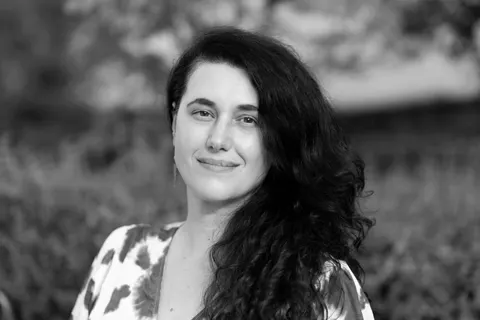
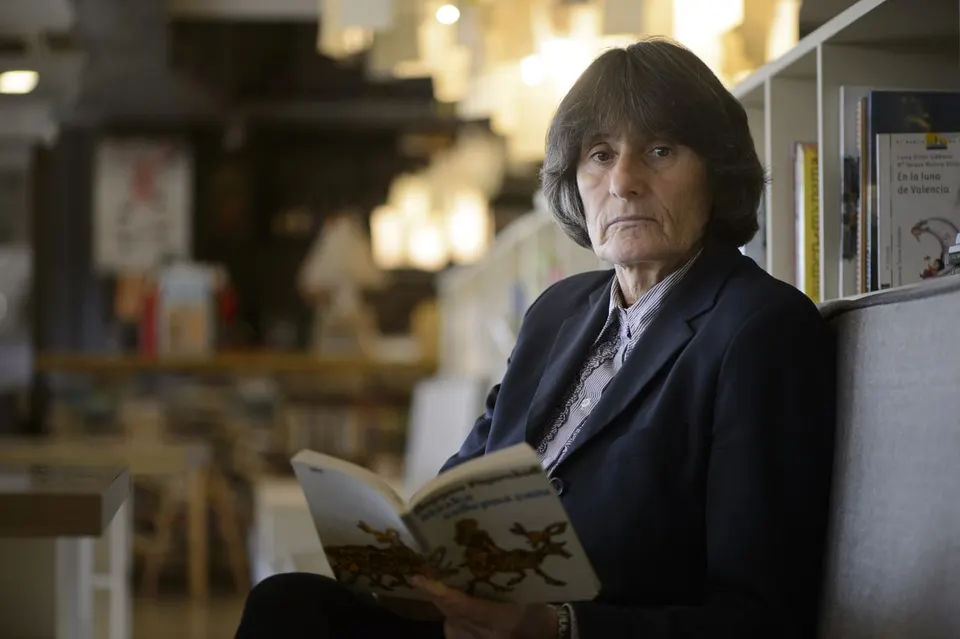
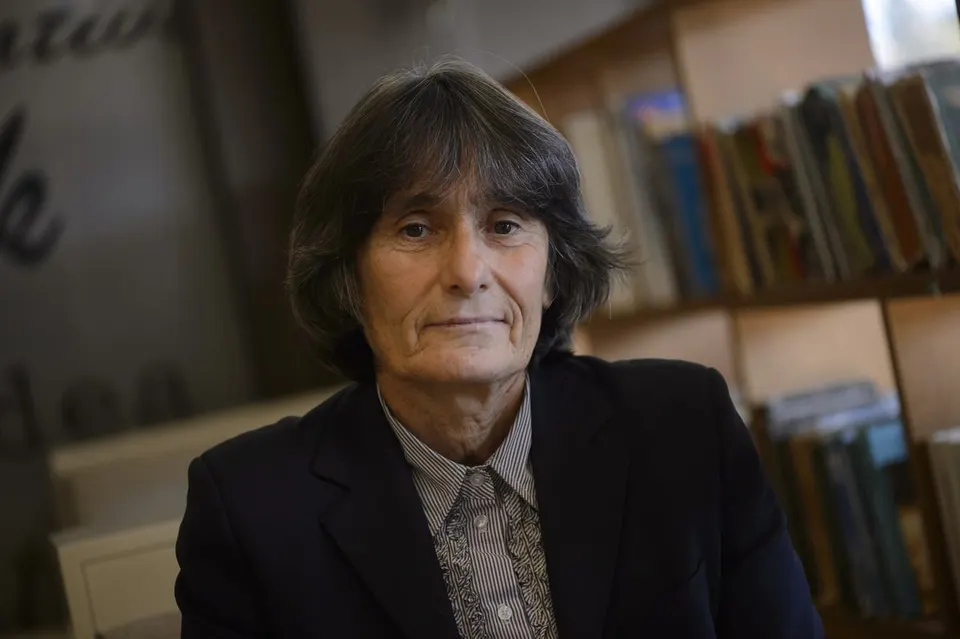
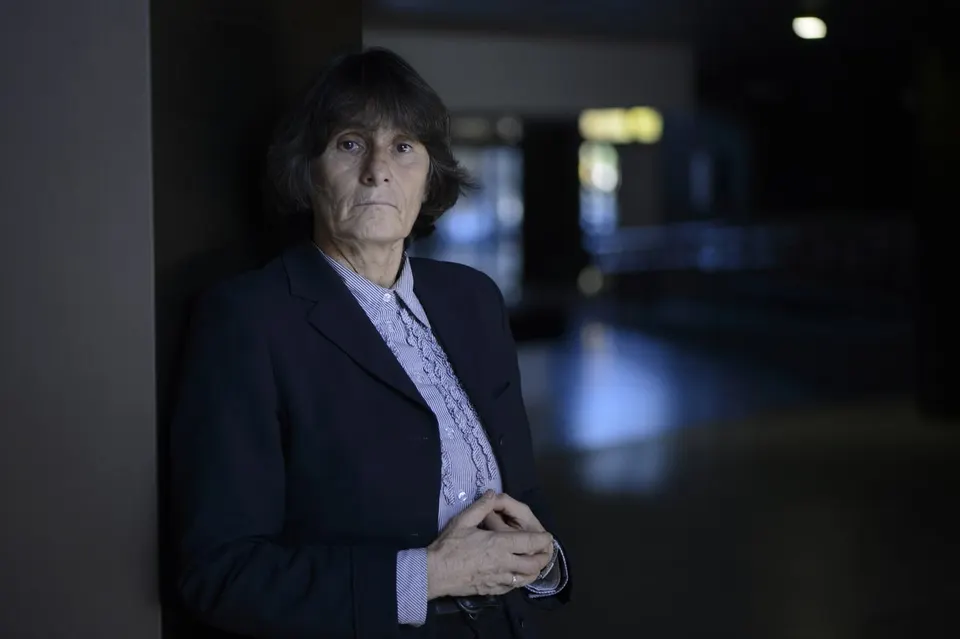
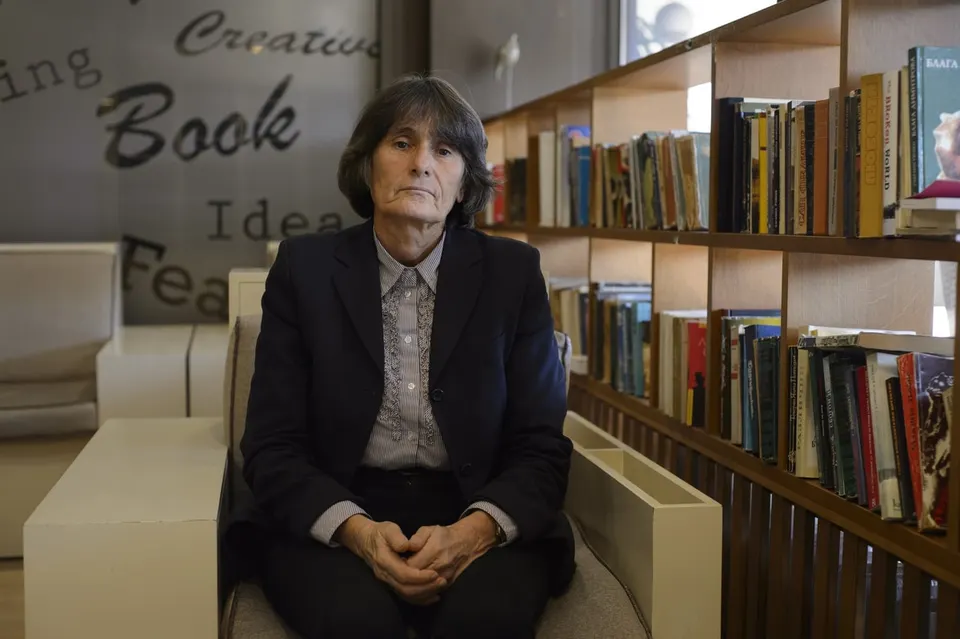
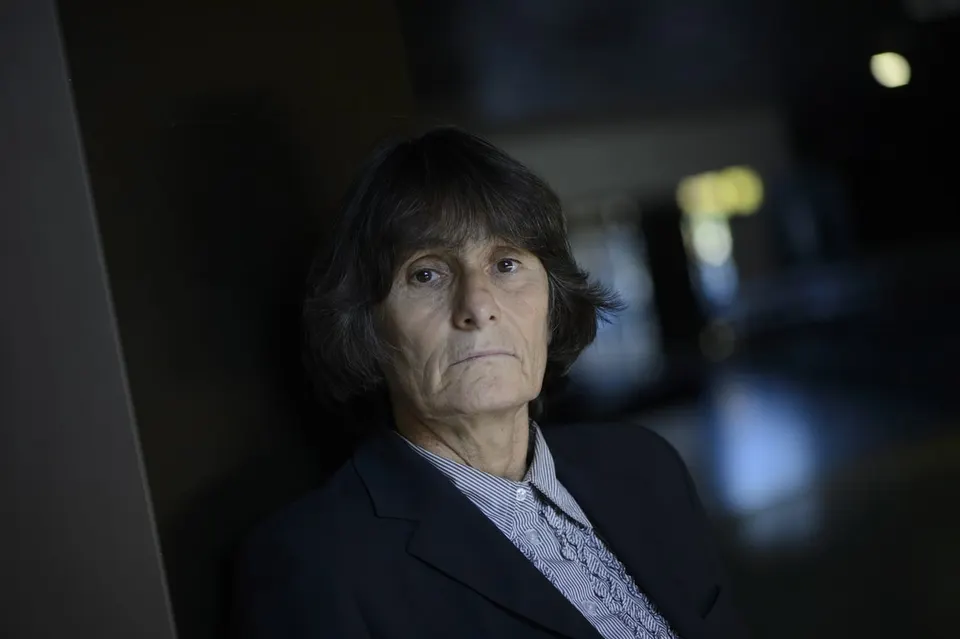
Zdravka Evtimova is among the strongest voices in Bulgarian literature of recent decades. Translated into countless languages, honored with the most prestigious awards in Bulgaria and unquestioned acclaim beyond its borders, her work is taught in schools in the United States and Denmark.
We talk online late on a Saturday evening, after she has come home on the train from Sofia to Pernik, an old mining town just west of the capital. We talk about technology and people, and she impresses me once again with her subtle wisdom… then it turns out that, for the first time since I started doing interviews, the recording is simply gone. Technology is sometimes indistinguishable from magic—alas, not always in the good sense.
I gather the courage to call her, and she remembers how an entire novel of hers once vanished and she had to write it all over again. And so we talk again, on an even later Sunday evening, after the “almost-the-last” train has been delayed and she is home once more.
Where will the locomotive of words take us?
– After the recording of our first conversation disappeared…, I started wondering: aren’t we delegating too much to computers, to technology? Here we are, counting on them to keep our books, our conversations, our memories, to decide what we read… Aren’t we overdoing it?
– I am a great and passionate supporter of technology. The fact that we delegate rights to it speaks only of how our minds have grown. And of our growing ability to move, if not on the crest of the wave of the latest in the world’s technical progress, then at least to have heard of it and to strive to learn it.
The deeper they reach into every sphere of our lives, the more we will master them, and at an ever earlier age.
By mastering something, we learn the rules that some cleverer people before us have drawn up. But once we know them, we are free to break them, because
the new is created by breaking a rule. Through the breach in the rule erupts a volcano of something entirely new and unexpected.
And the human mind, the human spirit, is built in such a way that it is drawn to the new, the frightening and the unknown. That is why, the deeper they reach, the better it is for humanity, as I see it.
Perhaps I am too optimistic, but everything created so far helps me a great deal. It saves me enormous effort and leaves me time
to think about how the human mind can outwit technology.
That is great fun, one of the pleasant subjects for reflection and for jokes.
– But isn’t it all a bit too much—the new and the unknown that we have to react to, get used to and learn to outwit?
– For me it isn’t too much. Again, it depends on each individual. Some people move at a slower pace, which means they go into greater detail, greater depth on a subject, and that helps them pinpoint exactly the field that interests them. It can help them achieve something close to perfection in a particular area.
On the other hand, when we move faster and innovations flood us from every side, I feel as if I am in a forest full of unfamiliar species of plants, since I love trees beyond measure. So I liken every new thing in the technical world to a living organism, to a tree that draws me irresistibly.
At this stage I am still in a state of delight at what has been created.
Neither its variety nor its sheer quantity frightens me; on the contrary, I am like a child in a pastry shop or a chocolate store. It wants dark chocolate, white chocolate, it looks at them and wonders what to do with them, but it is very happy.
– I have yet to meet a child who wants dark chocolate. Forgive the joke, I understand the metaphor. But let’s give our imagination free rein. If you read a story that seemed to you to have been written by you, but had actually been written by an algorithm, would that frighten you more, or please you?
– It would certainly not frighten me.
I would immediately write three stories better than the artificial intelligence’s. I am convinced I would beat it!
I am convinced, I say it categorically. It can build a much better plot, it won’t mix up the names the way I do because I am thinking about different people. He was Mihail, then he’s Plamen, but in my mind he is one character living in this story.
In the artificial intelligence’s story, numbers and algorithms will live.
One of my sons is a programmer like you. I have seen one of his textbooks—four pages of figures, therefore other figures. That is the pleasure of artificial intelligence. The figures, and then, like something lovely, comes the word “therefore,” as a reward. Whereas for me, the words are the lovely thing, and a number is just the page number at the bottom.
I welcome it—let it write a story, I challenge it. I would be very, very curious to meet its cool numbers, and to make it wither in the metaphors I will write.
Because artificial intelligence is logical, cool. It can only copy the outward expression of feelings, not experience them, and that is its misfortune. If it began to do so,
if wise programmers taught it to feel, it would no longer be artificial intelligence, but another type of human being.
Then there would be two parallel civilizations on Earth, and the competition between them would be very interesting.
– Can we really reach such a moment? Technology is advancing extremely fast. Every morning it wakes up twice as good as yesterday. Unlike us—we stay the same.
– The fact that we stay the same is our strength, because in their constancy human beings create something unpredictable.
Human constancy is a synonym for human unpredictability.
You think a person is the same, unchanged, but deep inside, not every day as with technology, but every minute, changes take place that also change the way they think. Perhaps imperceptibly, but they change. And this happens through their connection with other human beings and, above all, through the enormous difficulties a person faces. Difficulties are, in fact, the tools that bring strength into human constancy.
Whereas artificial intelligence is changed by people. The human being is the factor that brings change. The subtle difference between artificial intelligence and a human being is that other people, with their feelings, hatred, love, gratitude or lack of gratitude, change us every second of our lives. That is why today we are well disposed toward someone, and the next day we feel an inexplicable dislike for them. Someone you found very likable, whom you wanted to see—after seeing them three days in a row, you no longer want to run into them. How do you explain that? Artificial intelligence cannot do that. It will go on working with its system for a century and never feel dislike for anyone.
And the reverse—a person we once found deeply unpleasant and even feared suddenly says something, does something that draws us to them. And that is exactly where, if we are smart, we will try to find the answer: why? In what way has this person changed, what changed them?
Artificial intelligence doesn’t ask itself. A human tells it why.
– Which is more dangerous: to underestimate it or to overestimate it? Because those are the two extremes where I see most people today—some say we have a revolutionary technology that will soon change everything, others that it is just marketing noise.
– I have often thought about fear in the light of the question you are asking. People are very lucky to feel fear, because fear is the warning signal about a given phenomenon.
Fear shows itself in two ways. On the one hand, to save themselves from it, people start saying how wonderful this new thing is, how captivating, how it draws us in. And we end up overestimating both the technology and the phenomenon. On the other hand, again to escape fear, they say: “Well, what’s so frightening about it, it can’t do anything, it’s helpless. Someone said something, someone else repeated it, and it became an avalanche that scares us.”
No, let’s hold on to our fear. Let it be our companion, but a well-meaning companion.
How do we do that? When we feel fear, we should start investigating, very carefully, without rushing into praise and without setting off down the road of underestimating, of belittling the phenomenon. The easiest thing—and it is typical of all of us when we are not particularly hardworking or are too tired… let’s be honest, when we are lazy—is to just ride the sled downhill. “Bravo, bravo! Very nice!” Or else “This is worthless!”
This approach is harmful—both overestimation and underestimation. But the fact that they exist means there is reflection, that people are thinking about the issue. That people feel fear. Only let them turn that fear into an instrument for measuring, for research, for excavating in depth.
When we use this fear as a chisel, we will discover the truth, we will find out what is right: whether this technology really is so good that it deserves admiration, or whether it is worthless. Let’s investigate without throwing ourselves in one direction. Let’s use fear like a laser to see what the truth is.
– Only, experience so far shows that our encounter with technology tends to lead us down the easy path, toward delegating everything to it, accepting every convenience with pleasure, with joy… and that is how rifts open up between us.
– Rifts open up between us. Somehow I don’t agree with that observation. On the contrary, when you get to know a technology, you somehow draw closer, first, to the person who created it and, second, to the person who uses it. Such a person can become your friend. I, for example, have not mastered technology to a high degree, and someone more advanced will come and advise me, which will awaken in me, if not admiration, then deep respect.
The best working partnerships are built precisely on such respect—a person admitting they don’t know something, seeing the strength in the other. That is exactly what technology does—it makes one person more knowing, another less knowing. Here it depends on what kind of people they are. The person who is not sufficiently trained may be set in their ways and decide to stay with their ignorance. Then the ease that technology offers will turn them into someone walking the road of foolishness. On the other hand, if the one who doesn’t know sees technology as a path leading to the chance to develop their own qualities and skills, then I see absolutely no reason to fear that technology will make us passive and inert, amorphous heaps of sand.
– I, on the other hand, think we see it all around us. Online communication very easily turns us into knee-jerk fans, embittered creatures set against one another. It makes you love your own world and shut yourself inside it instead of seeking conversation.
– Shutting oneself away is sometimes very useful; that is when a person can see the real problems they suffer from. The wounds that have appeared on their flesh—their physical flesh and their spiritual being. This withdrawal is absolutely necessary. Because when a person is constantly in some community, they dissolve in it like a handful of salt in a glass of water. Or in a pot full of soup. Then they give flavor both to the community and to the soup. They are the product the community will create through common effort.
In order not to dissolve, to preserve their essence, a person needs the chance to be alone with themselves, with their fears, their happiness and their joys.
On the other hand, if they do it too often, they may come to feel that they are something more than others. Yes, every person is unique, but the thought that one stands high above the rest, that they are the fools and he is the chosen one—yes, that could be one of the consequences of technology.
Real life is the best mentor, the best judge. The moment always comes when a person steps out of the bubble in which technology has allowed them to stay—first of all, by going to the ATM. Before the ATMs we are all equal. And when they see there is no money in their account, the bubble that enveloped them bursts at once.
When something hurts, again, this bubble not only bursts, it turns out it never existed at all. When they trust a particular person and that person betrays them. And the reverse—when they feel enormous distrust, open dislike, toward someone who turns out to be honorable.
Technology is not to blame for our wrong conclusions. If anything, it helps us set our clocks right—both the spiritual ones and the purely physical ones.
Today, for instance, it helps us see how many steps we have taken, what our pulse is at any moment. In this way technology drives the laziness out of us and becomes a factor in preserving our health—I find that extraordinarily powerful.
– True, it gives us many possibilities. For example, it lets me talk with you for a second evening. What are the next technological discoveries you look forward to that would make you happy?
– I am writing a story right now in which a liquid is created—I think it will be a lake—from which you can draw with a tap or a bucket, and a person can dissolve in it. I look forward to such a technology; it would help a great deal if someone wanted to understand the secrets of something—the liquid penetrates more easily and becomes part of a given living system. That way a person could witness what is happening inside a tree, inside another person. It would be very interesting and fun for me if that happened. But it would also be dangerous—imagine the container you are dissolved in got mixed with the one in which another person is dissolved. How would they mix? Would there be a Punic war between the two? Or would they form an alloy?
I very much hope for progress in medicine, but the greater the progress, the more our expectations grow.
New challenges will always keep appearing. If there are no challenges, what will we become? People who know only where the supermarket is, where the restaurant is, how many calories they eat a day—that will be our main concern.
Instead of searching for new suns, new galaxies. And within each individual, too, there are so many undiscovered secrets of the human organism! My older son, who is a psychiatrist, says that only 0.02 percent of our brain and its abilities has been even partially studied.
A human being can be a perfect machine, but doesn’t yet know how to operate it.
That is one of the directions that interests me greatly—for the human being to become exactly the kind of machine civilization has made it. I believe that today humanity is at the level of a 20-day-old baby. It can distinguish the shapes in front of it and expects the Universe, the galaxy, to embrace it so that it may feel some sense of security. But it cannot manage what this Universe has given it.
– From another point of view, humanity looks like an aging man who has given up on his dreams… But have words lost their power because there are so many of them, all around us, in every moment of our lives? Do we scroll down, flick through words instead of reading them carefully and respecting them?
– You can’t make a sweeping generalization; it all depends on the individual.
In the hands of a very talented person, even the biggest clichés acquire the power and sharpness of the sword of Damocles, forever hanging over us.
And the reverse—when a person has no sense of the beauty of the word and its might, of the impossibility of living without that word, then words turn into a filthy sludge that creeps forward and sets out to swallow us.
For a talented person, words are the most precious building material. For example, I translate from Bulgarian into English. How do I translate the sentence “Той се прокуди от Перник” (Toy se prokudi ot Pernik, roughly “he drove himself out of Pernik,” with the sense of self-imposed exile)? Clearly, he left, but can the English “He went away” catch all of it—can we translate all the sadness of this man and his inability to return? Perhaps he abandoned his girlfriend or his mother.
Words can be priceless material, and they can never be traitors. They don’t lie. It is enough to listen to a person for three or four minutes, to see what words they use and how they connect them, to form a first impression of them. Just as in a blood test the level of hemoglobin tells you a person’s condition, words are the true hemoglobin of communication; nothing can hide behind them. If someone uses them as a mask, they will do so for a while, but the mask is heavy, and sooner or later they will want to feel the wind on their face.
– How do we learn to be better in our words, more humane? And how do we pass that on to technology?
– Hemingway says: “If you can, don’t use adjectives. If you can, don’t use adverbs. The simpler the sentence, the more powerful it is.” We know he was a good boxer and often drew a parallel between sentences and punches. A very beautiful comparison. This writer relies on the energy of words, on sentences being a river.
The writer falls into it, and if he learns to swim, the reader will never forget him.
Nor can I forget the words of the American poet whose name sometimes appears as Elizabeth Glock, better known as Louise Glück. She has published nine collections of poetry, and in the first eight there is not a single adjective and very few adverbs. Her poems are built on widely known biblical stories, and also on the frightening fairy tales of the Brothers Grimm, which we know in a considerably softened form. When you read her poems, and they are quite short, what the biblical story created, and what has kept working for centuries, slips unnoticed into your blood, your feelings, your senses. But this time the tale, this fear, this dread and, in the end, the striving toward good enter a person together with the story she has written.
That is what technology can do—lean on the wisdom of the centuries humanity has passed through, conduct experiments, remove a certain sector and see whether humanity can go on developing without it. On the other hand, it can put in something new. And what would matter for people is that this new thing leads toward well-being. Toward humaneness.
– Any such process, though, can also be turned into technology—we can train artificial intelligence to write without adjectives. But then it would become an end in itself.
– That is exactly what is interesting—to see what comes out of it. That is why this subject interests us so deeply—yes, writing without adjectives is only an outward sign. What this artificial intelligence will be like depends on the person who creates it, who guides and controls it.
Will it turn toward wisdom or toward murderous force? That is also humanity’s capacity to wipe itself out. Here again, it is people who decide—whether to live or to put an end to themselves.
Why blame poor artificial intelligence when it is not the one at fault,
but its sick creator? And why did we allow such a sickness in its creator at all? We must look at ourselves too—why did we let such a person be unhappy?
– The thing is, it could also happen completely unconsciously, simply by underestimating the technology. But how can we reduce the risk?
– I very much like the maxim that a battle avoided is a victory. How do we achieve that? Humanity has invented nothing better than respect. It worked at the dawn of the human race, and it still works just as powerfully today. A human being is an alloy of malice and spite and of the striving toward good and goodness, just as water is made of hydrogen and oxygen. If we split the water molecule in two, we no longer have water.
In the same way, if we separate the malice from the goodness in a person, there will be no person—there may be an artificial intelligence, a program. That is why humanity, in its long experience, invented respect. When you treat another person well, even the most primitive, the most uneducated person, when you show them respect, they will sense that the one speaking with them is trying to find the value in them, the strength that makes them into something meaningful.
That, for me, is the way out, the way to be good—by trying to focus our attention on the meaningful part of a person. It alone is capable of transforming malice into something good.
The best probiotic for a human being is to do something good for another, even for a stranger.
It is up to us to learn, first of all, respect. No matter what kind of person stands before us. Respect is the path that will tame both the wicked and the good and allow them to walk together.