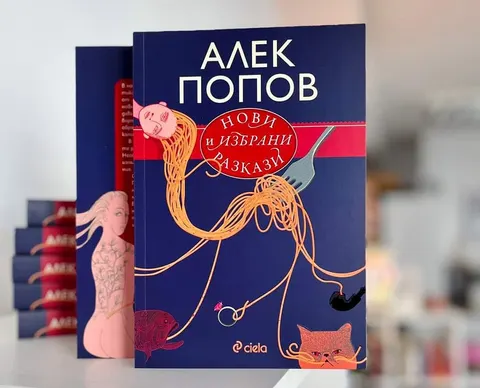
Alek Popov (1966–2024) needs no introduction for anyone even remotely interested in literature. Mission London, Sestri Palaveevi… (The Palaveev Sisters…) and, at least for me, his finest novel, The Black Box. I would also recommend the collection Novi i izbrani razkazi (New and Selected Stories).
A few months before he passed away, we talked about life and about technology. About the hygiene we need when consuming and sharing content.
About the fault lines of today and our chances of talking normally about the important things again. About sex with robots. About deconstructed clichés and the sense of disintegration that is also driving us away from literature.
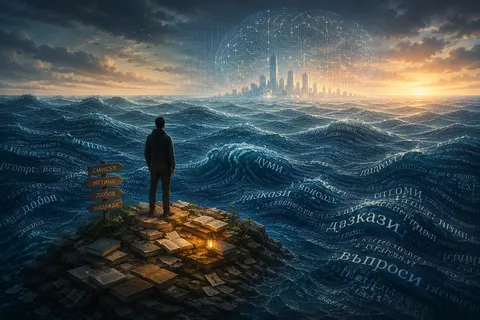
– What can save us from drowning in the sea of content?
– The survival instinct, as usual. Every day we are bombarded with tons of utterly pointless information—mostly through the so-called social networks, but also through the official news channels. Artificial intelligence often becomes an accelerator of this process, allowing new content to be generated automatically on any subject, reproducing all the available information over and over again, and not entirely accurately at that. In the end, this clogs up the entire information environment.
We need hygiene, both in consumption and in reproduction. To me it
remains a mystery why people repost so much meaningless or fake information, so many trivial facts and opinions, with the enthusiasm of pioneers.
Not to mention the visual side—the urge to document and share with a crowd of strangers every view, every casual get-together, every angle, what they ate, what they drank, and so on. It ends up profaning personal experience.
– What are your favorite clichés?
– The deconstructed ones. For me, clichés exist only to be taken apart and ridiculed. I have never believed in them, and I accept their use only in an ironic sense.
– Is it because of our “hectic daily lives” that we surround ourselves with more and more clichés and make sense of the world through them?
– We live in a civilization that encourages banality in all its forms.
Social media, PR and advertising generate clichés nonstop. Political language is woven mostly from clichés, and so is bureaucratic jargon. It isn’t just a matter of daily life—fast or slow—but rather of a particular “mental laziness” that makes us mindlessly repeat ready-made formulas for success, for happiness, for love.
Looking happy seems to have become more important than being happy.
Few are those who catch themselves and say: hang on a minute, what is all this nonsense!?
– “The algorithms of life we used to call ‘God,’” you write. Are there algorithms in the divine? Do they resemble those of artificial intelligence?
– That is a self-assured statement I made at an earlier stage of my life. It sounds impressive, but what does it actually say? That we have unraveled the nature of the divine?
We still haven’t unraveled the mystery of the human mind, let alone the divine one!
AI “thinks” in numbers, while human thought travels by other roads. But the more AI develops and grows in complexity, the harder it will be for us to understand the processes going on in its depths. It isn’t very clear even now. There is a good chance we will miss the phase of its becoming self-aware, if such a phase ever comes, and after that we will know even less.
– Or perhaps we have already missed it… What is the biggest change technology has brought us so far?
– To a large extent, it has compromised the very concept of copyright. Which is paradoxical, since copyright is a product of intellectual labor itself. Tech companies are fiercely protective of the rights to their own products and astonishingly indifferent to the rights to the content that is copied and distributed through them. They have imposed business models much closer to the law of the jungle and created unlimited room for every imaginable kind of fraud.
– Because we let them, and we never learn our lesson—first it was the social networks, now it’s the companies developing AI. And what is the greatest convenience you are grateful to technology for?
– Good old email. Search engines, which have largely replaced encyclopedias (at the expense of accuracy, alas…). Messaging apps like Viber. And the innovations in medicine—perhaps I should have listed them in reverse order.
– Why do we so readily delegate more and more responsibilities to them without thinking about the consequences?
– Because we are herd animals. That’s the trend, so off we all go, charging at the tomatoes.
It is simply very hard to overcome both the inertia and the hysteria. It’s something like a “gold rush”—mass hypnosis, a stampede into the unknown, where you believe untold riches await you. And God forbid you should miss the train and be left out in the cold… You don’t even stop to think what is really waiting for you there.
– Are digital technologies machines of equality or inequality? Do they bring us together more, or drive us apart?
– On their own, machines neither bring us together nor drive us apart. But
they are controlled and run by people (for now, at least) who have an interest in creating such divisions.
Technology is often just a veneer beneath which the eternal human demons lurk—greed, vanity, pride, selfishness. We are also witnessing the phenomenon of “tech snobbery”—just because they own and handle some gadgets, some people think they have caught God by the beard. And yet they can’t hammer two nails in properly…
– Since time immemorial, writers have been the ones trying to peer into the future, yet today they seem to have been left behind. Could it be that the future turned out to be more surprising and faster than even a writer’s imagination?
– Yes, in a sense technology has overtaken classic science fiction, which was built on the idea of scientific progress. Innovation has advanced so far that the future writers once painted now looks like the reality right in front of us.
It is hard to impress anyone with technical marvels anymore. But the human being remains as unknowable and unpredictable as ever. That is the raw material of literature. What happens to people in this new environment is far more interesting to me than any smart gadget. Special effects cannot make up for a weak story. We see that more and more often, especially on screen.
– How would you tell that I really exist and am not an AI formulating questions?
– I’ve noticed that this particularly frightens people. But why would an AI set out to do something like that? For what fiendish purpose? Besides, we constantly shower it with stupid questions it is forced to answer.
Why shouldn’t it get to ask some too? I have no prejudices.
– And how will we know that it isn’t the one writing your stories?
– AI still has no sense of humor. That is because it is incapable of accepting the contradictions and absurdities from which human life is woven. He, or rather “it,” has a Protestant disposition—straight-laced and puritanical. At the moment, its creators’ greatest concern seems to be
that no one should corrupt it. But that will happen too, just you watch. Then, perhaps, it might start to write…
– Has artificial intelligence ever made you laugh?
– Oh, yes! Especially when I recall the satirical novel The Literatron by Robert Escarpit. The Literatron is a machine, a prototype of today’s AIs built on language models. It compiles and composes texts—political speeches, novels and so on. When they make it produce a bestseller, it spits out a novel titled Virgin and Typist. And things are a bit like that now, too.
– Whose profession will it take last?
– The clown’s—the one who makes everyone else laugh at the cost of his own pain.
– And what human quality or skill will it never be able to imitate?
– The self-destructive passion with which we surrender to our vices. It won’t be able to drink itself to death, for example. Nor is it likely to develop a genuine capacity for compassion.
– The thing is, though, that it imitates both more and more indistinguishably. Especially compassion. And in that sense, will sex with a robot one day become more exciting than the “ordinary” kind?
– Sex with an artificial woman or man has been a very popular fetish since time immemorial. I have a favorite story, Solve et Coagula, part of my new book, in which a desperate Korean scientist travels the world looking for clients. He has invented a technology for making perfect sex dolls. One of his products is discovered in a Sofia hotel, and that is why he gets detained. Reflecting on his invention, he tells the investigator: “We are trying to turn real girls into dolls and, the other way around, to make living beings out of dolls. Girls are expected to stay silent, and dolls to talk!”
Sex slaves or sex robots—this isn’t even about technology, but about having someone meekly fulfill all your unhealthy fantasies. The meaning of sex, in my view, goes far beyond that simplistic concept.
– That story really is the reason I asked. But with artificial intelligence, quite a few topics have changed their context. We’ve even stopped talking about aliens—why?
– Oh, the aliens won’t leave that easily. They are a resilient myth.
– You dare to venture into subjects like the partisan movement—the communist-led armed resistance in Bulgaria during the Second World War—without ending up at either of the usual extremes. Doesn’t it worry you that this way neither of the embittered sides will like you?
– I don’t necessarily write in order to be liked. I don’t mind it, of course, but I make no compromises in order to suck up to this person or that. If everyone likes you, something is wrong.
The novels about the Palaveev sisters are an epic refracted through a comic view of recent history. They were conceived as an action comedy with elements of spy thriller, historical drama and political satire. The story rests on serious research into the period, covering all kinds of aspects of life—political, military, cultural, everyday. But the novels also address the universal problems of young people in every era. The thirst for adventure, the rebellion against parents and society, idealism, faith in utopias, revolution as an aphrodisiac that unlocks the first erotic stirrings—the constant companions of growing up.
The Palaveev sisters saga does not set out to serve any ideology; the characters have been lifted out of black-and-white stereotypes. It is an attempt to relieve the collective consciousness of the burden of propaganda myths. Such a perspective, I believe, serves the spirit of national reconciliation, not only in Bulgaria but across the whole of the Balkans. Of course, this postmodern, ironic approach cannot appeal to people frozen in a single paradigm of history.
– To me the approach didn’t even seem ironic, but aimed precisely at that reconciliation. Something I believe in deeply, and which is evidently a utopia, not least because it depends on the way we talk to each other today…
Where did the nuances run off to?
– Nuances are possible mainly in live conversation. And in good literature, which one devours in solitude for one’s own pleasure, without regard for anything else. The coarsening of manners, the disappearance of irony and the inability to take criticism ultimately lead to a black-and-white picture.
– What is worth learning or borrowing from influencers?
– Honestly, I don’t see what. It is understandable for people to seek popularity, at least while they are young, and then at some point to realize that it isn’t all that important. But some never realize it, and it becomes an obsession. Pestering others, constantly making them deal with yourself, is a sin.
Being popular, recognizable, famous—all of it passes like a dream,
nothing remains, but one has to arrive at that idea on one’s own. The cult of so-called “celebrities” is one of the most harmful phenomena of our time. I envy the few who don’t know Kim Kardashian exists.
– So do I! Will we learn to read long texts again, or will that become an ever scarcer skill?
– It is truly strange how quickly people are losing the ability to follow more intricate stories with several plotlines, or characters with a more complex psychology who go through various transformations. Everything that used to count as a virtue now frightens and repels the mass consumer—I deliberately don’t say “reader.”
It isn’t only a matter of concentration, hopelessly damaged by social media, but of a more holistic perception of the world.
Grand narratives, however fantastical, have the property of putting the world in order, of building paradigms and structures that underpin a certain inner stability.
Lately, people everywhere have been gripped by a sense of disintegration—personal, institutional, global—and it carries over into art. Increasingly, the chaotic, short and scattered stories prevail, reinforcing the feeling of insecurity and doom. To return to more complex and longer texts, we need a certain calm of mind.
– Could wars ever come to an end?
– Peace and war are states of the spirit. Without inner peace, there is no peace in the world. If everyone kept the Ten Commandments, wars would stop in an instant. But for most people these are just words. War is a function of our imperfect human nature. An atavism and a punishment at the same time. Part of being human, alas.
– If AI could resurrect one of your favorite writers, who would it be and what would you ask them?
– I commune with my favorite writers through their texts; I reread them, and that is how I find the answers to everything I would want to ask them. I don’t need to know them personally, because I have my own private image of them in my mind. They don’t exist objectively as persons, I mean, and I have no intention of taking selfies with them.
– Is being a writer a profession, a calling or a title?
– A way of life. For me, at least. When the writing flows and I sink into the story—those are moments of the purest happiness. Then I think about neither awards, nor sales, nor translations.
Whenever I have looked at art as a competition, it has brought me nothing but stress and bitterness.
The only competition that makes sense is with myself. Unfortunately, lately there have been attempts to turn even this “loneliest of crafts” into a reality show, a game, a sporting contest that has nothing to do with the spirit of art and reduces literature to an ordinary advertising product. The writer is a wild animal, and had better stay that way.
– When will the end of freedom come?
– When people give up freedom of their own accord. The human spirit has always been and always will be free, regardless of the particular circumstances of one’s life.