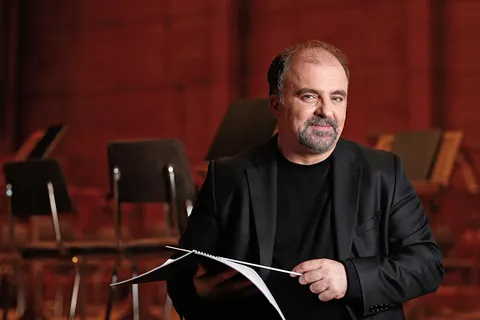
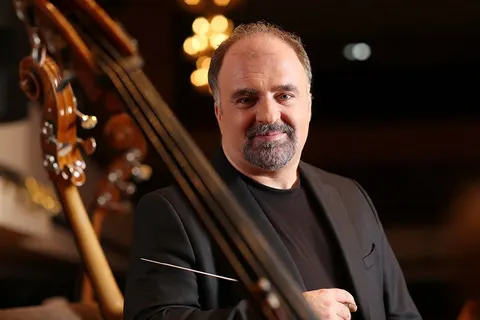
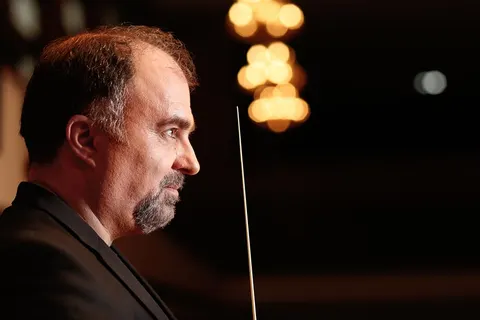
Nayden Todorov is a world-class musician, but also an erudite man with a broad outlook and a distinctive view of technology and the way it changes us.
Since 2017 he has headed the Sofia Philharmonic, and he has worked with the biggest names in classical music. He has performed on the stages of the greatest cultural centers in Europe, Asia, Africa and America. Besides conducting, he plays the trumpet and the piano and writes his own music.
He received his musical education in Vienna. He is known for working across many genres, and one of his specialties is film music.
He has also tried his hand at quite different roles. He hosts a classical music program on Bulgarian National Television (BNT), and last year saw the publication of his debut book, the short story collection Polah ot angeli (A Breath of Angels), in which he gathers stories about angels and robots, about technology and magic.
Why does he believe our constant rush is a disease we must fight? How is the digital world pulling us away from our humanity, and why is art the only salvation?
How did the maestro go 12 years without setting foot in an opera house, horrified by his first encounter with one? And why does he often run an experiment, going to an online forum to defend two opposite points of view in an attempt to escape the filter bubble?
– Maestro Todorov, we were introduced by… Facebook. You had commented on the digital story about how technology is changing the relationship between men and women. You wrote that “the future is already here while we are laughing. And as it arrives, humanity is leaving.” Is it really leaving?
– This is the biggest problem of our time, and the most frightening thing is that it is being killed by precisely what was supposed to help us most. I was firmly convinced that digitalization would make our lives so much easier that we would be able to pay more attention to human relationships. It turned out to be the exact opposite.
The worst example is social networks—their very name says their purpose is to keep us in social contact with other people. That was the case once; today they lock us into bubbles. Everyone surrounds themselves, sometimes deliberately, sometimes without a thought, with people who think alike. At some point they see that an awful lot of people reason the way they do, when in fact that is simply the circle they have built around themselves.
Because of the bubble, we convince ourselves far more of how right we are. As a result, when we run into a different opinion—whether online or in person—we become aggressive.
– The filter bubble is one of the big themes of Digital Stories. How can we get out of it?
– My solution is that whenever I clash with colleagues online, I always ask that we discuss the issue in a face-to-face meeting. Because eye to eye, a person is careful not only about what they say, but also not to offend the other. In the end, the aim of communication is not to hurt, but to get our way by persuading the other person. Or to be persuaded ourselves.
To meet opinions in a civilized way. Not attacks and hatred!
What Europe swore by until recently—tolerance—is being killed by the digital environment.
– Given that the business of the biggest corporations rests on exactly this… what is the way out?
– A way has to be found for people to start communicating with one another again. The piece we started with talked about how in Japan there are people who have taken robots as wives, live with them, take care of them.
It's important to think about why that is. Because these robots' programs are made that way. They learn from our behavior, and we get something we want, dream of and expect.
Communication with living people isn't like that; it is something completely different. I know it sounds absurd, but that is what we have to learn—to talk more with living people. We need more communication with each other. Not through social networks, not through emails.
– It seems the pandemic sank us even deeper into digital communication.
– It accelerated a process that would have happened without it. I see it in art, too. In classical music there is one ensemble that acts as the battering ram, leading the way while everyone else follows—the Berlin Philharmonic. Fifteen years ago it created a digital concert hall—a huge space with all kinds of music, with the best performances in the world. For a subscription, you can even hear all their concerts live. Covent Garden in London, the Met in New York and many others followed, including us.
We all knew things were heading that way, but slowly. At some point
the pandemic came, and then the digital environment saved us from going mad.
If this pandemic had happened 25 years ago, it would have been terrible; there would have been victims because of problems of this kind. Social networks and similar platforms for concerts and theater saved us.
On the other hand, I come back to the great danger—our bubbles. We gather with people we want to argue with and with those who think like us. And here comes the really big question—how to keep the balance between developing in this new direction and preserving what is human in us.
– Can art help us in the search for that balance?
– Why, it's the only thing that can help! I don't see anything else. Going to work certainly doesn't help. The idea of art has always been
to develop empathy, and that is exactly what we lack most today.
At the same time, going to concerts, theaters and exhibitions is a social activity, a way for people to meet. And not only with the friends they've been saying the same things to all their lives. You meet new people, you live through something together. Or you find others to argue with, why not? But in the end you are building human relationships.
Even now, in Europe, the States and Asia, art is saving the situation. While concerts were suspended, social tension in the US shot up. Now the halls are open and things are calming down.
Some time ago the police in New Zealand ran an experiment. In the big squares that are pedestrian zones, classical music was played quietly over loudspeakers. Within a year the number of crimes had dropped drastically. You'd never imagine that one could have anything to do with the other, but it is a fact that there is such a connection.
Art sometimes helps us accept this reality. Sometimes—survive in it without losing our minds.
– But now it is competing with the newsfeed. It's a very unequal battle—isn't it already lost?
– The newsfeed mostly gets on our nerves, but in terms of attention, yes, it is much more interesting. But this battle isn't lost; it only looks that way right now. I work in art, and still the newsfeed is interesting to me; I keep following what's happening. Only it frays my nerves, and at some point I need to go somewhere. Symphonic music doesn't calm me at the moment, because I take it in from a professional point of view. But I go to some museum, not even to look at things, but for the atmosphere. Museums I've been to a thousand times. It works!
The digital environment and art don't need to be set against each other. The future of art lies in the digital environment too.
– Because that's where our lives are.
– I don't want us to reach the point where we exist only in the digital environment. I want my living life too, the real, physical one. At the same time, my own online presence is very substantial, because I find it interesting and I like it.
These days I argue very rarely. At first it interested me; I even went out of my way to do it. I would pick some hot topic of the day, go to various forums and
choose two in which to defend the two extreme points of view.
I did it for myself, but I was also studying how people react. And I drew my conclusions from their reactions. When people aren't sure, they defend their position very aggressively. If they're convinced, they aren't nearly as aggressive, because they know they're right.
– But perhaps at some point the hate simply became too much for you?
– I'm used to hate. I've held leadership positions since 1995, and in that position you are forced to put up with hate. Even if you do something good for someone, somebody else will be offended that it wasn't for them. I have a job that has taught me to endure hate, and I can afford experiments like this from time to time.
On the one hand, I'm interested in seeing people's reactions, because they help me clarify my own view of the issue; on the other, it is a very good exercise to learn to defend positions you don't believe in. There used to be a whole art of this—rhetoric.
Orators were a phenomenal thing that no longer exists. People have grown used to saying everything in plain words.
And here the digital environment helps us, because it doesn't tolerate veiled moves; everything there has to be relatively clear in order to work.
I learned this the hard way. Years ago I wanted to build a website gathering every kind of information that interested me, on every possible topic. At some point it had become something monstrous. You could find everything about my hometown, about my favorite actors, about Vienna, which is an obsession of mine. In the end that site turned into an utterly useless monster, because when you pile up so many topics, none of them is covered with real professional depth. I shut it down, kept what I had collected and made a new site with focused information, so I'd know that anyone who came in would find only things that made sense.
In ordinary life, when you meet friends, you talk about this and that, but that is not how a social network works. There's one topic everyone fixates on, and in my view that's a problem, because it breeds aggression.
– That experiment of yours embodies what is happening to us purely in terms of information on the internet. We're flooded with information gathered from everywhere, and it's useless because we don't know how to sift it.
– Exactly. Back at the very beginning, when Wikipedia launched, I couldn't believe how popular it was getting. Then it became humanity's main database, even though it is actually written by random people. At one point some man from Ruse, a city on the Danube, had taken a dislike to me and regularly went into my biography to mock it. It would stay that way for a while, then someone would notice there was nonsense in it and change it back. And what happens with politicians? With all sorts of topics that are important or simply interesting, written about by people who don't understand them? I know a lot of people who draw information from there even for master's degrees and doctorates. That's insane!
In other words: information has replaced knowledge.
That's what the digital environment did. Another very dangerous thing is that information can be changed retroactively.
I remember, many years ago, Edvin Sugarev had declared a hunger strike. I set off from Plovdiv to Sofia early in the morning and bought Demokratsia, a leading daily of the time, at the bus station; the front-page headline read: “Edvin, stop!” But while I was traveling, he had already stopped, and they immediately changed it to “Edvin stopped!” Great, but I have both papers.
On the internet you change things as much as you like… That is very dangerous!
– How can we get back to knowledge?
– We don't value it; that's the whole problem. The issue isn't that it doesn't exist. We look for the easier way, and that is to open Facebook, see who wrote what and draw my conclusions from there.
The internet expanded the world immeasurably. And at the same time it created some false senses.
A false sense that we know. A false sense that our opinion matters. I find it so interesting to watch colleagues who write on social networks, comment and post statuses on every conceivable topic. They are firmly convinced that their opinion matters. Why? Because now I have the chance to write it, which wasn't possible until recently. And because there are people in our bubble who read it, comment on it, like it. We believe that what we think on a given topic is important. When in fact we may be writing complete nonsense.
We have to learn to tell the difference, that's all. To see that
one thing is a form of communication with people far away from us, but when the goal is to know something, this is not the place.
Depending on what a person is interested in, they can find their place. Finding sheet music for a given piece used to be a nightmare; now it's all in one place.
That is one half of the problem. For me, though, the bigger half lies in purely human relationships.
– You said art is the only salvation in this respect. Doesn't it seem to you that it's getting ever harder to draw the next generations to it?
– Yes and no. A young person can't imagine walking into the hall and listening to a symphony orchestra for two hours; it simply doesn't occur to them as a possibility.
But once you manage to “trick” them into it a single time, more than 80 percent of people like it and come back.
Because they discover it's something different. We humans are afraid of the unknown.
Things are changing. The pandemic helped, because most of the older people stayed at home and suddenly the hall filled up with bored young people. They came once, then started coming back; they found something they'd been missing.
We picture classical music as the equivalent of pop, rock or rap. But in itself it is a separate world with many genres. And if in your first encounter with it you land on something very remote from you, you decide classical music isn't for you and you delete it. But if you land on the right thing, you fall in love.
– I'll never forget how at school they took us to four-hour operas…
– That's exactly my own example. I've been involved in classical music since I was little; I should like such things. But when school took me to the opera for the first time,
I was so shaken that I didn't set foot in an opera house for 12 years.
I was doing music professionally, playing the piano and the trumpet, but when an opera singer started singing on the radio, I changed the station! I went to study in Vienna and everyone started asking me: “What's it like at the Vienna State Opera, is it interesting?” How could I explain that I don't go to the opera—embarrassing, I'm a musician!
In my second year I decided to buy one of the cheapest standing tickets, just to get in. To see the first act so I could say I'd been, and then leave. But I happened upon an extraordinarily emotional performance, the kind that destroys you from the inside. I didn't notice when it ended; I walked out sobbing.
What on earth possesses you to take a small child to the opera?!
It's the same with the concert hall. If you take a fourth-grader to hear Bruckner, you can immediately count it twice—as their first and last time in that hall. Bruckner is for people with life experience, and it's on that basis that they'll like it. Music for young people should be fast and rhythmic, and there are plenty of such works. Then they fall in love. But the big question remains that it is ever harder to hold their attention.
– It's a fact that we all skim and scroll now instead of reading. And this is changing us even as a species.
– Yes, I see it in young people, and in my daughter. They no longer go on Facebook but on Instagram, on TikTok. They get used to the next thing coming along; there is a constant exchange of mainly visual information. And for them
it is a constant flow of whatever is happening, not just of information, but of everything.
At some point, for such a person, reading a book sounds like science fiction, even watching a whole film. Let alone getting them into the opera house for a five-hour Wagner opera.
But it's not only the young. We can no longer hold our attention on anything for long. It's some kind of disease of the brain, which constantly seeks extra activity, for something to happen, to change. This is a problem we'll have to fight at one point or another. For me, it is a pathological condition.
It is a long, hard battle that sooner or later we'll have to take on. And not against someone else, but within ourselves. It's like the battle over food, over fast food—we know what's healthier, but we have little time. The same goes for information.
– Do you think artificial intelligence will one day be able to compose music?
– It can do it right now. Purely technically, composing music isn't hard if you master the rules. But to make it interesting to people, captivating, to make it move their emotions… For that
we would have to give artificial intelligence the ability to feel as well. And that frightens me.
I fear an algorithm that, on the one hand, can reason rationally and, on the other, experience emotions. Because rational thinking could bring it to the question: why is humanity needed? And the added emotional element could pull in the answer.
– Which brings us to that notorious moment of the singularity… And still, algorithms are stepping into many fields to replace us there.
– In art we won't be replaced.
– Yes, I think musicians are a precise argument for that. Machines have long been able to produce a perfect sound and play music flawlessly, yet we keep seeking the human performance.
– Absolutely! The emotion a human being can create, artificial intelligence cannot, because it doesn't understand it. How would you explain to it what emotion is?
A robot could play music perfectly, but that wouldn't make it well performed. The great pianist Vladimir Horowitz said: “If I've managed to play everything perfectly at a concert, then it wasn't a good one.” Perfection in performance doesn't always mean it's of a high standard.
– Just as a painting doesn't need to be hyperrealistic.
– If we want hyperrealism, we use a photograph. Artificial intelligence will never replace humans in art. Of that I'm sure. But in many other directions it can be an enormous support.
Medicine, for example—I believe it will lead to incredible breakthroughs there.
As for art… Every now and then they build robot conductors: it stands in front of the orchestra and conducts. And you watch it, it conducts perfectly. But things don't come together, because the musicians would have to follow it in the same way. Each has their own emotion, their own reaction, one person's thought runs faster, and a human conductor reacts accordingly. The robot, at least for now, can't do that. It does what it's supposed to, rather than reacting to the circumstances.
As we advance further, we'll have to redefine very precisely the very notion of “life.” A rabbi in Israel told me that the first description of how to create a robot is actually in the Bible. It is God who creates a biological robot in the form of Adam and Eve. And only afterward does he breathe the divine spark into them—that is the soul. I wonder how we will manage that step?