Journalism isn’t valued today? I say it often, here in Digital Stories too, and yet there are plenty of arguments against it. Here is one huge, huge argument. Horned Joe—to a Bulgarian ear, Rogan sounds a lot like рогат (rogat, “horned”).
$200,000,000. That, it turns out, is what the notorious Joe Rogan got for his deal with Spotify. The creator of the most successful podcast, the man who certainly paved the way for the whole genre, is clearly highly valued by his employers, and with good reason. He is everyone’s favorite figure in the battle between anti-vaxxers and vaxxers, the “modern” and the “backward,” left and right, all those who envy him, are outraged by him or simply admire a strong persona.
So who, in the end, is this pleasantly dim-witted uncle who has gathered so many eyeballs… and millions? How did it get to the point where even the White House grew indignant with his employers because of him? And how is his story connected to the future of journalism? After all, at first glance he is anything but a journalist, right…
Dear Wayfarer
The answer to the last question is clear. Quite simply, he is creating it, the future of journalism, one way or another.
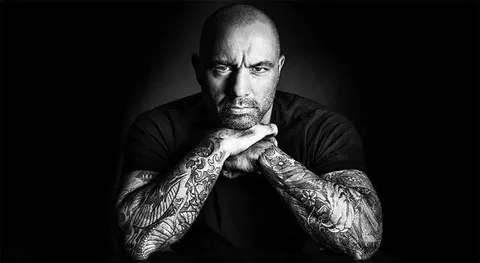
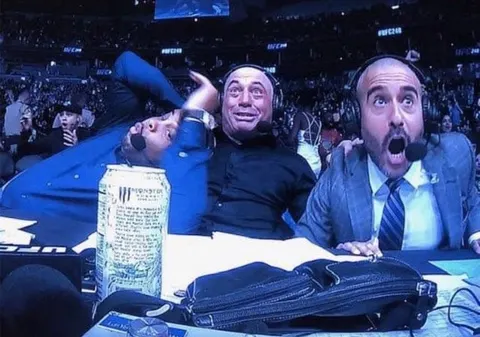
He says himself that he is not a journalist but “a stand-up comic, a mixed martial arts fan, a psychedelic adventurer.” He is 53 today, and before stepping into his current role he was a mixed martial arts commentator (and before that a fighter himself), a stand-up comic and a reality show host.
He holds a black belt in Brazilian jiu-jitsu. As an actor, he is a flat-out failure. He loves bow hunting for big game and pumping iron. The other thing he probably doesn’t love quite as much—stirring up fierce public clashes—but that is how things have turned out for him in recent months. Before the news from Ukraine swallowed the media stream, his case and Djokovic’s in Australia were the world’s favorite public battleground.
And so, Joe is the creator of the notorious podcast with the not-so-original name The Joe Rogan Experience, which has become the benchmark for the genre.
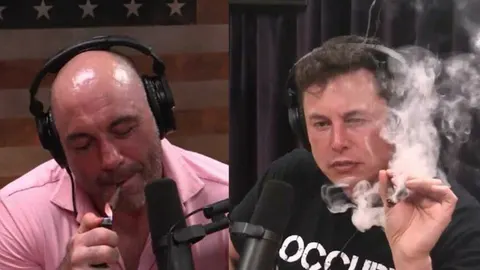
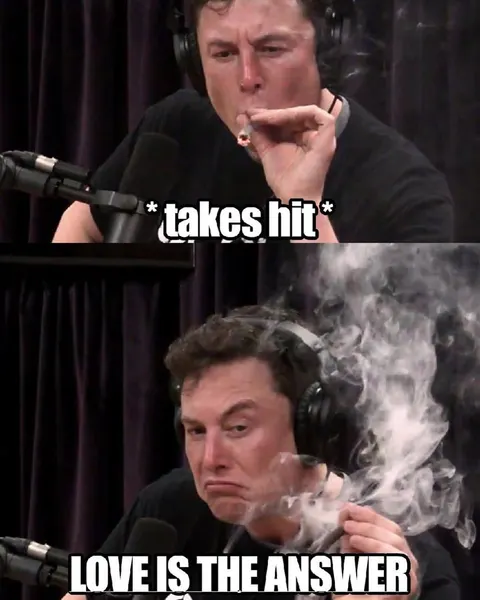
Elon Musk regularly spends several hours on it talking about the future, once even “assisted” by a joint handed to him by the host himself. Both the socialist Bernie Sanders and Jordan Peterson, a cult figure for the right, come on to give it to you straight, along with many other thoughtful people ready to change the future. Every cult appearance spawns a meme that all of us recognize today. Sometimes, however, crackpot conspiracy theorists show up too (or prophets and truth-fighters, as their fans see them). And it was precisely they who became the problem.
All Ears
Rogan was the favorite media figure; the Kevork Kevorkian—Bulgaria’s legendary television interviewer—of the modern Western world; Larry King without the suspenders and the intellectual air. Until he waded into the most fashionable battle, the one that has turned us against each other.
But we won’t throw ourselves into that battle; we’ll look for something more interesting instead. How did rough-edged Joe turn into such a successful venture, and what signals does this send about the future?
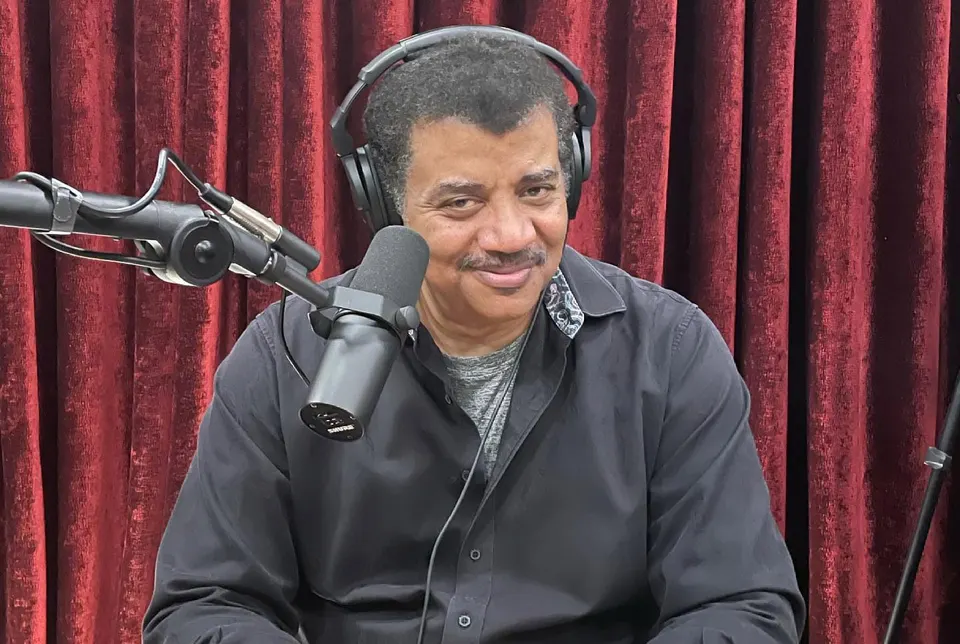
Two people sit in a room homely kitted out as a studio, chatting from topic to topic for hours, with no real script, no visual attractions. Very much in the spirit of the classic talk show of yesteryear, only without the commercials and without the time limits. Hardly anyone would have guessed that in our hyper-fast age, at the expense of the collapse of traditional media, this genre would emerge.
Suddenly it turned out to have so many fans that it was worth one of the world’s entertainment giants offering a gigantic sum to a self-taught journalist.
Millions of podcasts sprang up; even in Bulgaria a niche of sorts took shape, with some quality examples. And yet Rogan became the only globally recognizable face in the podcast world, across all positions and ages. Even before he became both Spotify’s spoiled child and the thorn in its side.
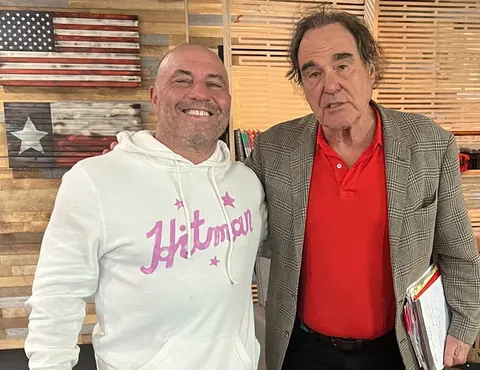
A Trained Ear
What makes the former combat sports competitor so interesting? Does he dazzle with intelligence, with charm, with a journalist’s knack for putting guests at ease?
His conversations are iconic because they are simple, direct and sincere. He is who he is, and he expects the same from his guests.
Joe knows how to talk and, even more, how to listen. To put the other person at ease from the very first moment, the way hosts once could, before earpieces sprouted in their ears.
And since we’ve started down the road of clichés, Rogan is definitely “a man of the people,” or downright a proletarian. He was born on August 11, 1967, in Newark, of Italian and Irish descent. His parents split up when he was 5, and from the age of 7 he was raised by his mother, losing all contact with his father.
He Who Has Ears, Let Him Hear
His family moved often. School wasn’t his strong suit, and from an early age he turned to sports. First baseball, then martial arts, which proved to be his true passion. He trained in karate and kickboxing. He won a state championship in taekwondo, but a series of injuries kept him from becoming a professional athlete. He never managed to finish college.
Today he hardly regrets it much. He and his wife Jessica, a former waitress, live in Texas on an estate worth $14 million. They have two daughters and are also raising together Jessica’s daughter from a previous marriage.
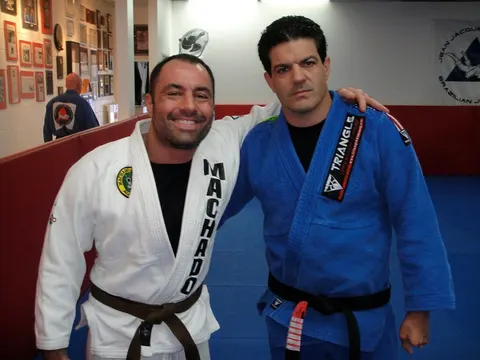
Who’s Afraid?
Before taking up his current calling, from 2001 to 2006 Joe was the host and trademark of the show Fear Factor. If you don’t remember it, this was the intellectual reality show in which contestants were challenged to compete by climbing to great heights, eating raw delicate parts of all sorts of beasts… and generally stepping into the role of beasts themselves in order to cope with the things they feared.
The host was ideal for the part, primal, strong… And yet the reality show quickly ran its course. His earlier career—as a stand-up comic, a Disney actor and… a singer—was far shorter and less successful.
As early as 1999, plans began for his own sitcom—The Joe Rogan Experience, with Warner Bros. The show was meant to be a natural extension of his stand-up recordings, but for one reason or another things dragged on, and the idea fell through after Rogan agreed to host Fear Factor.
Hear Me Out
One amusing story from 2005 is worth mentioning. Wesley Snipes, by then a star on the wane, decided to grab some media attention by challenging Rogan to an MMA fight. Joe agreed at once, and later said the fight had really been arranged. It never became clear what stopped Snipes, a black belt in Shotokan karate, from facing the jiu-jitsu master. The good thing is that nobody got hurt.
Back in the now distant year of 2009, Rogan had an unconventional idea that he decided to put into practice: to start recording his conversations with interesting people. Thanks to his earlier gigs, he happened to know quite a few curious personalities from various fields, and he made the most of it.
The first episode was recorded with his colleague Brian Redban and released on December 24. By August of the following year, the podcast had made the iTunes top 100. By January 2015, the recordings had been downloaded a total of 11 million times, and by October of that year downloads had reached 16 million a month.
Meanwhile he took on side projects too—he hosted another season of Fear Factor and started a show in which he explored topics such as Bigfoot and UFOs.
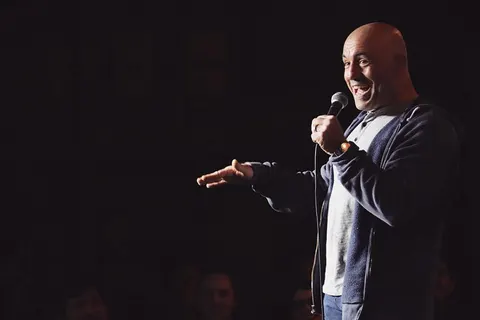
By Ear
For many years everything happened mainly on YouTube. Until he decided on a rather bold, but also logical, step, given the scale of the deal that became known afterward. On May 19, 2020, Rogan announced he had signed the notorious contract, under which, from January 2021, the show has run only on Spotify, with just short clips published on other channels.
Shortly after that, the problems began. Business interests are surely involved in them: Rogan’s show deprived the traditional platforms of considerable revenue, while his new hosts’ investment is said to have paid for itself many times over already.
Today The Experience has more regular viewers than all the current affairs programs of the leading American television networks put together. Its monthly listens reach 190 million.
Rumors
The turning point came when Rogan declared he would not get vaccinated. Then he went through a bad case of COVID and underwent a controversial treatment. The first serious attack came from CNN, which accused him of treating himself with a horse dewormer. Rogan produced documents showing he had followed a medical protocol and boasted that it had helped him beat the illness in just three days.
The scandal, however, broke precisely when the battle for and against vaccines was raging at full force both in Bulgaria and in the US.
The tension heated up further when musicians such as Neil Young and Joni Mitchell announced they were leaving the platform because it kept carrying Rogan’s show. Spotify didn’t need to think long about how to react: the journalist Ted Gioia calculated that a musician would have to rack up 23 billion streams on the platform to earn as much as Rogan. The figure is utterly unattainable.
His musing that if you are young and healthy there is no point at all in getting vaccinated stirred up particularly strong feelings. This is where the White House stepped in—its communications director Kate Bedingfield, appearing on CNN, remarked: “Maybe we missed the moment when Joe Rogan became a medical professional?” Anthony Fauci rebuked him and called his words irresponsible.
Two hundred seventy doctors sent a letter of protest saying Rogan was giving a platform to highly dubious guests. He apologized, saying he was simply looking for different points of view, which did nothing to satisfy his opponents. Clearly scandal still sells, because Spotify’s shares jumped 12 percent that same day.
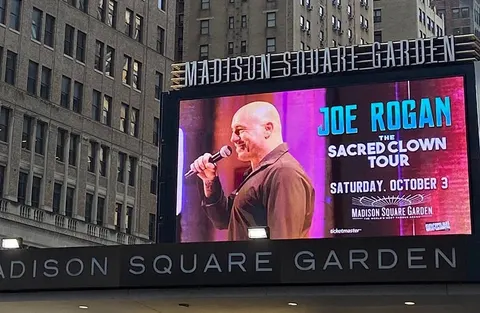
A Tug on the Ear
The platform had clearly set itself the goal of dominating the podcast world, investing around a billion dollars in various projects over four years. And it turned out to be on the right side: its profit for 2021 grew by a record amount, beyond all earlier forecasts.
Joe Rogan holds on to his independence, choosing his guests and topics himself. His views are atypical and don’t fit into either of the two traditional American extremes. He supports same-sex marriage, universal basic income and the free circulation of soft drugs, but also everyone’s freedom to own a gun. Sometimes he says he will vote for Trump, sometimes for Bernie Sanders, because the man has stood by his ideas all his life. And in the end he admits he backed one of those fringe candidates we have never even heard of over here.
Of his own experience with the hallucinogen DMT, he told Rolling Stone that it is “f…ing billions of roller coasters plus aliens. It is what it is, I don’t know what it is. Is it a chemical gateway to other dimensions? A portal that souls pass through? I don’t think there are any negatives.”
Unheard Of
The show now has more than 1,780 episodes. It is a fact that since the scandal there have been noticeably fewer famous guests, but that is unlikely to last long. New conversations usually appear every two or three days, a much faster pace than at the start of the project.
Where does Joe Rogan himself find the explanation for his success? “My podcasts are just conversations. Often I have no idea what I’m going to talk about until I sit down and the meeting begins. Some of my ideas aren’t prepared or specific; I pick them up on the spot, but I give it everything I’ve got. These are just conversations, and I think that’s why people like the show.”
The success of podcasts surprised us all. Supposedly we have no time for long formats, we’re in a hurry, always in a hurry… and that is exactly where they shone at full strength. Because while we scroll, we actually… don’t think. We don’t focus, we don’t reflect.
At the same time comes the overload on our senses. Somehow we don’t feel comfortable doing nothing. While scrolling, we began to find ourselves an excuse if at least we were listening to something we considered meaningful. Somewhere around then came audiobooks.
And then, like a huge wave, podcasts. Some people sit and talk, or present meaningful audio content in some form. Video Killed the Radio Star, they said, video supposedly killed radio, and then radio crept up on it from behind, like in a silent film.
Ears for the Truth
So what of it? Apparently we are all tired of special effects and sometimes look for something else. Meaning, the message, the narrative, the story. The intonation, the moment, the right words. Leading well-known figures out of their gloss. That is the beauty of the podcast.
Roughly the way it happened with the meme. Supposedly everyone is after effects, and suddenly we started laughing at the same pictures repeated with slightly altered text.
If there is one person who embodies all the genre’s successes, it is undoubtedly Horned Joe.
“Today we can no longer imagine the life of the world community without the media. The danger is that the media, which have become a great power, have stopped dealing only with information. They have set themselves a more ambitious goal: they are beginning to shape reality.” The theorist of journalism Ryszard Kapuściński wrote these words almost 20 years ago, long before today’s media situation. And yet he seems to say it all about what Rogan does and how the media treat him.
We undoubtedly live in a time of rifts, widened by the chisel of boredom, struck hard with every scroll by the hammer of the filter bubble.
Heard the Gossip?
One of the main accusations the traditional US media level at Rogan is that he doesn’t choose his guests carefully, that he gives the floor to people without proven authority. But what is the criterion a journalist must have to judge that authority on his own? If, say, a journalist in Bulgaria faces the notorious topic of COVID, how exactly should he decide whether he can invite Prof. Ch. and Assoc. Prof. M., if they are undisputed specialists in immunology and infectious diseases? Which journalist, exactly, can judge in what way they are more competent than, say, professors of surgery? So far even their own professional guilds aren’t unanimous, so what do we do then?
The journalist is the convenient culprit. Everyone knows whom he should invite and how he should talk to whom.
It isn’t easy, nor can it be squeezed into a framework.
Just like Rogan himself. With the small difference that he does what he likes. For $200,000,000 and the love of millions of people.
The Walls Have Ears
As usual, attitudes toward him run along fault lines, but the most fashionable one has split off right where the vaccine needle went in. It is through that rift that attitudes toward the bow-hunting enthusiast pass. Even in Bulgaria you can quickly come across texts that flatter him beautifully as the brave fighter against corporate media or, conversely, call him a liar, a seasoned manipulator and a hunter of the gullible.
To me, though, he is simply a man who happened to be in the right place at the right time.
A time when people need a meaningful, human conversation with some of the great figures of our age. Not interrupted by laundry detergent commercials, as on the big media. Or by their dependencies—political, opportunistic or corporate. Not driven by speed, led into a doomed battle with social networks. But offering full-blooded portraits, painting meaningful stories.
And so what if he makes good money? So do far more “meaningful” TikTok influencers. And OnlyFans influencers. And all sorts of influencers.
While he simply invites people who have something to say and chats the way we used to chat with the neighbors, over cards or a beer, before Facebook came along.
Even so, the future of Rogan and his show looks bright, and brighter still is the future of the podcast genre. This week Digital Stories will be themed: on Friday, look out for an interview with one of the most popular and original Bulgarian podcasters. Who could he be, and what does he have to tell us about the future of the genre and of the way we get our information?
“That’s my only goal,” says Uncle Joe. “To surround myself with fun people, making sure everybody has a good time and works hard.” It may not be the deepest wisdom you’ll read today, but it resembles our hero—simple, clear and yet accurate.