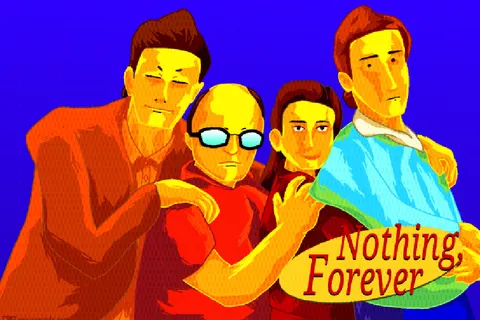
Nothing, Forever is a venture as wacky as its title. At first glance it is rather fun: a series, a sort of sequel to the cult sitcom Seinfeld, that runs without pause and without the plot ever repeating itself. Whenever you open the window in your browser, you will see a new, different story, and if you pay up… you might even appear among the characters yourself.
Yet it gives us plenty of reasons to think about the future of art and entertainment in the age of artificial intelligence.
Can you imagine your favorite writer—Márquez, Grisham, Gospodinov (Georgi Gospodinov, the Bulgarian novelist who won the International Booker Prize), or anyone else—writing their next book especially for you? Or your favorite director—Spielberg, Nolan, Valo Radev (the Bulgarian director behind some of the country's most beloved films), or anyone else—gathering your favorite actors and telling, especially for you, the story that would move you most?
Well, thanks to the progress of technology, the moment when this becomes possible is not far off at all. Yes, at first with plenty of imperfections, but ever more skillfully we will be getting exactly the content that would intrigue us most. Personalized art.
Is this a dream, a paradigm of its own? Or the end of human creativity as we have understood it until now?
As Long as the World Turns
Do you remember Ridge Forrester, the legendary macho man from The Bold and the Beautiful, who kept ruling hearts for several thousand episodes? By the way, he is still “alive,” now played by a fourth actor, and the series rolls on. Although I have no particular aesthetic criteria for male beauty, the level in that department doesn't seem to me to be climbing the way the development of artificial intelligence is. Ah, not even The Bold and the Beautiful was spared. And what series we used to have…
The Nothing, Forever project takes us back to those nostalgic times when cult soap operas emptied the streets… only in a brand-new voice.
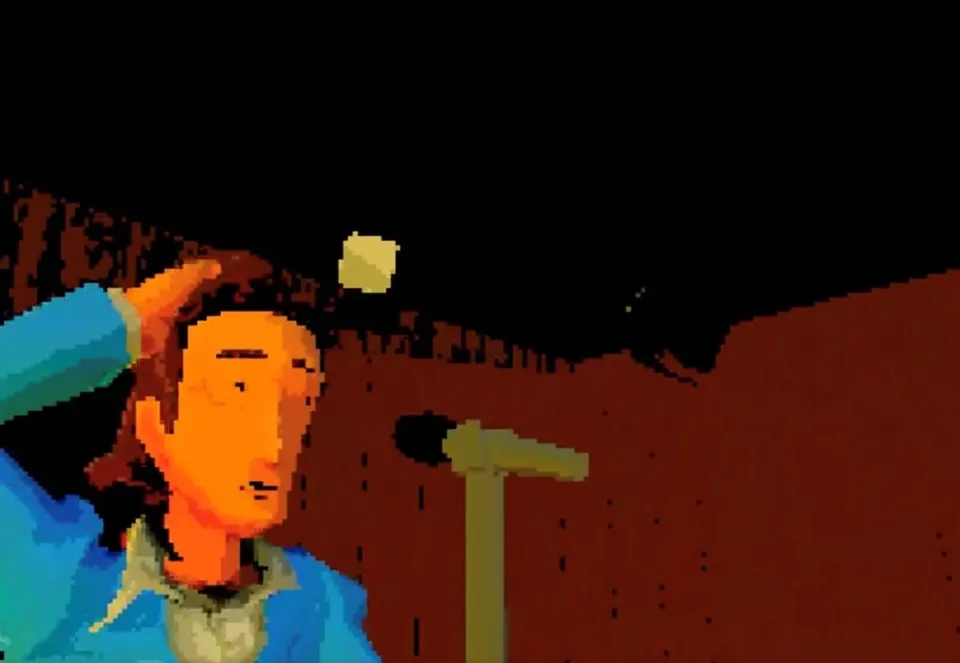
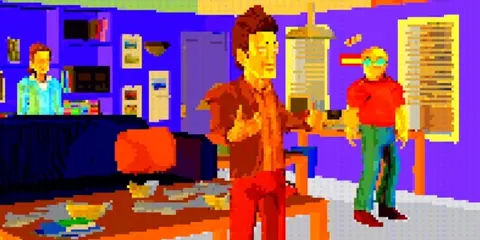
If you open the site…, at first it will seem utterly absurd. You land in something that, graphically, looks like a computer game from the '90s. Yes, the sound is like a TV series, and if you're used to listening in English, you'll quickly get into it. Now and then the dialogue comes out downright convincing. In the spirit of the sitcoms of old, every few seconds you hear the audience laughing…
Yes, Nothing, Forever is more of a social experiment than a masterpiece. And still it is telling, because… it captures what is supposedly the hardest thing of all: humor.
To Each According to His Needs
There is always a dose of magic in art. There is the spirit of the times, the timeless power of the moment, even luck. To catch the instant, to find the way to the hearts of fans, publishers, producers… Art is and will remain magic. The question is not whether algorithms will be able to repeat it.
They won't.
The real question is how indistinguishably they will manage to imitate it. And this is where the dimensions come in that hold surprises for us.
Nothing, Forever was born shortly before Christmas. The creators of the “series” chose the online platform Twitch, which is provocative enough. It is a place for sharing live streams of every possible kind, very often of computer games.
The “series” quickly became popular. It relies on the popular GPT-3 platform to generate the plot in real time. To make images appear, however imperfect, garnished with jokey lines and laughter. All of it comes through the connection to the neural network that was the first to show how far these technologies have come, and then handed all of this to the general public through the famous ChatGPT.
Guiding Light
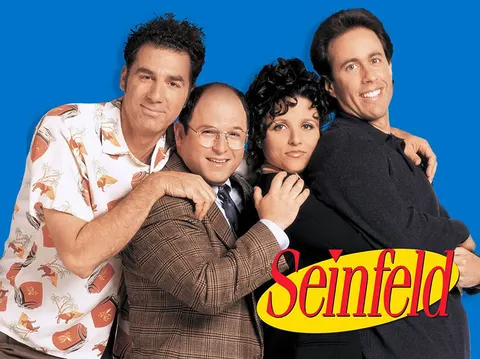
Seinfeld is a cult American series, a symbol of the situation comedies fashionable in the '90s, broadcast over 9 seasons and 180 episodes in total between 1989 and 1998. Its plot… is not overly witty: its creator, Jerry Seinfeld, paints a kind of fictional portrait of his own life, an approach later repeated in many of the long-running series beloved by generations.
Except that in one of the episodes Jerry admits that what the show is really about is “nothing.” True, we would hardly accuse the series that followed of “depth of plot” either, whether Kassandra (the Venezuelan telenovela that swept Bulgaria in the 1990s), Friends or How I Met Your Mother… Series are a momentary entertainment that we quickly forget.
But clearly not everyone has forgotten Jerry Seinfeld's words, because their algorithm-generated version began to echo online with new force in Nothing, Forever.
Exactly how the neural network was fine-tuned is a secret for now, but it doesn't matter that much. The fact is that new episodes of Seinfeld suddenly started flowing across the web with the Nothing, Forever project. Yes, the characters have slightly altered names, but the show quickly piled up fans.
A five-digit number of users began following it constantly, and interest kept growing. The platform is supported by donations. Five dollars, and you help the series go on and on. 365 days, 24 hours, without anything repeating. Whenever you drop in, the content is new, current… Absorbing enough for you to lose a few hours watching, and at the same time ready to greet you a few days later without your having missed anything essential.
Once Upon a Time There Was an AI…
The launch was on December 14, 2022, and the production belongs to Mismatch Media, a company created specifically for the purpose. The project is the work of two curious programmers: Skyler Hartle is a product manager at Microsoft's software platform Azure, and Brian Habersberger is a physicist specializing in polymers.
The two met by chance, united by their love of the computer game Team Fortress 2.
Of course, the project's name is inspired by Everything Everywhere All at Once, the film that swept the latest Oscars and, with its serious eclecticism, turned out to be a serious challenge for the armchair film critics on Bulgarian social media.
They say the idea for the series came from David Lynch's ultra-strange (even by his standards) project Rabbits. In this sequence of short episodes, three actors from his popular film Mulholland Drive, Naomi Watts among them, sit in a room and talk, dressed… yes, as rabbits. The dialogue is half-absurd, and that series, too, is more of a social experiment than cinema. I confess I put it on for a little while, and against its backdrop… Nothing, Forever sparkles with both plot and a sense of humor.
“The grocery store isn't the best place to listen to celebrity gossip. It's hard to appreciate the juicy details while you're picking up a carton of eggs,” says the main character in the online series, and, as one commenter put it, it's not clear whether the canned audience laughter isn't triggered by the egg prices that greeted us this Easter.
Strawberry fields forever
Jokes are hard to describe, you know. What did the author mean? Once we reach the point of having to explain them, they're no longer jokes. And yet, it turns out, the algorithm apparently pulls it off. The producers say it was enough to fine-tune the algorithms on the entire run of Seinfeld to get the desired result. The fact is that many thousands of people gathered, curious, listening to and watching the eternal tale.
Then suddenly the platform itself stopped it. Wicked tongues claim the reason was that Jerry and the other participants in the pixelated series suddenly… started behaving badly.
Twitch gave no public explanation, but unofficially it became clear that the reason was crude jokes aimed at people of different sexual orientations. Somewhat understandable, given that at the core lie jokes from the late '80s, when the topic was viewed quite differently. Perhaps that is one of the reasons why, after the pause, the plot changed abruptly.
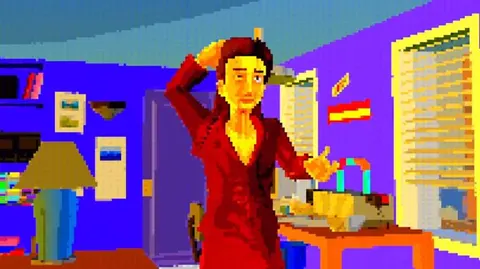
Sometimes I'm Good and Kind
The creators blamed the problem on the safety systems of the platforms they use—a topic that will be discussed more and more in the context of artificial intelligence.
Viewers describe how the main character, Larry, joked by comparing gender transition to mental illness, and then wondered: “Hey, why is nobody laughing? Where did everybody go?”
Twitch stopped the stream on February 6, and it resumed on March 8 this year. The show's creators call the new “episodes” the second season. They chose entirely new characters: Larry is now Leo, and a blogger. The change, however, disappointed a huge share of the fans, used to enjoying the familiar Seinfeld sense of humor. That's how quickly you forget what exactly you're watching, and how the line between a created and a generated series melts away…
The platform is supported by donations. As the creators put it, their goal is not profit but a social experiment, and in the future a platform where many other similar projects can be made. Still, for the series to exist, certain costs are necessary, mainly for the AI platforms used at various stages of its creation.
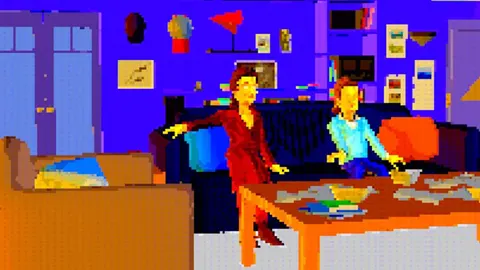
The Game of Toys
Curiously, until recently, for a donation of $1,000 they even promised you could appear as a character in the series itself. Quite tempting! Among the fans who went for such a donation is the influencer Félix Lengyel, also known as xQc. It's not clear exactly how he became part of the plot, and lately the option for such a donation has been removed.
As the description itself said, “Look, we wouldn't advocate for this. It's probably pretty silly to donate this much. But if you do… we'll create a character based on your characteristics and you'll show up on the show sometimes. It'll take some time, we'll let you know when it happens… but it will happen!”
The fact is that, technically, little is known about what exactly is fed to the algorithms on the basis of which they generate the content. At one point the creators claimed that viewers' chats and discussions mattered too; later they admitted this was more of an idea for the future.
The NeverEnding Story
The script is created with the GPT-3 platform, and it is turned into images with DALL·E. The “eternal series” uses the logic of procedural programming: basic logical frameworks and procedures are set, on the basis of which the algorithm can generate a huge, unexpected number of different subplots and details.
It is known that the plot is generated by a function on the Azure platform written in the programming language TypeScript. The machine learning model is in Python using TensorFlow, and the picture is “painted” with Unity and C#.
“Nothing, Forever was conceived four years ago as an art project, a parody of '90s sitcoms,” says Skyler Hartle. “Our big creative inspiration was originally Lynch's Rabbits, but we've evolved a lot since then. Today we strongly believe that these forms of generative media are the future, and our goal is to create a show that is just as strong as, or even stronger than, any media that exists on Earth today.”
“Generative media is getting better, and we think that in the future equivalent of Netflix you'll be able to watch your favorite show continuously, without interruption, as much as you want,” Hartle adds. “You won't just have seven seasons of your favorite show, but hundreds of seasons, as many as you want and whenever you want. Our experience has proven that we can create a show that generates entertaining content forever. The next step is to raise the bar and add more and more projects like this.”
Don't Make a Movie Out of It!
Will the two of them get rich? Perhaps not that quickly, at least. Yes, Nothing, Forever may catch your eye, even amuse you a little, if you go for more “nerdy” humor, as we would say today, or bookworm humor.
And yet this project is more interesting in its role as a possible forerunner of something much bigger.
The technology will advance, the pixels will be smoothed out. Plot development will advance too. Then will films like today's still make sense? Or will the algorithm simply be able to generate them for us personally, based on our preferences, our reactions, our thoughts? Quite possibly, even without any extra payment, we ourselves will be able to appear in the story, on the sidelines, or… as the main characters? And what if we add three dimensions to all of this, the delayed but still, for many, tempting metaverse? And interactivity, the possibilities of computer games?
Could the entertainment of the future be a three-dimensional film close to perfect realism, created entirely according to our own preferences and steered by them?
Against the backdrop of all this, will television, cinema… literature survive? Experience shows that every new, more impressive, “lazier,” more spectacular and personalized form of entertainment in history has, if not killed, then at least strongly marginalized the ones before it…
Slave Isaura by Carlos Saura
Today, if you study marketing, they'll tell you that everything is “storytelling.” Yes, people need stories, stronger and more exciting than the feed can give them, than the media and mass culture manage to create for them. Even those born on TikTok, at least not for the generations who aren't used to it.
The interesting thing is that Nothing, Forever loses out when it breaks away from its successful logic, from the proven story and model, but otherwise it turns out to be an extremely successful venture. The algorithm building on jokes that are proven and… funny to a given audience.
Are its jokes really witty? Definitely not, but next to the things we've laughed at as TV humor over the past decade… hmm, they sound like the high art of comedy. I don't know about you, but I'm not burning with impatience for an algorithm that will broadcast 24 hours of laughs in the spirit of Komitsite (The Comedians, a long-running Bulgarian TV sketch show). But one that goes back to the truly funny Bulgarian films… Or a new reading of Wodehouse? Of Douglas Adams?
Technologies based on artificial intelligence are capable of ever more impressive successes in entertainment and culture as well. And while new solutions gush out one after another, it is more important to think about the paradigm. Are we ready to immerse ourselves so deeply in technology, and how will it affect us?