Do the world's tech leaders read books? What are the favorite reads recommended by Elon Musk, Sam Altman and Mark Zuckerberg? Will you find some overlap with your own literary taste, or is there no such topic at all?
In Bulgaria it isn't fashionable to talk in the media about what we read. Journalist and translator Daniel Penev got me thinking about this during his visit. Yes, you'll probably remember the notorious Winnetou—Karl May's Wild West adventure novel, a staple of every Bulgarian childhood—as someone's favorite book and… that's it.
It isn't like that everywhere. In both West and East, the people who end up in the spotlight love to talk about books, about their favorite authors, about the literature that helps us keep going.
Well, it's time we started doing it here too!
What Are You Reading?
I don't know about you, but for me this question has always mattered. Both in a conversation with a stranger and in the search for my next favorite book. That's why I'm putting it front and center in the next few Digital Stories.
This time I'll tell you about the favorite books of some of the world's great tech leaders. We'll peek into Sam Altman's library and lose ourselves in Steve Jobs's recommendations. Which of them is the biggest admirer of Tolstoy, and which of Shakespeare?
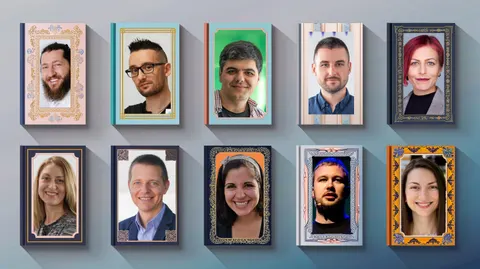
The topic continues on Tuesday with a visit from Hristo Blazhev, creator of the biggest book blog in Bulgaria, Knigolandia (Bookland), and of the Facebook group “What Are You Reading?” And next Friday we'll turn our gaze to Bulgaria. I asked 15 Bulgarian IT leaders about their favorite books and got their recommendations.
Will Ivan Vazov, the patriarch of Bulgarian literature, make the list? Be patient—an unexpectedly colorful and curious palette of answers has definitely piled up, both for the book people and for the programmers who read this site… but do we really have to separate the two?
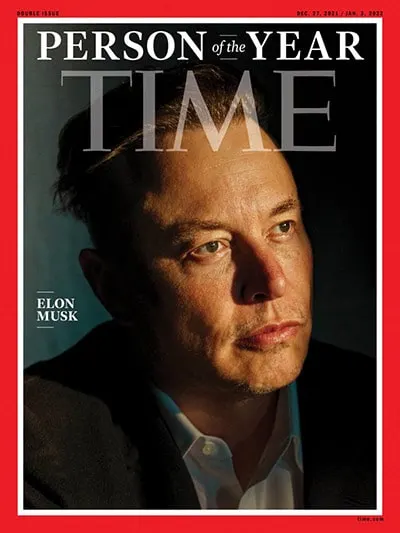
Strangers in a Strange Land
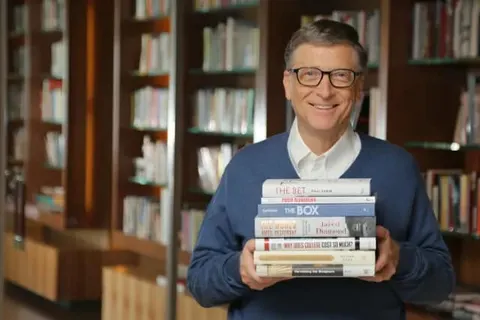
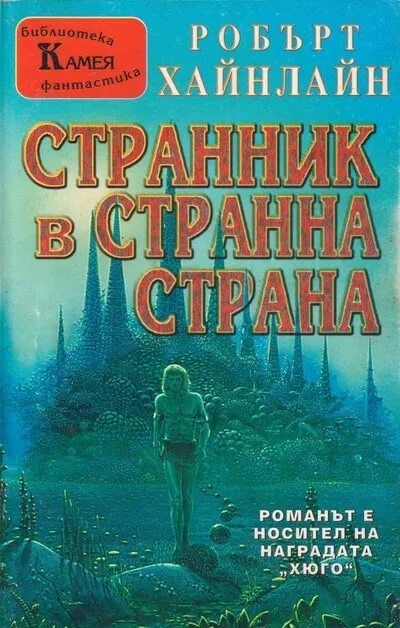 But how on earth did Bill Gates become… a literary guru? Which book shaped Elon Musk's life?
“Never appeal to a man's ‘better nature.’ He may not have one. Invoking his self-interest gives you more leverage.”
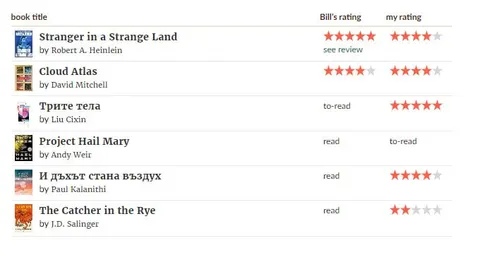
No, that's not my opinion, and it's not Bill Gates's either. But it is a quote from one of only two books—out of the 258 he has marked as read and rated—that overlap with the 951 I've logged the same way in my Goodreads library. For me, and for many other readers around the world, over the past ten years or so this has been the platform where we record what we read and follow the moods, ratings and opinions of others. I've chosen not to write reviews… and I must be right, since colleague Bill isn't generous with words, or with ratings either. (You'll find his Goodreads profile here, and mine here).
I seem to have gotten lost in the details. So, did you guess whose quote it is? I'd be very surprised, even though it comes from a work we're used to thinking of as a classic—Robert Heinlein's Stranger in a Strange Land. That's one of the two books that both Bill Gates and I have rated; the other is Cloud Atlas. He has some catching up to do on certain counts—he's noted that he wants to read Liu Cixin's hit science fiction trilogy, The Three-Body Problem. Here I'm ahead of him, but that series is about to show up on other famous lists too.
But wait, don't tech leaders read only… tech books? And business ones, fine, and now and then a self-help title? Nothing of the sort, as you'll see from these lines—it really is time to say goodbye to the stereotypes that pit letters against bytes.
Don’t kill Bill
“I try to read every day, whether I'm having a busy day at the office or I'm on vacation. It's one of my favorite ways to learn new things and to understand the world better.” So says that very same Bill Gates. He never stops recommending books, and every year he publishes reading lists on his blog. They too are wonderfully varied and colorful, and fiction very often sneaks in among them.
How much does he read? Far more than the notorious 40 percent of Bulgarians who didn't read a single book last year. Many sites collect his ratings—here, for example, you can see no fewer than 343 of Bill Gates's opinions on various books!
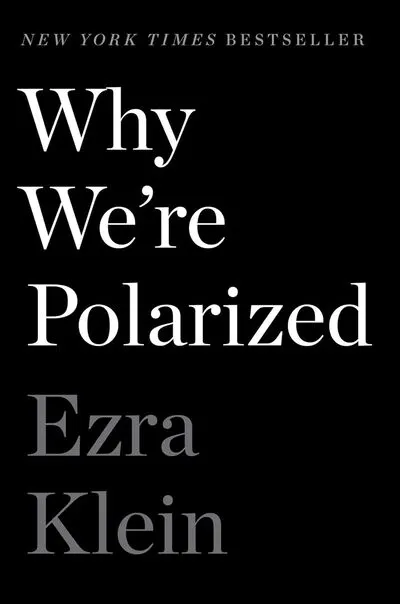
On no fewer than seven different occasions Gates has recommended Ezra Klein's Why We’re Polarized, a book that has never been published in Bulgarian, and neither has anything else by its author. (I put no small effort into checking the Bulgarian editions, but if I've made a mistake, I'll be grateful to be corrected.)
Considering how much more relevant the divisions in society become every day, though, perhaps it wouldn't be a bad idea for Bulgarian publishers to think about it… “If you want to understand what's happening in US politics right now, this is the book,” says the creator of Microsoft.
The Solitude of Prime Numbers
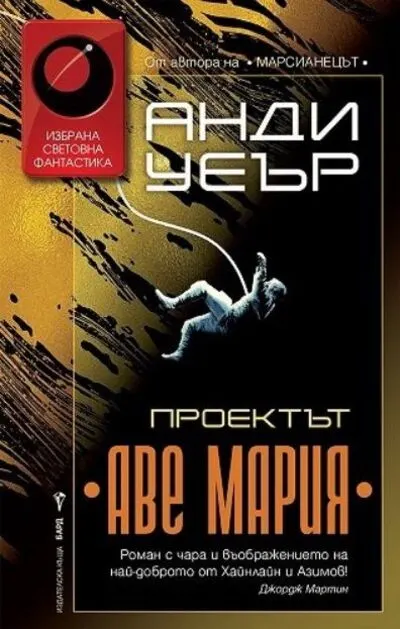 Another favorite author he often names is Andy Weir. The science fiction writer turns up in many other tech leaders' recommendations too. Three of his books have been published in Bulgarian, and of them the only one still easy to find is the one Gates mentions: Project Hail Mary.
The truth is that although they often talk about their favorite books, according to quite a few rankings and summaries I've read, tech leaders rarely give a complete list. That's perfectly understandable: when someone asks me for my five favorite books, the answer would differ drastically depending on who's asking and at what stage of my life the question comes. And every reader I know struggles to squeeze into such a small number of favorites. So let's continue our flight over the tech leaders' libraries.
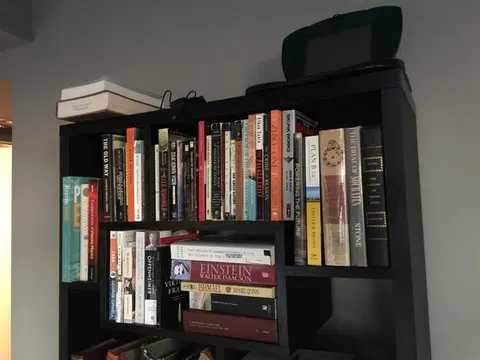
Sam Altman, for instance, talks about favorite books far less often (and in general, only in the past year has he started giving interviews a bit more frequently). Our main clues with him come from a challenge a few years ago, when he was called on to show his personal library after the trend swept through social media. And… what variety we saw there! Starting with Plato's Republic, moving through Isaac Asimov's Foundation, Alice Munro and Marcus Aurelius, and ending with biographies of Napoleon and Elon Musk.
Beyond those, among the recommendations he has given is Nick Bostrom's Superintelligence: Paths, Dangers, Strategies, which he calls essential reading for anyone interested in natural and artificial intelligence. “It's great to reread this book,” he says of Shirley Hazzard's The Transit of Venus, which has also never been published in Bulgaria.
The Man in the Iron Musk
And speaking of Musk, there's no way to skip him—he talks often, at length and in detail about the books he reads and that have made him who he is. I wonder whether, after his two highly curious biographies, we'll eventually get one of his own…? It would bring publishers a fair amount of money, if only he can find the time.
He himself reads plenty of biographies—among his favorites are those of Benjamin Franklin and Einstein written by Walter Isaacson, author of the newest and scandalous biography of Musk himself, which came out in Bulgarian just days ago.
“I know it's a cliché, but The Lord of the Rings is my all-time favorite book,” Musk admits. And Asimov's Foundation, in his own words, is one of the books that drove him to create SpaceX. He also recommends Robert Heinlein and Frank Herbert's Dune, because it defends the principle of keeping artificial intelligence in check.
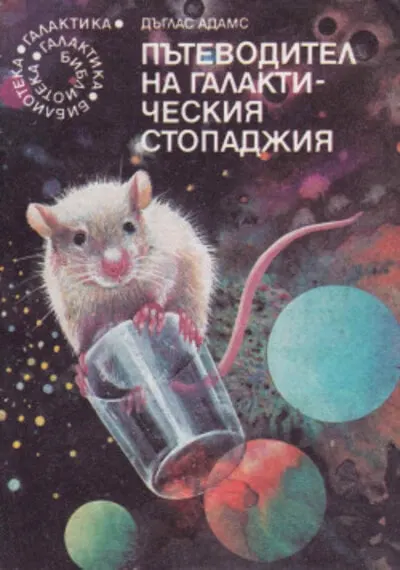
He's a fan of Douglas Adams's The Hitchhiker's Guide to the Galaxy. “When I was around 12 or 15, I had an existential crisis, and I was reading various books trying to figure out the meaning of life and what it all means,” Musk recalls. “We had some Nietzsche and Schopenhauer books in the house, which you should not read at age 14. And then I read The Hitchhiker's Guide, which I think is quite a positive book, and it highlighted an important point, which is that a lot of times the question is harder than the answer. And if you can properly phrase the question, then the answer is the easy part.”
I'll tell you, for me at least, he became quite a bit more likable and relatable after this list.
And if there's anything worrying in his book recommendations, it's that over the past year Musk has increasingly been recommending reads connected one way or another with war. With the greatest battles, with history, with how wars are waged.
Still think it doesn't matter what today's leaders read? Let's hope this is just a fad and has nothing to do with this undeniable visionary's predictions about our future…
Face…book
The books of Nassim Taleb and Peter Thiel turn up quite often on the lists of our readers of the day. But if there's one author who stands out for appearing on almost all such lists, it's undoubtedly Yuval Noah Harari. Every IT hero mentioned so far describes him as a writer of enormous importance for our time.
There's no way to pass over Mark Zuckerberg, who has always tried to build an image as an avid reader, although in recent years his book recommendations have become far rarer.
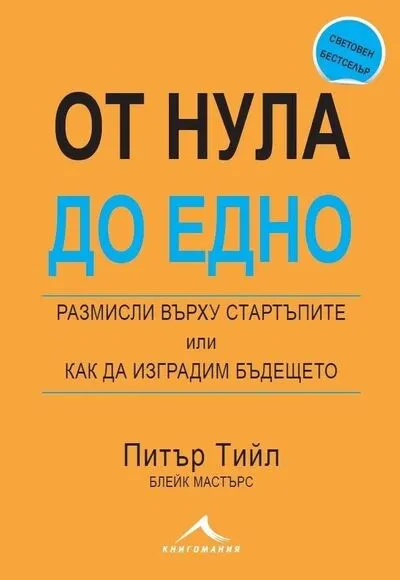
His list also includes the entrepreneur who helped almost all of today's giant companies get where they are—Peter Thiel, with Zero to One: Notes on Startups, or How to Build the Future.
 He also recommends the aforementioned Liu Cixin trilogy—“a science fiction masterpiece of enormous scope and vision.” Of Harari's Sapiens he writes that “the chapter on evolution and the role of religion in human life was the most interesting to me, and I wanted to dig deeper into it.” Is he planning to start a religion?
“It's mind-blowing that almost 3 billion people live on $2.50 a day or less,” he writes of Portfolios of the Poor by Daryl Collins. What he has done, from his position as a hegemon of the IT world, as a result of his amazement, history does not say.
Coincidence or not, Zuckerberg is also familiar with, and comments on, the most popular dystopias we keep talking about more and more. Of Peter Huber's Orwell’s Revenge: The 1984 Palimpsest (also never published in Bulgaria), he writes that it “is an extraordinary demonstration of the potential of the emerging supermedium to give rise to new forms of creativity. It boldly reimagines 1984 from the computer's point of view. Having first scanned all of Orwell's texts, Huber used a computer to completely rewrite the book, mostly using Orwell's own language. Alternating fiction and nonfiction chapters, Huber develops the plot to a surprising new ending. The result is a compelling utopian work that foresees a world at our fingertips, where information keeps multiplying, opportunities are equal and there is freedom of choice.”
Now all that's left is for him to convince us that he himself is working in that direction…
The Choice
 Dune, the novel recently turned into a successful film, is also a favorite of Jeff Bezos. The creator of Amazon also warmly recommends the work of Iain Banks, a science fiction writer less known in Bulgaria, and in particular his series of novels published from the 1980s until 2012, The Culture.
An unexpected number of recommendations—from Bill Gates through Satya Nadella to Stewart Butterfield—go to an economics read, The Rise and Fall of American Growth by Prof. Robert J. Gordon.
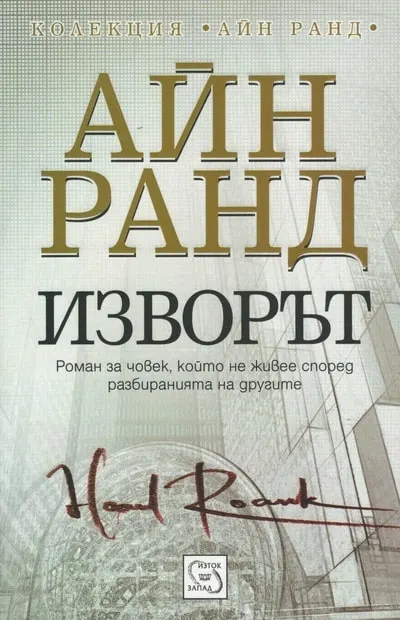
Oracle's creator Larry Ellison, for his part (not especially surprisingly, at least to me), is an admirer of Ayn Rand. “As a child I wanted to be an architect because of her novel The Fountainhead.” Whether we're better off that it didn't happen, I leave for you to judge.
Peter Thiel himself is an admirer of her other notorious work, Atlas Shrugged. Thiel and quite a few other leaders on the list are also fans of Ray Kurzweil.

Alas, I Knew Him, Horatio
Among his favorite reads, though, there are far more unexpected choices. Anna Karenina, for example. Thiel says the classic novel illustrates the IT business well: “Tolstoy opens with the observation: ‘All happy families are alike; each unhappy family is unhappy in its own way.’ Business is the opposite. All happy companies are different: each one earns a monopoly by solving a unique problem. All failed companies are the same: they failed to escape competition.” We're also left to guess whether he kept going past the first sentence…
Jack Dorsey says one of his favorite books is Mikhail Bulgakov's The Master and Margarita. Bryan Johnson, meanwhile, is an admirer of Hermann Hesse's Siddhartha. Among the unexpected classic recommendations is Shakespeare's King Lear, from Steve Jobs. “At one point in my life I started listening to a lot of music and reading more outside science and technology—Shakespeare, Plato. I loved King Lear.” He has also spoken of how much he valued Moby-Dick and the poems of Dylan Thomas.
We could go on for a long time, but there's no point.
Before I forget—I'll be waiting for you on Goodreads! If you've made it this far, literature surely excites you, and it's always a joy to meet people like that.
I hope you've found at least one recommendation for yourself. Were you surprised by any of the books recommended in this piece? I certainly was. But even more surprising suggestions are coming exactly a week from now. What books will 15 Bulgarian IT leaders recommend to us?