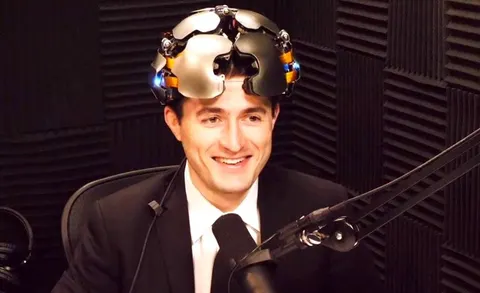
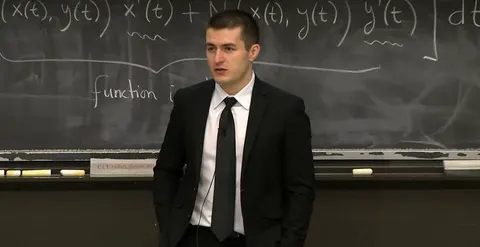
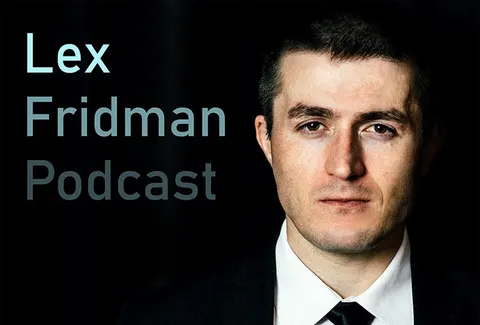
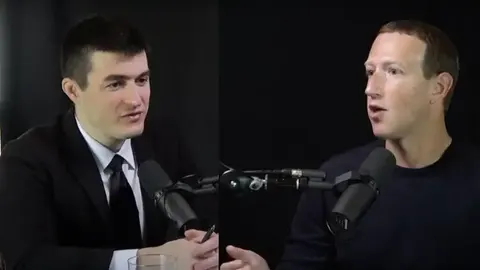
A slightly dry young man in a thin tie and an impeccable suit sits behind the microphone, and across from him, one after another, come people like Musk, Zuckerberg, Kanye West, Vitalik Buterin, Noam Chomsky, Jaron Lanier, as well as leading scientists from the world of artificial intelligence, with whom he speaks the same language.
Lex Fridman has been one of the most popular podcasters of the past year, even though by profession he is a scientist, an artificial intelligence researcher and a lecturer at the Massachusetts Institute of Technology.
Born and raised in Moscow, of Jewish-Ukrainian descent, today he says he is American and speaks English without an accent. That does not stop him from blaming his new homeland for all the wars it wages around the world, just as he blames his old one.
Lex is more than an interesting bird because of his successes as a scientist and a podcaster (some would say a journalist). Here is what else is worth learning from his very curious story.
Iron man
“The most realistic conversation between two robots,” reads the most-liked comment under Elon Musk’s latest appearance on Lex Fridman’s show. And indeed, with the typical manner of engineers, the two talk in an even tone, the host spruced up in his classic suit, the kind you mostly see in Sofia on the young men handing out Mormon literature.
And yet, as the robots chat away, Elon recounts that although he is not religious, he went down on his knees and prayed for SpaceX’s first crewed mission to get people safely to the International Space Station.
Interestingly, not long ago Musk promised that it would be on Lex’s show that he would fully explain his view on Twitter, after the notorious poll decided he should step down from running it. (Musk later sent his brother Kimbal instead, but the turmoil easily explains why.) And Lex complained that right after that, attacks began against him too—such as people doctoring the information about his biography on Wikipedia.
Lex is not a journalist, but he manages to put his guests at ease and let them talk. His other impressive skill is presenting subjects like artificial intelligence, complex and full of specialized knowledge, to specialists, while telling them in a way that is both scientifically sound and accessible.
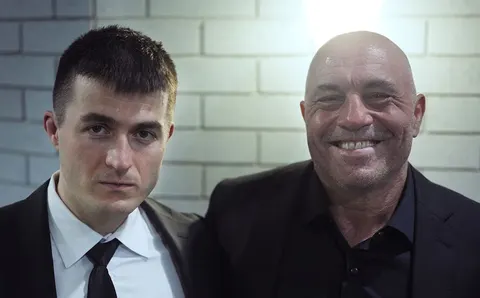
He may not have the enormous popularity of his colleague and friend Joe Rogan, with whom he often trades guest appearances, but he does something very important—he shows that in the world of digital content there is room for popular science, for intelligent conversation.

Judged by the Suit
How come he is called Lex if he comes from the Slavic world? Well, yes, his name is of course Alexander, and he was born in 1983 in the tiny Russian town of Chkalovsk.
Alexander Friedmann—heard that name before? Yes, that is the name of one of the greatest physicists of the 20th century. In the 1920s he came up with the theory of the expanding universe, later confirmed by Hubble, who got considerably more of the glory.
The elder Friedmann fought in the First World War, and after the Russian Revolution ran an aircraft factory. He died of typhus during his honeymoon.
The name really is common: Alexander Fridman is also the name of Lex’s father, likewise a leading scientist, only in the field of plasma physics. Whether he has anything to do with the researcher of a century ago, or it is simply a coincidence of names, has never come up.
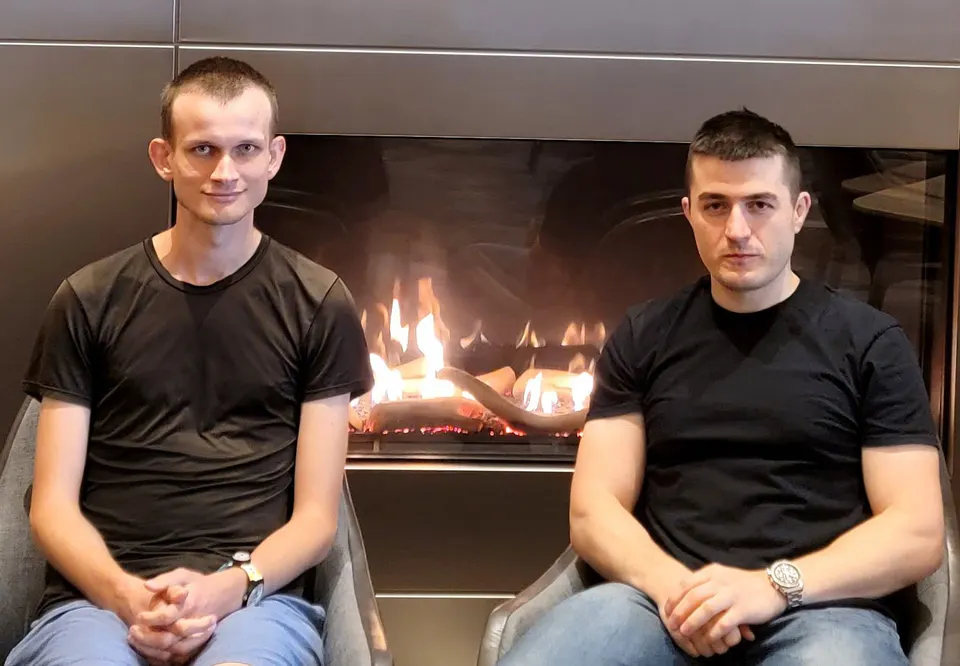
What is more than curious, though, is the podcast episode in which father and son Fridman talk about theoretical physics, about Chernobyl, about the life of an émigré. The distinguished physicist even looks like Einstein, and unlike his son he speaks with a heavy Russian accent, often switching to his native language when he cannot find the thread of his thought.
Every time he gets excited, he pours himself a glass from the bottle in front of him and takes a sip… yes, it is water in this case, they are scientists, after all.
How the Steel Was Tempered
In the same episode Lex talks about coming to America and how it seemed like a terrible idea to him. Although he arrived at just 13, in Russia he had been surrounded by kids who shared his interests—physics, mathematics—while across the ocean he landed in an ordinary school.
As his father replies, it also matters that they are Jewish by origin. Throughout its entire history, this people has grown used to dealing with such things, to moving, to surviving. And he quotes, in Russian, lines from a song by Vysotsky: “when they go to their death, they sing. The most terrible hour in battle is the one when you are waiting for the attack.”
They also discuss Lex’s grandfather, who fought in the Second World War as a sniper in the lands of today’s Ukraine.
The father is a world-class scientist in his field, and the podcaster also has a brother, Greg, who heads a startup that, as it happens, also works on plasma physics.
Interestingly, this landmark episode, which was number 100 exactly on Lex’s list, is now missing from his official channel and can only be found through other sources. It is not hard to guess that the reasons lie in the international situation.
In November 2021, news emerged that talks were under way for Vladimir Putin to appear on his podcast, which Lex announced himself, but it was later denied at the highest level. When Musk weighed in on the topic of the day with a proposal for negotiations between Russia and Ukraine, Lex said he would be glad to take on the role of mediator.
“Don’t try to run away from history, learn from it,” the podcaster urges. “Those who crave power for power’s sake rely on chaos, on anger, on fear. Don’t give them a chance. Be kind. Be patient. Be strong.”
Dura lex, sed lex
Which is Latin for “the law is harsh, but it is the law.”
Lex holds a PhD in software engineering. His first job was at Google, but he stayed only half a year, working on new methods of user authentication. He decided he missed the university and moved to MIT, where, besides teaching, he does research in autonomous vehicles, machine learning and robotics. He has a fair number of publications in serious scientific journals.
How did he decide to start the podcast? For more than 10 years he has been a big fan of Joe Rogan, listening to him from the very beginning. It was Rogan who inspired him to start, and to focus specifically on artificial intelligence.
Later they became friends. A curious recent episode is connected with that. During Neil deGrasse Tyson’s latest appearance on his show, Rogan did his best to convince him how cool Lex is and that it was time he went on Lex’s show too, but Tyson brushed off the invitation, who knows why, visibly showing only lukewarm interest.
Today his channel has gathered around 3 million subscribers and 300 million views, which is far from the records but still impressive for a project devoted mainly to technology… Lex has had a YouTube channel since 2006. In its current form the venture has existed since 2018; at first it was called the Artificial Intelligence Podcast, and later it took its creator’s name. Its purpose: to discuss “AI, science, technology, history, philosophy and the nature of intelligence, consciousness, love, and power.”
His guests have included scientists such as Andrew Ng and Yann LeCun, James Gosling—the creator of the Java programming language—and the chess players Garry Kasparov and Magnus Carlsen.
A Spark of Life
Yes, Lex is a man of science… and yet, a month ago many more people with no interest in the subject heard of him, thanks to the appearance of the rapper Kanye West. Shortly before that, Kanye had announced that he was getting ready to try his luck once again in the race for president of the United States.
Well, they waded so deep into a discussion of the Holocaust that afterward a whole bunch of huge sponsors terminated their contracts with the rapper.
The conversation was genuinely emotional, especially for Lex, who has ancestors who lost their lives in the Holocaust. The interview became really quite popular.
“We are still in the Holocaust. Six million people died in it, 20 million are the victims of abortion,” says Kanye, who now goes by Ye and has evidently turned toward ultraconservative American voters. “The media promote ‘my body, my choice,’ and what this is about is promoting a new Holocaust. Fifty percent of Black deaths in America are from abortion. The most dangerous place for Black people in America is their mother’s womb,” Ye rambles on. And he repeats over and over that the media around the world are Jewish and that they set the agenda.
“Jewish media is a tautology,” says Ye, and Lex replies that this sounds like the words of Goebbels.
Ye. “No, no,” you can tell the host wants to tell him, but the guest carries on in the same vein, and Lex, sitting across from him, is left speechless. But he keeps the conversation going, engages in conversation, in discussion.
The Struggle Is Merciless and Cruel
This, in my view, is precisely the big lesson worth taking from the podcaster in our part of the world. That it is always worth continuing to seek out the other opinion, not giving up on the conversation, not digging in inside your filter bubble. “Given my family history, the conversation was difficult, but important,” Lex wrote afterward. “Because I believe in the value of deep, honest and empathetic conversation between different points of view.”
In this context, it is curious to note that our protagonist is into fitness, and another sport too. These days, it seems almost impossible to make it in the world of podcasts unless you are a master of Brazilian jiu-jitsu. Both Lex and his friend Joe Rogan hold high belts in the fashionable martial art, and the same goes for our part of the world—one of the most successful podcasters, “the superhuman” Georgi Nenov. Perhaps it is also because I cannot fold people’s kimonos while they are still in them that I do not dare to start a podcast version of Digital Stories.
Besides holding a black belt in this sport, Lex also practices judo and wrestling and takes part in competitions.
So, from this point of view, the suited host’s experience clearly proves useful. Because it is clear that combat sports, much more than meets the eye, teach you to respect your opponent.
His favorite book is Camus’s The Plague. He also loves music and plays guitar and piano, but his guests are rarely musicians—with the exception of Ye, insofar as he is a musician at all.

Never to Grow Up
“Life gets more fun if you manage to keep your spontaneity,” says Lex.
He usually records his podcasts on weekends, when he is not at work and his guests are free. One of the questions he asks most often is what advice they would give to young people. “Surround yourself with the right people!” declares Mark Zuckerberg, who says he has always focused on choosing employees and on the human side. Well, let us take his word for it.
The message of Lex’s beloved Elon Musk: “Be useful to society.” He advises the young to learn a little about many fields, to meet all kinds of people, to read lots of books and to seriously develop their general knowledge.
Yann LeCun recommends that they take an interest in the big questions, such as what the universe is and what time is, while Joe Rogan tells them to find for themselves whatever excites them.
Lex says he is just a kid in a suit who loves to talk about love and robots. “Being an adult is overrated. I refuse to grow up,” the scientist adds. Well, he is a Soviet kid; he must have read about the adventures of Pippi Longstocking.
Lex’s great strength, besides seeking out the differing opinion, is painting the future. Presenting technology, with its incredible possibilities, in accessible language that at the same time stays true to the science.
Presenting the themes of the digital present and the exciting future, just as this site tries to do. Because the important questions about us as a species have long been here, and they hide many interesting answers…