The Digital Prophet Who Came to Hate the Internet
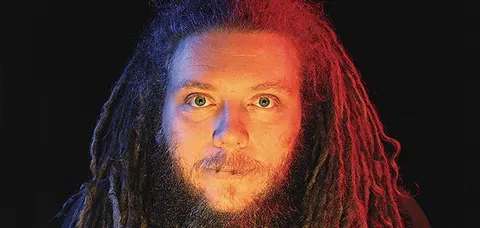
“You are not the customer of the internet giants, you are their product.” “Social media is worse than cigarettes. Cigarettes don’t make you degrade. They kill you, but you still remain yourself.” You will hardly believe that these words belong to one of the pioneers of today’s digital world. Jaron Lanier popularized the term “virtual reality” and created the concept of avatars. His path crossed those of Richard Feynman, Marshall McLuhan and Andy Warhol. For a long time he was at the height of fame, on first-name terms with Steve Jobs, Sergey Brin and Bill Gates. In a single afternoon he personally showed his pioneering virtual reality goggles to the Dalai Lama, Leonard Bernstein and Terry Gilliam. And today he is a preacher of sorts, speaking out against the flaws of the digital world.
 02
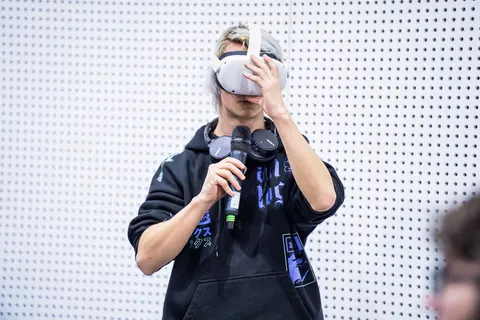
Vasil Anastasov: Virtual Reality Meets the Mutual Teaching Method
He is 21, and he has already helped more than 200 children take their first steps in a professional field that could grow into a successful career. Today Vasil Anastasov has taken up another cause: using modern technology to make Bulgarian museums more attractive and appealing to young people. Roll up your sleeves, an adventure awaits!
 03
“Literature Can Still Save Us from the Future”
Nikolay Genov is a lecturer, a PhD in literary theory and a chief assistant professor at the Institute for Literature of the Bulgarian Academy of Sciences. A young man who loves books and dreams of lighting the flame of that love in more young people. Is the end of literature approaching, what does science fiction have to tell us today, and what should Mark Zuckerberg learn from the wise Stanisław Lem while building his notorious metaverse?
 04
Facebook Is Now Meta. What Does the Metaverse It Wants to Send Us To Look Like?
Suddenly… a brand we all mention every day is no longer the same. Facebook is becoming Meta to draw attention to its hyper-ambitious metaverse project. But what does this future, which will merge the real and virtual worlds into one indistinguishable environment, look like? When should we expect to find ourselves in the metaverse? And what risks does such a vast project carry?
 05
Estorium: A Digital Treasury of Stories
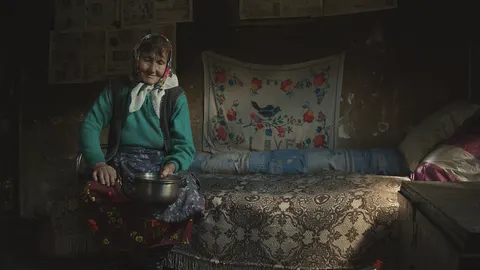
A treasury of meaningful stories, told online. That is Estorium! A digital anthropological archive where people stay alive forever, captured in a small piece of their everyday lives. The idea is as inspiring as it is real.
 06
“You Think You Know. Until Something Else Decides What to Show You”
“A minimalist style, repetitions, deceptive simplicity, the sound of a world that is changing, industrializing; the quiet tones can be read both as the last moans of a humanity surrendering to the machines and as the first timid songs of newborn machines.” Vladimir Poleganov published his novel Drugiyat san (The Other Dream) almost a decade ago, and some of its strokes now ring prophetic: how we delegate more and more to machines—our memories, our knowledge, ourselves. Today's guest is a writer, translator, screenwriter and teacher, and a conversation partner worth talking to about books and the future, about words and machines, and about whether literature will arrive too late to remind us what it means to be human and what we must never delegate to machines…
 07
Would a World Without Work Really Be So Bad?
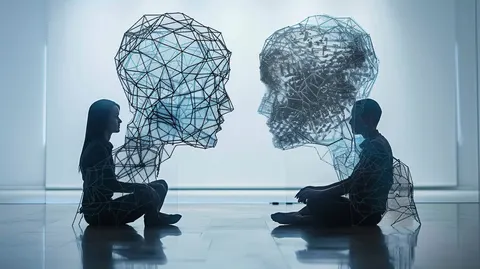
Have you heard of… cyberpsychology? At last there is a field of science that studies how we interact with technology. Is it changing us as a species? What are the biggest challenges it puts before us? Is its rapid development an inhuman challenge or, on the contrary, a natural turn in evolution? These are all questions whose answers I have been looking for in more than 300 digital stories, and now the time has come for the cyberpsychological point of view. Elena Tsankova holds a PhD in psychology, earned in Germany, and continued her research in Bremen as a postdoctoral fellow. In 2020 she returned to Bulgaria and began work as a researcher at the Bulgarian Academy of Sciences, with the ambitious idea of paving the way for this new and so important field. In recent years she has studied how people get to know each other online, as well as communication between humans and artificial intelligence (AI). She researches human behavior in the context of evolving technologies and describes herself as an experimental cyberpsychologist. We will talk about rushing and awareness. About the “uncanny valley,” where our perception of a technology grows more and more positive as it comes to resemble a human, until at some point it gets so close to human that it is perceived as eerie… And about the calm, philosophical point of view that helps us make sense of and accept the big changes.
 08
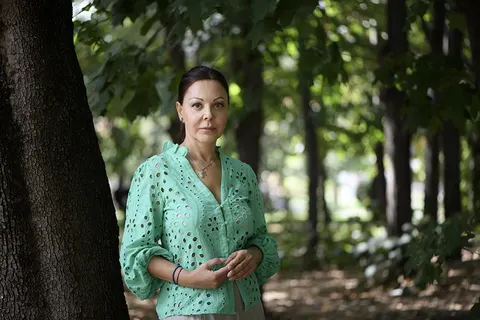
“The Problem Is That We Became Godlike in Our Heads”
“Suddenly it became clear just how far apart people had actually drifted.” Why did empathy fall victim to our capture by social media, and how do we get it back? Why have selfishness and the drive for self-sufficiency become the main obstacle to our happiness? Ani Vladimirova is a psychologist with a long and colorful career and an always interesting point of view. Known from numerous television projects, she also created Bulgaria’s first website for online therapy, back in 2003. We meet to talk about the big challenges facing the “little” person. About the imperceptible changes technology has brought us. About how it made us feel godlike, even though we are still the same fragile, vulnerable creatures. About the instincts that will one day make us value information again.
 09
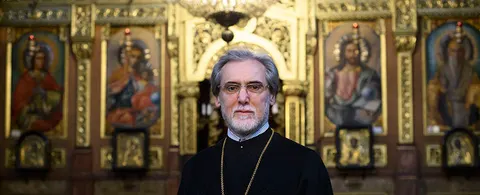
“There Are Saints on Facebook, Too”
Where do the paths of religion and artificial intelligence cross? And those of God and social media? Father Nikolay Georgiev is just the right person, with a worldview broad enough to offer a meaningful perspective on the subject. Will robots have a soul? Where do faith and technology meet? What moral categories should we build into artificial intelligence?
 10
“I Have the Feeling the Internet Is Erasing Our Memories”
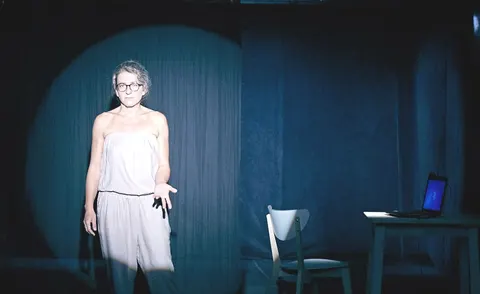
Theater lovers know her from “Nice to Meet You, Iva!”. Iva Todorova’s singular debut one-woman show became an undisputed hit, and now “Iva Is Online” at Theatre 199, a story that is, of course, digital. Is there freedom online, are our Facebook friends really friends, and what jokes will AI tell us? Iva answers in her trademark dizzying style.